

Your website probably isn’t your problem. The way it’s set up for search usually is.
Most UK businesses I speak to already have a decent site. It looks professional, says the right things, and explains the service clearly enough. But it still doesn’t generate enough enquiries from Google. A key issue is that generic website build quality and effective seo for company websites are not the same thing, especially when you rely on local demand.
For a local business, SEO can’t be treated as a blog add-on or a few title tag edits done once a year. It has to start with local intent, Google Business Profile, and the service areas you aim to win. That’s the difference between a company site that just exists and one that consistently brings in calls, quote requests, and booked appointments.
That business case is hard to ignore. 49% of UK business owners rank SEO as the highest ROI channel, and 94% of webpages receive zero organic traffic from Google, according to Reboot Online’s SEO statistics analysis. If your site isn’t visible, polished branding alone won’t rescue it.
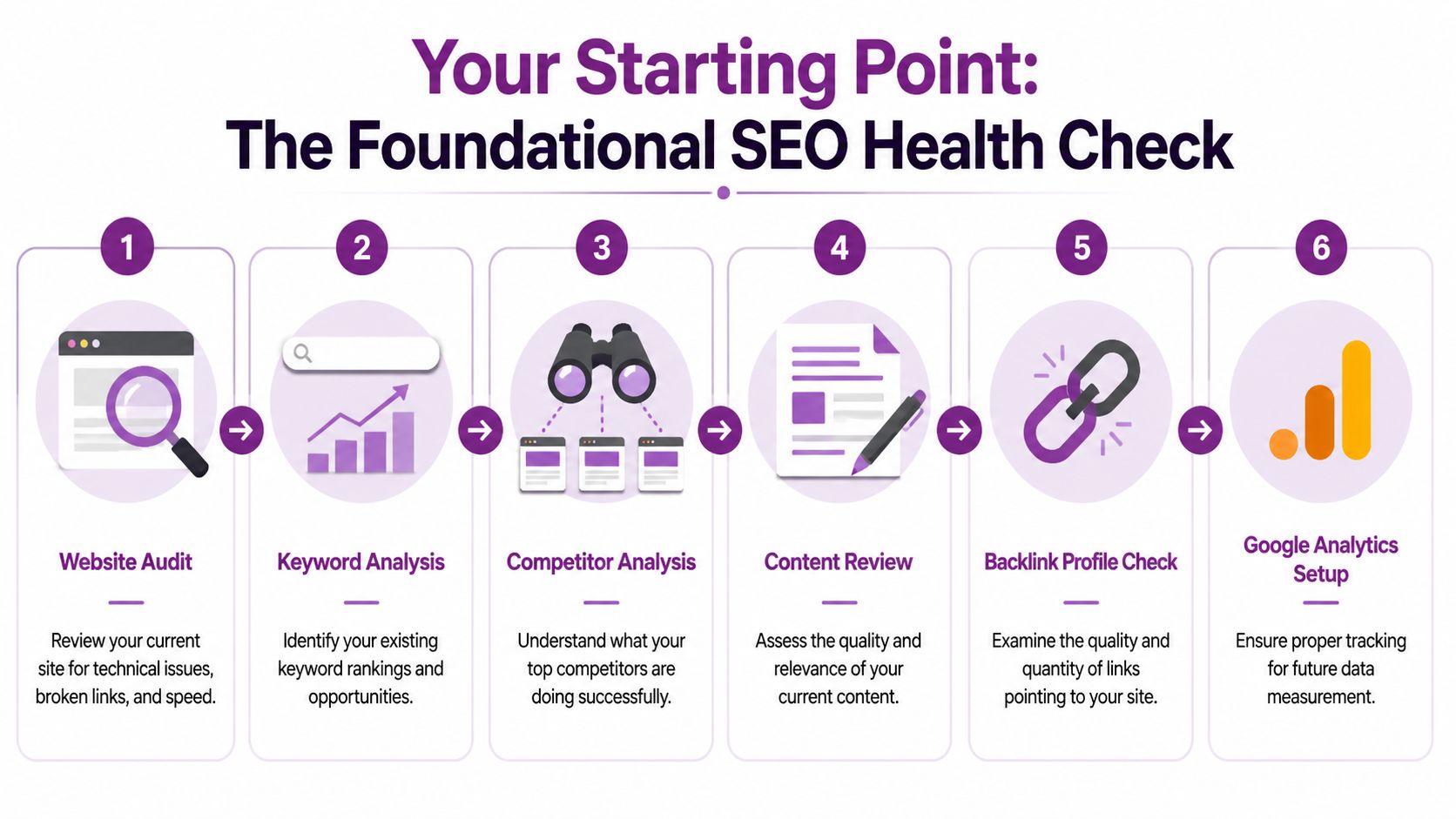
Your Starting Point The Foundational SEO Health Check
A proper health check isn’t a technical ritual. It’s the first commercial decision in the process.
If you don’t know which pages Google can find, which locations are underperforming, or which service pages never get impressions, you can’t prioritise properly. That’s how businesses waste months rewriting copy on the wrong pages while indexation, speed, and local relevance issues sit untouched.
Start with the data you already have
Use Google Search Console first. It tells you what Google sees, which queries trigger impressions, which pages are indexed, and where click-through rates are weak. For local firms, this often reveals a familiar pattern. The homepage gets branded impressions, a few service pages appear inconsistently, and location intent is barely covered.
Then move into GA4. Don’t obsess over vanity traffic. Look for pages that assist enquiries, pages that attract visitors but don’t lead anywhere, and mobile engagement patterns. Local businesses lose leads on mobile long before they notice ranking drops.
I also check:
- Screaming Frog for crawl issues, redirects, missing metadata, canonicals, and thin pages
- PageSpeed Insights for obvious speed bottlenecks
- Google Business Profile for category use, service completeness, photos, and landing page alignment
- Ahrefs or SEMrush for keyword coverage and competitor gap analysis
If you need an external benchmark or want another pair of eyes, a structured audit from a local agency such as Bare Digital can help turn raw findings into a prioritised action plan.
What usually matters most first
Not every issue deserves immediate action. Businesses often get distracted by low-impact SEO chores because they feel tidy and manageable.
Focus on the blockers that stop visibility or conversions:
Indexation problems
If key service or location pages aren’t indexed, nothing else matters yet.Weak local signals
Inconsistent name, address, and phone details, poor internal linking to location pages, or a thin Google Business Profile can undermine local trust.Misaligned page targeting
Many company sites try to rank one broad service page for every town they cover. That rarely works well.Mobile friction
Slow loading, awkward navigation, oversized images, and poor form design lose leads.
Practical rule: Don’t start by asking “how do we get more traffic?” Start by asking “which pages should already be generating business but aren’t?”
Build a baseline before making changes
Before any fixes go live, record your current position. That baseline should include:
- Current rankings for core service and area terms
- Current indexed pages
- Organic sessions to service and location pages
- Phone calls and form submissions from organic traffic
- Google Business Profile actions such as calls, direction requests, and website clicks
Without that baseline, SEO becomes opinion-led. With it, you can tell whether technical fixes improved access, whether content improved relevance, and whether local visibility turned into commercial leads.
A good health check should leave you with three buckets only: fix now, improve next, ignore for now. Anything more complicated usually means the audit hasn’t been translated into business priorities.
Finding Your Customers Uncovering Local Keyword Opportunities
Keyword research for local businesses isn’t about finding the biggest terms. It’s about finding the phrases that reveal buying intent in a specific place.
That matters because in the UK, 81% of consumers use Google to evaluate local businesses before engaging, and approximately 46% of all Google searches have local intent, according to SEO Sherpa’s SEO statistics roundup. If your site doesn’t line up with the way people search locally, you’re invisible at the exact moment they’re comparing options.
Think in services and places, not just industry labels
Most businesses start too broad. An architect wants to rank for “architect”. A caterer wants to rank for “catering”. A photographer wants “wedding photographer”.
That’s rarely enough. Local search intent is more specific. Buyers search by problem, place, urgency, and trust signal.
A caterer in Bristol might need page targets like:
- wedding catering Bristol
- corporate caterer Bristol
- buffet catering near me
- funeral catering Bristol
An architect in Manchester may need:
- residential architect Manchester
- house extension architect Manchester
- architect for planning drawings Manchester
Those phrases don’t all belong on one page. They often point to different services, different user intent, and different conversion journeys.
Build a keyword map that matches the site structure
A useful keyword map is simple. Every important query group needs a logical page type.
Use this model:
| Page type | Best use | Example |
|---|---|---|
| Homepage | Brand plus broad service area relevance | Architect in Manchester |
| Service page | Core offer | House extensions |
| Location page | Service + town or city | House extension architect in Altrincham |
| Blog or guide | Questions, comparisons, supporting intent | Do I need an architect for a loft conversion in Greater Manchester |
Many local businesses tend to overdo it. They create dozens of weak area pages with almost identical text. Google usually sees through that quickly. Better to build fewer pages with clear intent, proper service detail, and local context.
A practical resource like Bare Digital’s local SEO checklist can help turn this into a working page map.
Use the search results as your brief
The search results tell you what Google expects for each term. Check them manually.
If you search a phrase and see mostly service pages, don’t force a blog post to target it. If you see map results, reviews, and local businesses, the query has transactional local intent. If you see guides, definitions, or how-to content, that’s an informational query and should support the main service pages rather than replace them.
The best local keyword research usually sounds obvious once you’ve done it properly. It reflects how real customers ask for help, not how the business describes itself internally.
What works and what doesn’t
What works
- Building keyword sets around service + place
- Including “near me” intent naturally in strategy, not by stuffing the phrase everywhere
- Splitting urgent services from research-led services
- Mapping one primary intent to one primary page
What doesn’t
- Chasing broad national terms when you serve a local radius
- Using one generic service page for every location
- Writing location pages with only the town name swapped out
- Treating blogs as a substitute for core commercial pages
For seo for company websites, local keyword strategy should produce a build list. You should know which pages need rewriting, which pages need creating, and which keywords belong to Google Business Profile activity rather than site copy. If that list still feels vague, the research isn’t finished.
Building Your Digital Foundation On-Page and Technical SEO Fixes
Once the keyword map is clear, the site has to support it properly. This is the part many businesses skip because it feels less visible than content or rankings. It isn’t glamorous, but it’s where strong local campaigns stop leaking performance.
One figure says enough. 62% of UK SME websites fail Google’s Core Web Vitals page speed thresholds, and that issue is tied to a 19% drop in local conversions, based on the source cited in Ironpaper’s page performance article. For local firms, technical friction isn’t just an SEO issue. It’s a sales issue.
Fix site-wide problems before polishing individual pages
Start with the parts that affect the whole domain.
Look at crawlability, indexation, internal linking, XML sitemaps, redirect chains, and mobile rendering. If Google can’t reliably access or understand the site, on-page refinement won’t carry much weight.
Then review the basics that shape usability:
- Page speed on mobile
- Image compression and sensible file sizing
- Template bloat from sliders, animations, and heavy scripts
- Navigation depth so important pages aren’t buried
- Broken internal links and outdated redirects
For local companies, I often see websites built beautifully on desktop but clumsy on mobile. Menus are oversized, forms are awkward, map embeds drag down speed, and call buttons are hard to find. Google notices. So do users.
Tighten on-page targeting page by page
Once the domain is stable, move into page-level work.
Each primary service or location page needs a clear target. That means one core topic, a strong title tag, one sensible H1, useful subheadings, and copy that answers what the customer is looking for. Don’t force every variant into every page.
A good local service page usually includes:
- A precise headline that reflects the service and place
- A short opening section that confirms relevance quickly
- Service detail that explains approach, scope, and who it’s for
- Trust content such as reviews, accreditations, or process clarity
- A visible next step like call, booking, or enquiry
This sounds straightforward, but many sites still fail because pages are written like brochures. Search pages need to help a buyer decide. That means useful specificity, not filler.
Field note: If a service page could sit on any business website in the same sector with only the logo changed, it probably isn’t strong enough to rank well locally.
Add structured local signals
Schema helps Google connect the dots. For local businesses, LocalBusiness schema, service data, and location details can support understanding when implemented cleanly.
You don’t need to overcomplicate it. What matters is consistency. Your business details on the site, in schema, and in your Google Business Profile should align. If you serve several branches, each branch page should point clearly to its own location information rather than blending everything together.
What to stop doing
Some habits still hold businesses back:
| Common mistake | Better move |
|---|---|
| Repeating the same keyword awkwardly | Write naturally around one clear intent |
| Using one thin page for multiple services | Split distinct services into dedicated pages |
| Publishing city pages with duplicate copy | Add unique local relevance and real service detail |
| Ignoring template speed issues | Reduce unnecessary scripts and media load |
Technical SEO doesn’t need to be mysterious. For seo for company websites, it’s mostly disciplined housekeeping plus sharp page targeting. When the structure is clean, Google can crawl the site properly, users can move through it without friction, and local pages have a fair chance to rank on merit.
Dominating the Map Google Business Profile and Location Pages
For local SEO in the UK, your website and your Google Business Profile should not operate as separate assets. They should work like a single system.
That’s where many generic guides miss the point. They treat Google Business Profile as a directory listing and the website as the actual SEO work. In practice, local visibility is stronger when both reinforce the same services, areas, and trust signals.
A strong local methodology starts here because Google Business Profile optimisation is the first step in a process that can deliver up to 85% of local search visibility, and businesses that neglect basics such as photos can see a 42% reduction in clicks, according to this local SEO roadmap reference.
Treat your profile like a revenue page
Most profiles are underused. They’re claimed, lightly filled out, then ignored.
That’s a mistake. Your profile needs active management:
- Primary and secondary categories should match actual services
- Business description should be clear, local, and service-led
- Services should reflect real commercial priorities
- Photos should be current and useful, not random stock-style uploads
- Reviews should be monitored and answered properly
- Posts should support offers, updates, credibility, and local relevance
If you’re unsure what needs fixing, a focused review using a Google Business Profile audit tool can highlight missing or weak signals.
Build the digital perimeter around each location
A Google Business Profile is stronger when the linked page deserves to rank for the same local intent.
That’s why location pages matter. Not boilerplate pages. Real ones.
If you’re a funeral home serving Leeds and Wakefield, you shouldn’t point both profiles or local intent campaigns to one generic service page and hope Google sorts it out. Each important area needs its own landing page with genuinely local substance. That includes service coverage, practical details, trust signals, FAQs, and internal links from relevant parts of the site.
Good location pages usually include:
Specific service relevance
Explain the actual work delivered in that town or service area.Local proof
Reviews, examples, team presence, or operational detail tied to that area.Consistent business data
Match the page details with the profile and wider citations.Clear conversion paths
Calls, forms, booking actions, or quote requests should be easy to complete.
A location page should help a nearby customer decide you’re relevant. It shouldn’t exist just to catch a keyword.
Multi-location businesses need separation, not overlap
This becomes more important when a company has multiple branches.
A construction firm with offices in Birmingham, Coventry, and Wolverhampton can’t afford vague overlap between branch pages. If all three pages target the same broad copy and send mixed signals, Google struggles to understand which branch should rank for which local search.
Use a clean structure. One branch, one page, one profile, one set of locally relevant supporting signals. Keep the messaging aligned at brand level, but let each page reflect the reality of that branch’s market.
That means avoiding:
- duplicated testimonials across every location page
- shared copy with just the town swapped out
- all branches linking to the same generic contact page
- weak internal linking between service pages and local pages
The video below gives useful context on how local visibility works in practice.
What the strongest local setups get right
The best-performing local businesses usually do four things consistently:
| Area | Weak setup | Strong setup |
|---|---|---|
| Google Business Profile | Claimed and forgotten | Updated, reviewed, and aligned with priority services |
| Landing page | Generic homepage link | Dedicated location page |
| Reviews | Passive collection | Ongoing request and response process |
| Service area targeting | Broad and vague | Structured by town, branch, and commercial intent |
For seo for company websites, this combination creates what I think of as a local perimeter. Your profile attracts map visibility, your location pages support organic relevance, and both send Google the same message about who you serve and where you do it. That consistency is what local businesses need if they want to dominate the map rather than just appear on it occasionally.
Becoming a Local Authority Content and Link Building
Foundational SEO gets you into the race. Authority keeps you there.
A lot of local businesses stop too early. They fix titles, sort out service pages, improve their Google Business Profile, and expect rankings to hold indefinitely. In quieter niches that might be enough for a while. In competitive towns and cities, it usually isn’t. Other firms catch up, publish better material, earn stronger links, and push ahead.
Build and broadcast
I use a simple framework here. Build authority on your own site. Broadcast that authority through mentions and links from other relevant websites.
The build side is content. Not content for the sake of volume. Content that helps a buyer trust you before they enquire.
That usually means publishing material such as:
- service-adjacent guides that answer pre-sale questions
- location-specific articles where there’s genuine local demand
- decision-stage content comparing options, processes, or considerations
- trust pieces that explain credentials, standards, or how your work is delivered
For example, a construction company may publish planning-focused articles, renovation process guides, or explanations of how projects are managed locally. That supports commercial pages and gives the site more topical depth. A niche example of how this applies in practice appears in Bare Digital’s piece on SEO for construction companies.
Content that helps rankings usually helps sales too
The best local content does two jobs at once. It attracts useful search visibility, and it removes buying friction.
A wedding venue can answer practical questions about capacity, timings, catering coordination, or ceremony setup. A photographer can explain how local shoots are planned across seasons and locations. An architect can clarify planning, drawings, and consultation expectations. These aren’t just blog topics. They’re sales objections handled early.
If your content never helps a prospect make a decision, it may still get traffic, but it won’t do enough for the business.
Links still matter, but bad link building causes damage
Local businesses often hear “you need backlinks” and then buy rubbish placements that do nothing or make things worse.
Good links are earned from places that make sense for the business:
- trusted UK directories
- local press coverage
- trade associations
- suppliers and partners
- sponsorships and community involvement
- useful guest contributions on relevant industry sites
What doesn’t work well is random scale. If the links have no local, commercial, or topical relevance, they rarely strengthen the right pages.
A sensible link plan starts with page targets. Ask which pages deserve stronger authority. Usually that’s your most valuable service pages, location pages, or cornerstone guides. Then earn links that support those assets directly or strengthen the domain around them.
What I’d prioritise for most UK local firms
If budget or time is limited, I’d usually put effort into this order:
- Create strong service and location pages first
- Publish a small set of useful supporting articles
- Clean up weak directory and citation signals
- Pursue relevant local and sector links steadily
That approach is slower than buying shortcuts, but it’s far more durable. For seo for company websites, the aim isn’t to look busy. It’s to become the business Google trusts to represent that service in that area over time.
Measuring Growth and Scaling Your SEO Success
SEO becomes much easier to manage when you stop asking “are we ranking?” and start asking “which activities are moving local enquiries?”
That shift matters because rankings on their own don’t tell the full story. A business can rank for low-value phrases and still struggle commercially. Another can improve map visibility, increase phone calls, and win more local leads without celebrating every position movement.
There’s useful evidence behind that commercial focus. 63% of UK businesses see positive ROI within 6 months when GBP insights are integrated with website analytics, and an optimised Google Business Profile alone can lead to a 42% increase in phone call enquiries, according to Authoritas on SEO process and KPI tracking.

Track the KPIs that connect to actual demand
A local SEO dashboard doesn’t need to be complex. It needs to reflect visibility, engagement, and conversion.
Here’s a practical set of metrics to monitor.
| KPI | What It Measures | Tool to Use | Good Target |
|---|---|---|---|
| Google Business Profile calls | Enquiry activity directly from local profile visibility | Google Business Profile insights | Upward month-on-month trend |
| Website organic enquiries | Form submissions or tracked lead actions from organic search | GA4 | Upward month-on-month trend |
| Local keyword positions | Visibility for service plus area searches | Google Search Console, Ahrefs, SEMrush | Improvement on priority terms |
| Landing page engagement | Whether local pages hold attention and prompt action | GA4 | Strong engagement relative to site average |
| Indexed page coverage | Whether priority pages are accessible to Google | Google Search Console | All key pages indexed |
| Impressions and clicks | Search demand and click capture by page/query | Google Search Console | Growth on targeted pages and queries |
If you need a commercial model for judging return, a niche planning tool such as Bare Digital’s self storage ROI calculator for SEO shows the broader principle well. SEO works best when you connect visibility to lead value rather than traffic alone.
Read the numbers in context
Not every positive signal means the same thing.
If impressions rise but clicks stay flat, your pages may be appearing for the right terms but failing to win the click. That usually points to weak titles, poor local relevance, or stronger competitors in the results.
If traffic rises but enquiries don’t, check intent. You may be attracting research queries instead of commercial searches. It can also point to weak calls to action, poor mobile usability, or trust issues on the landing page.
Rankings are a diagnostic metric. Enquiries are the business metric.
Scaling across multiple locations without creating a mess
Scaling local SEO is where discipline matters most. As a business expands, it becomes easy to create overlapping pages, confused internal linking, and branch content that competes against itself.
For multi-location companies, keep these rules in place:
- Give each branch a defined page and purpose
- Align each Google Business Profile with its own landing page
- Keep service templates consistent but local details unique
- Track results by branch, not just at domain level
- Review cannibalisation regularly in Search Console
A good scaling setup feels repetitive operationally but distinct in the search results. That’s the balance. You want a repeatable framework behind the scenes and strong local specificity on the page.
For seo for company websites, measurement is what stops SEO turning into a vague monthly activity. It shows where growth is coming from, which branches need attention, and when to expand the model into new towns without weakening the existing footprint.
Frequently Asked Questions About SEO for UK Companies
How long does SEO take for a local UK business
You should expect visible movement before full maturity. Technical fixes and Google Business Profile improvements can create early gains, while stronger service pages, location pages, and authority work usually take longer to compound. The mistake is expecting SEO to behave like paid ads. It builds over time, then keeps working if you maintain it properly.
Should I focus on my website or Google Business Profile first
For most local businesses, start with both, but not equally. Google Business Profile often needs immediate attention because it directly affects local discovery and calls. Your website then needs to support that visibility with strong landing pages and a credible conversion path. One without the other limits results.
Do I need a page for every town I serve
Only if you can make each page useful. If the page is just duplicated copy with a place name changed, skip it. Build pages for priority areas where you have real service relevance, local proof, and a reason for that page to exist.
Is blogging still worth it for local SEO
Yes, if the topics support your services and help customers decide. No, if you’re publishing generic filler that never strengthens a commercial page or answers a real buying question.
What if reviews or search results affect trust in my business
That’s part of SEO now. Local visibility and reputation work together. If you’re dealing with misleading, harmful, or outdated material online, it’s worth understanding the basics of online reputation protection alongside your SEO efforts.
What is the biggest mistake companies make with SEO
Treating it as a one-off project. Search visibility for local firms depends on maintenance, better pages, active profile management, review handling, and measured improvement. The businesses that stay visible are usually the ones that keep refining the basics.
If you want a practical plan rather than a generic audit document, Bare Digital helps UK businesses turn local search visibility into measurable enquiries with Google Business Profile work, technical fixes, location pages, and ongoing SEO support.






