
A lot of UK owners are in the same spot right now. The work is good, customers are happy, and referrals still come in, but online visibility doesn’t match the quality of the business. A bakery in Leeds can be full of regulars yet still lose breakfast trade because nearby searchers never see it. A funeral home can have years of trust in the community and still get buried beneath bigger directories. A photographer can have a strong portfolio but weak local intent coverage, so the enquiries go elsewhere.
That gap is what small business online marketing is really about. Not posting for the sake of posting. Not chasing vanity metrics. It’s about making sure the right people can find you, trust you, and contact you when they’re ready.
In the UK, small businesses represent 99.9% of all businesses, totalling 5.5 million enterprises as of 2023, with 76% being sole proprietorships (electroiq.com). That means local competition is crowded in almost every category, from trades to professional services to venues. Good businesses don’t automatically win online. Organised ones do.
If you want a broader primer on digital marketing for small business, that resource gives a useful overview. The approach here is narrower and more practical. It focuses on local search, conversion paths, and what turns visibility into enquiries for UK firms.
Introduction to UK small business online marketing
The pattern is usually easy to spot. A business has a basic website, a neglected Google Business Profile, irregular social posts, and no clear idea which channel is supposed to produce calls or quote requests. Everything exists, but nothing works together.
That’s where local-first marketing changes the picture.
A family-run business doesn’t need national reach before it can grow. It needs to show up for the town, service area, and postcode terms that matter. It needs pages that answer local intent. It needs a profile that looks active and trustworthy. It needs a clear next step when someone lands on the site.
The businesses that gain traction usually stop trying to “do marketing” as one vague task. They break it into jobs:
- Google Business Profile handles discovery in Maps and branded trust.
- Local SEO captures service plus area searches and builds longer-term visibility.
- Location pages help multi-area businesses rank without blending every town into one generic page.
- Paid search fills gaps where organic visibility is still building.
- Social and email support trust, repeat business, and review generation.
A sensible roadmap matters because channels behave differently. Search reaches people with intent. Social keeps your name familiar. Email brings people back. Paid search buys speed, but only if the landing page and offer are already sound.
For businesses that want help auditing the basics first, https://www.bare-digital.com/ is one example of a local SEO resource focused on UK service businesses. Whether you use an agency or do the work in-house, the sequence matters. Fix the local foundations first. Then scale the channels that produce actual enquiries.
Practical rule: If a channel can’t be tied to calls, forms, bookings, or visits, it shouldn’t sit at the centre of your plan.
Optimising Google Business Profile
Google Business Profile is often the first real impression a local customer gets. Before they visit your website, they see your category, reviews, opening hours, service area, and photos. If that profile looks incomplete or stale, trust drops before you’ve had a chance to sell anything.

Start with the basics that owners often skip
Claiming the listing is only the first step. Most underperforming profiles have the same weak points:
Primary category is too broad
If you’re a wedding photographer, don’t default to a generic creative label if a more precise business category fits. Relevance starts there.Services are missing or badly named
Add service lines that match real search behaviour. Keep them plain. “Emergency boiler repair” is stronger than clever branding.Business description sounds generic
Mention what you do, where you operate, and who you help. A Manchester plumber should sound like a Manchester plumber, not a template.Photos are poor or outdated
Upload current work, team images, interior shots, vehicles, and location cues. The profile should look active.Opening hours and contact options aren’t maintained
Wrong hours create frustration fast. So does a profile with messaging turned on but no replies.
Build a profile around local intent
A good profile isn’t stuffed with keywords. It reflects how a local customer decides.
For a London photographer, that might mean:
- portfolio photos tied to actual shoot styles
- clear service labels for weddings, events, brand shoots
- review replies that mention the type of job, naturally
- Q&A entries covering travel, turnaround times, and booking steps
For a Manchester plumber, it might mean:
- emergency and scheduled work listed separately
- service areas clearly defined
- mobile-first phone contact
- regular posts about common repair issues and availability
Google Business Profile also rewards completeness and activity. The methodology cited for UK SMBs recommends a free SEO health check and auditing GBP completeness with a goal of fully optimised fields, including Q&A and photos, as part of a wider local SEO process (digitalredzone.com).
If you want a structured starting point, this https://www.bare-digital.com/google-business-profile-audit-tool/ gives you a practical way to review whether key fields are missing.
What to post and how often it matters
Posts aren’t a magic ranking lever on their own, but they help show that the business is active. They also give searchers one more reason to click or call.
Use posts for:
- Offers for seasonal or service-specific promotions
- Updates such as extended hours or event availability
- Trust signals like recent project photos
- Education on common buyer questions
Keep them short. Add an image. Tie each one to a clear action.
A short walkthrough can help if you’re setting up or cleaning up a profile for the first time:
Reviews, Q&A, and the details that lift response rates
Reviews shape trust before someone reaches your site. Ask for them consistently, but don’t force a script that sounds unnatural. A good request is simple and timed close to the service experience.
The Q&A section is underused. That’s a mistake. Seed it with real questions people already ask by phone or email.
Add answers around:
- parking or accessibility
- service coverage
- appointment process
- lead times
- payment basics
A profile should answer the questions that stop someone from calling. If those answers aren’t there, another listing gets the click.
The trade-off is straightforward. A polished profile takes upkeep. But for local businesses, few tasks produce a better return on attention than maintaining the digital shopfront customers see before anything else.
Building Local SEO and Content Strategy
A UK business can have a polished website, solid reviews, and decent footfall, then still miss local search demand because its pages target the wrong places, the wrong terms, or the wrong stage of intent. I see this often with multi-location firms. One generic service page tries to rank everywhere, a blog covers broad topics with no local angle, and enquiries stay flat.
Local SEO and content strategy work best as one plan. The site needs clear commercial pages for service-plus-place searches, support content for earlier research, and internal links that push authority towards the pages that generate calls and quote requests.
Start with the local search pattern that drives enquiries
Local buyers rarely search in one neat format. In the UK, they mix service terms, town names, postcode areas, county references, and modifiers like “near me”, “emergency”, “same day”, or “open Saturday”. Sector context changes the pattern again. A solicitor in Leeds, a private clinic in Kent, and a wedding venue in the Cotswolds will all have different local intent signals and different compliance limits on what they can publish.
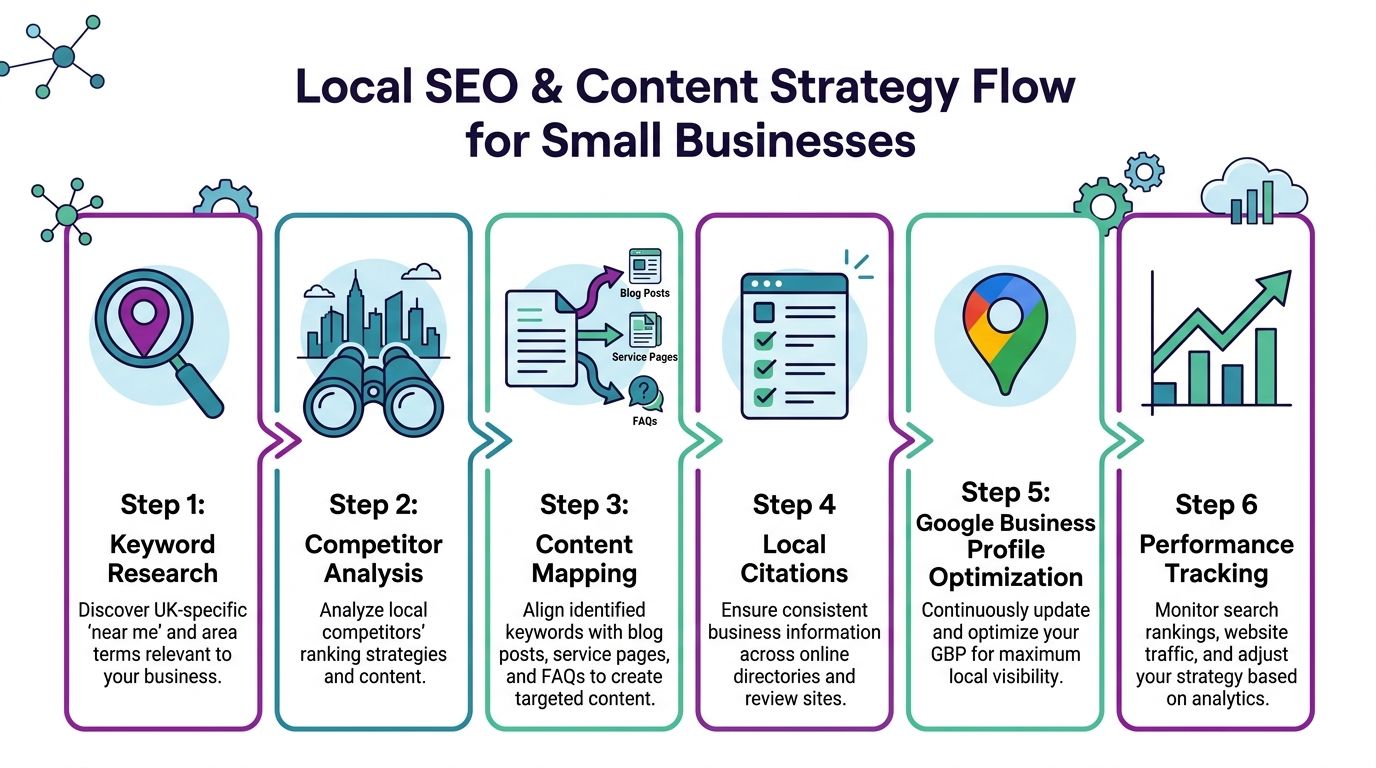
A workable planning sequence looks like this:
- map core services to towns, cities, or service areas you can fulfil well
- review who ranks in Maps and organic search for those combinations
- group keywords by intent, not by tiny wording differences
- assign each cluster to one primary page type
- support commercial pages with FAQs, case studies, and local guides
- keep citations and on-site business details consistent
This forces prioritisation. It stops teams publishing random articles while high-intent service terms are still unsupported.
Research intent first, then choose the page type
Broad search volume can distract small businesses from the terms that produce revenue. “Accountant” may look attractive. “Small business accountant Bristol”, “Xero accountant Bristol”, and “year end accounts for contractors Bristol” usually produce better leads because the need is clearer.
Use a simple intent model:
| Search type | What it usually means | Best page type |
|---|---|---|
| Service plus town or city | Ready to compare nearby providers | Primary service page for one area, or a dedicated location-service page if demand justifies it |
| Problem-led local search | Checking options, cost, process, or suitability | FAQ, advice article, or sector guide linked back to the relevant service page |
| Brand plus service or area | Referral follow-up or repeat demand | Homepage, branded service page, contact page, or key location page |
The “best page type” needs to match the sector, not just SEO theory. A trades firm may win with tightly written service-area pages. A healthcare provider may need condition or treatment explainers reviewed for compliance. A regional caterer may get more value from venue-led and event-type content tied to booking windows. That is where sector-specific planning makes the difference.
One page should serve one main intent cluster. That keeps the site easier to scale across multiple locations without cannibalising itself.
Tighten the on-page signals that local rankings still rely on
Local pages do not need clever wording. They need clarity, evidence, and a structure that helps both search engines and buyers.
Focus on:
- title tags that combine the service and primary location naturally
- headings that confirm exactly what the page covers
- opening copy that states service area, audience, and offer without filler
- internal links from supporting articles into service and location pages
- consistent NAP details where business address and contact information appear
- local business schema where it reflects the business model accurately
- fast mobile performance, because a large share of local searches happen on phones
The trade-off is straightforward. Over-optimised pages can look spammy and underperform with users. Underwritten pages often fail to rank because they never make the service and geography explicit. The middle ground usually wins. Clear page targets, enough local detail to be credible, and copy written in the tone buyers expect from that sector.
For teams building content with outside help, the split between persuasive service copy and educational blog work matters. This guide on content writer vs copywriter is useful because it clarifies who should handle what. Local SEO often needs both.
Build supporting content that strengthens money pages
Blog content earns its place when it supports a commercial path. If it cannot help a service page rank, answer a sales objection, or assist a location page, it is usually a low priority.
Useful formats include:
- FAQs taken from calls, quote forms, and sales emails
- short local guides tied to service demand
- case-study posts showing recent work in named areas
- comparison content that helps buyers choose between service options
- seasonal articles linked to booking cycles or demand spikes
For a multi-location framework, use the same content architecture across the site, then tailor the detail by service line and geography. A childcare group with nurseries across several towns might run the same parent-question themes across the network, but each article set should point to the right branch pages and reflect local availability, fees, or admissions information where appropriate. That gives you scale without turning the site into a template farm.
If you need a practical starting point, this local SEO checklist for UK small businesses helps you review content gaps, internal links, and local signals before you add more pages.
Use selective link building, not volume for the sake of it
Local link building works best when the referring site has either local relevance, sector relevance, or both. Ten weak directory submissions usually add little. One strong mention from a trusted local or industry source can do more for visibility and referral traffic.
A few examples:
- a wedding venue in the Cotswolds listed on a respected regional wedding directory with a real audience
- a solicitor earning a profile link from a local chamber of commerce
- a building contractor featured by a supplier, trade body, or local project partner
- a care provider cited by a regional community organisation after sponsoring a useful event
That is also the easier model to scale across several locations. Centralise standards, then let each branch, office, or service area earn links from its own local ecosystem. The framework stays consistent. The opportunities stay local.
Field note: Stable local growth usually comes from stacking the basics correctly. Strong service pages, useful support content, clean internal linking, reliable local details, and a selective approach to authority building.
Creating Location Pages that Convert
Most multi-location sites fail in one of two ways. They either clone the same page for every town with a place name swapped in, or they cram every area into one service page and hope Google figures it out.
Neither works well.
Multi-location small businesses in the UK often struggle with scalable local SEO. Only 28% effectively use location-specific tactics, and agencies using sector segmentation and coordinated profiles achieve 3x faster ranking gains (entrepreneur.com). The reason is simple. Scaling local visibility needs a framework, not a template factory.
What a strong location page actually includes
A useful location page should answer three questions fast:
- Do you serve this area properly
- Why should someone in this area trust you
- What should they do next
That means the page needs genuine local detail. Not filler.
Use:
- Unique page titles and meta descriptions based on service and location
- Area-specific opening copy that reflects the place, not a copy block
- Service relevance specific to local pain points
- Visible contact options such as calls, quote forms, or booking buttons
- Trust signals including local testimonials where appropriate
- Maps or service coverage cues when they help the user
A regional architect, for example, shouldn’t run the same copy for Cambridge, Norwich, and Peterborough. Planning context, property style, and buyer intent differ. A funeral home chain needs even more care. Tone, trust, and local sensitivity matter as much as keywords.
Avoid duplicate-content traps without making production slow
If you’re running two to ten locations, the answer isn’t writing from scratch every time. It’s building a controlled page structure and customising the sections that need real variation.
A scalable template often includes:
- service intro with local context
- area-specific trust section
- practical information for that branch or service area
- FAQs tied to that location
- internal links to nearby relevant pages
- one local call to action
The unique material should sit in the sections that searchers care about most. Intro copy, trust proof, FAQs, and location references usually deserve the most attention.
A clean URL structure also helps. Keep it simple and predictable. Users should understand where they are, and the site should make it easy to move between nearby service areas when relevant.
Internal linking for multi-area growth
Internal links are where many multi-location sites leave value on the table.
Good links do three jobs:
- connect each location page to the relevant service page
- connect related nearby locations where that helps users
- connect blog content to the exact local page it supports
If you’ve got a core service in Cambridge and want to see how a focused local service page can be framed, https://www.bare-digital.com/seo-services-cambridge/ is a practical reference point for structure and local intent alignment.
Don’t build location pages to prove you cover an area. Build them to help a buyer in that area choose you.
Maintenance matters more than launch day
Publishing the pages isn’t the finish line.
Review location pages regularly for:
- outdated opening hours or branch details
- broken forms or map embeds
- old testimonials
- weak internal links after new pages go live
- repeated copy that crept in during expansion
That workflow matters a lot for businesses with several branches. A tidy maintenance routine protects rankings and conversion rate at the same time.
Leveraging Paid Search and Local Ads
A Leeds plumber gets three emergency calls before 9am. A nearby competitor gets six. The difference is often ad structure, not service quality. Paid search can create demand capture fast, but local campaigns only work when the account reflects how people in that town, city, or postcode area search.
Pick the platform based on intent, not habit
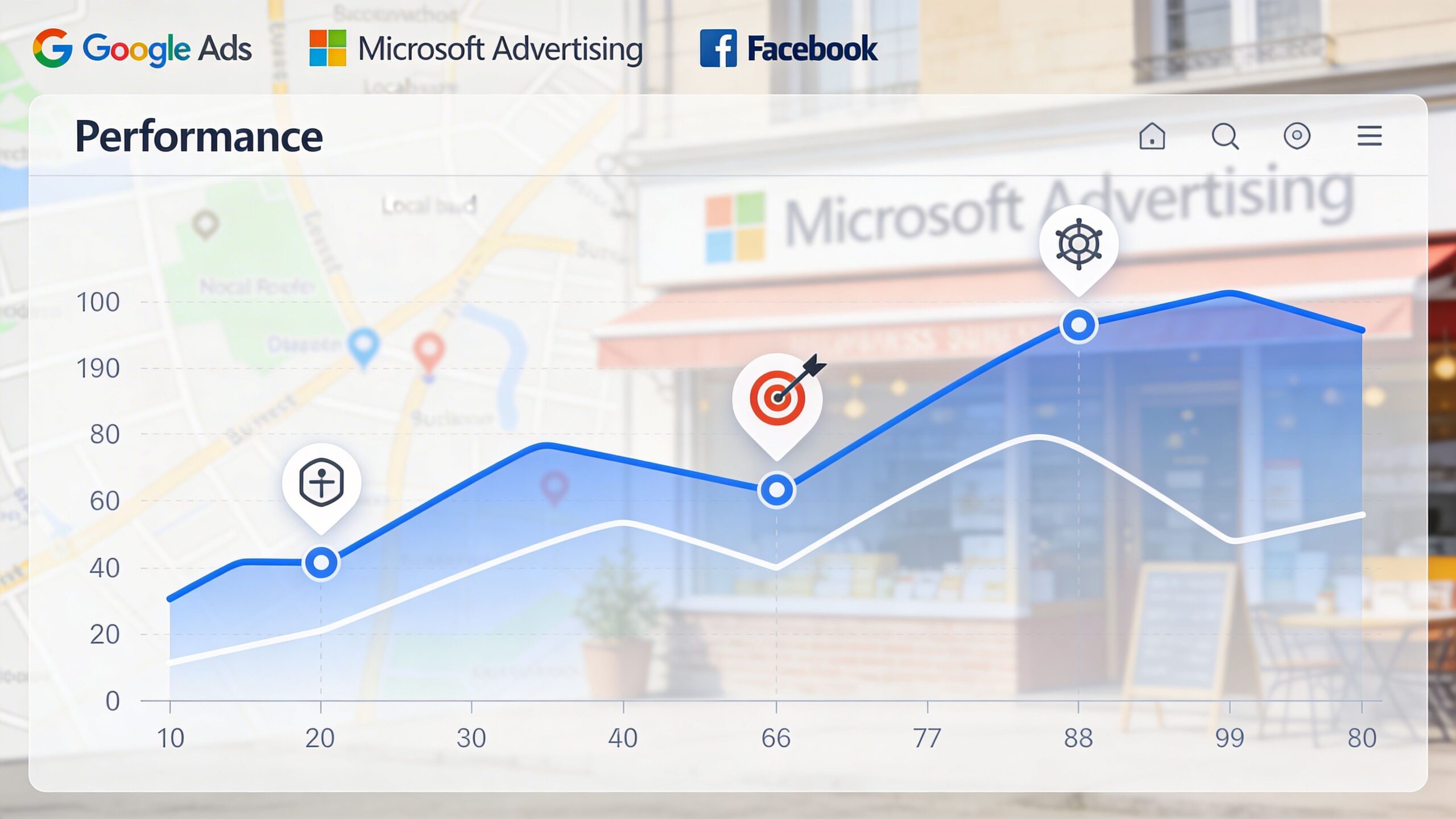
Small UK firms often default to Google Ads because that is the obvious starting point. In many cases, that is the right call. It captures high-intent searches and gives the strongest local query coverage. But platform choice should follow audience behaviour and buying context, not familiarity.
| Platform | Cost visibility | Local Targeting | Best Use Case |
|---|---|---|---|
| Google Ads | CPC varies heavily by sector and postcode | Strong | High-intent local service searches and urgent enquiries |
| Microsoft Advertising | Usually lower competition than Google, but lower volume | Good | Older audiences, office-based buyers, and sectors where Bing still has steady desktop use in the UK |
| Facebook local awareness ads | Costs vary by audience and creative | Good for area and interest targeting | Events, offers with strong visuals, and remarketing to people who already know the business |
For a care home, private clinic, or funeral director, Microsoft Advertising can be more useful than many guides suggest because older demographics and family decision-makers still use Bing on work and home devices. For a gym, salon, or restaurant launch, Meta can support local reach well, but it usually performs better as a demand support channel than a first-choice lead channel.
Build campaigns around services, locations, and buying urgency
Good local paid search accounts are narrow by design.
Split campaigns by service line first, then by area where volume justifies it. A locksmith should not mix emergency lockout terms with uPVC repair queries. A dental clinic should separate urgent appointment terms from cosmetic treatment searches. A multi-location business should avoid one national campaign with every branch dumped into the same ad groups, because budgets drift toward the busiest areas and weaker branches become hard to diagnose.
A practical structure for UK small businesses looks like this:
- separate campaigns by core service or treatment type
- isolate urgent and non-urgent searches
- target the actual service area, not a hopeful radius
- write ad copy at branch or town level where scale allows
- send each click to the nearest relevant page, not a generic homepage
That structure becomes more important as locations grow. A three-branch business can manage town-based campaigns manually. A twenty-site group needs naming rules, shared negative keyword lists, and a repeatable branch launch process or the account gets messy quickly.
Budget split and where small firms go wrong
Start with search, then expand once the lead quality is proven.
The usual mistake is not just overspending on display or paid social. It is spreading budget evenly across every service and every location from day one. That approach hides useful signals. Put more spend behind the services that close fastest or deliver the best margin, then widen coverage once the numbers justify it.
The second mistake is ignoring sector-specific waste.
A funeral home running Google Ads should exclude broad informational grief terms and focus tightly on service-plus-location searches such as funeral director in Stockport or direct cremation Manchester. The ad copy also needs restraint. Urgency language can lift click-through rate and still damage trust.
A law firm should separate family law from wills and probate because the intent, call handling, and conversion window are different. A heating engineer should break out boiler repair from boiler installation because one is urgent and one is researched. Those decisions affect cost per lead more than generic checklist items ever will.
Before increasing spend, check the operational side:
- call answering is reliable during advertised hours
- branch-level conversion tracking is working
- search terms are reviewed by service line, not in one merged report
- excluded areas reflect where jobs are profitable, not just where you can technically travel
- lead handling differs for urgent, booked, and quote-led enquiries
Ad copy and extensions that improve lead quality
Specific ads attract better leads. Vague ads attract more irrelevant clicks.
Use the service name, the location where useful, and one clear qualifier that helps the searcher decide. That might be same-day callouts, evening appointments, CQC-registered care, FCA-authorised advice, or fixed-fee conveyancing. The right message depends on the sector and the compliance limits around it.
Extensions still matter because they filter traffic before the click. Use location extensions, call extensions, sitelinks, callouts, and structured snippets where they add decision-making detail. For multi-location firms, keep extension assets aligned with the branch or campaign group they support. A Birmingham searcher should not see a Manchester phone number.
Paid search works best as a controlled route to qualified local demand. It struggles when the account structure is broad, the geography is loose, or every branch is treated the same.
Integrating Social Media and Email Marketing
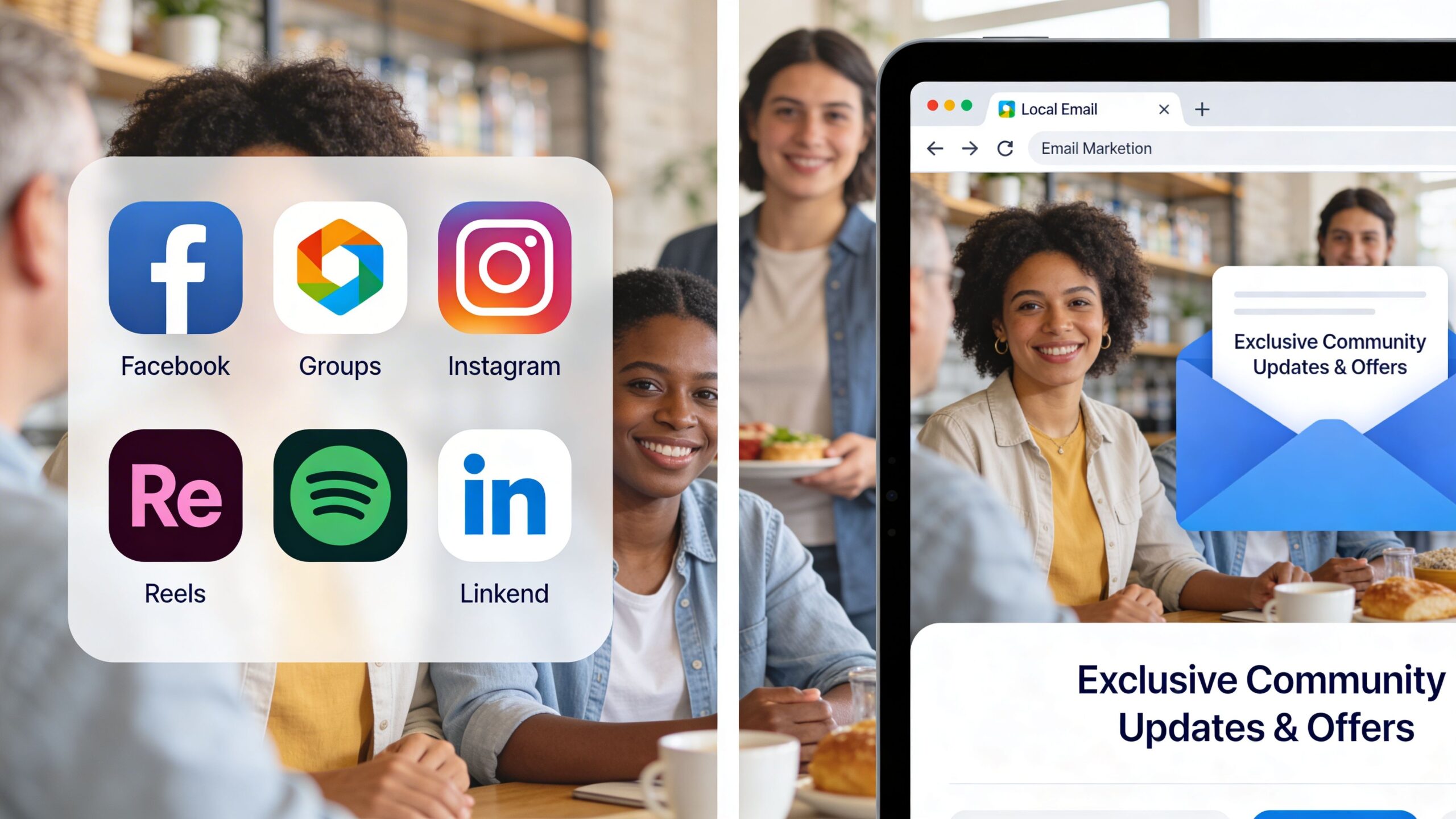
Social media and email aren’t usually the first channels to create local demand. They’re often the channels that deepen trust after demand already exists. That distinction matters, because it changes what you expect from them.
If a business treats Instagram, Facebook, LinkedIn, and email as direct replacements for local search, results tend to disappoint. If it uses them to reinforce expertise, keep the brand visible, and bring warm prospects back, they become much more valuable.
Choose channels based on audience behaviour
A local bakery, venue, or photographer may get more out of visual social content than a specialist B2B consultant. A solicitor, architect, or care provider may see stronger engagement through email and selected professional channels than through daily social posting.
The point is not to be everywhere. It’s to match channel to buying context.
Use social for:
- current work and behind-the-scenes proof
- community relevance
- reminders, launches, and availability
- light education that points back to your site
Use email for:
- enquiries not yet ready to buy
- repeat customers
- seasonal or event-driven offers
- follow-up after downloads, audits, or initial calls
Reviews, trust, and compliance in sensitive sectors
For regulated or trust-heavy sectors, the rules tighten. 71% of UK consumers trust local searches influenced by reviews, yet regulated sectors see 45% higher complaint risks from non-compliant review solicitation (catchmarkit.com).
That creates a real trade-off. Reviews matter. But the method you use to request and promote them needs to be compliant.
For healthcare, funeral homes, and home care providers, a safer approach usually includes:
- neutral review requests rather than suggestive wording
- no pressure or incentive framing
- careful use of testimonials
- approval workflows before case studies or sensitive stories go live
- clear consent handling for email capture and follow-up
A business in a regulated field should also be cautious with social proof. The strongest trust signal isn’t always the loudest one. Sometimes a properly written case study, a calm service explanation, or a well-handled FAQ does more than aggressive promotional posts.
What to send and post so it actually helps sales
Most local business social feeds fail because they talk only about themselves. Most local email lists underperform because every message is a promo.
A better balance is:
- Proof content such as recent work, process, or team credibility
- Helpful content that answers recurring pre-sale questions
- Local relevance tied to place, season, event, or service timing
- Action content that gives one clear next step
Examples:
- a caterer sending event planning reminders tied to booking windows
- an architect sharing project-stage advice linked to a relevant service page
- a funeral home using email carefully for service information and supportive resources rather than overt promotion
- a healthcare provider posting educational updates reviewed for compliance
Build a list properly and segment it early
A small list can still perform well if it’s segmented.
Useful segments include:
- service interest
- customer type
- location or branch
- stage in the buying cycle
That allows you to avoid blasting the same message to everyone. A warm lead in one service area shouldn’t receive the same content as a past client in another.
Social keeps you visible. Email keeps you remembered. Neither fixes weak positioning, but both strengthen trust when the search foundations are already in place.
Measuring Success and Planning Next Steps
The businesses that get stuck in small business online marketing usually aren’t doing nothing. They’re doing lots of disconnected things and measuring the wrong outputs.
That’s why tracking isn’t a reporting chore. It’s the control system.
Over 70% of small business digital campaigns fail to generate meaningful returns due to poor ROI tracking, and implementing multi-touch attribution and clear KPIs yields 2.5x higher conversion rates for UK SMBs in competitive sectors (jscottmarketing.com).
What to track instead of vanity metrics
Start with business actions, not platform-level fluff.
A useful KPI set often includes:
- GBP actions such as calls, direction requests, or website visits
- organic rankings for priority local terms
- form submissions and qualified calls
- paid ad conversion rate by service and area
- email click-to-enquiry patterns
- landing page conversion rate
If a metric can’t influence a decision, it doesn’t belong on the main dashboard.
Attribution and monthly review
Last-click reporting creates bad decisions. It overcredits the final touchpoint and hides the role of search discovery, follow-up visits, and branded return traffic.
Use GA4 with UTM tagging and a dashboard that pulls together:
- organic
- paid
- GBP
- landing page performance
Then review monthly.
Check:
- where leads came from
- which pages assisted conversions
- where users dropped off
- which services and locations underperformed
- whether the call to action on key pages needs testing
A practical way to tie projected search value back to returns is using tools such as https://www.bare-digital.com/self-storage-roi-calculator-for-seo/ when assessing whether SEO investment and lead value line up for a given service model.
Plan the next step by maturity, not by trend
Not every business needs the same next move.
A sensible sequence looks like this:
- fix profile and website basics first
- build local service and location coverage second
- add paid search where speed or testing is needed
- use social and email to support trust and retention
- review performance monthly and adjust based on enquiry quality
That order prevents wasted spend. It also stops the common pattern where a business buys traffic before it has built a convincing local path to conversion.
If your current setup feels fragmented, the right next step is usually an audit, not another channel.
If you want a practical review of your local visibility, enquiry path, and ranking gaps, Bare Digital can help assess where your search presence is leaking leads and what to fix first. Start with Bare Digital and work from a clear action plan rather than guesswork.