
For any small business in the UK, Search Engine Optimisation (SEO) is the single most powerful tool you have for connecting with local customers who are actively looking for what you do. Without it, you're practically invisible online. A smart small business SEO UK strategy is what turns that digital invisibility into real-world customers.
Why SEO Is Essential for UK Small Businesses
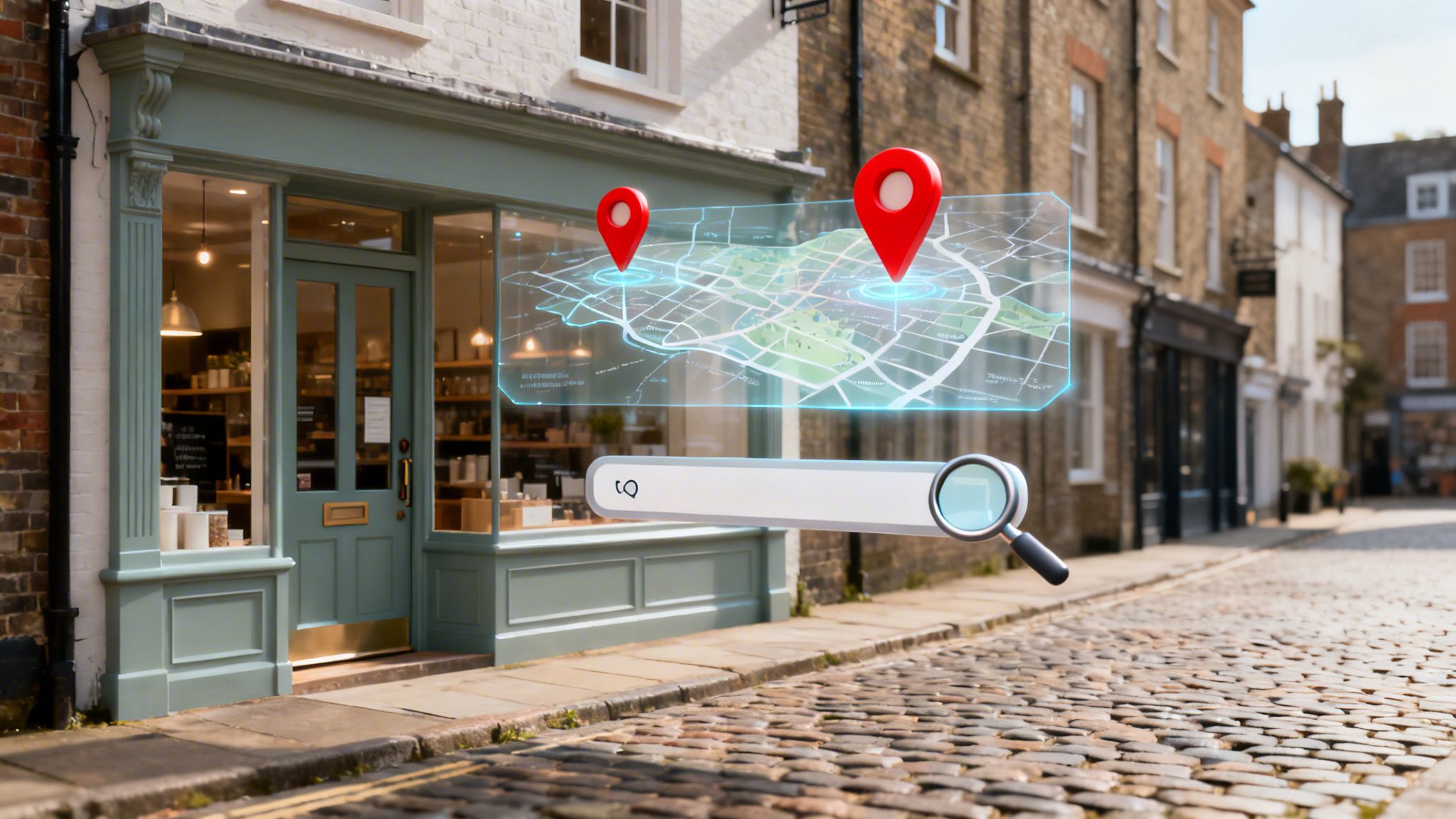
Imagine you run a brilliant little shop on a bustling high street, but the windows are blacked out and there's no sign above the door. Potential customers walk straight past, completely unaware of the amazing things you offer inside. This is exactly what your business looks like online without SEO.
A targeted SEO plan is like throwing open the doors, putting up a bright, welcoming sign, and having a friendly guide outside to greet every person who might be interested. It ensures that when someone in your area searches Google for "artisan bakery in Manchester" or "emergency plumber near me," your business shows up right at the top.
But this isn't just about getting seen; it's about getting chosen. SEO connects you with customers at the precise moment they need you, turning curious browsers into loyal patrons. It builds trust and establishes your credibility long before they ever step through your door or click 'buy'.
The Competitive UK Market
This need for visibility is more critical than ever in the UK's crowded marketplace. Small and medium-sized enterprises (SMEs) make up an incredible 99.9% of the entire UK business population, which comes to around 5.9 million businesses.
In competitive hubs like London (1.1 million businesses) and the South East (940,000), which together host 35% of all private sector companies, just hoping to be found isn't a strategy. This is where a focused SEO plan gives you a decisive advantage, helping you cut through the noise and get ahead of the competition.
In a market with millions of competitors, relying on word-of-mouth alone is a recipe for stagnation. SEO is your digital megaphone, broadcasting your value to the exact audience that needs to hear it, driving sustainable growth and ensuring you're not just surviving, but thriving.
A Non-Negotiable Investment for Growth
Ultimately, investing in a solid small business SEO UK plan is a non-negotiable priority for any serious business owner. It's the most reliable and cost-effective way to generate a consistent stream of qualified leads and sales directly from your own website.
A well-executed strategy delivers compounding returns. The work you do today—optimising your site, creating helpful local content, and building authority—continues to pay dividends for months and even years to come.
By making SEO a core part of your business strategy, you're not just investing in a bit of short-term traffic. You're building a valuable, long-term asset that secures your position as a local market leader. This is the proactive approach that transforms your website from a passive online brochure into your hardest-working salesperson.
Mastering Your Google Business Profile
If your website is your digital office, your Google Business Profile (GBP) is your high-street shop window. It’s the first thing most local customers will see, popping up right there in Google Search and on Maps. Leaving it half-finished is like having an empty, dusty window display—a huge missed opportunity for every potential customer walking past.
Turning your GBP from a simple listing into a lead-generating powerhouse is one of the most effective moves any small business SEO UK strategy can make. A properly optimised profile does more than just list your opening times. It builds instant trust, answers questions before they’re even asked, and gives searchers a solid reason to pick you over the competition next door.
The path from digital obscurity to becoming a recognised leader in your area isn't magic; it's a clear, strategic process.
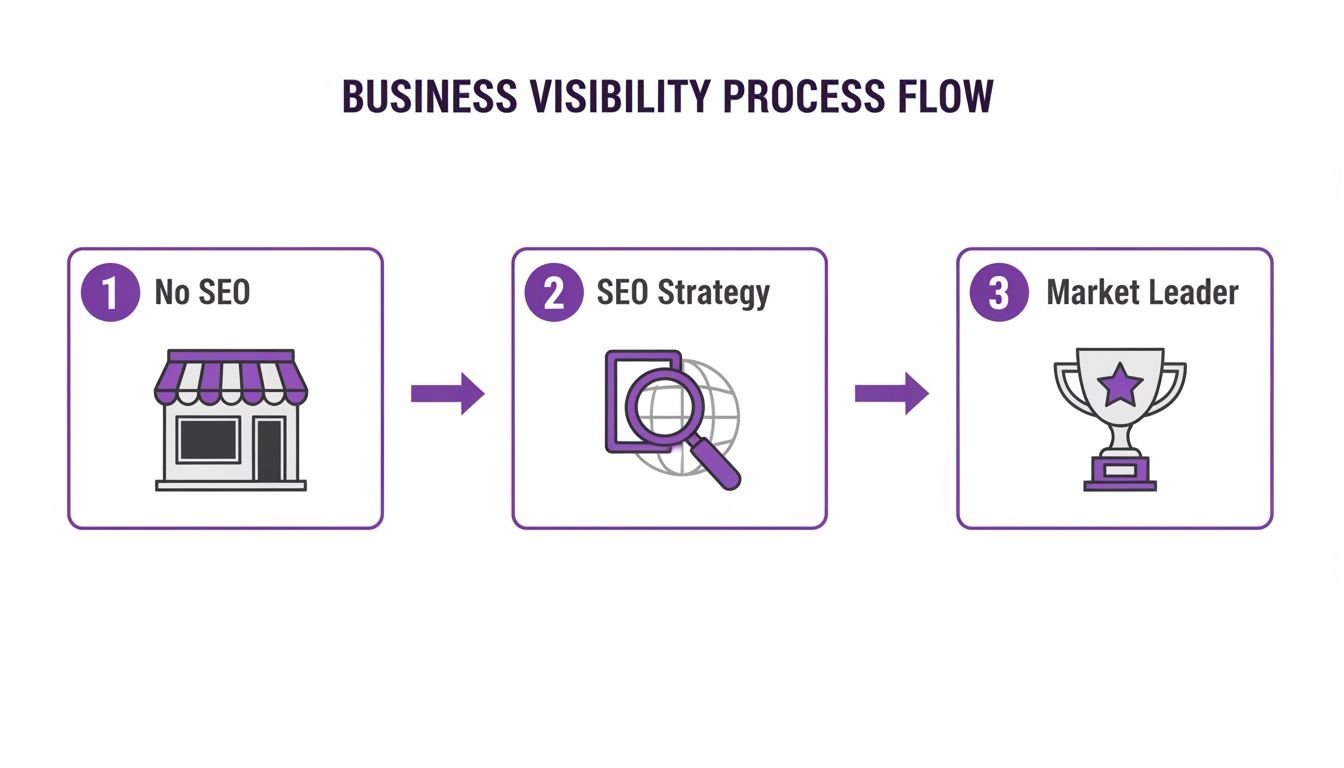
This journey shows that just being in business isn't enough. It's the deliberate SEO strategy that builds the bridge from simply existing to actually leading the market and getting noticed.
Building Your Digital Foundation
First things first: your core information has to be perfect. This is completely non-negotiable and forms the bedrock of all your local SEO. Think of it like this: the address on your front door, your business cards, and your Royal Mail listing all need to match exactly.
Any inconsistencies create confusion for both Google and your customers. So, before you even think about the fancy stuff, you have to get these fundamentals spot on.
- NAP Consistency: Your Name, Address, and Phone number need to be identical everywhere online—your website, your social media, and every single online directory you’re listed in.
- Business Categories: Be specific. Your primary category should be as precise as possible (e.g., "Landscape Gardener" is much better than just "Gardening"). Then, use secondary categories to cover everything else you do, like "Fencing Contractor" or "Patio Contractor".
- Service Areas: Clearly define the specific postcodes, towns, or counties you cover. This is what tells Google exactly where to show your profile when someone searches "near me".
Adding Colour and Detail to Your Profile
With the foundations sorted, it’s time to bring your profile to life. An empty or sparse profile just feels unwelcoming and unprofessional. You need to layer in rich, helpful information that makes a customer feel confident they’ve found the right business.
A well-detailed profile is like having your best employee on duty 24/7, ready to answer questions and show off your best work. It’s your chance to control the narrative and make a fantastic first impression. If you’re serious about this, using a free tool to run a full Google Business Profile audit can quickly highlight what needs fixing.
Your Google Business Profile is more than a listing; it's a dynamic, interactive mini-website. It's where you prove your credibility, showcase your expertise, and convert a local searcher into a paying customer—all without them ever having to click through to your main site.
Proactively managing your profile this way turns it from a static business card into an active lead-generation machine.
Engaging Actively with Customers
A truly great GBP is never a "set it and forget it" tool. Constant activity is a massive signal to Google that your business is open, active, and engaged with the local community. This is where you can easily pull ahead of lazy competitors who let their profiles gather dust.
To stay on top of this without it taking over your life, you might want to look at a Google Business Scheduler to keep your profile fresh with new posts and offers. Consistent activity is what wins the game.
Here’s how to keep your profile active and engaging:
- Use Google Posts: Regularly share updates, special offers, new products, or news. These posts show up directly on your profile for a set time and are a brilliant way to showcase what’s happening in your business right now.
- Upload High-Quality Photos: Add new, geo-tagged photos and videos all the time. Show off your team, your shop, your products, and your work in action. Photos build trust much faster than words ever can.
- Proactively Manage the Q&A Section: Don't just wait for customers to ask things. Pre-load your Q&A section by asking and answering your own frequently asked questions about services, parking, pricing, or opening hours.
- Encourage and Respond to Reviews: Make a point of asking your happy customers for reviews, and then reply to every single one—good or bad. This shows everyone that you care about customer feedback and are committed to great service.
Nailing Your Local Keywords and On-Page SEO
If your Google Business Profile is the digital equivalent of your shop window, then your website pages are the aisles inside. And just like in a physical shop, you need clear signage to guide customers to what they’re looking for. In local SEO, that signage is built from the exact words and phrases your customers are typing into Google every day.

This isn’t about guesswork. It’s about uncovering the language of local intent. A generic term like "plumber" is a shot in the dark; you could attract clicks from anywhere in the country. But a hyper-local phrase like "emergency plumber in Bristol" is a laser-focused signal that connects you with a customer who needs you, right here, right now.
Finding the Phrases That Matter
The key is to put yourself in your customer's shoes. What would they search for when they need your services in their specific part of the world? They aren't just looking for any wedding photographer; they're searching for a "wedding photographer in the Cotswolds" or "documentary wedding photography near Bath."
You can start finding these golden phrases with a few simple, free tools:
- Google's Autocomplete: Start typing your main service (e.g., "new boiler installation") into Google, followed by different UK towns or postcodes. Pay attention to the suggestions that appear—these are based on real-world searches.
- "People Also Ask" Box: This section in the search results is a goldmine. It shows you the actual questions your customers are asking, giving you perfect ideas for content on your website.
- AnswerThePublic: This tool is brilliant for visualising all the questions swirling around a keyword, handing you hundreds of ideas for blog posts and service pages.
There's a huge gap between knowing SEO is important and actually doing it. A massive 89% of small business owners agree SEO is vital, but a staggering 80% skip content marketing altogether. This is a real opportunity, especially when you realise that 70-80% of people research a small business online before they visit or buy.
This simple table shows just how powerful it is to shift your focus from vague, national terms to highly specific local ones.
From Generic to Hyper-Targeted Local Keywords
| Business Type | Generic Keyword (Low Intent) | Hyper-Targeted UK Keyword (High Intent) |
|---|---|---|
| Bakery | "birthday cakes" | "vegan birthday cake delivery Manchester" |
| Accountant | "small business tax" | "accountant for sole traders in Leeds" |
| Electrician | "rewire house" | "emergency electrician North London" |
| Estate Agent | "sell my house" | "estate agent valuation in Cardiff" |
Switching to these hyper-targeted keywords is the difference between shouting into the void and having a direct conversation with a customer who is ready to act.
Weaving Keywords Into Your Website (On-Page SEO)
Once you've got your list of local keywords, you need to weave them into the very fabric of your website. This is what we call on-page SEO. It’s all about placing these phrases in specific, strategic places so that Google can instantly understand what each page is about and who it’s for.
Think of it like labelling your office files. You wouldn't label a folder with your 2026 tax return as "important stuff." You’d call it "2026 Tax Return – [Your Business Name]." On-page SEO does exactly the same job for your webpages.
Here are the most critical places to get your keywords:
- Title Tags: This is the headline that shows up in Google search results and on the browser tab. It must include your main keyword and location (e.g., "Artisan Cake Shop in York | Bespoke Birthday & Wedding Cakes").
- Meta Descriptions: This is the short summary under your title in the search results. While it doesn't directly affect rankings, a compelling description convinces people to click. Make sure it includes your target phrase and a clear benefit.
- Headings (H1, H2, H3): Use your keywords in the main headings on the page. This gives your content structure and signals what's important to both readers and search engines.
- Image Alt Text: This is the text description that appears if an image can't load. Describing your images using local keywords (e.g., "Victorian terraced house loft conversion in Clapham") helps you show up in Google Image searches and improves accessibility.
For a structured way to tackle all these optimisations, our comprehensive local SEO checklist gives you a step-by-step guide to follow.
A crucial warning: Don't just stuff keywords everywhere. Your first job is to write for human beings, not for Google. The content has to flow naturally, be genuinely helpful, and answer the searcher's question. Google is more than smart enough to tell the difference between a useful page and one that’s just a mess of repetitive phrases.
By thoughtfully applying these principles, you start to transform your website from a generic brochure into a valuable local resource. It’s this alignment that convinces Google to show your business to the right people, at precisely the right moment.
Building Local Authority Through Content and Links
Getting seen on Google is one thing, but getting chosen is something else entirely. This is where you build genuine authority. Think of it like earning a reputation in a small town. The more credible locals vouch for you, the more new customers will instinctively trust you. In the online world, that trust is built with top-notch local content and what we call ‘digital handshakes’ from other websites, known as backlinks.

This part of your small business SEO UK strategy is all about proving to Google that you are a legitimate, respected, and authoritative voice in your local patch. It’s what separates a fleeting, temporary ranking from long-term, sustainable success at the top of the search results.
Creating Hyper-Local Content
The most potent content you can create is the stuff that speaks directly to the communities you serve. Instead of one generic 'services' page, think about building out dedicated landing pages for each key town or borough in your service area. For example, a roofer in London could have specific pages for ‘Roof Repairs in Islington’, ‘New Roofs in Hackney’, and ‘Gutter Cleaning in Camden’.
These pages need to be packed with local flavour to really hit the mark. Here’s what makes them work:
- Local Case Studies: Showcase a project you’ve nailed in that specific area. Walk people through the problem, your solution, and the fantastic result.
- Location-Specific Testimonials: A glowing review from a customer in that town carries far more weight when it’s on the page for that town.
- Photos of Your Work: Include images that clearly show your team working in recognisable local spots.
- Local Landmarks and Language: Mentioning nearby landmarks or using local turns of phrase shows you’re a genuine part of the community, not just targeting it from a distance.
This approach proves your deep connection to an area, which builds trust with both potential customers and search engines. It also helps you rank for those highly specific, high-intent searches. For creatives like photographers, this hyper-local angle is just as crucial. You can see how this works in practice in our guide on SEO for photographers.
To pull all this great local content together effectively, understanding what is a content hub is a game-changer. It gives you a central, organised place to showcase your expertise for each area you serve.
Earning Local Backlinks
If creating local content is you telling Google you're an expert, then backlinks are other local businesses and organisations confirming it. A backlink is simply a link from another website to yours. But not all links are created equal. A single link from a relevant, trusted local source is worth a hundred links from irrelevant, low-quality sites.
A backlink is a vote of confidence. When another respected local website links to yours, it's telling Google, "We vouch for this business. They are a legitimate and valuable part of our community." This is one of the most powerful ranking signals in all of SEO.
Think about the other organisations active in your community. Earning these ‘digital handshakes’ is an active process that involves building real-world relationships.
Here are some prime opportunities for local link building:
- Local News Outlets: Sponsoring a local charity event or offering an expert comment on a relevant story can land you a feature in the local paper's website—a very powerful backlink.
- Community Groups and Clubs: If you sponsor a local football team or community group, make sure they link back to your website from their sponsors page.
- Neighbouring Businesses: Team up on a joint promotion or event with a non-competing business that serves a similar audience, and get them to link to your site.
- Industry-Specific Directories: Getting listed in reputable, UK-based directories for your trade or profession (not the spammy, generic ones) helps confirm your credentials.
Steadily accumulating this mix of relevant content and authoritative local links is what will solidify your position at the top of the search results for the long haul.
Choosing Your SEO Path with Realistic Timelines
"So, how long will this actually take?" It’s the first question nearly every business owner asks, and it’s the right one. The honest answer is that SEO isn’t like flicking a switch on a paid ad campaign. It’s a marathon, not a sprint, and you need to have your expectations set right from day one.
Think of it like planting a garden. You can’t stick a seed in the ground and expect a prize-winning marrow the next morning. You have to prepare the soil, plant carefully, water regularly, and protect it from pests. SEO works in the exact same way. The early work sets the stage, and consistent activity is what nurtures growth over time.
For most UK small businesses, the journey follows a fairly predictable path. You’re building momentum that compounds, meaning the results you see in month nine are a direct consequence of the foundations you laid back in month one.
Understanding SEO Timelines
Setting realistic expectations from the start is critical. While you might see a few quick wins, a sustainable small business SEO UK strategy delivers its real value over the medium to long term. Chasing overnight rankings often leads to risky shortcuts that can get you penalised by Google, setting you back even further.
Here’s a typical timeline for a well-run local SEO campaign:
- Months 1-3 (The Foundation Phase): This is all about getting your house in order. We’re talking technical audits, fixing website errors, deep keyword research, overhauling your Google Business Profile, and building out core pages. You might see a few small movements here, but this stage is about building a solid base.
- Months 3-6 (Gaining Traction): Now you should start seeing tangible progress. Your rankings for key local terms will begin to climb, traffic from search engines should increase, and you’ll likely notice more phone calls or enquiry forms coming through. This is where the initial work starts to build real momentum.
- Months 6-12+ (Compounding Growth): This is where the magic really happens. All the consistent content creation and link-building efforts start to pay off significantly. Your business begins to establish itself as a local authority, rankings become far more stable, and the flow of leads becomes predictable and reliable.
SEO is not a one-time fix; it's an ongoing investment in a core business asset. The first 3-6 months are for building momentum, while the 6-12 month period is where that momentum turns into significant, compounding growth that drives your business forward.
What Does an SEO Investment Look Like?
To make this more concrete, it helps to see what different levels of investment can actually achieve. The packages below are just examples to illustrate the kinds of deliverables you might expect, not a direct sales pitch. They show how a strategy can be scaled depending on your business size, your goals, and just how competitive your local market is.
Whether you're a single-location boutique or a multi-location service company, your ambitions will dictate the level of activity needed. You can even explore our guide to calculating the ROI of your SEO efforts to get a better handle on the potential returns.
This table contrasts typical SEO activities for different business needs, helping you see what a Growth, Advanced, or Accelerate plan might include.
Comparing Local SEO Packages for UK Businesses
| Feature/Deliverable | Growth Package (Single Location) | Advanced Package (Growing Business) | Accelerate Package (Multi-Location/Competitive) |
|---|---|---|---|
| Google Business Profile | 4 Posts Per Month & Monitoring | 8 Posts Per Month & Proactive Q&A | Weekly Posts, Photo Optimisation & Full Management |
| Content Creation | 1 x 1,000-Word Blog Post Per Month | 2 x 1,500-Word Blog Posts or 1 Landing Page | 4 x Long-Form Content Pieces & Hyper-Local Pages |
| On-Page & Technical SEO | Core Optimisations & Monthly Checks | Ongoing Optimisations & Speed Audits | Advanced Schema & Continuous Site Health Monitoring |
| Local Link Building | Basic Directory & Citation Building | 2 High-Quality Backlinks Per Month | 4+ High-Authority & Niche Backlinks Per Month |
| Reporting | Monthly KPI Report & Keyword Tracking | Monthly Report & Live Dashboard Access | Customised Reports, Dashboard & Strategy Calls |
| Best For | Local trades, single-location shops, startups. | Service businesses in competitive cities. | Multi-location brands, national ecommerce. |
Choosing the right path means aligning your budget with your ambitions. A new florist in a small town has very different needs from a construction firm aiming to dominate three separate counties. By understanding what’s involved at each level, you can make a much more informed decision on how to invest in your company’s future growth.
Got SEO Questions? We’ve Got Straight Answers.
Trying to get your head around SEO when you're busy running a business can feel like you're chasing a moving target. To cut through the noise, we've rounded up the most common questions we hear from UK business owners just like you.
Think of this as your go-to guide for busting myths and getting straight answers on what actually moves the needle for your website.
How Much Does Small Business SEO Cost in the UK?
This is always the first question, and the honest answer is: it depends. The cost of a small business SEO UK plan hinges entirely on your ambitions, how tough your market is, and the sheer amount of work needed to get you results.
A word of warning: be very sceptical of those rock-bottom offers promising page-one rankings for £99 a month. Proper SEO takes expertise, time, and relentless effort. For a quality local SEO package from a credible UK agency, a realistic starting point is around £500-£750 per month, and it can scale up from there.
A foundational package would typically cover:
- Full Google Business Profile optimisation and consistent posting.
- On-page SEO for your most important website pages.
- One or two pieces of highly targeted content each month.
- Building out your essential local citations.
Bigger packages will naturally bring in more firepower, like advanced link-building campaigns, the creation of hyper-local landing pages for different service areas, deep technical monitoring, and a more aggressive content plan. The goal is always to match your budget to your growth targets.
Can I Do My Own SEO?
Yes, you absolutely can! If you have more time on your hands than budget, tackling the basics yourself is a brilliant way to start. There are plenty of fantastic free tools and guides out there.
You can make a real difference by focusing on a few key areas:
- Completely filling out and optimising your Google Business Profile.
- Making sure your business Name, Address, and Phone number (NAP) are identical everywhere online.
- Researching what your local customers are searching for and weaving those keywords into your site’s titles and text.
- Systematically asking your happy customers for reviews.
The real test, however, is consistency. SEO isn't a one-off job; it requires constant attention to keep up with Google's relentless updates. As your business grows, you'll likely find that your time is better spent running the show, while the more complex tasks—like technical SEO, strategic content creation, and building real authority through links—are best left to a specialist agency.
What’s More Important: Local SEO or National SEO?
For the vast majority of small UK businesses with a physical location or a set service area, local SEO is infinitely more important.
Just think about your perfect customer. Are they vaguely searching for a "therapist" somewhere in the UK, or are they looking for a "therapist in Tamworth"? Local SEO is all about capturing these high-intent, location-specific searches. It’s about winning the business right on your doorstep.
National SEO is the right play for businesses that can serve anyone, anywhere in the country—think of a purely e-commerce shop that ships nationwide. But if your customers are mainly in your town, city, or region, pouring your budget into local SEO will give you a much, much better return.
For a local business, ranking number one nationally for a broad term is a vanity metric. Ranking number one in the Google Map Pack for a local service term is what actually pays the bills. It connects you directly with customers who are ready to buy.
How Long Until I See SEO Results?
SEO is a long-game, not a quick-fix. While you can sometimes see small, early wins, genuine, lasting results take time to build up.
Here’s what a realistic timeline usually looks like:
- Months 1-3: This is the foundation-laying phase (audits, technical fixes, profile optimisation). You might see a few small movements, but this stage is all about setting you up for success.
- Months 4-6: You should start to see tangible improvements in your local rankings, a steady climb in organic traffic, and more calls or enquiries coming through.
- Months 7-12+: This is where the magic happens and the results start to compound. Your authority grows, your rankings become more stable, and the flow of leads becomes a reliable, predictable part of your business.
Patience is key. Any agency that promises you guaranteed page-one rankings within a month is almost certainly using risky, short-term tactics that could get your website penalised down the line.
Is SEO Still Worth It for a Small Business?
One hundred percent, yes. With 70-80% of consumers now researching local businesses online before they visit or buy, not being visible on Google is like having a shop with no sign on the door.
A well-managed SEO strategy is one of the most cost-effective marketing channels there is. Unlike paid ads, where your traffic disappears the second you stop paying, the authority and rankings you build through SEO become a long-term business asset. It’s an investment that keeps delivering value and new customers for years to come.
Ready to stop being invisible online and start dominating your local market? Bare Digital has over 15 years of experience helping UK businesses like yours turn search visibility into measurable growth. We create bespoke strategies that deliver real results. Get your free, no-obligation SEO health check and see what's possible. Book your free SEO plan with Bare Digital today.