
Let's be honest, what is your website content, really? It's your single hardest-working digital employee, on the clock 24/7. It's the engine that powers your local business online, the bit that turns casual browsers into loyal, paying customers. This isn't just about filling pages with text; it's about putting words to work.
Why Your Web Site Content Is Your Best Local Salesperson
Think of your website as a physical shop. Your homepage is the bright, inviting shop window, designed to catch the eye and draw people in. Your service pages are the neatly organised aisles, clearly showing what you offer and making it dead simple for customers to find what they need.
And your blog posts? They’re your expert staff on the shop floor. They’re the friendly, knowledgeable team members answering questions, offering solid advice, and building a real relationship with every single person who walks through the digital door. For any UK local business looking to thrive, this digital "staff" is absolutely essential.
Answering Every 'Near Me' Search
Every time someone in your area searches for "plumber near me" or "best café in Cambridge," your website content gets a chance to be the perfect answer. It’s what Google reads to figure out if your business is a relevant, trustworthy solution for that searcher's immediate problem.
High-quality content gives the search engine undeniable proof of your local relevance. It speaks directly to the needs and wants of your community, building a vital bridge between a local problem and your business solution.
The ultimate goal of your content is to turn a curious browser into a paying customer. It achieves this by building trust, demonstrating expertise, and making it clear why you are the best choice in the local area.
This whole process translates directly into tangible results for your business. More phone calls, more contact form submissions, and more people walking through your actual door are all direct outcomes of strategic website content. The line between well-crafted words on a screen and real-world revenue is much shorter than you might think.
The Core Functions of Web Site Content
To really make your content hit home with local customers, you need to get inside their heads and understand their location-based needs. For a deeper look at crafting a local strategy, it’s worth exploring the role of geographics in marketing. Different types of content play distinct but complementary roles in this customer journey.
This table breaks down the primary jobs that different types of content do to attract and convert local customers.
The Core Functions of Web Site Content
| Content Function | Purpose for UK Businesses | Example |
|---|---|---|
| Attract | Captures the attention of potential customers who are looking for solutions or information. | A blog post titled "5 Telltale Signs Your Boiler Needs Servicing This Winter" for a heating engineer. |
| Engage | Builds trust and demonstrates expertise by providing valuable, locally-focused information. | A detailed case study of a garden transformation for a landscaping company in Surrey. |
| Convert | Persuades the visitor to take action, such as making a purchase or booking a consultation. | A service page for wedding photography with clear packages, pricing, and a prominent "Check Availability" button. |
Understanding these functions helps you build a website that doesn't just rank well but also works tirelessly as your most effective salesperson. If you're curious to see how this approach builds local authority in the real world, take a look at our SEO services in Cambridge, where we put these exact principles into practice every day.
The Building Blocks of High-Performing Local Content
To build a website that consistently wins local customers, you need a solid foundation. It helps to think of your website content not as one big lump of text, but as a collection of specialised pages. Each page has a specific job, and when they all work together, they create a powerful system for turning local searchers into loyal clients.
Let's break down this essential toolkit. We’ll start with the non-negotiable pages every UK local business needs, then move on to the strategic content that really fuels your growth.
Your Foundation: The Three Essential Pages
Before you even think about writing a blog post, you have to nail the three most fundamental pages on your site. These pages answer the basic questions every potential customer has: What do you actually sell, where do you do it, and why on earth should I trust you?
Service Pages (The 'What'): This is where you make your case. Each page needs to focus on a single service you offer, explaining precisely what it is, who it's for, and the benefits of choosing you. For a Bristol-based plumber, this means having separate, detailed pages for "Boiler Installation," "Emergency Leak Repairs," and "Central Heating Servicing." These are the pages where people who are ready to buy will land, so they must be clear, persuasive, and make it incredibly easy to get in touch.
Location Pages (The 'Where'): For any business serving a specific geographic area, location pages are an absolute must. They are powerful signals to Google that you are the go-to provider in a particular town or city. A catering company might create dedicated pages for "Wedding Catering in the Cotswolds" and "Corporate Events in Cheltenham," each one packed with local details, case studies, and testimonials from that area. This tells both users and search engines that your service is hyper-relevant to their exact needs.
About Us Page (The 'Why'): This is often one of the most visited pages on a local business website, and for good reason. People don't just buy services; they buy from people they know, like, and trust. Your About Us page is your chance to tell your story, introduce the team, and share your values. It’s where you prove you’re a real, credible business run by passionate experts, not just some faceless website.
Attracting Customers with Strategic Blog Content
Once your foundational pages are in place, it’s time to start attracting customers who aren't quite ready to buy. These are the people who are "just looking," researching a problem, or exploring their options. This is where a strategic blog comes into its own.
A blog lets you cast a much wider net by answering the questions people ask at the very beginning of their journey. It positions you as a helpful expert, building trust long before they ever need to part with their money.
A well-written blog post is like offering free, valuable advice. It warms up potential customers, making your business the first one they think of when they're finally ready to take action.
Take our Bristol plumber, for instance. They could write a blog post titled "Fixing Common Boiler Issues in Victorian Homes." This content is incredibly useful for homeowners in areas like Clifton or Redland. It tackles a local pain point head-on, attracts highly relevant traffic, and shows off their deep expertise.
In the same way, a Scottish tour operator might create a guide on "Hidden Gems on the North Coast 500." This doesn't directly sell a tour, but it hooks adventure-seekers who are actively planning a trip to the area. By providing immense value upfront, the operator becomes a trusted resource, making their paid tours an easy choice later on.
Tying It All Together
These different types of content don't exist in a vacuum; they form an interconnected system. Your blog posts attract new visitors, and within those posts, you can gently guide readers towards your core service or location pages when they’re ready for the next step. A complete local content strategy has an answer for customers at every single stage.
Getting this right requires a plan. For a deeper dive, check out our complete local SEO checklist to ensure you're covering all your bases. This holistic approach is what transforms a simple website into a proper lead-generating machine for your UK business.
Using Visual Content to Captivate Your Local Audience
In a world overflowing with information, your website content needs to do more than just tell; it has to show. Words are fantastic for explaining what you do, but it's the visuals that grab attention, spark an immediate emotional connection, and make your local business genuinely memorable.
Showing is always more powerful than telling. Think about it: a page of text describing a beautifully landscaped garden is fine, but a gallery of stunning before-and-after photos is unforgettable. It’s the difference between describing a delicious cake and showing a video of it being iced.
The Power of High-Impact Photography and Portfolios
For so many UK local businesses, especially skilled trades and creative professionals, high-quality photography isn't some luxury—it's an absolute necessity. A builder can talk all day about their craftsmanship, but a portfolio gallery showing off flawless extensions and renovations provides undeniable proof.
This is where your website stops being a simple brochure and starts becoming a powerful sales tool. A well-organised portfolio lets potential customers picture themselves as your next success story. For these visual-heavy sectors, optimising your images and galleries is crucial, and you can learn more about this in our guide to SEO for photographers, which has tips that apply to plenty of other trades.
Why Video Is a Game-Changer for Local Trust
Video content isn't just for big brands with massive budgets anymore. These days, a simple, authentic video can forge a personal connection that text alone just can't match. A behind-the-scenes peek at a local bakery preparing its morning sourdough or a heartfelt video testimonial from a family praising their home care provider can be incredibly powerful.
And the data backs this up. Here in the UK, digital ad spend rocketed to £35.53 billion in 2024, with video formats seeing a massive 20% growth. A staggering 91% of businesses now use video as a core marketing tool, and with good reason—59% of B2B buyers would rather watch a video than read text. You can explore more fascinating insights in these UK video marketing statistics.
This flowchart shows how the core pillars of your local content strategy—the What, Where, and Why—all need to work together.
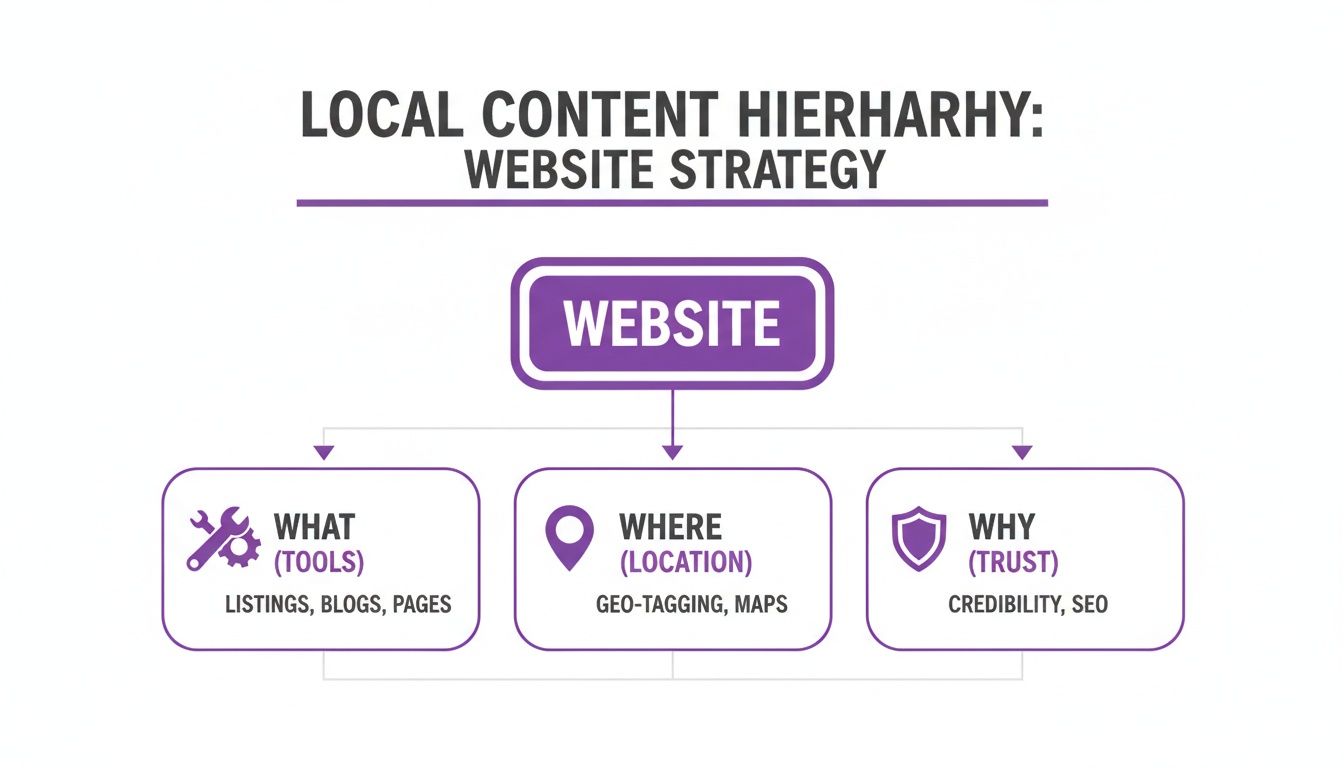
As the diagram shows, the tools you use, your focus on location, and the elements that build trust must combine to create a website that actually works.
Integrating Visuals for Maximum Conversion
Visuals shouldn't just exist to look pretty; they need a strategic purpose—driving action. When you’re using visual content to pull in your local audience, applying effective landing page design best practices is what turns that attention into actual enquiries and sales.
Every single image and video should guide the visitor towards a specific goal. Not all visuals are created equal, and knowing which type to use for a specific job is key.
Different types of visuals are better suited for different goals and business types. This table breaks down which visuals tend to work best for specific local business sectors.
Visual Content Impact on Local Businesses
| Visual Content Type | Best For Which Sector? | Primary Goal |
|---|---|---|
| High-Quality Photos | Caterers, tradespeople, artists, retail | Showcase quality, build credibility, and display products. |
| Video Testimonials | Service-based businesses (solicitors, carers) | Build social proof, create an emotional connection, and increase trust. |
| Team Photos | Any local business with a public-facing team | Humanise the brand, make the business feel more approachable. |
| Infographics | Technical services (engineers, accountants) | Simplify complex information and make data easy to digest. |
By choosing the right visual for the right job, you make your message much more powerful and guide your visitor more effectively.
Here’s a quick rundown of how different visuals contribute:
- High-Quality Photos: These build credibility and show off the quality of your work or products. A caterer’s site packed with vibrant food photos is far more persuasive than a text-only menu.
- Video Testimonials: Nothing builds trust like social proof. Hearing a happy customer praise your service in their own words is often the final nudge a new prospect needs to get in touch.
- Team Photos: These humanise your brand. A friendly photo of your team on the "About Us" page makes your business instantly more approachable and trustworthy.
- Infographics: These are perfect for breaking down complicated information into an easily digestible format. A heating engineer could use an infographic to explain the benefits of a new boiler system, making the data clear and compelling.
Your visual content should stop the scroll, hold attention, and guide the user seamlessly towards taking that next step, whether that's filling out a form, making a call, or walking through your door.
Ultimately, weaving compelling visuals into your site is about making your business unforgettable. In a competitive local market, the business that best communicates its value visually often wins. It’s your chance to stand out, build immediate trust, and turn passive browsers into active customers.
Your Step-By-Step Local Content Planning Framework
Great website content is never an accident. It’s the direct result of a focused plan, carefully designed to grab the attention of your ideal local customers and turn them into real business. Moving away from sporadic, "let's-just-post-something" updates and towards a proactive system is the only way to get measurable results.
This section gives you a practical, no-nonsense roadmap for creating content that pulls in new business consistently. We're going to demystify the planning process and break it down into four straightforward steps. This is about building a sustainable system that works for you, not creating more work for yourself.
Step 1: Define Your Ideal Local Customer
Before you write a single word, you have to know exactly who you're talking to. Creating a simple customer persona helps you ditch generic marketing fluff and speak directly to the needs, worries, and hopes of people right in your community.
Think of it this way: you wouldn't give the same sales pitch to a young first-time buyer as you would to a retiree looking to downsize. Your website content needs to be just as targeted. A persona is simply a fictional profile of your perfect customer.
To build one, ask yourself these questions:
- Demographics: What's their age, where do they live (e.g., a specific neighbourhood in Manchester), and what do they do for a living?
- Goals: What are they trying to accomplish that your service is the perfect solution for?
- Challenges: What problems are they wrestling with? What frustrates them about finding a good local service?
- Watering Holes: Where do they hang out online to find information? Are they active in local Facebook groups or on specific community forums?
By answering these, you create a clear picture of someone like "Sarah, a 35-year-old homeowner in Norwich who needs a reliable gardener she can trust." Now, every piece of content you create can be designed to answer Sarah's specific questions and ease her worries.
Step 2: Uncover Your Local Keywords
Once you know who you're targeting, you need to figure out what they’re searching for. Local keyword research is all about discovering the exact phrases people in your area use when they need your services. It’s less about guesswork and more about using data to spot opportunities.
Think beyond broad terms like "builder." Your real customers are searching with local intent, using phrases like:
- "loft conversion specialist Bath"
- "emergency plumber near me in Glasgow"
- "best wedding caterer in the Cotswolds"
Keyword research is your roadmap to creating website content that both search engines and customers will love. It tells you what topics to cover and what language to use to show up when it matters most.
Tools like Google Keyword Planner, Ahrefs, and Semrush can give you hard data on what people are searching for. But don't forget the simplest tool of all: Google itself. Type a service and your town into the search bar, then look at the "People also ask" questions and related searches at the bottom. These are absolute content goldmines.
Step 3: Map Content to Customer Needs
With your personas and keywords ready, the next step is to match them to specific pages on your site. This process, called content mapping, makes sure you're delivering the right message to the right person at the right time. Your goal is to create a seamless journey from their initial search to them picking up the phone.
A simple way to organise this is to map your content to the three stages of the customer journey:
- Awareness Stage (Blog Posts & Guides): The customer has a problem but isn't ready to buy yet. Your content should educate them. Think of an article like "How to Choose the Right Interior Designer for Your Victorian Terrace."
- Consideration Stage (Case Studies & Service Pages): The customer is weighing up their options. A case study showing off a successful project in their town builds huge trust and proves your expertise.
- Decision Stage (Location & Contact Pages): The customer is ready to hire someone. Your service and location pages must be crystal clear, persuasive, and feature a strong call to action, making it incredibly easy for them to get in touch.
Step 4: Build a Sustainable Content Calendar
Finally, you need a plan to make it all happen consistently. A content calendar is a simple schedule that maps out what you're going to publish and when. It turns your grand strategy into an actionable plan and takes away the weekly stress of "what should I write about now?"
Your calendar doesn't have to be some complex beast. A simple spreadsheet is all you need to get started.
Basic Content Calendar Template:
| Publication Date | Topic / Title | Keywords to Target | Content Type | Status |
|---|---|---|---|---|
| 1st July | 5 Signs Your Roof Needs Repair | "roof repair Leeds", "leaking roof signs" | Blog Post | Drafting |
| 15th July | Case Study: New Driveway in Roundhay | "driveway installers Roundhay" | Case Study | Published |
This framework takes the guesswork out of creating high-performing website content. It transforms your site from a static online brochure into an active, strategic asset that generates local leads day in and day out.
How to Promote Your Content and Maximize Its Reach

Creating a brilliant piece of web site content is a huge win, but it’s only half the job. Think of it like a perfectly crafted shop display hidden away in a locked stockroom. If nobody ever sees it, it can't possibly make any sales. To get a real return on your investment, you have to get out there and make sure your message actually reaches your target audience.
Promotion starts long before you hit "publish." It begins with those on-page SEO wins that make your content magnetic to both search engines and human beings. This means writing compelling titles that spark curiosity, using clear headings to structure your ideas, and optimising your images with descriptive filenames and alt text. These foundational steps get your content ready for prime time.
Harnessing the Power of Social Media
With your on-page elements sorted, it's time to take your content out into the world where your customers live online. For UK businesses, that means social media. It's a vast digital space where you can join conversations, build a community, and drive highly qualified traffic straight back to your website.
This isn't about just broadcasting links into the void, though. The key is to engage strategically. Here in the UK, a massive 55.5 million people—that's 79.0% of the entire population—actively use social media. With 44% of users discovering products through brands on these platforms, it’s a channel you simply cannot afford to ignore. These figures show just how vital it is to connect with your audience where they spend their time. You can explore more UK-specific data on social media usage on Metricool.com.
A Simple Content Repurposing Strategy
The secret to effective social media promotion is to work smarter, not harder. You don’t need to invent brand-new content every single day. Instead, you can repurpose one single, high-quality blog post into a full week’s worth of engaging social media updates.
Here’s a practical example for a local catering company that just published a blog post titled "5 Summer Wedding Food Trends in the UK":
- Day 1 (Launch Day): Share the full blog post on your Facebook page and LinkedIn profile with an eye-catching image and a question like, "Which of these trends is your favourite for a summer wedding?"
- Day 2 (Tip Tuesday): Pull out one trend (e.g., "Grazing Tables") and create a simple graphic for Instagram. Write a short, snappy caption explaining why it's so popular.
- Day 3 (Go Live): Host a short Facebook Live or create an Instagram Reel showing off a grazing table you recently created, talking through the different elements.
- Day 4 (Share a Quote): Take a key quote from your blog post and turn it into a text-based image. Share it on all your platforms, reminding people of the original article.
- Day 5 (Join the Conversation): Find local wedding planning groups on Facebook. Share a helpful tip from your article (don't just drop the link!) and offer to answer questions.
This approach transforms one piece of web site content into multiple touchpoints, squeezing every drop of value out of it and driving consistent traffic.
Promoting your content effectively means connecting your website to the broader digital world. It’s about meeting your customers where they are and giving them a compelling reason to visit your online home.
This promotional loop is vital for growth. It strengthens your brand, builds authority, and keeps a steady stream of potential customers flowing to your site. It’s also a powerful signal to Google that your content is valuable and relevant, which can further boost your search rankings. For local businesses, this visibility extends to your Google Business Profile, a critical asset for attracting local customers. For more on optimising this, have a look at our insights on the importance of a Google Business Profile audit tool.
Measuring What Matters for Local Business Growth
Creating great website content is a fantastic start, but if you're not measuring its impact, you're flying blind. The real skill is turning all that data into smart decisions, which is what separates businesses that grow from those that just tread water. It’s time to stop drowning in analytics and focus on the handful of metrics that actually signal success for your UK local business.
Forget chasing vanity metrics like overall page views that just stroke the ego. We’re talking about tangible Key Performance Indicators (KPIs) that draw a straight line from your content efforts to your bank account. These are the numbers that prove your strategy is actually working.
Focusing on Actionable Local KPIs
For a local business, not all website traffic is good traffic. A thousand visitors from across the globe are completely useless if you’re a plumber based in Leeds. Your focus has to be laser-sharp, zeroing in on the metrics that reflect genuine local interest and the intent to buy.
Here are the core KPIs you should be tracking:
- Local Organic Traffic: How many visitors are finding you through search engines from your specific town, city, or county? This tells you if you're reaching your actual target market.
- Local Keyword Rankings: Are you showing up on the first page of Google for money-making local searches like "best wedding venue in the Cotswolds" or "emergency electrician in Manchester"? Tracking your rank for these phrases shows your visibility where it counts.
- Conversion Rate on Key Pages: This is the most crucial metric of all. What percentage of visitors on your service and location pages are actually taking action—filling out a form, clicking to call, or asking for directions? A high conversion rate means your content isn't just being read; it's being acted on.
The core principle is simple: your content strategy is a continuous loop. You have to create, measure, learn, and then refine. This iterative process is the engine of sustainable, long-term growth.
Conducting a Quarterly Content Check-up
To make this whole process manageable, set up a simple quarterly check-up. This gives you enough time to spot real trends, identify your best-performing content, and double down on what works, all without getting lost in the day-to-day data whirlwind. During your review, dig into your traffic and conversion data to see which blog posts drove the most leads or which service pages have the highest engagement.
This process also helps you figure out which promotional channels are pulling their weight. With 54.8 million active social media users in the UK, it’s vital to measure which platforms are sending you meaningful traffic. And while data from UK digital trends shaping content strategy shows that 92.4% of social ad clicks come from mobile, you still need top-notch content to make anyone care enough to click.
By identifying these content 'winners', you can create more of what your audience loves and what actually converts. Perhaps a case study about a local project smashed all expectations, which is a clear signal to create more of them. Maybe a guide to calculating returns connected with savvy customers; you could explore this further with our own guide to understanding self-storage ROI for SEO. This cycle of measuring and refining is how your web site content becomes an increasingly powerful asset for your business.
Right, you’ve got a plan for your local content, but that’s often when the really specific questions start popping up. To cut through the noise, we've rounded up the most common queries we hear from UK business owners about putting their content strategy into practice. Think of this as your go-to guide for straight, no-nonsense answers.
How Often Should I Be Publishing New Content?
For most local businesses, consistency will always beat sheer volume. It’s far, far better to publish one high-quality, genuinely helpful blog post or case study a month than it is to churn out several thin, low-value posts every week.
A steady rhythm of valuable content builds much more trust and authority over time than sporadic, low-effort updates. Focus on quality, not just the calendar, to make your web site content work harder for you.
On top of that, you should get into the habit of reviewing your core service and location pages at least once every quarter. This makes sure everything from your pricing to your opening times stays perfectly accurate and fresh for both your customers and the search engines.
Can I Just Use AI to Write Everything?
While AI is a brilliant assistant for smashing through writer's block, brainstorming ideas, or creating a first-draft outline, it should never completely replace your human expertise. Think of it as a tool to speed up the process, not a substitute for genuine, hard-won insight.
To build real trust and stand out from the crowd, your web site content needs a human touch. Your local knowledge, your brand’s personality, and your authentic understanding of your customers are all things AI simply can't fake. Use it as a starting point, but always make sure you infuse the final text with your own unique voice and experience.
Which Is More Important: Service Pages or My Blog?
This is a classic question, and the answer is simple: they're both critical, but they have completely different jobs.
Think of your service pages as your 'money pages'. They’re designed to convert visitors who already have a good idea of what they need and are close to making a decision. Your blog, on the other hand, is there to attract visitors who are much earlier in their journey. It builds your authority and captures potential customers while they're still in the research phase, figuring out their problems.
The best strategy? Perfect your service pages first. Once those are optimised to convert, use a regularly updated blog to consistently feed them with qualified, local traffic.