

In digital marketing, your Click-Through Rate (CTR) is one of the most honest metrics you have. It’s simply the percentage of people who click your link after seeing it. Think of it as a direct measure of how well your headline, advert, or email subject line grabs someone’s attention and convinces them to take the next step.
The formula is straightforward: (Clicks ÷ Impressions) x 100%. But behind that simple calculation is a ton of insight into what your audience really wants.
Understanding Click Through Rate In Simple Terms

Imagine your CTR as a digital show of hands. Every time your website pops up in a Google search, your ad appears on a social feed, or an email lands in a subscriber's inbox, that’s an 'impression'. It's an opportunity for someone to see what you have to offer. The 'click', of course, is when they’re interested enough to act on it.
CTR is the bridge connecting these two events. It cuts through the noise and answers a crucial question: out of all the people who saw your message, how many actually found it compelling enough to learn more? It’s a raw, unfiltered look at how well your content resonates.
The Core Components Of Click Through Rate
To really get a handle on CTR, it helps to break down its two moving parts: impressions and clicks. While they sound simple, they mean slightly different things depending on where you are in the digital world. Getting this distinction right is the first step to making real improvements.
Let's quickly define these key pieces with some real-world context.
| The Core Components Of Click Through Rate |
| :— | :— | :— |
| Term | What It Means | Real-World Example |
| Impressions | The total number of times your link or advert was displayed. | Your Google Ad for "emergency plumbers Cambridge" is shown 1,000 times in a week. |
| Clicks | The number of times people actually clicked on that link or advert. | Out of those 1,000 impressions, 50 people clicked the ad to visit your website. |
| CTR | The percentage of impressions that resulted in a click. | (50 Clicks ÷ 1,000 Impressions) x 100 = 5% CTR. |
Understanding these components makes it clear what you're actually measuring.
A high CTR is a great sign. It tells you that your messaging is on point, your targeting is sharp, and your call-to-action is hitting home. It shows a powerful alignment between what you're offering and what your audience is looking for.
On the other hand, a low CTR is a red flag signalling a disconnect. Maybe your headline is boring, your ad copy isn't persuasive, or you’re showing it to the wrong crowd entirely. This makes CTR an essential diagnostic tool for figuring out what’s working and, more importantly, what isn’t.
Why Click-Through Rate is a Big Deal for Your Business
Click-Through Rate isn't just another number on a spreadsheet; it’s one of the most honest health checks for your digital marketing. Think of it as an early warning system. It tells you, almost instantly, if your message is actually landing with the people you’re trying to reach.
A strong CTR is the first domino in a successful campaign. When someone clicks your ad, link, or subject line, they’re raising their hand and showing interest. That flicker of interest is the first step towards a new lead, a sale, and real business growth. Put simply, a higher CTR means you get more shots at turning browsers into buyers.
This single metric can have a surprisingly direct impact on your bottom line. From bringing down ad spend to giving your organic search a lift, getting a handle on CTR is a strategic move that pays dividends.
How It Shapes Your Search and Ad Performance
In the fiercely competitive world of Google Ads, a high CTR is rewarded. It’s a massive piece of your Quality Score—Google’s way of rating how relevant and useful your ads are. A better Quality Score means a higher ad rank and, most importantly, a lower cost-per-click (CPC). You end up paying less for better ad spots.
It's a similar story for organic search. While not a direct ranking factor in the way a backlink is, a high organic CTR sends a powerful signal to Google. It suggests your page is a fantastic answer to what someone was looking for. This kind of positive user feedback can indirectly boost your rankings over time, helping your best content climb up the results page.
A low CTR isn't a failure; it’s a clear signal that your message isn't resonating. It offers a valuable opportunity to refine your headlines, ad copy, or targeting before you waste more budget on a campaign that isn't performing.
Driving the Actions That Matter
At the end of the day, clicks are the currency of online engagement, and they carry real commercial weight. Nowhere is this clearer than in email marketing. A lot of people get hung up on open rates, but a click shows a much deeper level of intent.
Data from the UK’s Direct Marketing Association (DMA) drives this point home. An email open is estimated to be worth around £0.50, but a single click-through? That's valued at nearly £5. A click is almost ten times more valuable for driving revenue, which shows exactly why optimising for CTR is so critical. You can dig into more of these email marketing insights on the DMA's website.
A healthy CTR doesn't just bring any old traffic; it brings the right kind of traffic. These are people genuinely interested in what you have to offer, making them far more likely to take that next step. By focusing on improving your CTR, you’re not just chasing clicks—you're working directly to improve your website conversion rates and get a better return on your marketing spend.
Comparing CTR Across Different Marketing Channels
One of the biggest mistakes people make in digital marketing is treating Click-Through Rate as a one-size-fits-all number. The truth is, a ‘good’ CTR looks completely different from one channel to the next. What counts as a huge success in an email campaign might be a total disaster for an organic search result. Getting your head around these differences is the first step to setting realistic goals.
Trying to compare your organic search CTR to your display advertising CTR is like comparing apples to oranges. They just aren't the same. Each channel has its own rules, user expectations, and, most importantly, levels of intent. Someone actively searching on Google is in a completely different headspace to someone passively scrolling through a website where your display ad happens to pop up.
Let's break it down.
Organic Search (SEO) CTR
When someone types a search query into Google, they have a problem or a question. Your job is to convince them that your webpage is the best solution. In the world of SEO, your CTR is hugely influenced by your ranking position, how relevant your meta title is, and how compelling your meta description sounds.
Of course, a top position naturally gets a higher CTR. But a killer title can help you punch above your weight, stealing clicks from competitors ranked even higher than you. For instance, a search for "best coffee shops in Cambridge" is highly intentional. A result titled "10 Best Independent Coffee Shops in Cambridge (2024 Guide)" will almost certainly pull in clicks.
Paid Search (PPC) CTR
Paid search ads, like the ones you see on Google, also target users with high intent, but the game is a little different. Here, your ad's position, the copy you use, and whether you include ad extensions (like site links or star ratings) all play a massive part.
The average CTR for Google Ads in the UK typically hovers between 2-5%. But that figure can swing wildly depending on the industry you're in and how competitive your keywords are. A great PPC ad doesn't just match the search query; it presents a clear, irresistible offer. The quality of your ad also directly impacts your Quality Score, which can lower your advertising costs, making CTR a vital metric for keeping your budget in check.
Email Marketing CTR
Email marketing is a different beast altogether. With email, you're talking to an audience that has already given you permission to be in their inbox, so a relationship already exists. The main things driving your CTR here are the subject line (which gets the open) and the content and call-to-action (CTA) inside the email (which gets the click).
A click in an email shows a much stronger level of interest than a simple open.
An email open might show curiosity, but a click demonstrates genuine intent. Valuing clicks over opens helps you focus on what truly drives results, moving subscribers from passive readers to active customers.
Display Advertising CTR
Display ads—those visual banners you see scattered across websites—usually have the lowest CTR of all channels. The average CTR for display ads in the UK can be as low as 0.10%. Why so low? Because they're often disruptive. People are on a site to read an article or browse products, not necessarily to click on an advert.
Success with display ads depends less on user intent and more on eye-catching creative, clever targeting, and brand recognition. Often, the main goal isn't even about getting clicks but about building brand awareness.
This chart really brings home the difference in value between an email open and a click, showing where the real impact lies.
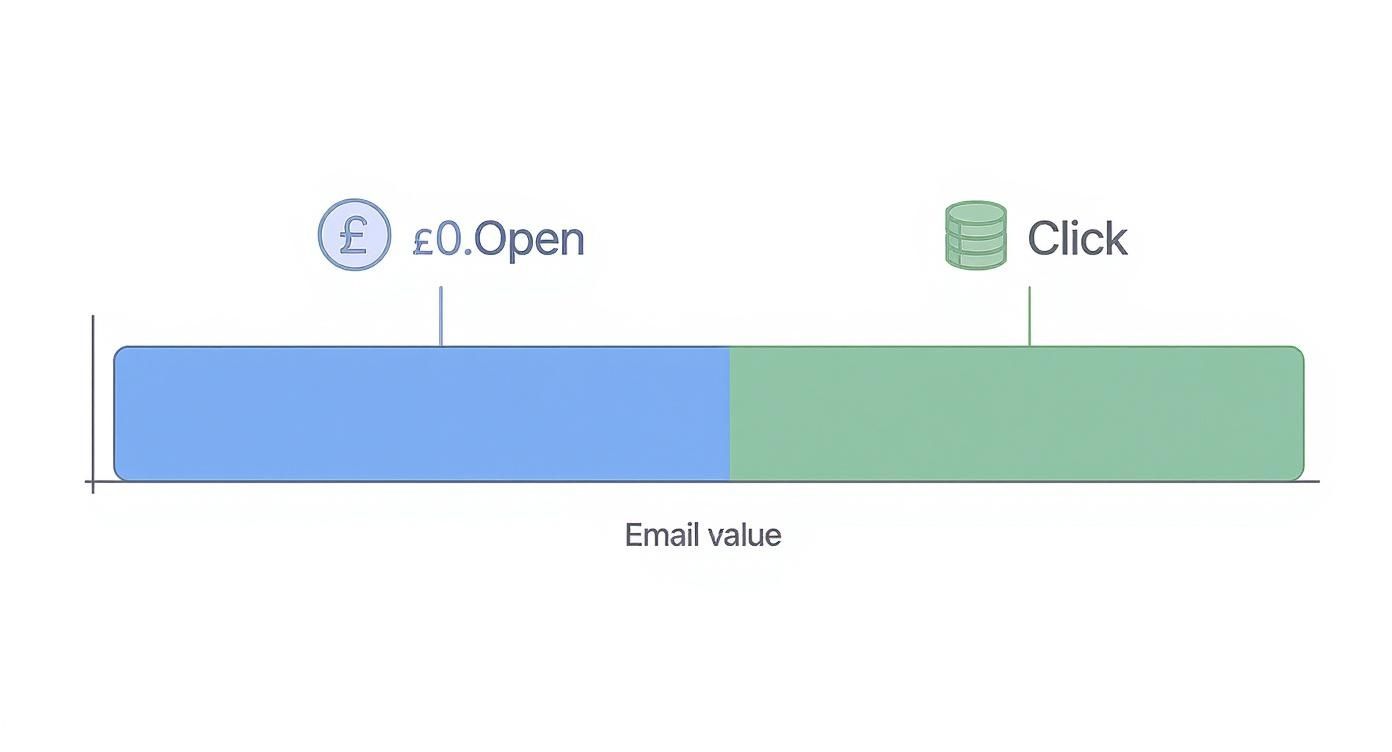
As you can see, a click is where the value is. This reinforces why optimising for CTR is so important for driving real, meaningful business outcomes.
To give you a clearer picture, here’s a look at some typical CTRs across the main marketing channels.
Typical UK Click Through Rate Benchmarks By Channel
This table offers a comparison of average CTRs across major digital marketing channels. Use it to benchmark your own campaign performance and get a feel for what "good" looks like in different contexts.
| Marketing Channel | Average UK CTR | Key Influencing Factors |
|---|---|---|
| Organic Search (SEO) | 2-10% (Varies by position) | Ranking position, title tag, meta description, brand recognition |
| Paid Search (PPC) | 2-5% | Ad copy, keyword relevance, Quality Score, ad extensions, offer |
| Email Marketing | 2.5-4% | Subject line, audience segmentation, CTA, content relevance |
| Social Media Ads | 0.9-1.5% | Creative, targeting, platform (e.g., Facebook vs. LinkedIn), ad format |
| Display Advertising | 0.10-0.50% | Creative design, ad placement, targeting, brand awareness |
Remember, these numbers are just averages. Your industry, audience, and the quality of your execution will all play a huge role in what you can achieve. The key is to understand the context of each channel and optimise accordingly, rather than chasing a single, universal CTR figure.
Diagnosing The Causes Of A Low Click Through Rate
A low Click-Through Rate isn't a dead end; think of it more like a diagnostic tool. It shines a light on a disconnect between what you're offering and what your audience actually wants to see, telling you exactly where your strategy needs a tweak. Getting to the root cause is the first step in turning poor performance into a powerful opportunity for growth.
Often, the problem starts with your messaging. If your meta descriptions in search results or your ad copy on social media are generic, vague, or just plain boring, people will simply scroll past. Your message has to resonate with a specific need or desire, compelling them to choose your link over all the others crowded onto the page.
In the same way, a weak or non-existent call-to-action (CTA) can absolutely cripple your CTR. You have to tell people what you want them to do next. Simple phrases like "Learn More," "Shop Now," or "Get Your Free Quote" provide clear direction and create a sense of purpose that encourages that all-important click.
Mismatched Targeting and Intent
One of the most common culprits behind a low CTR is a fundamental mismatch between your content and the audience seeing it. You might have crafted the most compelling ad in the world, but if you're showing it to people who have no interest in your product, your CTR will inevitably suffer. It's a classic case of casting your net far too wide.
This is especially obvious in display advertising. Click-through rates for display ads in the UK are notoriously low, hovering around a mere 0.10%. Research from IAB UK even highlights that for many campaigns, there’s no consistent link between clicks and sales, which suggests that impressions are often just reaching an indifferent audience. You can read the full analysis on display ad performance here.
The fix? You've got to refine your targeting. Dig into your analytics to understand who your best customers are, then build detailed audience profiles based on their demographics, interests, and online behaviour. The more precisely you can define your audience, the more relevant your messaging becomes, which leads directly to a much healthier CTR.
Poor Visibility and Ad Fatigue
Sometimes, the problem isn't what you're saying but where—or how often—it's being seen. In organic search, if your page is languishing on the second or third page of Google, your impressions might be high but your clicks will be minimal. A low ranking is a direct barrier to a good CTR.
Another factor to watch out for is ad fatigue. This happens when the same audience sees your advert over and over again until it just becomes background noise. The initial impact wears off, and people start to ignore it completely. This is a clear sign you need to refresh your creative, test new headlines, or pause the campaign to give your audience a break.
Keeping a close eye on these performance trends in your analytics is key. You might find that tracking these metrics is simpler with some of the top Google Analytics alternatives out there, which can offer a clearer view of what's really going on.
Actionable Strategies To Improve Your CTR

Knowing why your Click-Through Rate is low is one thing; actually fixing it is another beast entirely. Improving your CTR isn't about guesswork. It’s about applying proven tactics that are tailored to the specific channel you’re working on.
From the search results page to someone's inbox, even small, strategic changes can lead to a significant lift in engagement. This is where we move from diagnosis to action. Think of this as your practical toolkit for boosting performance, whether you're focused on organic search, paid ads, or email marketing.
Optimising For Organic Search Clicks
Your spot on the Google results page is your digital shop window. To get people to come inside, your title and description have to work together to create an offer that’s too good to ignore.
-
Write Compelling Meta Titles and Descriptions: Your meta title is the single most important factor for winning an organic click. It needs to answer the user's query directly while using emotional or power words to spark curiosity. The meta description then acts as a mini-advert, backing up the title's promise and ending with a clear call-to-action. We've got detailed guidance on this in our post about how to write meta descriptions that actually convert.
-
Leverage Structured Data (Schema Markup): Implementing schema markup is like giving Google a cheat sheet for understanding your page's content. Get it right, and you can be rewarded with rich snippets. These are the enhanced listings you see with star ratings, prices, or FAQs right there in the search results. They take up more space, draw the eye, and can seriously increase your visibility and clicks.
-
Target Long-Tail Keywords: Short, punchy keywords are almost always fiercely competitive. Long-tail keywords—those longer phrases of three or more words—are far more specific. This specificity means the searcher's intent is crystal clear. When you target these terms, you can create hyper-relevant content that perfectly matches what they're looking for, which naturally leads to a higher CTR.
Boosting Paid Advertising CTR
In the fast-paced world of PPC, a higher CTR is your reward for a job well done. It directly contributes to a better Quality Score, which means lower ad costs. That's why every single element of your ad needs to be fine-tuned for maximum impact.
A successful paid ad doesn't just appear relevant; it feels personal. By mirroring the user's language and directly addressing their needs, you create an immediate connection that makes clicking feel like the next logical step.
A non-negotiable technique here is running A/B tests on your ad copy. Create a couple of variations of an ad—maybe with different headlines or descriptions—and let them run at the same time. This data-driven approach takes the guesswork out of the equation and gives you hard evidence of which message truly connects with your audience.
And don't forget to use ad extensions. Things like sitelinks, callouts, and location extensions add extra, valuable information to your ad, making it physically larger and much more useful. This extra real estate not only improves visibility but gives users more reasons to click your ad instead of the one above or below it.
Elevating Email Marketing Engagement
Getting your email into someone's inbox is only half the battle. The real prize is earning that click. It's a tough environment, but the data shows it can be done. In the UK, email marketing CTR saw a notable jump from 1.84% in 2022 to 2.74% in 2023, partly thanks to smarter personalisation and targeting.
To get your own email CTR moving in the right direction, focus on these key areas:
- Personalise Subject Lines: This goes way beyond just using a subscriber's first name. Try referencing their past purchases, their location, or even their recent browsing behaviour to create a subject line that feels like it was written just for them.
- Segment Your Lists: Blasting the same email to your entire list is a recipe for low engagement. Break your audience down into smaller, more focused groups based on their interests or purchase history, and send them content that’s actually relevant.
- Design Unmissable CTAs: Your call-to-action button needs to be the hero of your email. Make it visually prominent with a contrasting colour and clear, action-oriented text. Ditch the generic "Click Here" for something specific and benefit-driven, like "Claim Your Discount" or "Read the Full Guide."
How To Measure And Analyse Your CTR Performance
You can't improve what you don't measure, and your Click-Through Rate is no exception. Before you can start boosting performance, you need a clear picture of where you stand. Luckily, a few powerful and free tools give you all the data you need to get started.
The number one tool for keeping an eye on your organic search CTR is Google Search Console (GSC). This platform is non-negotiable for any website owner, offering a direct look at how Google sees your site and how real people interact with it in the search results. It’s where you’ll find the raw data on impressions, clicks, and average CTR for your entire site, down to specific pages or individual search queries.
Finding Your Data In Google Search Console
To get started, just head over to the 'Performance' report in your GSC dashboard. You can toggle the "Average CTR" metric to overlay it on the graph, giving you an instant visual of how your click-throughs are trending over time.
This report shows you exactly how you're doing right there on Google's search results page.
By digging into this data, you can quickly spot pages with tons of impressions but a disappointingly low CTR. These are your prime candidates for optimisation.
Once you’ve found these underperformers, the real work begins. A low CTR isn't just a number; it's a story. It might be telling you about a boring meta title, a description that completely misses the user's intent, or a lack of eye-catching features like rich snippets.
Analysing CTR is less about hitting a single 'good' number and more about understanding the context. A 2% CTR might be fantastic for a highly competitive commercial keyword, but pretty poor for a branded search term where you should be dominating.
Analysing Trends And Segments
Beyond just looking at individual pages, it’s vital to slice up the data and analyse performance across different segments. GSC makes this easy by letting you filter your data by:
- Device: Compare your CTR on desktop versus mobile. If there’s a big drop-off on mobile, it could be a sign that your titles or descriptions are getting cut off or just aren’t compelling on smaller screens.
- Country: See how your performance changes from one place to another. This is crucial for businesses targeting specific regions in the UK, like London or Manchester.
- Queries: Pinpoint the exact search terms that are actually driving clicks. This helps you understand which keywords are truly hitting the mark with your audience.
This level of detailed analysis is what takes you from basic monitoring to smart, strategic optimisation. By understanding these nuances, you get a much clearer view of your overall on-page SEO success and can start making decisions backed by real data.
Got Questions About CTR? We've Got Answers
We've covered a lot of ground, from what click-through rate actually is to the nuts and bolts of improving it. But when you start applying these ideas, a few common questions always seem to pop up. Let's tackle them head-on.
What's a Good Click-Through Rate in the UK, Anyway?
Honestly, a ‘good’ CTR is a bit like asking "how long is a piece of string?" It really depends on the industry and the channel you're using.
For something like Google Ads, seeing a CTR around 2-5% is pretty standard. When it comes to UK email marketing, recent data puts the average at 2.74%. The best approach isn't to chase some universal magic number. Instead, benchmark against your own past performance and make steady, continuous improvement your goal.
Does CTR Really Affect My SEO Rankings?
This is a classic question. While Google has never come out and said CTR is a direct ranking factor, a high organic CTR sends a very strong signal. It tells the search engine that your page title and meta description are a perfect match for what people are searching for.
Think of it this way: search engines want to serve up the most helpful results. When users consistently click on your link over others, it’s a massive vote of confidence. This kind of positive user engagement can definitely influence your rankings indirectly.
Can a Really High CTR Ever Be a Bad Thing?
Surprisingly, yes. An unusually high CTR isn't always the win it seems to be, especially if it comes with a sky-high bounce rate on your landing page.
This combination usually points to a mismatch between what your ad promised and what your page delivered. You’re essentially paying for clicks from people who feel misled and leave immediately. That's why you should never look at CTR in a vacuum. Always analyse it alongside your conversion rates to get the full, honest picture.
Ready to turn those clicks into actual customers? At Bare Digital, our expert SEO services are all about boosting your rankings and driving traffic that genuinely matters.
Start with a free, no-strings-attached SEO Health Check and a tailored activity plan. Let's see what's possible.