
At its core, the Google algorithm is a massive, complex system of rules and signals that sorts through billions of webpages. Think of it as the ultimate librarian for the internet, whose only job is to find the most relevant and reliable source to answer your question. It's not one single programme, but a whole collection of processes all working together.
Understanding Google's Digital Librarian
So, what is this algorithm everyone talks about? It's the sophisticated system Google uses to find, understand, and rank content. Its primary goal is simple: deliver the best possible results for any search, ensuring a great experience that keeps people coming back. For any UK business, getting your head around this mission is the first step towards getting seen online.
Picture this: you type a question into Google. In mere seconds, the algorithm dives into its enormous digital library—an index holding trillions of webpages—and pulls out a neatly organised list of the most helpful answers. This isn't just about matching the words you typed; it's about figuring out your intent, the context of your search, and the quality of the pages it finds.
To really get how Google’s algorithm affects your business, you have to understand what Search Engine Optimization is. SEO is simply the practice of making your website a better, more authoritative answer in Google’s eyes by aligning it with the signals the algorithm cares about.
The Three Core Functions
At a high level, the algorithm's entire job boils down to three fundamental stages. Your website has to pass through each one to even have a chance of showing up in the search results.
-
Crawling: This is the discovery phase. Google sends out automated programmes, often called "crawlers" or "spiders," that constantly travel across the web. They follow links from one page to another to find new and updated content.
-
Indexing: Once a crawler discovers a page, Google analyses its content—the text, images, videos, and everything else—and stores this information in a gigantic database called the index. If your site isn't in the index, it's completely invisible to searchers.
-
Ranking: This is the magic moment. When someone searches for something, the algorithm springs into action. It sorts through all the relevant pages in its index, weighing hundreds of factors to decide which ones are the most helpful and trustworthy. The final output is the ranked list you see on the Search Engine Results Page (SERP).
Let's break that down with a quick analogy.
Google's Three Core Processes At A Glance
This table gives a quick summary of the fundamental stages Google uses to find, understand, and rank web content.
| Process | Purpose | Analogy |
|---|---|---|
| Crawling | To discover new and updated web content across the entire internet. | A librarian sending out scouts to find every new book being published. |
| Indexing | To analyse and store the content of discovered pages in a huge database. | The librarian reading each book and adding it to the library's catalogue. |
| Ranking | To sort indexed pages by relevance and authority for a specific query. | The librarian recommending the best books when someone asks a question. |
This process makes it clear why getting the basics right is so important for your business.
The ultimate aim of the Google algorithm is user satisfaction. Every update and adjustment is designed to better interpret what users want and provide answers that are not only relevant but also trustworthy and easy to access.
This three-step process—crawling, indexing, and ranking—is the backbone of how search works. For your business, this means your first job is making sure your site is easy for Google to crawl and index. Only then can you start focusing on the hundreds of ranking signals that will convince the algorithm your content is the best answer out there.
How Google Finds And Understands Your Website
Before your website can even dream of hitting the first page, Google has to know it exists. The whole process really boils down to two key steps: crawling and indexing. Get these wrong, and your site is basically invisible, no matter how fantastic your content is.
Think of the internet as a massive, ever-growing map of cities (websites) all connected by roads (links). To navigate this world, Google sends out automated explorers called crawlers or spiders. These little bots are constantly travelling the roads, following links from one page to the next to discover new destinations and check for any updates on old ones.
This discovery mission is what we call crawling. The spiders are on the job 24/7, tirelessly building and updating Google's map of the web.
The Digital Library Card Catalogue
Once a crawler lands on one of your pages, it does more than just note its existence. It analyses everything on it. This is the second crucial step: indexing. Google takes all the information it’s collected—text, images, videos, you name it—and files it away in a gigantic, searchable database.
It’s best to think of this index as a colossal library's card catalogue. Every single page on your website gets its own entry, detailing what it's about and how it connects to everything else. If your website isn't in this index, it simply cannot show up in search results. It’s like a book that never even made it onto the library shelf.
This visual guide neatly breaks down the three core functions that take your website from discovery to ranking.
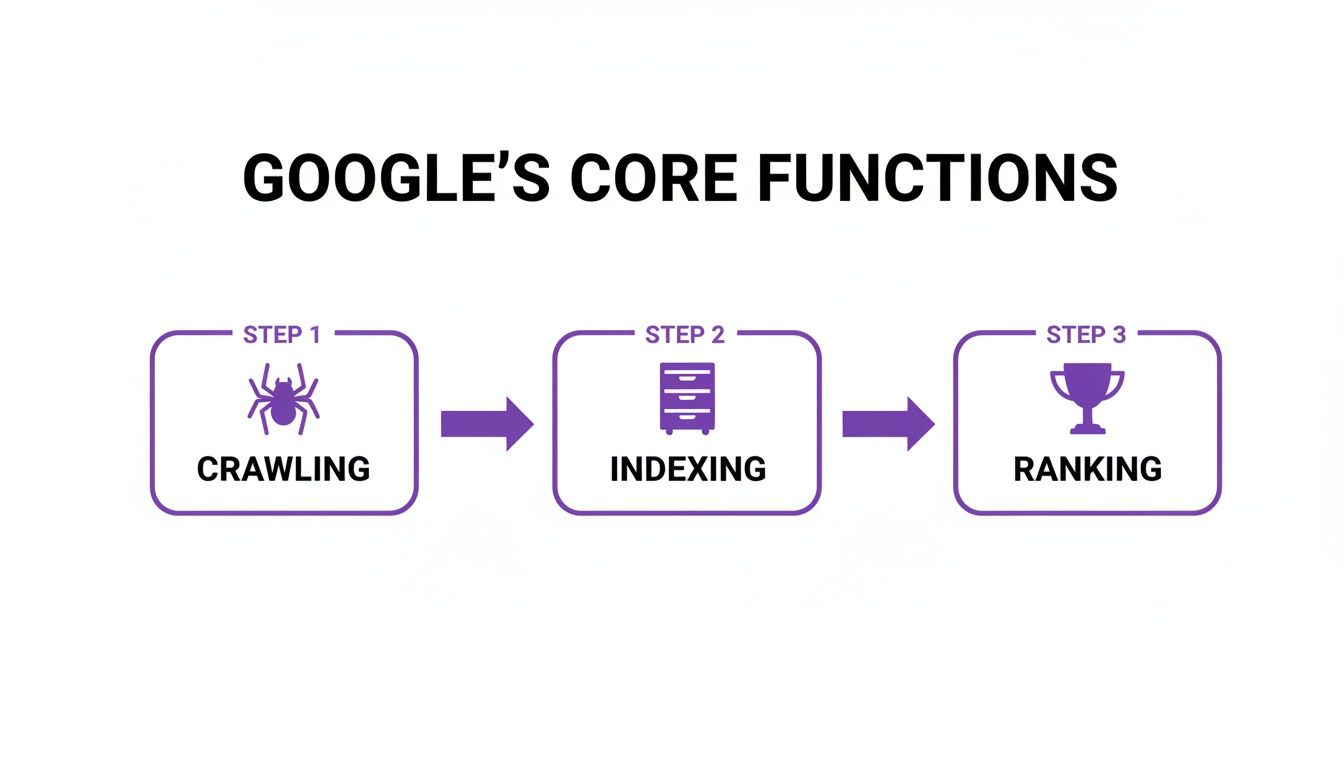
As the flow shows, crawling and indexing are non-negotiable prerequisites for ranking. One step has to follow the other.
It’s this incredibly systematic organisation that allows Google to sift through trillions of webpages in the blink of an eye when you type in a search. The quality of this indexing process has a direct impact on how well the algorithm can later match your content to what a user is looking for. You can dive deeper into the nuts and bolts in our complete guide on what search engine indexing is and how it all works.
Making It Easy For The Spiders
So, what does this mean for a business owner? It means your very first SEO priority is getting the technical stuff right. You need to make sure Google’s crawlers can find and read your website without any trouble. If they hit roadblocks like broken links or a confusing site layout, they might just give up and move on, leaving huge chunks of your site undiscovered and unindexed.
Here are the key things that help the crawlers do their job:
- XML Sitemaps: This is a file that lists all the important pages on your website, basically acting as a direct roadmap for the crawlers. Submitting it via Google Search Console is like handing Google a map and saying, "Here’s everything I want you to find."
- Logical Site Structure: An organised website with clear navigation doesn't just help your visitors; it helps crawlers understand how your content is structured. Pages should be grouped and linked in a way that makes sense, creating clear pathways for the spiders to follow.
- Internal Linking: Linking between relevant pages on your own site guides users to more content, but just as importantly, it helps crawlers navigate your website. This distributes authority and shows Google how different topics on your site are related.
Without effective crawling and indexing, even the most valuable content remains hidden. Technical optimisation is not an optional extra; it is the foundation upon which all other SEO efforts are built.
At the end of the day, a technically sound website is what allows the Google algorithm to work its magic. By making sure your site is accessible and easy for Google to interpret, you're removing the biggest initial barriers to visibility. Think of it as the handshake that starts the entire conversation.
The Core Ranking Factors For UK Businesses
Once Google has crawled and indexed your site, the real work begins. Your pages are now in the running, but to climb the rankings, the algorithm needs to see that you’re the best answer out there. It sifts through hundreds of signals to make this call, but for businesses here in the UK, it really boils down to four critical areas.
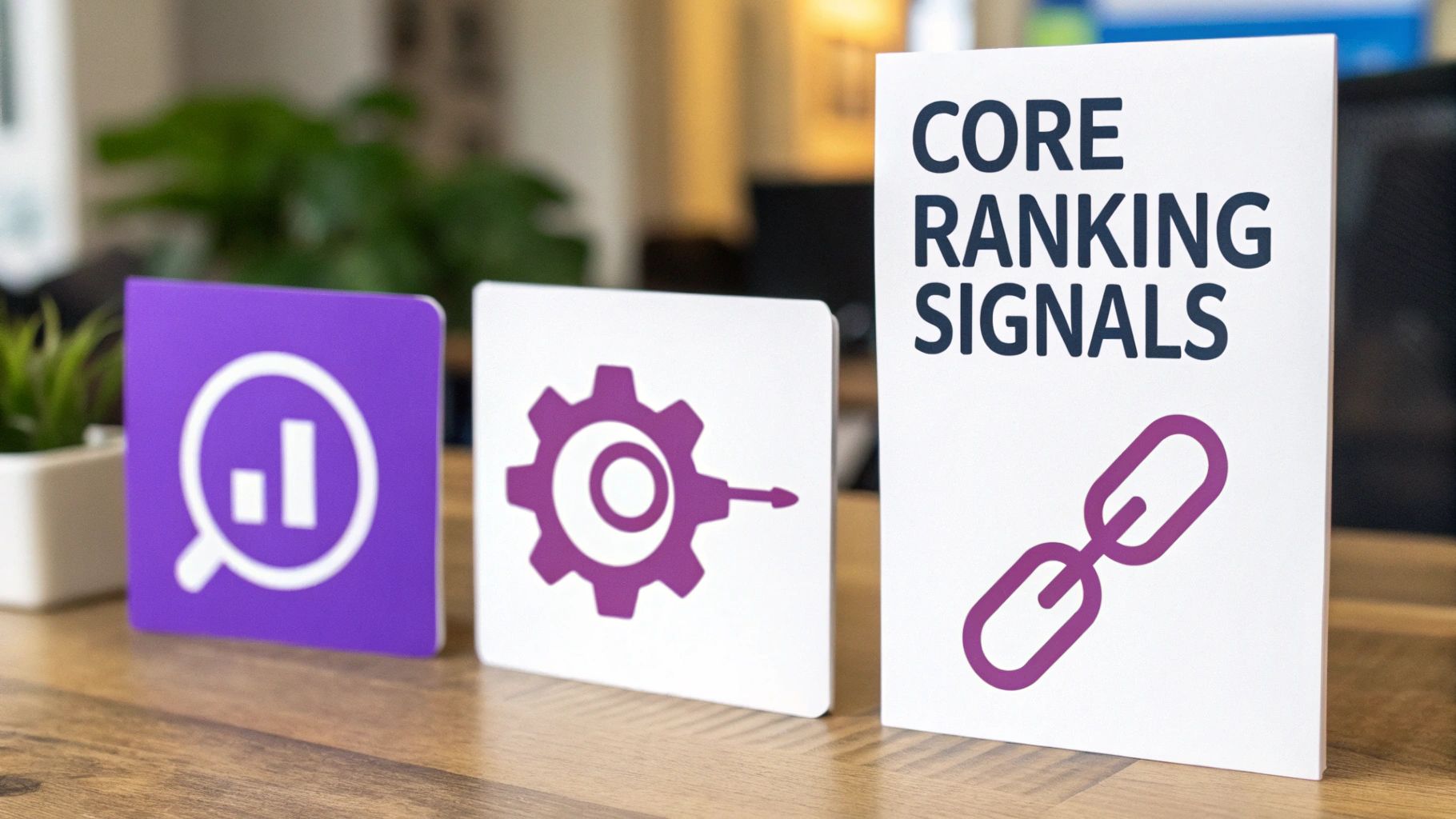
Nailing your SEO strategy isn't about finding some secret hack. It’s about building a solid, trustworthy presence that tells the algorithm you’re the real deal. Getting these four pillars right is your first step.
Content Quality The Foundation Of E-E-A-T
Everything starts with your content. Google’s algorithm is laser-focused on quality, and it uses a framework called E-E-A-T to figure out how helpful your content really is. This stands for Experience, Expertise, Authoritativeness, and Trustworthiness.
Think of E-E-A-T not as a direct ranking factor, but as a concept that shapes how the algorithm sees you.
- Experience: Have you actually done what you’re talking about? A plumber’s guide to fixing a leaky tap, written from years on the job, will always beat an article from a generic content writer. It shows first-hand knowledge.
- Expertise: Are you a genuine expert in your field? This is non-negotiable for topics that require deep, specialised knowledge, like financial or medical advice.
- Authoritativeness: Is your business seen as a go-to name in your industry? Getting mentioned or linked to by other respected sites helps build this up.
- Trustworthiness: Can people trust you? Things like having clear contact details, a secure website (HTTPS), and transparent business policies all build trust.
For any UK business, the takeaway is simple: create content that genuinely solves your customers' problems, backed by your real-world experience in the local market.
On-Page SEO Optimising Your Content
Great content is one thing, but you also have to make it easy for Google to understand. That’s where on-page SEO comes in. It’s all about optimising individual pages so the algorithm knows exactly what they’re about.
Here are the key bits to get right:
- Keyword Research: Find out the actual words and phrases your UK customers are typing into Google.
- Title Tags and Meta Descriptions: Write punchy, compelling titles and summaries for the search results page. Make them relevant.
- Header Tags (H1, H2, H3): Use headers to give your content a clear, logical structure. This helps both your readers and search engines follow along.
- Image Optimisation: Give your images descriptive filenames and alt text. It’s another clue for Google to understand the context of your page.
Good on-page SEO is like framing a beautiful picture. It makes sure your high-quality content is presented perfectly for the algorithm to see its value.
Technical SEO A Healthy Foundation
Technical SEO is the engine room of your website. If your site has technical gremlins, it doesn’t matter how good your content is—Google will struggle to crawl, index, and rank it properly.
Think of technical SEO as the plumbing and wiring of your digital property. If it's faulty, everything else suffers. A fast, secure, and mobile-friendly website provides the seamless experience that both users and Google demand.
These technical signals are absolutely essential:
- Site Speed: Page load time is a massive factor for user experience. One study showed that just a one-second delay in mobile load times can slash conversion rates by up to 20%.
- Mobile-Friendliness: Most searches happen on mobile now, so your site absolutely must look and work great on any screen.
- Site Security (HTTPS): A secure site is a must-have. It protects your users’ data and is a confirmed (though small) ranking signal.
Getting these right gives your content the solid, accessible foundation it needs to perform.
Off-Page SEO Building Your Reputation
Off-page SEO covers all the things you do away from your own website to boost your rankings. By far the biggest piece of this puzzle is backlinks—links pointing to your site from other websites.
The Google algorithm sees a quality backlink as a vote of confidence. When another credible website links to you, it signals that your content is valuable and trustworthy. But quality is everything. A link from an industry authority like the BBC is worth far more than one from a brand-new, unknown blog.
This web of links helps Google piece together a picture of your site's authority in its niche. If you want to get a better handle on this, our guide explains what Domain Authority is and why it's a metric worth watching. To fully grasp how Google's algorithm evaluates your website's network, it's beneficial to gain a deeper understanding referring domains and their function. Ultimately, it’s the quality of these "votes," not just the quantity, that builds a powerful online reputation.
The Evolution Of Google's Search Algorithm
Google’s search algorithm isn’t some fixed rulebook gathering dust on a shelf. It’s a living, breathing system that has changed almost beyond recognition over the years. What started as a fairly basic tool for matching keywords has become a deeply intelligent system that’s obsessed with understanding what you really mean when you search.
This constant evolution is precisely why SEO is never a “set it and forget it” job.
In the early days of search, winning was often a numbers game. SEO tactics were crude, to say the least, usually involving stuffing pages with as many keywords as possible or buying hundreds of cheap, dodgy links from spammy websites. The algorithm was much easier to game, and the person searching often paid the price with terrible results.
Google knew this was a massive problem. To hang onto its crown as the world's most trusted search engine, it had to get much better at filtering out the junk and promoting genuinely useful content. This sparked a series of landmark algorithm updates, each designed to penalise manipulative tactics and reward sites that put real human beings first.
The Rise Of Quality Content And Links
Two of the most famous updates completely rewrote the rules of the game. First came the Panda update in 2011, which took aim at low-quality content. It penalised websites with thin, duplicated, or unhelpful pages, instantly rewarding sites that had invested in well-researched, original material. All of a sudden, content quality wasn’t just a nice-to-have; it was a matter of survival.
Then, the Penguin update landed in 2012 to clean up the web’s messy link profiles. It specifically targeted sites that had built their authority using spammy, irrelevant, or paid links. This forced a huge shift in the industry, making SEOs focus not just on getting any link, but on earning high-quality, relevant links from trusted sources—a principle that still sits at the heart of good SEO today.
These updates were a clear signal of intent. Google was moving beyond simple, easy-to-fake signals and getting much smarter about what quality actually looks like. A clear and consistent theme was emerging in how Google was refining its approach.
To help you keep track, here's a quick rundown of some of the most significant updates and what they mean for your strategy.
Key Google Algorithm Updates And Their Focus
| Update Name | Primary Focus | Impact on SEO Strategy |
|---|---|---|
| Panda (2011) | Content Quality | Punished thin, duplicate, and low-value content. Made high-quality, original content non-negotiable. |
| Penguin (2012) | Link Quality & Spam | Penalised manipulative link-building. Shifted focus to earning natural, high-authority backlinks. |
| Pigeon (2014) | Local Search Results | Better integrated local search signals with the core algorithm. Boosted the importance of local SEO. |
| BERT (2019) | Search Query Context | Improved understanding of natural language and user intent. Rewarded content that answered questions thoroughly. |
Each of these updates pushed SEOs to think more about the user and less about simply trying to trick the system.
The history of Google’s algorithm is a story of moving from an engine that understood words to an engine that understands intent. Each major update has been a step towards penalising manipulation and rewarding genuine user value.
This evolution is why sustainable, 'white-hat' SEO practices—those that play by Google's rules—are the only way to build a lasting presence. The shortcuts that try to trick the algorithm are eventually sniffed out and penalised. You can dive deeper into the specifics of these changes in our comprehensive list of Google search algorithm updates.
Understanding Intent And Local Relevance
More recently, the algorithm has become incredibly sophisticated in understanding the subtleties of human language. The BERT update in 2019 was a huge leap forward, allowing Google to grasp the context of words in a search query, much like a person would. This means it can serve up far better results for conversational or complex questions, rewarding content that answers queries naturally and completely.
For UK businesses, one of the most transformative developments was the Pigeon update. This update was crucial because an enormous share of local customers now start their buying journey online. In fact, Ofcom’s 2023 report revealed that 93% of UK internet users rely on search engines, where Google completely dominates the market. When Pigeon landed in the UK in late 2014, it tightened the connection between core ranking signals and local search results. This meant factors like your proximity to the searcher, your site's authority, and on-page optimisation became far more important for showing up in local searches and on Google Maps.
This constant refinement means that the Google algorithm of today values authenticity, expertise, and a fantastic user experience above all else.
How To Align Your Website With The Modern Algorithm
Understanding how Google’s algorithm thinks is one thing, but putting that knowledge into practice is what actually drives results. Aligning your site with today’s algorithm isn't about chasing secret formulas. It's about systematically showing Google that your website offers the best possible experience for your target audience.
This means leaving old-school tactics behind and embracing a user-centric approach. From the content you write to your site’s technical health, every single element should be geared towards helping, informing, and satisfying the people searching for what you offer.

Create Content That Genuinely Helps
Helpful content is the foundation of any SEO strategy that works today. The modern algorithm is incredibly good at telling the difference between a page that thoroughly answers someone’s question and one that just scratches the surface.
To get it right, you need to think like your customer. What are their biggest questions? What problems are they trying to solve? Your content needs to tackle these points head-on with clear, practical, and authoritative information.
Here are a few ways to create content that puts the user first:
- Answer Questions Directly: Structure your pages to answer the "who, what, where, why, and how" of your topic. This usually means creating detailed service pages, in-depth blog posts, and comprehensive FAQ sections.
- Go Beyond the Obvious: Don't just say what you do; explain how it benefits the customer. Use real-world examples, case studies, and testimonials to add depth and build trust.
- Write for Humans, Not Robots: Your writing should feel natural and be easy to read. Ditch the jargon and focus on clear, straightforward language that speaks directly to your UK audience.
Google’s algorithm has steadily evolved here in the UK to better understand natural language and user intent. A huge shift was the October 2019 BERT update, which impacted about 10% of English-language searches, including ours. BERT helps Google grasp the context of words in a search, rather than just matching keywords. This means old tactics like keyword stuffing are dead in the water; instead, pages that naturally answer specific questions in clear English perform much better.
Prioritise The Mobile Experience
With most searches now happening on mobile devices, Google has switched to mobile-first indexing. In simple terms, this means Google primarily looks at the mobile version of your site for indexing and ranking.
A clunky mobile experience is a massive red flag for the algorithm. If your site is a pain to navigate, slow to load, or has text that’s too small to read on a phone, your rankings are going to suffer. Period.
A seamless mobile experience is no longer an optional extra; it is a fundamental requirement for search visibility. If your site doesn't work perfectly on a phone, you're actively telling the algorithm that you're not prioritising the majority of users.
Master Your Local SEO Signals
For any business serving a specific area, like those in Cambridgeshire, local SEO is everything. The algorithm uses a unique set of signals to rank businesses for searches like "plumber near me" or "best cafe in Cambridge."
Your Google Business Profile (GBP) is the absolute cornerstone of your local presence. A complete, accurate, and well-managed GBP is one of the most powerful signals you can send to Google.
Essential GBP Optimisation Steps:
- Claim and Verify Your Listing: This is the first and most critical step. Don't skip it.
- Ensure NAP Consistency: Your Name, Address, and Phone number must be identical everywhere—on your website, in directories, everywhere.
- Choose Accurate Categories: Select the primary and secondary categories that best describe your business.
- Gather Customer Reviews: Actively encourage happy customers to leave reviews. They are a massive trust signal.
- Use Posts and Q&A: Regularly share updates, offers, and answer questions on your profile to show Google you're active and engaged.
Build A Clean And Authoritative Backlink Profile
Backlinks are still a powerful signal of authority. Think of them as votes of confidence from other websites. But the algorithm is incredibly discerning now—it values quality far more than quantity.
Your focus should be on earning links from relevant and reputable sources within your industry or local community. A single link from a respected local news site or an industry blog carries far more weight than dozens of links from low-quality directories.
Effective link-building is a long-term game that requires patience and strategy, but it’s vital for building the trust that Google's algorithm rewards. Of course, none of this works without a solid technical foundation. You can dive deeper into this in our guide explaining what is technical SEO.
Got Questions About the Google Algorithm? We’ve Got Answers.
Trying to keep up with Google can feel like you're chasing a moving target. To cut through the noise, we've rounded up the most common questions we hear from business owners just like you about how the algorithm really works.
Think of this as your go-to guide for busting myths and getting straight answers on what actually moves the needle for your website.
How Often Does The Google Algorithm Change?
All the time. Seriously. Google makes thousands of tiny tweaks every single year, most of which fly completely under the radar. But a few times a year, they roll out a big one—a "core update"—and those are the ones that can really shake up search rankings.
But here’s the secret: you don’t need to panic about every little change. Your energy is much better spent on the fundamentals that never go out of style, like creating genuinely helpful content and making sure your website is a pleasure to use.
These have always been Google's top priorities. A site built on that solid foundation can weather almost any storm, making it far more resilient to the algorithm's inevitable shifts.
Can I Pay Google To Improve My Organic Ranking?
Nope. You absolutely cannot pay Google for a better spot in the organic search results. This is probably one of the biggest myths in SEO, and it’s vital to know the difference between paid and organic traffic.
Organic rankings have to be earned. They’re decided by the algorithm's deep analysis of your website's quality, relevance, and authority. This is a completely separate world from Google Ads, the auction-based system for the paid ads you see at the very top of the page.
While a Google Ads campaign is a fantastic tool for getting immediate visibility and driving traffic, it has zero direct impact on your organic SEO. Earning those top organic spots is a long-term game of quality, strategy, and patience.
Why Did My Website Traffic Suddenly Drop?
A sudden nosedive in your website traffic is always scary, but there’s almost always a logical reason behind it. A common culprit is a recent Google core update, especially if your site was leaning on outdated tactics or had quality issues the update was designed to penalise.
But it's not always a Google update. Other potential causes include:
- A new technical glitch: Something as simple as a mistake in your
robots.txtfile could be accidentally telling Google's crawlers to ignore your site, making your pages disappear. - The competition stepped up: A competitor might have just seriously upped their SEO game, knocking you down the rankings for keywords that matter.
- It’s just the season: For many businesses, search interest rises and falls with the seasons. That drop could just be a normal part of the annual cycle for your products or services.
The first thing you should do is check for news about recent Google updates, then log into your Google Search Console account. Look for any manual penalties or crawl errors. From there, a full SEO audit is the best way to pinpoint the exact problem and map out a recovery plan.
At Bare Digital, we make it our business to demystify the Google algorithm for businesses across Cambridgeshire. Our data-led SEO services are built to create a sustainable online presence that weathers algorithm updates and delivers real, measurable growth. If you’re ready to see your rankings climb and your traffic increase, request your free, no-obligation SEO Health Check today. Get your custom SEO proposal from Bare Digital.