

What Exactly Is Local Search Optimisation?
So, what is local search optimisation all about?
Think of it this way: your business is a shop on a bustling high street. Local SEO is the digital equivalent of making sure your shop has the brightest sign, the most welcoming entrance, and glowing recommendations from everyone who walks by. It’s the art and science of getting your business in front of local customers right when they’re searching for you online.
This process involves a specific set of strategies designed to boost your visibility for geographically-related searches. We’re talking about all those “near me” or “[service] in [city]” queries that signal someone is ready to buy, book, or visit. The goal is simple: when someone in your area needs what you sell, you’re the first and best answer they find.
Connecting With Local Customers Online
The impact here is huge. A staggering 46% of all Google searches are for local information, meaning nearly half of all users are looking for something in their immediate area. By focusing on local optimisation, you’re tapping directly into this massive pool of motivated buyers.
Local search optimisation is a cornerstone of successfully building an online presence for small business, enabling companies to connect with nearby customers who are actively searching for their services.
Unlike broader SEO which might target a national or even global audience, local SEO is intensely focused on your community. It helps you stand out against larger, non-local competitors by playing to your strengths—your physical presence. We dive deeper into these key differences in our guide to local SEO vs national SEO.
Ultimately, it's about making sure you’re the go-to choice for customers right on your doorstep.
Why Local SEO Is a Game-Changer for UK Businesses
Knowing what local SEO is one thing, but truly understanding its direct impact on your bottom line? That’s where things get interesting. For businesses across the UK, this isn't some fluffy marketing concept; it’s a direct line to more phone calls, more customers walking through the door, and a healthier cash flow. It’s about becoming the go-to, obvious choice for people right in your neighbourhood.
Think about it. A tourist in Brighton fancies a cream tea and searches for “best scones near me.” A strong local SEO presence puts your bakery at the very top of their screen, turning a quick search into an immediate sale. Or picture this: a homeowner in Manchester wakes up to a burst pipe. They aren’t leisurely browsing websites; they’re frantically Googling an emergency plumber. Local optimisation puts your number right under their nose when they need it most.
Levelling the Playing Field
One of the best things about local SEO is how it empowers independent businesses. It really does level the playing field, giving a small, family-run shop a fighting chance to outrank a massive national chain within its own postcode. Google’s local algorithm is smart—it cares more about relevance and proximity than it does about a huge marketing budget. This gives local experts a genuine opportunity to win.
This focus on local relevance is exactly what you need to connect with your community. People genuinely want to support local businesses, and seeing you pop up in their search results reinforces that you’re a trusted part of the neighbourhood. The upsides are huge and can fundamentally change your growth. You can dive deeper into the specific benefits of local SEO in our detailed guide.
Connecting Optimisation to Business Outcomes
The numbers back this up, loud and clear. Around 64% of UK small businesses are already using local SEO in some form because they know it’s vital for attracting new customers. And consumer habits confirm it—a staggering 21% of people search for a nearby business every single day, with another 32% doing so several times a week. That’s a constant stream of people with money to spend, looking for someone local.
Ultimately, a focused local SEO strategy transforms your online visibility into measurable, real-world success. It's the bridge between a potential customer's need and your business's solution.
It’s all about getting your business seen and, ultimately, getting you fully booked. In fact, exploring strategies for getting fully booked online shows just how powerful this approach can be for maximising your customer base. Every optimised profile, every glowing review, and every local mention all work together to make your phone ring and keep your door swinging.
The Three Pillars of Local Search Success
To really get your head around what local search optimisation involves, it helps to break it down into its core parts. A solid local strategy is built on three distinct but interconnected pillars.
Get these right, and you’ll create a powerful foundation for pulling in nearby customers and driving real growth. Each pillar sends vital signals to Google, proving your business is a relevant and trustworthy choice for people searching in your area.
This structured approach is what turns online visibility into phone calls, shop visits, and sales.
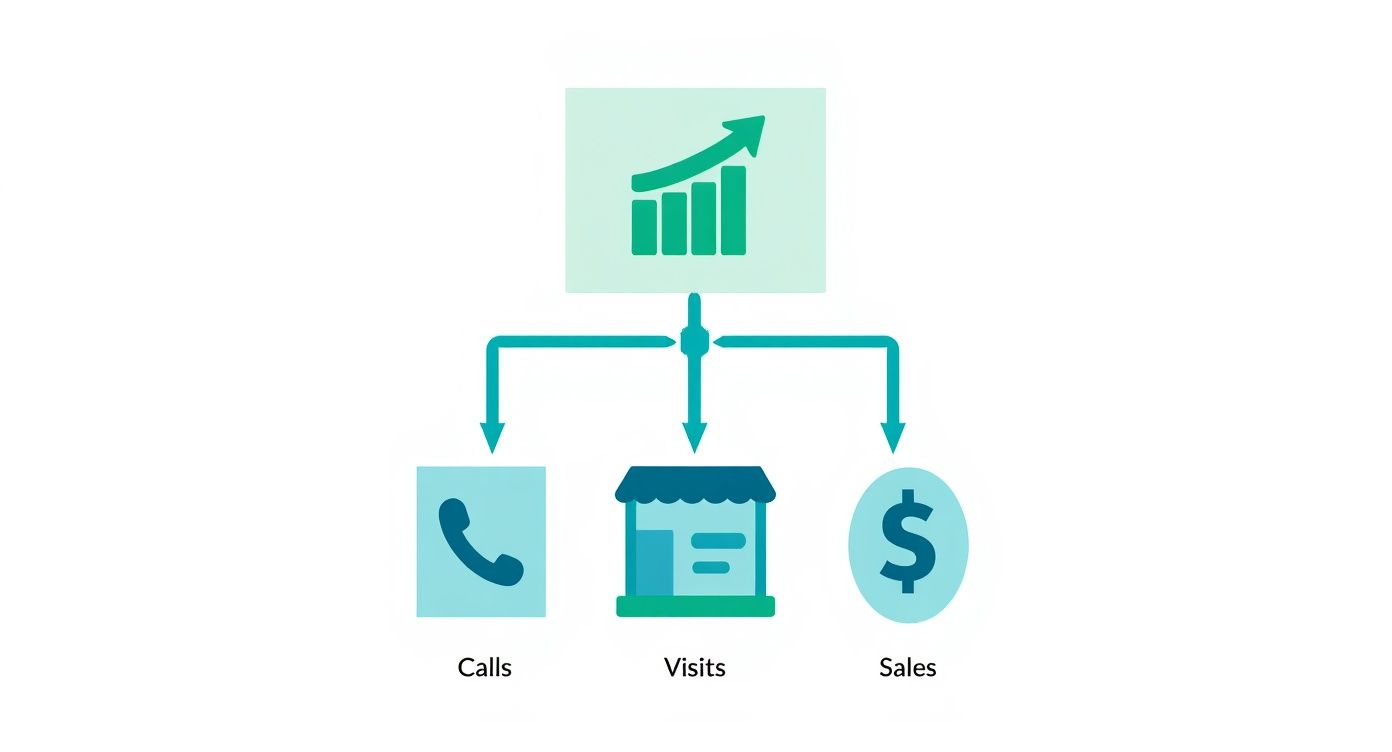
As you can see, a successful local SEO strategy feeds directly into the metrics that matter most for business growth, simply by making you easier to find.
1. Google Business Profile: Your Digital Front Door
Your Google Business Profile (GBP) is the single most important piece of the local search puzzle. Think of it as your digital shopfront—it’s often the very first interaction a potential customer has with your business online.
This profile is what feeds the Google Map Pack, that prime bit of real estate at the top of local search results.
A fully optimised profile acts as a powerful snapshot of who you are, what you do, and why customers should pick you. This includes:
- Complete and Accurate Information: Making sure your business name, address, phone number, and opening hours are spot-on. No typos, no old information.
- Engaging Visuals: Adding high-quality photos of your premises, your team, and your work. This builds trust and shows you’re a real, authentic business.
- Customer Reviews: Actively encouraging and responding to customer reviews is huge. It builds social proof and is a major ranking factor.
Getting this right isn’t optional. For a deep dive, our complete guide to Google Business Profile optimisation covers every detail you'll need.
2. On-Page Signals: Your Website’s Local Relevance
Next up, your website itself needs to scream "local". On-page signals are all the clues you leave for search engines within your site's content and code that confirm where you operate and what you offer there.
Without these signals, Google might struggle to understand your geographic relevance, even if it seems obvious to you.
An optimised website tells a clear story to both users and search engines. It says, "We are experts in this service, and we are based right here in your community."
Key on-page actions include creating dedicated location pages if you serve multiple areas, embedding a Google Map, and weaving local keywords naturally into your page titles, headings, and body text. It’s all about making your local identity impossible for search engines to miss.
3. Off-Page Authority: Your Digital Reputation
The final pillar is your off-page authority, which is basically your digital reputation across the wider web. This is built through links and mentions from other reputable, locally relevant websites. Google sees these as votes of confidence in your business.
A massive part of this is building local citations. These are simply mentions of your business's Name, Address, and Phone number (known as NAP) in trusted online directories. Consistency is everything here.
With over 65% of local UK searches now happening on mobile, ensuring your details are identical across influential directories like Yell, Thomson Local, and Checkatrade is vital. It builds the trust signals that search engines depend on to rank you.
How Google Ranks Local Businesses
Ever wondered how Google picks the winner for that top spot in local search? It’s not a lottery. It's a smart algorithm that weighs up a few key signals to figure out which business is the most helpful and trustworthy answer for someone’s search. If you want to get what local search optimisation is all about, you first need to get inside Google's head.
The whole process really comes down to three core ideas: Proximity, Relevance, and Prominence. Think of them like a three-legged stool. If one leg is wobbly, the entire thing is unstable. But when you get all three right, you’re giving Google exactly what it’s looking for.
When someone types in "best fish and chips in Cambridge," Google’s algorithm kicks into gear, running through a quick checklist based on these three pillars to serve up the best possible results.
The Power of Proximity
Proximity is the most obvious factor: how close is your business to the person searching? If someone’s standing in the middle of Bristol and searches for a “coffee shop near me,” Google is naturally going to show them cafes they can actually walk to, not ones on the other side of town.
Now, you can't just pick up your shop and move it. But what you can do is make sure Google knows exactly where you are. This is why having a precise, verified address on your Google Business Profile and consistent location details across the web is absolutely non-negotiable. It’s the very foundation of your local visibility.
Making Your Business Relevant
Relevance is all about how well your business matches what someone is looking for. Google digs into the information on your Google Business Profile and your website to decide if you’re a good fit for what was searched.
For instance, if the search is for an "emergency plumber," Google scans for businesses that list "Plumber" or "Emergency Plumbing Services" as their main category. It also checks that these services are mentioned clearly on their website. The more specific you are, the more confident Google can be in sending searchers your way.
Google’s job is to give the most accurate answer to someone’s question. Your job is to give Google all the proof it needs to see that your business is that answer.
Building Your Digital Prominence
Prominence is basically your business’s online reputation. How well-known and respected are you on the web? Google figures this out by looking at signals from all over the internet.
This includes things like:
- Customer Reviews: The number of reviews you have, how good they are, and how often you get new ones all send powerful trust signals.
- Backlinks: When other respected local websites link to you—think the local paper or a business association—it’s like a vote of confidence in your favour.
- Citations: Mentions of your business name, address, and phone number (NAP) in reputable online directories like Yell help build up your authority.
Prominence isn’t built overnight; it’s earned through consistent effort and great service. For a much deeper look, you can explore the key local search ranking factors that all feed into your online authority. A business with strong prominence is seen as a reliable, established player in its local market, and Google rewards that.
Key Local Ranking Factors Compared
To help you prioritise your efforts, it helps to see how these three core pillars stack up against each other. Each one plays a distinct role, but they work together to build a complete picture of your business for Google.
| Ranking Factor | What It Measures | How to Improve It |
|---|---|---|
| Proximity | Your physical distance from the searcher. | Verify your address on Google Business Profile; ensure consistent location data online. |
| Relevance | How well your business matches the search query. | Choose accurate business categories; use relevant keywords on your website and GBP. |
| Prominence | Your business's online authority and reputation. | Actively seek customer reviews; build local backlinks; create consistent directory listings. |
While you have the least control over proximity, you have complete control over your relevance and can actively build your prominence over time. Focusing on what you can influence is the key to climbing the local rankings.
Your Practical Local SEO Audit Checklist
Right, enough theory. It's time to get your hands dirty.
Knowing the 'what' and 'why' of local search is a great start, but real progress comes from knowing exactly where you stand today. This checklist is your starting point—a straightforward way to audit your local presence without needing a degree in computer science.
Think of it as a quick health check for your digital shopfront. By answering a few simple but vital questions, you'll uncover your biggest wins and the most urgent gaps to fix. It’s the first step to building a to-do list that will actually make a difference.
Your Google Business Profile Health Check
Your Google Business Profile (GBP) is the most critical asset you have in the local search game. If you want to show up in that coveted Google Map Pack, a complete and active profile isn't just a nice-to-have; it's non-negotiable.
- Is your profile 100% complete? Go through every single field. We’re talking services, business description, opening hours, and all those little attributes like "wheelchair accessible." Any gaps make Google less confident about showing your business to potential customers.
- Are your business categories spot on? Don't just settle for "Restaurant." If you're an "Italian Restaurant" or a "Fish and Chip Shop," say so. The more specific you are, the better Google can match you to people searching for exactly what you offer.
- Do you have recent, high-quality photos? You should aim for at least 10 photos. Get shots of your exterior, interior, your team, and your products or services in action. Profiles with more photos get 42% more requests for directions. It’s a no-brainer.
On-Site and Off-Site Consistency Audit
Next up, let's look at how your business information appears on your website and across the rest of the web. Consistency is everything when it comes to building trust with search engines.
Any inconsistency in your business name, address, or phone number across different platforms is a massive red flag for Google. It just creates confusion and chips away at your authority.
Run through this quick check to see if you have any issues:
- Is your NAP (Name, Address, Phone number) identical everywhere? And I mean identical. Check your website's footer, your contact page, your GBP, and key UK directories like Yell. Even a tiny difference like "St." versus "Street" can cause headaches.
- Does your website clearly signal your service area? Your homepage should proudly mention your main town or city. If you serve multiple areas, think about creating dedicated location pages to target each one properly.
- Are you actively managing your reviews? A steady stream of new, positive reviews is gold. But just as important is responding to all of them—good and bad. It shows you're engaged and you value what your customers have to say. This is a huge piece of the puzzle for building prominence.
How to Measure Local SEO Success
All your local optimisation efforts are only as good as the results they generate. But how do you actually know if your strategy is working? Tracking success means looking past vanity metrics and homing in on the Key Performance Indicators (KPIs) that actually translate into business growth.
This isn't about chasing rankings for the sake of it. It's about measuring real-world actions from potential customers. You need to know if your improved visibility is making your phone ring, getting people through the door, and building a stronger local reputation. These are the tangible outcomes that prove your local SEO is paying off.
Key Performance Indicators That Matter
To get a clear picture of your performance, the first place to look is your Google Business Profile Insights. This free tool is packed with data showing you exactly how people are interacting with your profile.
Here are the essential KPIs to keep an eye on:
- Phone Call Clicks: This one is straightforward—it tracks how many users hit the "call" button right from your profile. It's a direct signal of immediate customer interest.
- Website Clicks: This shows how many people clicked through to your website from your GBP. It’s a crucial step in the customer journey, telling you they want more detailed information before making a decision.
- Direction Requests: This metric counts how many users asked for directions to your physical location. It’s one of the strongest indicators of genuine intent to visit and a great predictor of footfall.
- Search Queries: Here you can see the exact terms people used to find your business. This is gold for understanding customer needs and fine-tuning your keyword strategy.
Your 90-Day Action Plan for Growth
Tracking data is useless without a plan to act on it. This simple 90-day roadmap will help you implement, measure, and refine your strategy for sustained local growth.
A great local SEO strategy is a cycle of action, measurement, and refinement. Start with the foundations, track the impact, and then double down on what works.
Month 1: Foundation and Optimisation
- Week 1-2: Complete a full audit of your Google Business Profile. Fill in every single section, upload at least 10 high-quality photos, and make sure your core business information is perfect.
- Week 3-4: Start actively asking recent happy customers for reviews. Aim to get at least five new, positive reviews to build that initial momentum.
Month 2: Content and Engagement
- Week 5-8: Get into the habit of using Google Posts. Post weekly updates about offers, events, or new products. This keeps your profile active and shows Google (and customers) that you’re open and engaged.
Month 3: Review and Refine
- Week 9-12: Dive into your GBP Insights. Compare your call, direction, and website clicks to where you started on day one. Pinpoint which search queries are bringing in the most traffic and start creating content that leans into those topics.
Your Local SEO Questions Answered
To wrap things up, let's tackle a few of the most common questions we hear from UK business owners. Think of this as a quick-fire round to clear up any lingering doubts before you dive in.
How Long Does Local SEO Take to Work?
It's the million-pound question, isn't it? While some tweaks can bring surprisingly quick wins—like fully fleshing out your Google Business Profile, which can show results in just a few weeks—real, sustainable local SEO is a marathon, not a sprint.
You should start seeing a noticeable uptick in visibility and leads within three to six months. But building genuine local authority, the kind that makes you the go-to choice in your area, comes from consistent, long-term effort.
Can I Do Local SEO Myself?
Absolutely. Many of the foundational tasks are perfect for a hands-on business owner. Claiming your Google profile, encouraging and responding to reviews, and making sure your business details are spot-on across the web are all great first steps you can take yourself.
But as you start aiming for those top spots against tougher competition, you'll run into more advanced strategies. Things like local link building and technical website optimisation become critical. That’s often the point where partnering with a specialist gives you the edge needed to pull ahead and stay there.
Do I Need a Physical Shopfront?
This one trips a lot of people up. To rank in Google's coveted Map Pack, you do need a registered physical address in the area you're targeting. But—and this is a big but—it doesn't have to be a public-facing shopfront.
If you’re a Service Area Business, like a mobile mechanic or a consultant who visits clients, you can register your address and then choose to hide it from the public. Instead, you'll display a defined service area on your profile. This gets you on the local map without having to publicise your home or private office.
Ready to stop guessing and start growing? Bare Digital offers a free, no-strings-attached SEO Health Check and a clear, tailored Activity Plan. We’ll show you exactly where the opportunities are hiding and how to grab them.
Get your free SEO Health Check today and let's start turning local searches into loyal customers.