

Structured data is essentially a standardised code format you add to your website. Its job is to explicitly tell search engines what your content is all about. Think of it as a universal translator—it converts the human-friendly language on your pages into a machine-readable format that Google can digest instantly, helping it organise and classify your information with pinpoint accuracy.
What Is Structured Data In Simple Terms

Imagine your website is a brilliant novel. To a search engine, though, it’s just a long wall of text. It can read the words, but it often struggles to grasp the plot, the characters, and the key themes. Structured data acts like a concise summary on the book’s cover, telling search engines exactly what each part of your story means.
This special code works entirely behind the scenes. It doesn’t change a single thing your visitors see, but it adds invisible labels that translate your content for search engine crawlers. For a deeper dive into how search engines use this, check out our comprehensive guide on what is structured data in SEO.
To better understand the difference it makes, here's a quick comparison.
Structured Data at a Glance
This table shows how a search engine's interpretation of your webpage changes dramatically when structured data is added.
| Webpage Element | Search Engine's View (Without Structured Data) | Search Engine's View (With Structured Data) |
|---|---|---|
| Address | "Cambridge" is just a word on the page. | "Cambridge" is identified as the business location. |
| Price | "£49.99" is a string of numbers and symbols. | "£49.99" is the price of a specific product. |
| Instructions | A list of steps is seen as plain text. | This is a step-by-step "How-To" guide. |
| Author Name | "Jane Doe" could be anyone mentioned in the article. | "Jane Doe" is the author of this article. |
As you can see, structured data removes the guesswork and adds clear, undeniable context.
Turning Words Into Meaning
Without this helpful code, search engines are left to guess the context of your information. With it, you remove all ambiguity. You're no longer just hoping Google figures it out; you're telling it directly.
This process of adding explicit meaning is often done using a specific "vocabulary". The most common and widely supported vocabulary is Schema.org. You can learn more about it in our guide on what is schema markup.
By providing this level of clarity, you help search engines understand, index, and display your content far more effectively. It transforms your website from a simple collection of words into a well-organised database that search engines can trust and feature prominently.
This makes your site instantly more intelligible to the algorithms that determine your ranking, laying the groundwork for some seriously powerful SEO benefits.
Why Structured Data Is Your SEO Superpower
Knowing what structured data is opens up a whole new world of SEO possibilities. Think of it as a translator for search engines. It’s a non-negotiable part of modern optimisation because it lets you turn a standard, boring search listing into an eye-catching, information-packed result that practically begs to be clicked.
These upgraded listings are called rich results (or rich snippets), and they are your secret weapon in a crowded search page. They’re the results you see with star ratings, product prices, event dates, or even those handy FAQ dropdowns right there on Google. By giving search engines explicit instructions on what your content is about, you put yourself in the running for these premium spots.
Command Attention and Boost Clicks
It's simple, really. Rich results make your website stand out from the sea of plain blue links. This isn't just about looking good; it has a direct impact on your click-through rate (CTR), driving more relevant, high-intent traffic to your site.
Let’s bring this to life with a few examples:
- A local service in Cambridgeshire can use structured data to show its opening hours and customer ratings, building instant trust with someone searching for help nearby.
- An e-commerce store can display product prices, whether an item is in stock, and review scores, grabbing the attention of shoppers ready to buy.
- A content creator can earn a prominent spot for a how-to guide, complete with a thumbnail image and the time it takes to complete the task.
Structured data bridges the gap between what search engines think your content means and what it actually means. This clarity is what unlocks the potential for rich, engaging, and high-performing search results.
Building Trust with E-E-A-T
Beyond the visual flair, structured data is a powerful ally for Google’s E-E-A-T principles (Experience, Expertise, Authoritativeness, and Trustworthiness). When you explicitly define information like an article's author, your organisation's official details, or the sources you've cited, you're handing Google clear, verifiable facts. This builds your site's credibility in a way that’s impossible to ignore. For a deeper dive, read our guide on why schema markup is important for SEO.
For SMEs in Cambridgeshire, this is a massive opportunity. Our free SEO Health Checks often find that implementing simple technical fixes, like schema for local businesses, can lead to a 30% uplift in CTR from rich snippets alone.
And as search engines lean more heavily on AI, structured data becomes even more crucial. It provides the clean, organised information these systems need to understand context, making it vital for future visibility and Mastering AI Search Engine Optimization.
Understanding Schema Vocabularies And Formats
To get structured data working, you need two things: a vocabulary and a format.
Think of it like building with LEGO. The vocabulary is the instruction manual that shows you all the different types of bricks you can use—a car piece, a window piece, a door piece. The format is how you actually click those bricks together.
For SEO, the go-to vocabulary is Schema.org. It's a massive, shared library that defines thousands of types of information, from a LocalBusiness and its opening hours to a Recipe and its cooking time. It’s the common dictionary that Google, Bing, and Yahoo all agree to use, making sure everyone is speaking the same language.
This standardisation is what makes it all work. When you label your business address using the LocalBusiness schema, you're not just adding text to a page; you're using a globally recognised tag that tells every search engine exactly what that bit of information is.
The Universal Dictionary: Schema.org
Schema.org gives us the definitions for all the possible labels we can apply to our content. This shared understanding is vital for search engines to process your site accurately and consistently. Without it, developers and SEOs would be making up their own labels, which would create total chaos for search engine crawlers.
The vocabulary is incredibly detailed and covers a huge range of industries and content types. This lets you be really specific, which helps search engines grasp the finer points of what your content is about. Getting this right is a core part of good technical search engine optimisation, as it makes your site’s architecture crystal clear to search engines.
Choosing Your Format: JSON-LD, Microdata, and RDFa
Once you know which words you want to use from the Schema.org vocabulary, you need a syntax—the grammar—to write them into your website’s code. There are three main ways to do this, but one is the clear winner for modern SEO.
To help you see the differences, here's a quick comparison of the main formats.
Comparing Structured Data Formats
| Format | Implementation Style | Google's Recommendation | Best For |
|---|---|---|---|
| JSON-LD | A separate script block in the page's <head> or <body>. |
Preferred & Recommended | Almost all modern SEO applications. It's clean, flexible, and easy to manage. |
| Microdata | Attributes added directly into existing HTML tags. | Supported, but not preferred. | Older websites or platforms where editing the <head> is not possible. |
| RDFa | Attributes added directly into existing HTML tags. | Supported, but not preferred. | More complex web applications, but less common for general SEO today. |
Let's break that down a bit more.
-
JSON-LD (JavaScript Object Notation for Linked Data): This is Google's preferred and recommended format. It uses a simple script block that sits separately from your visible HTML content. This makes it much cleaner to manage and far easier for developers to implement without messing up the rest of the website's code.
-
Microdata: This format involves adding special tags directly inside your existing HTML. While it works perfectly fine, it can make your code feel cluttered and more complex, which increases the risk of mistakes when your site is updated.
-
RDFa (Resource Description Framework in Attributes): A bit like Microdata, RDFa also embeds the data straight into the HTML. It’s generally seen as more complex and is much less common for everyday SEO tasks now.
For its simplicity, flexibility, and strong backing from Google, JSON-LD is the top choice for nearly all structured data work. It keeps your SEO markup neatly organised and completely separate from the content your users see.
The infographic below shows the powerful SEO benefits you unlock when you get this right.
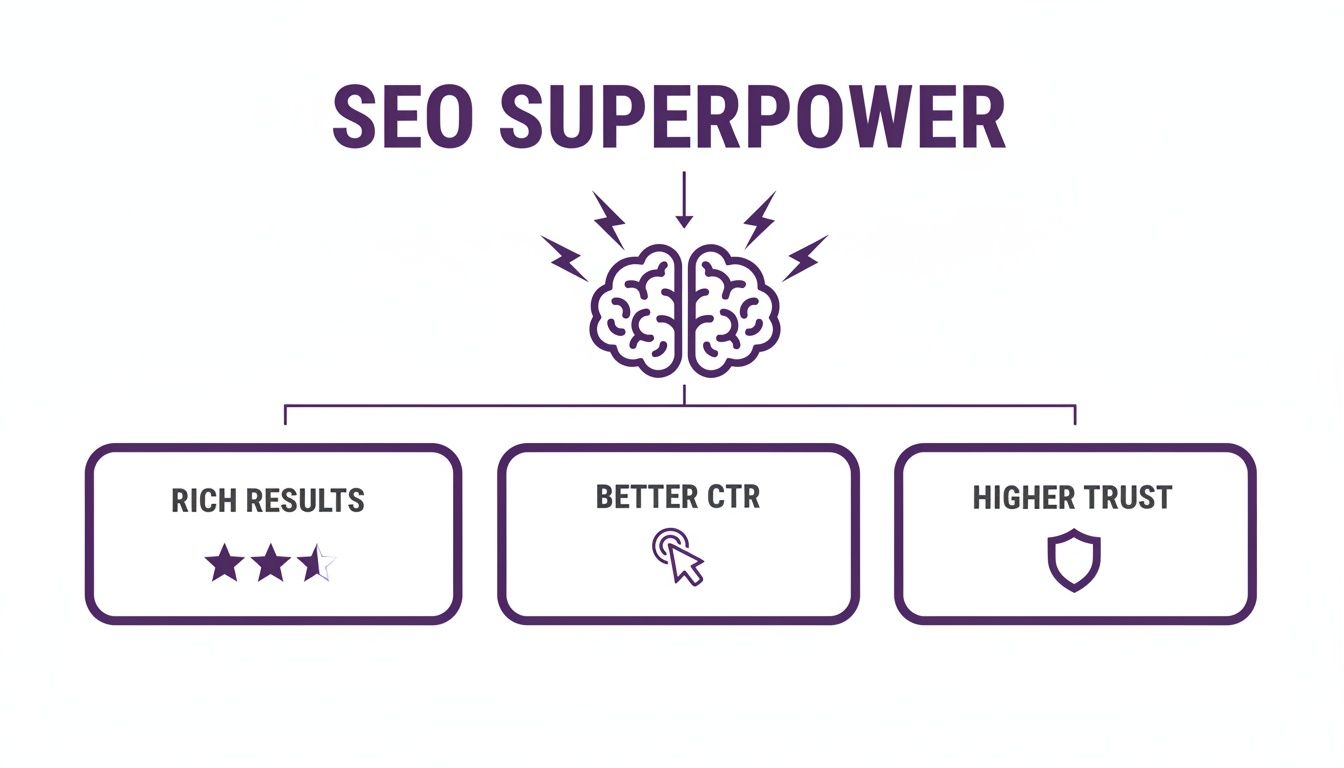
This shows how providing clear, machine-readable context is the foundation for getting rich results. Those rich results, in turn, are what improve your click-through rates and build trust with search engines over time.
Understanding these technical bits and pieces gives you the confidence to have smart conversations with your developer or SEO agency, ensuring you’re using the best methods to hit your goals.
Practical Examples of Structured Data in Action

The theory is great, but seeing structured data actually work is where it all clicks. This is the moment we connect the code to the conversions, showing how a few lines of JSON-LD can completely transform how your business shows up in search.
Let's look at a few real-world examples that UK businesses will recognise. Each one shows the clear difference between a standard search result and one enhanced with the right schema markup.
Local Business Schema for a Cambridgeshire Service
Imagine you run a plumbing service in Cambridge. Without structured data, Google just sees your address and phone number as plain text on a page. But with the right schema, Google understands exactly what that text means—your location, what you do, and when you're open.
- Before: Your search result is just a standard blue link with your company name and a short description. A potential customer has to click through to your site just to find your opening hours or service area.
- After: Suddenly, your business can show up in the local map pack with your address, phone number, opening times, and customer reviews displayed right there. It’s an instant credibility boost that gives people the key info they need without an extra click.
Product Schema for an E-commerce Site
For any online retailer, Product schema is an absolute must. It's how you communicate crucial buying information directly on the search results page, grabbing the attention of shoppers who are ready to make a purchase.
- Before: Your product page is a generic link, offering no clue about its price or availability. It just gets lost in a sea of similar-looking results.
- After: Now your listing is a powerful little advert. It’s enhanced with a price like £79.99, an availability status ("In Stock"), and those all-important star ratings from customer reviews. This visual upgrade makes your listing far more compelling than your competitors'.
This kind of organised data isn't just for retail. The UK government itself uses structured data extensively in GOV.UK's statistical datasets. These datasets cover everything from trade figures to fuel prices with regional breakdowns, providing the kind of precise economic analysis that helps Cambridgeshire SMEs make smarter decisions.
Article Schema for a Blog Post
If you're putting time and effort into content marketing, Article schema is how you make sure your hard work gets the credit it deserves. It gives search engines the essential context they need to understand what your content is all about.
By explicitly defining the author, publication date, and headline, you signal to Google that your content is a credible and well-structured piece of information, boosting its E-E-A-T credentials.
- Before: Your blog post looks like any other webpage in the search results—nothing special.
- After: Google might feature your article in the "Top stories" carousel, complete with a thumbnail image, author name, and publication date. It instantly looks more authoritative and trustworthy.
FAQ Schema for Extra Visibility
Finally, FAQ schema is one of the quickest and most effective ways to claim more real estate on the search results page. It lets you answer common customer questions directly within the search listing itself.
- Before: A user sees your page link, but they still have to click, navigate, and search your site to find the answer to their specific question.
- After: Your search result expands to show a series of clickable dropdown questions. When a user clicks, the answer appears right there. Not only does this make your listing bigger and more noticeable, but it also positions your brand as a helpful expert.
How to Implement and Validate Your Structured Data
Putting structured data into practice is a lot more straightforward than you might think. With the right process and some brilliant free tools, you can start giving your website a serious SEO advantage. This guide breaks it down into a clear, step-by-step approach.
The whole process kicks off with a simple, strategic decision: prioritisation. You don't need to mark up every single page on your site all at once. That would be overwhelming. Instead, focus on your most valuable assets first.
That usually means:
- Your homepage to nail down your brand identity.
- Key service or product pages that actually drive conversions.
- Your top-performing blog posts or articles that already pull in a lot of traffic.
A Step-by-Step Implementation Guide
Once you’ve cherry-picked your priority pages, the next job is to choose the most appropriate schema types. A local service business, for example, will find LocalBusiness schema essential, whereas an e-commerce site is going to lean heavily on Product schema.
With your pages and schema types sorted, you can get to work creating the code itself.
-
Generate the Markup: You don’t need to be a developer for this. Tools like Google's Structured Data Markup Helper let you simply highlight elements on your page—like your business name or a product price—and it spits out the necessary JSON-LD code for you.
-
Add the Code to Your Site: The script it generates should be added to the
<head>section of your page’s HTML. If you're on a platform like WordPress, plugins such as Rank Math or Yoast SEO have dedicated fields where you can just paste your schema code, making it incredibly simple.
The Crucial Final Step: Validation
After you’ve added the code, validation isn't just a good idea—it's non-negotiable. This step ensures Google can actually read your markup correctly and that it’s free from errors that would stop you from earning those rich results. This is a core part of modern data literacy. In fact, structured data is so fundamental that it forms the backbone of the UK Data Service's Data Skills Framework, launched to tackle growing complexities in data science. You can learn more about how these frameworks map out essential skills for data handling.
Google gives you two excellent, free tools for this.
The screenshot below shows Google's Rich Results Test, where you can paste your URL to check if your markup is valid.
A successful test will show a green tick and confirm exactly which rich result types your page is now eligible for.
Key Takeaway: Always, always test your implementation. A tiny syntax error can make your entire structured data snippet invisible to search engines, meaning you get zero of the benefits for all your hard work.
Finally, you can keep an eye on the performance and status of your structured data right from your dashboard. For detailed instructions on getting this set up, you can explore our guide on what is Google Search Console. It gives you the insights needed to track your rich results and fix any issues Google flags over time.
Got Questions About Structured Data? We’ve Got Answers
Even after getting the hang of what structured data is, a few common questions always seem to pop up. Let’s clear up the last few bits of confusion with some straight answers to what we hear most often from business owners.
Is Structured Data a Direct Google Ranking Factor?
Straight answer? No. It’s not a direct signal like high-quality backlinks or amazing content. But don't let that fool you—its impact on your search performance is massive.
When you implement structured data correctly, you become eligible for rich results. You know the ones: eye-catching listings with star ratings, prices, or those handy FAQ dropdowns. These rich results make your site stand out, seriously boosting visibility and your click-through rate (CTR). Over time, these become powerful indirect signals that tell Google you're a good result, which absolutely influences your rankings.
Think of it as upgrading from a standard, text-only advert to a premium, glossy one that grabs all the attention.
Can I Add Structured Data to My Website Myself?
Yes, absolutely. If you’re not a developer, it's definitely possible to add structured data yourself. Tools like WordPress have plenty of plugins to make it simpler, and free tools like Google's Markup Helper can even generate the code for you.
But here’s the catch: accuracy is everything. One tiny mistake can lead to Google ignoring your markup entirely or, worse, completely misunderstanding it. That's why working with an SEO specialist is often the safest bet. It guarantees your implementation is flawless and actually delivers the results you’re after without any technical headaches.
What Is the Difference Between Schema and Structured Data?
This is a classic point of confusion, but the difference is actually pretty simple. The easiest way to think about it is like a language:
- Structured Data is the overall concept. It's the grammar and sentence structure you use to organise your website's information in a standardised way that search engines can read.
- Schema.org is the specific vocabulary you use. It's the library of words and definitions you pull from to label your content within that grammatical system.
So, to put it all together, you use the Schema.org vocabulary to create your structured data markup. It’s how you tell search engines precisely what each bit of your page actually means.
Feeling ready to put structured data to work but want an expert eye to make sure it's done right? Bare Digital offers a free SEO Health Check to pinpoint your biggest opportunities. Get your bespoke proposal within 24 hours and see how our specialist SEO services can get you ranking higher. Start your free audit today.