
You open your Google Business Profile, see a fresh 1-star review, and your stomach drops. There’s no booking under the reviewer’s name. The complaint describes a service you don’t even offer. Or worse, it reads like a competitor having a go. At that point, most business owners ask the same thing: can i remove a google review?
The short answer is yes, sometimes. The more useful answer is this: you can’t remove a Google review just because it’s unfair, annoying, or damaging. You can remove it if it breaches Google’s policies, and in the UK you may also have legal options when the review crosses into defamation or misuse of personal data.
That distinction matters. A lot of generic advice online treats every bad review as if it follows the same process. It doesn’t. A fake review from a rival plumber, an ex-employee posting under a false account, and a real customer leaving a harsh but genuine complaint are three different problems. Each needs a different response.
Google’s moderation has become much more active. Google removed over 250 million reviews globally in 2023, a 40% increase from 2022, according to The Reputation Lab’s reporting on Google review deletions. That tells you two things. First, removals do happen. Second, Google is already filtering aggressively, so your report needs to be accurate and properly evidenced.
For UK businesses, this is now part of routine reputation management. Whether you run a wedding venue, funeral home, construction firm, dental practice, or photography studio, your review profile affects trust before a prospect ever calls. Agencies such as Bare Digital work in that reality every day. The practical question isn’t whether bad reviews exist. It’s how to deal with the ones that should come down, and how to manage the ones that won’t.
The Sinking Feeling of an Unfair Google Review
The emotional reaction is usually immediate. You read the review once, then again, hoping you’ve missed something. If it’s obviously false, the frustration gets sharper because you know other people will read it without context. If you depend on local search for leads, that single review can feel much bigger than one line of text.
That reaction is normal. It also leads a lot of business owners into the wrong first move. They reply angrily, accuse the reviewer in public, or start clicking through every support screen in a panic. None of that helps.
What helps is getting clear on one point early. You cannot directly delete a review from your own Google profile. Google controls removal. Your job is to decide whether the review is a policy violation, gather the right evidence, and use the right escalation path.
Bad reviews and removable reviews are not the same thing.
A harsh review from a real customer usually stays. A fabricated review, a review from a competitor, a post containing threats, or a review about the wrong business can often be challenged. In the UK, that can go further than Google’s basic tools if the content is defamatory.
The practical route is usually one of four paths:
- Flag it in Google Business Profile if it breaches policy.
- Escalate through Google’s appeal tools if the first report fails.
- Use UK legal remedies if the content is seriously harmful and false.
- Manage around it if the review is genuine and won’t be removed.
Most businesses don’t need all four. But you need to know which one fits your situation before you do anything publicly.
Understanding Google's Rules of Engagement
Google doesn’t remove reviews because a business dislikes them. It removes reviews because they breach specific rules. If you misclassify the issue, you waste time and make a later appeal weaker.
That’s why the first job is diagnosis. Is this fake? Is it off-topic? Is it a conflict of interest? Or is it a genuine customer complaint written in a way you don’t like?
In the UK, this matters even more because complaints around misleading online reviews have grown sharply. UK Consumer Rights Act 2015 complaints related to misleading online reviews rose 28% year-on-year to 45,000 cases by 2023, and reviews lacking customer experience were deleted at rates exceeding 80% in audited local SEO campaigns, according to Cloutly’s review removal analysis.
What usually qualifies for removal
The reviews most likely to come down tend to fall into a few recognisable groups:
Spam or fake content
No actual customer experience. Often vague, copied, or posted in a suspicious pattern.Conflict of interest
Reviews from competitors, current staff, former employees, or anyone with a clear vested interest.Off-topic content
The review isn’t about the service experience. It might be a political rant, a complaint about another business, or irrelevant commentary.Harassment or offensive material
Threats, abusive language, discriminatory remarks, or other prohibited content.Impersonation or misleading identity
The reviewer appears to be pretending to be someone they’re not.Wrong business or wrong location
Common with multi-location brands. The person reviewed the wrong branch, or a completely different company.
What usually does not qualify
Expectations about Google review removal often need adjustment. Google usually won’t remove:
- a real customer’s negative review
- a 1-star rating with no text, if it appears genuine
- a review that contains inaccuracies but still reflects a real interaction
- criticism of pricing, delays, communication, or quality of work from an actual customer
That doesn’t mean the review is fair. It means it probably isn’t removable through policy enforcement alone.
Google Review Policy Violations At a Glance
| Violation Type | What It Means | Example for a UK Business |
|---|---|---|
| Spam and fake content | No genuine customer experience or manipulative posting | A roofing company gets five near-identical 1-star reviews from accounts with no local history |
| Conflict of interest | Reviewer has a competing or internal connection to the business | An ex-employee leaves a review attacking a funeral home after a dismissal |
| Off-topic content | The review isn’t about the customer experience | A wedding venue gets a review ranting about local council planning policy |
| Harassment or offensive content | Threatening, abusive, or derogatory language | A trades firm receives a review containing personal insults and threats |
| Impersonation | Reviewer misrepresents identity | Someone posts as if they were a client when records show otherwise |
| Wrong business or location | Review belongs elsewhere | A construction company’s Manchester branch gets a complaint clearly about the Leeds team |
| Illegal or harmful content | Content includes unlawful or seriously harmful material | A review publishes private allegations or material that may require legal action |
A quick decision test
When a business owner sends me a screenshot, I usually run a simple filter:
- Can we identify a real transaction, appointment, booking, or enquiry?
- Does the text describe an actual experience with this business?
- Does it match a clear Google policy category?
- Do we have evidence, not just suspicion?
If the answer to those questions is weak, removal becomes difficult.
Practical rule: If your best argument is “this review is unfair”, you probably don’t have a removal case yet. If your argument is “this review is fake and here’s why”, you might.
That’s the shift. Don’t argue emotion. Argue policy.
Your First Line of Defence Flagging a Review
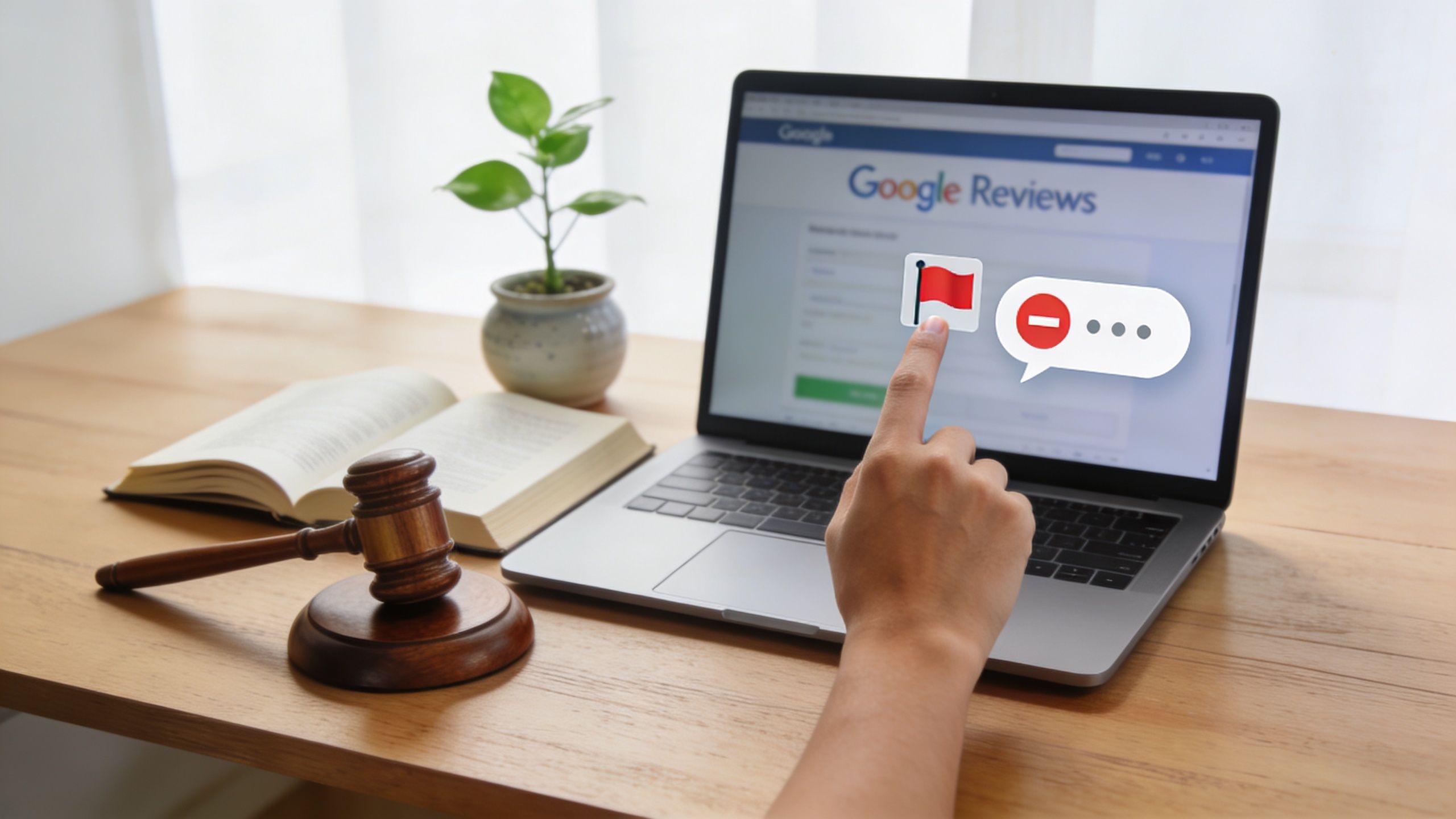
For most UK businesses, the first proper removal attempt happens inside Google Business Profile. This is the standard flagging route, and it’s still the right place to start when the review clearly breaches policy.

The process itself is simple. The strategy behind it is where businesses usually get it wrong.
Businesses can’t directly delete reviews, but they can flag them through Google Business Profile. Removal rates are under 20% for legitimate negative feedback, but 60 to 70% for clear spam or conflicts when well-documented, with Google typically responding in 3 to 7 days, according to Scorpion’s breakdown of the Google review flagging process. The same source notes that a vague explanation carries an 80% higher rejection rate.
How to submit the initial flag
Inside your Google Business Profile, go to the relevant location if you manage more than one. Open the review section, find the review, click the three-dot menu, and choose the option to flag it as inappropriate.
Google will ask you to choose the reason. That choice matters. Pick the closest real violation, not the one that sounds strongest emotionally.
A few examples:
- If there’s no sign of any customer relationship, spam or fake content is usually the cleanest category.
- If you know the reviewer is a competitor or former employee, conflict of interest is stronger than general spam.
- If the review is talking about politics, roadworks, or something unrelated to the business, off-topic is usually right.
- If it includes threats or slurs, use the category that reflects harassment or offensive content.
What to write in the explanation
Most failed flags aren’t failed because the review was acceptable. They fail because the business wrote a poor explanation.
Don’t write a long emotional account. Don’t call the reviewer names. Don’t threaten legal action in the flag form. Don’t paste in your whole backstory.
Write a short, factual statement tied to policy.
This review appears to violate Google’s policy on fake content/conflict of interest. We have no record of this person as a customer, booking, or enquiry under the name provided, and the review describes an experience inconsistent with our services. We believe this is not based on a genuine customer interaction.
That kind of wording works because it stays focused. It tells Google what rule you believe has been broken and why.
What to gather before you click submit
The best flags are backed by records you can produce later if needed. I’d line up:
Booking or CRM checks
Search the reviewer’s name, email, phone number, and any details mentioned in the review.Screenshots
Capture the review in full, the reviewer profile if visible, and anything relevant on the profile history.Service mismatch notes
If the review mentions a product or service you don’t provide, note that clearly.Location mismatch evidence
For multi-location firms, record why the review belongs to another branch.
If you’re not sure whether your profile has broader issues that weaken your reporting and trust signals, a structured review of the listing helps. Tools such as Bare Digital’s Google Business Profile audit tool can be useful for spotting gaps in profile health while you handle review problems.
What not to do while waiting
Google often takes a few days to respond. During that time, avoid making the case worse.
Don’t rally staff to post retaliatory reviews
That creates a second problem.Don’t submit multiple contradictory reports
Mixed reasoning makes the case look weaker.Don’t publish a defensive public reply full of accusations
If the review later stays live, that response becomes part of your profile.
One useful move is to prepare a calm public response in case the review remains visible.
A quick visual walkthrough can help if you prefer to see the interface before acting:
The wording I’d avoid every time
Some phrases almost always weaken a report:
“This is hurting our business”
It may be true, but it doesn’t prove a policy breach.“Please remove this immediately”
It adds urgency, not evidence.“We think it might be fake”
If you’re unsure, say what you can verify instead.
Keep the report narrow. Google is reviewing whether the review breaches policy, not whether your business deserves protection from criticism.
That’s the discipline. Your first flag should read like a clean incident report, not a complaint letter.
Escalating Your Case When a Flag Fails
A rejected flag doesn’t always mean Google thinks the review is valid. Sometimes it means the first report wasn’t specific enough, the evidence wasn’t attached through the right path, or the case landed in a grey area that needs a second pass.
That’s where escalation matters. Plenty of legitimate removals happen only after a structured appeal.
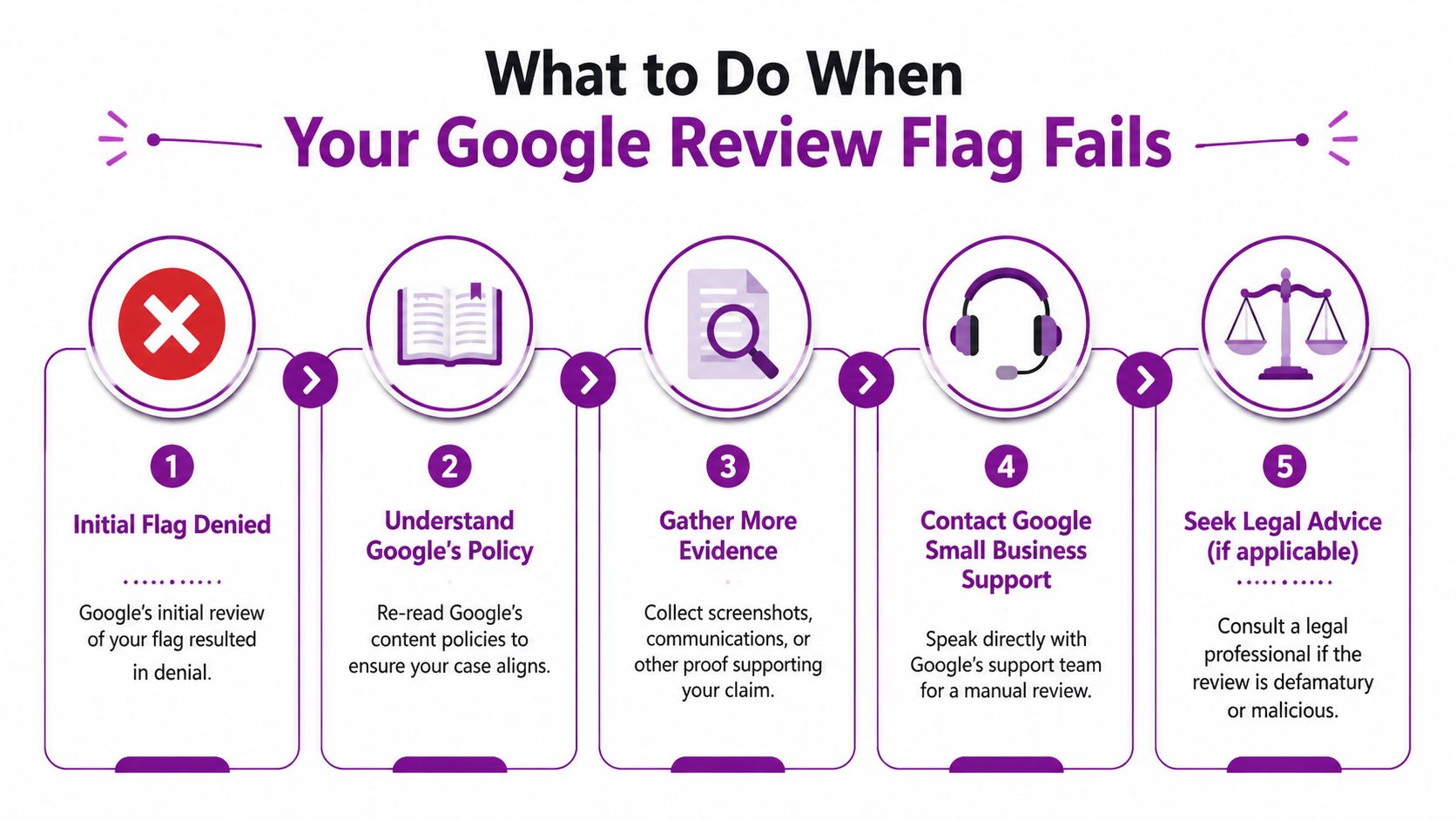
For UK businesses, the numbers improve at this stage if the evidence is solid. Appeal success averages 35 to 45% when using Google’s Review Removal Tool with detailed evidence, and missing the 14-day appeal window leads to a 90% failure rate, according to this review removal tool guidance video. The same source says multi-location brands often see a 50% uplift through bulk flagging tactics.
Use the Review Removal Tool properly
If the first flag fails, go to Google’s support flow for review removals and submit a formal appeal. At this stage, a loose suspicion needs to become a structured case.
What Google usually needs at this stage is coherence. Your appeal should answer three points clearly:
- Which policy has been breached
- What evidence supports that claim
- Why the review doesn’t reflect a genuine customer experience
That means your appeal should include the review link, the affected profile or location, a concise summary, and supporting material that directly relates to the policy category.
What good evidence looks like
A lot of business owners either send almost nothing or far too much. Neither works well.
Useful evidence often includes:
No-record checks
A clear note that you’ve searched bookings, invoices, call logs, or CRM records and found no match.Timeline conflicts
The review references a date when you were closed, not trading, or not operating that service.Location proof
The complaint references another branch, another town, or another company entirely.Internal relationship proof
If it’s an ex-employee or known competitor, document that connection carefully.Screenshots with labels
Short, organised exhibits are easier for support staff to assess than a messy screenshot dump.
Keep the appeal tight
Longer doesn’t mean stronger. The best appeals are precise.
A simple structure works well:
- one sentence identifying the violation
- one short paragraph summarising the facts
- a short list of attached evidence
- a direct request for manual review
A good appeal reads like a case file. A bad one reads like an argument after a difficult day.
When to contact support directly
If the removal tool doesn’t solve it, the next move is direct Google Business Profile support. This is especially useful when the review is clearly misattributed, clearly abusive, or part of a larger pattern across locations.
Use support when:
- the initial flag was denied without a sensible reason
- the review belongs to the wrong location
- you’re seeing a cluster of similar suspicious reviews
- the case needs human context that a standard form didn’t capture
For businesses managing several locations, documentation becomes much easier if you centralise evidence and track outcomes in one place. A reporting setup such as Bare Digital’s GBP reporting process can help teams keep review disputes, profile actions, and listing issues organised.
Bulk tactics for multi-location brands
Single-location businesses usually deal with one review at a time. Multi-location operators have a different problem. A false review might be copied to several branches, or one reviewer may target the wrong locations repeatedly.
In those cases:
Map the pattern first
List every affected branch and review URL.Use consistent reasoning
Don’t classify one as spam, another as off-topic, and another as harassment if they’re the same issue.Document local mismatches
Show why the customer could not have interacted with that branch.
Many franchised service brands, care providers, and regional trades firms improve outcomes. Their appeal is no longer “remove this review”; instead, it becomes “these reviews are part of the same invalid pattern”.
The mistakes that sink second attempts
These are the usual killers:
- Missing the deadline
- Adding emotional commentary instead of evidence
- Uploading irrelevant screenshots
- Changing your explanation halfway through
- Claiming defamation without legal grounds
If the appeal still fails, you’re left with two realistic paths. Either the review stays and you manage around it, or the issue moves beyond platform policy and into UK legal territory.
Leveraging UK Legal Options for Defamatory Reviews
Most guides stop at Google’s own forms. That’s where they stop being useful for some UK businesses.
If a review contains a seriously harmful false statement, this may no longer be just a platform moderation issue. It may be a legal one. Under the Defamation Act 2013, UK businesses can pursue removal through legal channels in the right circumstances.
This route is less common than policy reporting, but it’s more viable than many owners realise. Success rates are around 20 to 30% in small business cases, yet only 15% of SMEs are aware of the option, according to Essential Marketer’s summary of UK review removal legal avenues. The same source notes that ICO complaints involving GDPR breaches affect 8% of UK review disputes.
What counts as defamatory
Not every harsh review is defamatory. A review saying “service was slow” or “I wouldn’t recommend them” is usually opinion. Even if it feels unfair, that isn’t normally enough.
A stronger legal case tends to involve reviews that make false factual allegations, such as:
- accusing a business of fraud without basis
- claiming criminal conduct that didn’t happen
- alleging dangerous conduct with no truth behind it
- publishing false statements that cause serious reputational harm
The key difference is between opinion and false assertion presented as fact.
When legal advice makes sense
You don’t need a solicitor for every bad review. You probably do if:
- the review accuses you of unlawful or unethical conduct
- the wording suggests serious commercial harm
- the reviewer appears malicious and the review is clearly fabricated
- Google has refused removal despite strong evidence
- the review includes personal data or sensitive information
In those cases, legal advice can help you assess whether a formal letter, a court application, or another route is proportionate.
GDPR and personal data issues
Some review disputes are not mainly about defamation. They’re about privacy.
If a reviewer includes personal data about staff, clients, residents, patients, or family members, that can create a separate issue. This comes up in healthcare, care services, funerals, and family-facing businesses more often than many owners expect.
If a review reveals personal data, don’t treat it as a normal reputation issue. Treat it as a possible compliance issue as well.
That may justify raising the matter through privacy channels alongside Google reporting.
A realistic view of this route
Legal action isn’t quick, cheap, or suitable for every case. It’s a serious step. But for the right kind of review, it changes the balance of power.
Google’s reporting system works best for obvious policy breaches. Courts and solicitors become relevant when the issue is falsehood plus serious harm. That’s the distinction many UK businesses miss, and it’s why generic international advice often leaves them stuck.
Beyond Removal Proactive Reputation Management
Sometimes the review won’t come down. Sometimes it shouldn’t. In both cases, the business still needs a plan.
That plan has three parts: respond properly, generate more genuine positive feedback, and monitor mentions of your brand closely enough that nothing sits ignored for weeks.

There’s also a newer wrinkle. The EU’s Digital Services Act has had a ripple effect, leading to 25% faster UK review takedowns since Q4 2025, while “review shadowing” has risen 40% in UK service sectors, according to the verified data provided for this article. Shadowing means a review may be hidden by AI moderation rather than fully deleted, which confuses a lot of owners because visibility can differ between accounts and devices.
Write replies for future customers
Your public response is rarely about winning an argument with the reviewer. It’s about showing everyone else that your business is calm, organised, and open to fixing problems.
A strong reply usually does four things:
Acknowledges the complaint
Without admitting facts you can’t verify.Stays professional
No sarcasm, no accusations, no defensiveness.Offers an offline route
Invite the person to contact you directly.Protects privacy
Don’t reveal booking details, medical context, or internal history.
If the review is suspicious but still visible, you can say you’ve been unable to match the reviewer to your records and invite them to contact you. That signals doubt without escalating the tone.
Build enough positive proof around the problem
One unfair review has less influence when it sits inside a healthy pattern of recent, authentic positive reviews. That doesn’t mean gaming the system. It means asking satisfied customers consistently, at the right moment, with a simple process.
Good review generation usually comes from:
- Post-service follow-up emails
- SMS requests after successful completion
- Front-desk or project handover prompts
- Clear review links for the correct location
What matters is consistency. Businesses that only ask when they’ve had a bad week usually end up with an erratic profile.
Monitor more than just Google
A review issue often starts before you notice it. A complaint might first appear on another platform, in a local Facebook group, or as an unlinked mention of your business name. That’s why reputation work shouldn’t stop at one dashboard.
If you want a broader process for catching those signals early, this brand mention monitoring guide is a useful companion to review management. It helps frame reputation monitoring as an ongoing system rather than a one-off reaction.
For local businesses, this sits alongside the wider mechanics of visibility and trust. A practical framework such as a local SEO checklist helps keep review management connected to profile optimisation, consistency, and lead generation rather than treating it as a separate task.
Watch for shadowed reviews
If you suspect a review has been shadowed, check carefully before assuming it’s gone. Visibility may differ depending on logged-in status, geography, or device. That can affect how you respond and whether you escalate.
Don’t confuse hidden with deleted. If a review is still attached to the profile in any form, keep records and continue tracking it.
That’s the broader point. Removal is only one part of reputation management. Resilience matters more.
Taking Control of Your Online Reputation
If you’ve been asking can i remove a google review, the practical answer is this: sometimes yes, but only with the right route for the right type of review.
When the review breaches policy, flag it properly. If that fails, appeal with cleaner evidence and tighter reasoning. If the review is seriously false and harmful, UK law may give you options that generic guides never mention. If the review stays, respond well and strengthen the rest of your profile so one comment doesn’t define your business.
That’s how experienced local SEO teams handle this in real life. Not with panic, and not with promises that every bad review can disappear. With process, evidence, and judgement.
For many UK businesses, the biggest shift is mental. Reviews aren’t a side issue anymore. They’re part of your search visibility, your credibility, and your conversion path. Once you treat them that way, you stop reacting emotionally and start managing them properly.
If you need a second pair of eyes on a review issue, a profile audit, or a wider local search strategy, you can speak to Bare Digital through their contact page.
If you want help assessing whether a review is removable, building an appeal, or tightening the wider local SEO signals around your Google Business Profile, Bare Digital works with UK businesses that rely on local visibility to generate enquiries and sales.