


You search for seo services in surrey, open a few agency pages, and quickly realise half of them are talking about British Columbia. The examples feel off. The language feels imported. The advice sounds like it was written for a different map pack, a different customer, and a different set of business rules.
That’s a problem if you run a business in Guildford, Woking, Epsom, Reigate, Weybridge, Farnham, or anywhere else in Surrey, UK. You don’t need generic SEO theory. You need to know how to buy the right local SEO service, what a sensible process looks like, and how to spot the difference between proper strategic work and someone just changing a few title tags every month.
Good local SEO still does the same core job. It helps the right people find you when they’re ready to enquire. But the way that works in Surrey, UK depends on postcode targeting, town-level search intent, review handling, Google Business Profile management, and compliance details that broad “Surrey SEO” pages often ignore.
Why Most 'Surrey SEO' Advice Fails UK Businesses
The first failure is geographic. Search for seo services in surrey and you’ll find a lot of content aimed at Surrey, BC rather than Surrey in the South East of England. That sounds minor until you realise the advice often carries the wrong assumptions about the market, local competition, and how businesses here win enquiries.
The second failure is regulatory and behavioural. UK-focused local SEO has to account for how UK consumers judge trust online, especially around transparency, review handling, and business information quality. As Saltwater Digital’s Surrey SEO analysis notes, there’s a clear gap between generic Surrey SEO content and what Surrey, UK businesses need, with UK consumers expecting higher information standards and transparency.
What generic advice gets wrong
A lot of generic pages reduce local SEO to three things. Add keywords. Get backlinks. Ask for reviews.
That’s incomplete. In Surrey, UK, strong local SEO usually depends on whether your business information is consistent, whether your town and postcode signals are clear, whether your service pages match actual buying intent, and whether your review process is handled carefully enough for your sector.
Practical rule: If an agency can’t explain how local SEO for Surrey, UK differs from Surrey, BC, they probably don’t have a Surrey, UK playbook.
That matters more in regulated or trust-sensitive sectors. Funeral homes, healthcare providers, home care businesses, and firms dealing with vulnerable clients can’t treat reviews, testimonials, and local landing pages casually. The same goes for trades and construction companies competing across multiple towns where one broad county page rarely does enough.
Surrey isn’t one market
A business targeting affluent homeowners in Weybridge isn’t selling in the same way as a trades firm relying on emergency call-outs in Woking. A wedding venue near the Surrey Hills needs very different content and search positioning from a physiotherapy clinic serving commuters near Guildford station.
Here’s where poor advice usually falls apart:
| What generic Surrey SEO says | What Surrey UK businesses actually need |
|---|---|
| One local page is enough | Service and location intent often need separate pages |
| Reviews are just volume | Review wording, recency, trust and handling all matter |
| “Near me” is the whole strategy | Town names, postcode terms and service modifiers matter too |
| Rankings are the goal | Qualified enquiries and booked work are the goal |
What buyers should expect instead
A useful local SEO provider for Surrey should talk about your service radius, town priorities, your Google Business Profile setup, location-page structure, and how customers search in your niche.
They should also be comfortable saying no. Not every keyword deserves a page. Not every town needs its own landing page. Not every backlink opportunity is worth chasing.
That’s what practical SEO looks like. It isn’t loud. It’s structured, local, and specific to how people in Surrey search and choose.
The Five Pillars of an Effective Local SEO Strategy
When business owners ask what they’re buying with seo services in surrey, the clearest answer is this. You’re buying a system, not a trick. Good local SEO rests on a handful of core disciplines that work together.
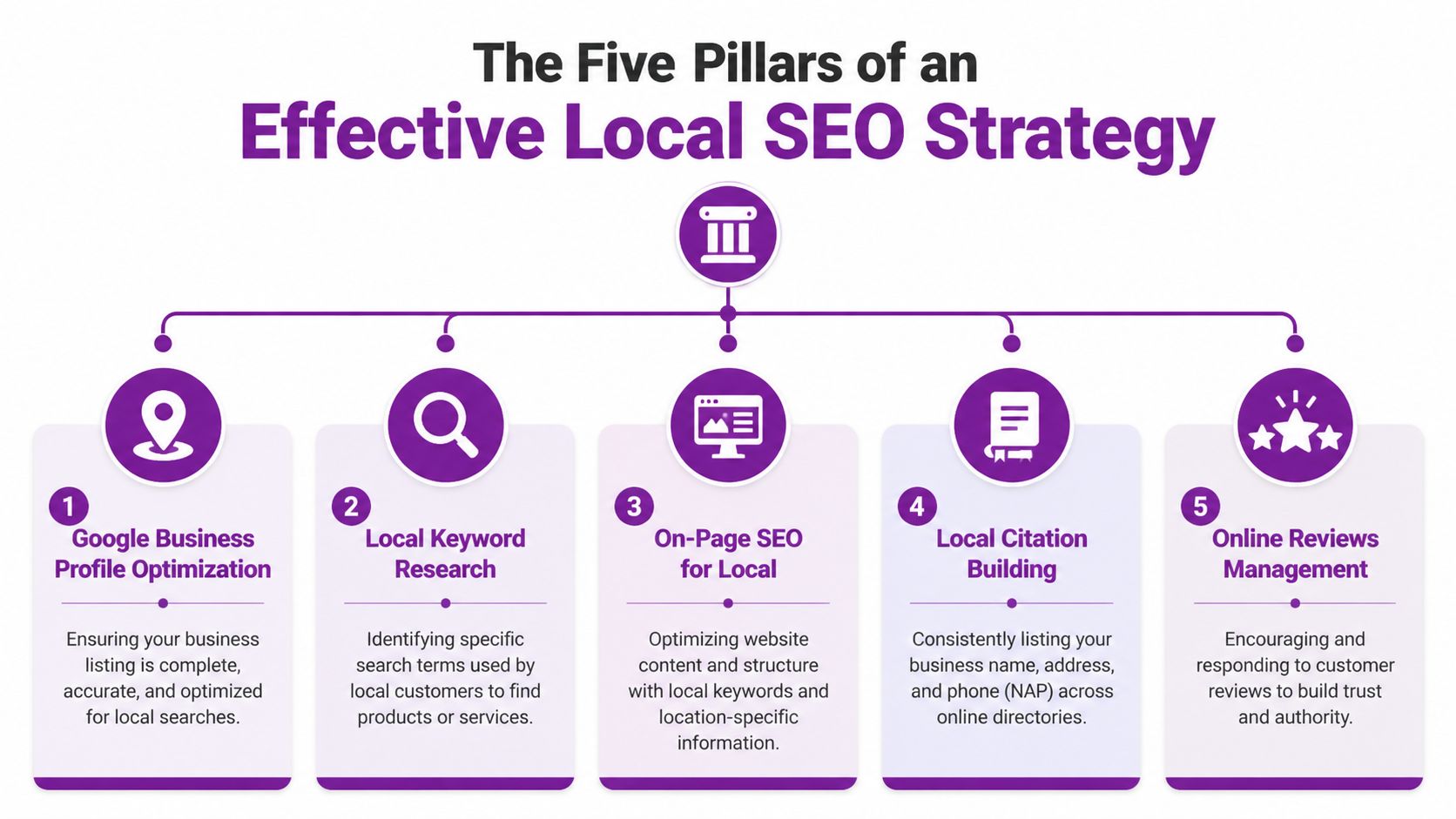
Google Business Profile and Maps presence
For many Surrey businesses, Google Business Profile is the front door before the website ever gets a click. If it’s incomplete, poorly categorised, thin on services, or neglected, local visibility suffers.
This isn’t just about filling in fields. It’s about choosing the right service categories, writing useful service descriptions, keeping opening information accurate, publishing updates where relevant, and making sure the profile supports the website rather than drifting away from it.
For a local service business, the profile often shapes first impressions faster than the homepage does.
Local keyword research that reflects real buying intent
Keyword research isn’t a spreadsheet exercise. It’s market reading. The job is to find what people in Surrey type when they need your service, then build pages that deserve to rank for those searches.
According to Cream Soda Media’s guide to SEO for Surrey small businesses, UK-specific keyword strategy requires targeting terms with at least 1,000 monthly searches and medium-to-low competition, alongside local intent signals such as “near me” and postcode-based queries. The same guide notes that organising content through SEO siloing helps drive measurable visibility and organic traffic growth.
That means a good agency shouldn’t just chase the broadest phrase. It should look at:
- Service-first terms: what people search when they know what they need
- Location-modified terms: town names, nearby areas, and county qualifiers
- Problem-led searches: terms used before the customer knows the exact service name
- Commercial intent phrases: searches that suggest someone is close to enquiry
If you want a useful benchmark before speaking to agencies, this local SEO checklist outlines the practical areas worth reviewing.
On-page SEO that matches local intent
A lot of sites in Surrey have one “Services” page trying to rank for everything. That rarely works well.
On-page local SEO means giving each important service a proper home, writing titles and headings that reflect actual search intent, adding location context naturally, and making internal links support the main commercial pages. It also means avoiding doorway-page tactics where every town page says the same thing with the place name swapped out.
The strongest local pages usually feel useful to a human first and clear to Google second.
Technical SEO that removes friction
Technical work doesn’t always look exciting, but it affects whether your site can compete. If Google struggles to crawl key pages, if the mobile experience is awkward, if pages load poorly, or if duplicate versions of content confuse indexing, rankings become harder to earn and easier to lose.
In practice, this often means cleaning up indexing issues, improving page hierarchy, fixing internal linking, checking local schema where relevant, and making sure important pages aren’t buried.
Local authority built through citations, links and reviews
Authority in local SEO comes from signals beyond your own site. That includes business listings, relevant links, local mentions, and review signals that reinforce trust.
The trade-off is simple. Cheap authority work usually creates junk. Better authority work takes longer but strengthens the profile of the business in a way that lasts.
A sensible provider will explain the difference between:
- Citation consistency, which supports trust in your business data
- Local links, which connect you to real geographic relevance
- Review management, which improves buyer confidence and local credibility
If one of those pillars is missing, the whole strategy weakens. The best results come when all five support each other.
The Typical SEO Project Roadmap From Kick-off to Growth
A Surrey business owner signs an SEO contract in January and expects more calls by March. By April, they have a ranking report, a few rewritten title tags, and no clear answer on what has been fixed. That usually happens because the project started with tasks instead of a plan.
A proper SEO roadmap for Surrey, UK starts with diagnosis, sequencing, and local priorities. It should reflect how people search here, by service, town, and often postcode. It should also avoid the generic "Surrey SEO" advice written for Surrey, British Columbia, which misses UK search behaviour, Google Business Profile setup for UK addresses, and the way nearby towns like Guildford, Woking, Epsom, Redhill or Camberley overlap in one catchment area.

The opening phase
The first month should answer a simple question. What is stopping this site from getting more qualified local enquiries?
That means access setup, benchmark reporting, technical checks, page-level review, local pack analysis, competitor comparison, and keyword mapping tied to real services. For a Surrey firm, I would also want to see whether the business is trying to rank one domain across multiple towns without enough local proof, whether postcode areas are being targeted sensibly, and whether the Google Business Profile matches the website and directory citations.
Common findings are predictable. Service pages overlap. Town pages are too thin to rank or too repetitive to trust. Old directory listings still show the wrong number. The contact page is weak. Key commercial pages sit three clicks deep. The Google Business Profile has the right category but poor supporting detail.
A sensible first month usually includes:
- Audit and benchmark: current rankings, indexation, map visibility, enquiries, and the pages that already attract local traffic
- Priority setting: fixes ranked by business impact, not by what is easiest for the agency to deliver
- Quick corrections: title tags, internal links, thin key pages, profile gaps, and citation inconsistencies
- Measurement setup: form tracking, call tracking where appropriate, and clear agreement on what counts as a lead
The order matters. Fixing low-value pages first can keep a campaign busy without changing revenue.
The build phase
Months two to four are where the serious work usually happens. Technical issues get resolved. Priority pages are rewritten or expanded. Internal linking is improved. Location intent is clarified. Supporting content is added where it helps a buyer decide, not just where it gives the agency another line in the monthly report.
For Surrey businesses, this often means making hard choices. A firm covering the whole county may want pages for every town, but that is not always the best use of budget. Sometimes one strong page for "accountants in Guildford" and one for "accountants in Woking" will outperform ten weak location pages spread across places with little search demand. Sometimes the bigger win is improving one service page and one Google Business Profile category set, rather than publishing more copy.
This is also where expectations need managing. SEO rarely moves in a straight line. One page can jump because its intent is finally aligned with what people search. Another can sit still because competitors in Farnham or Reigate have better local links, better reviews, or stronger brand demand.
If you want to check the listing side before signing a retainer, this Google Business Profile audit tool can help flag obvious gaps in the profile.
The growth phase
Once the core issues are fixed, the campaign should stop behaving like a repair job. The focus shifts to expansion and conversion.
That usually means improving pages sitting just outside the strongest positions, building better local authority signals, earning links that make sense in Surrey, tightening up service-area coverage, and refining the parts of the site that turn visits into calls or enquiries. On some projects, review generation and review response also become more important at this stage, especially in trades, legal, dental, and home services where buyers compare several local firms before making contact.
Good SEO roadmaps are not identical from business to business. A single-location physiotherapy clinic in Weybridge will not follow the same pattern as a multi-branch estate agency covering half the county. The right question is whether the sequence fits the business, the local competition, and the budget. If an agency cannot explain that clearly at the start, the project usually drifts.
How to Vet and Select the Right SEO Agency in Surrey
Buying SEO isn’t just buying tasks. You’re choosing the people who will shape how your business is found, compared, and contacted online. That’s why the agency selection process matters more than most owners realise.
The Surrey SEO market is established, and that’s useful for buyers. As Thrive’s Surrey SEO company page shows, some agencies have been operating since 2005, which reflects a mature market and gives buyers a benchmark for judging experience and credibility. Longevity alone doesn’t prove quality, but it does prove this isn’t a passing service category.

Questions worth asking in the first call
You don’t need to sound technical. You just need to ask questions that expose whether the agency has a method.
A strong first conversation should cover:
- How do you define success? If the answer is only rankings, that’s too narrow.
- What will you audit first? A serious agency should mention technical, local, on-page and competitor review.
- How do you approach Surrey, UK specifically? If they drift into generic local SEO language, keep pushing.
- What gets done monthly? You’re looking for a clear delivery model, not vague “ongoing optimisation”.
- What reporting will I see? Reports should tie activity to visibility and enquiries, not just list tasks completed.
Red flags that usually mean trouble
Some warning signs show up quickly once you know what to look for.
| Red flag | Why it matters |
|---|---|
| Guaranteed number one rankings | Nobody controls Google |
| No explanation of methodology | You can’t judge work you can’t see |
| Reports with no business outcomes | Activity without context is noise |
| Same package for every sector | A wedding venue and a roofer need different local strategies |
| Heavy focus on vanity metrics | More impressions don’t automatically mean more leads |
If an agency talks confidently about results but vaguely about process, be careful.
One area where this becomes obvious is niche sector understanding. A construction firm, for example, usually needs local service-page strategy, trust signals, quote-driven conversion paths, and area targeting that reflects how homeowners search. This SEO approach for construction companies gives a useful example of how one vertical needs its own model rather than a generic package.
Pricing and commercial fit
Pricing should reflect scope, competition, and the amount of work needed to move the business forward. Cheap retainers often mean light-touch work. That can include automated reports, minimal content, weak links, and no meaningful strategy.
That doesn’t mean the most expensive agency is the right one. It means you should ask what the retainer buys. How many pages are being improved? Who writes the content? Who handles Google Business Profile work? Is technical implementation included or just recommended?
A short video can also help you judge how an agency thinks about selection criteria and process.
What the best fit usually looks like
The right agency is rarely the flashiest one. It’s usually the one that can explain trade-offs clearly.
They’ll tell you when a broad county phrase is unrealistic in the short term. They’ll explain why one location page should be split into three. They’ll push back on duplicate content. They’ll talk about enquiry quality, not just search visibility.
That’s what a good buying decision looks like in local SEO. Clarity first. Deliverables second. Hype last.
Advanced SEO Winning in the Surrey Marketplace
Once the basics are handled, local SEO becomes a game of precision, allowing Surrey businesses to pull ahead of broader competitors who treat the county as one undifferentiated service area.

Postcode and town clusters matter
Search behaviour isn’t evenly distributed across Surrey. The language, urgency, and service expectations behind a search can shift by town, suburb, and postcode pattern. That’s why advanced local campaigns often organise activity around clusters rather than one blanket “Surrey” target.
For example:
- Affluent homeowner areas: premium renovations, landscaping, architecture and interiors often need more trust-heavy content and stronger project proof
- Commuter towns: clinics, personal services, and convenience-led searches often benefit from sharper mobile UX and clearer service summaries
- Rural or destination-led areas: venues and hospitality businesses often need content tied to place, surroundings and experience rather than pure service descriptions
This doesn’t mean every postcode needs its own page. That’s where weak SEO campaigns go wrong. The job is to identify where a cluster deserves dedicated targeting and where supporting content is enough.
Sector-specific local execution
A wedding venue near the Surrey Hills doesn’t win by publishing generic blog posts about weddings. It wins by building pages and supporting content around the way couples narrow choices. Accessibility. Setting. Nearby accommodation. Seasonal use. Ceremony and reception fit. Local area appeal.
A funeral director needs a more careful approach. Here, clarity, trust, and sensitivity matter more than aggressive keyword insertion. Local SEO still applies, but the tone, review handling, and page structure have to reflect the service.
Construction and trades firms often sit between those extremes. They need enough local specificity to rank, enough proof to convert, and enough breadth to cover multiple services without muddying the site structure.
Local SEO gets stronger when the page strategy matches how a customer chooses, not just how they search.
That’s also where the decision between internal hiring and external support becomes practical rather than theoretical. If you’re weighing capability, workflow and specialist depth, this in-house vs agency marketing breakdown is a useful read.
What localised optimisation can achieve
When localisation is done properly, the impact can be substantial. A documented case study covered by Hridoy Chowdhury’s roundup of Surrey SEO experts reported that a Surrey-based cleaning company achieved a 370% increase in local leads within 3 months after targeted Google Business Profile and content optimisation.
That result matters for one reason. It shows what can happen when local SEO is not treated as a generic content exercise. The gains came from focused local work tied to how customers search and enquire.
Local authority beyond directories
At the advanced level, links need to be geographically meaningful. A mention from a relevant local organisation, supplier, event partner, publication, or community body can reinforce the business’s real-world presence in Surrey.
The strongest opportunities often come from activity the business is already doing:
- Community involvement: sponsorships, charity support, local events
- Partnerships: venues, suppliers, trade associations, nearby complementary businesses
- Newsworthy projects: unusual builds, awards, launches, local initiatives
That’s usually more durable than buying generic links. It also creates a strategy that looks like a real business growing locally, which is exactly the pattern you want Google to recognise.
A Practical SEO Health Check for Your Surrey Business
A Surrey business can look busy offline and still be easy to miss online. I see it often with firms in Guildford, Woking and Epsom. Good reputation, solid work, poor local signals. The result is simple. Search visibility goes to a competitor whose website and Google Business Profile make the buying decision easier.
A useful health check does not need to be long. It needs to answer one commercial question. Can a potential customer in your target postcode find enough proof, clarity and trust to contact you?
Check your local search foundation
Start with the details that confirm you are a real, relevant UK business serving real places in Surrey.
Ask:
- Is your business name, address and phone number consistent across your website, Google Business Profile and the main directories that matter in the UK?
- Is your Google Business Profile complete with the right primary category, sensible secondary categories, services, opening hours and a description that reflects what you sell?
- Does your website show the areas you serve clearly using towns, villages and postcode-level signals where relevant, rather than a generic “we cover Surrey” line?
- Are your reviews recent and tied to the services you want more of?
- Do you reply to reviews in a way that sounds credible for your sector?
For Surrey businesses, the location point matters more than many generic SEO guides suggest. Targeting “Surrey” on its own is often too broad. Someone searching in Farnham may need a different page focus from someone searching in Redhill, even when the core service is the same.
If these basics are weak, rankings are rarely the first problem. Trust is.
Check your page structure and local intent
Many local sites still rely on one service page, one contact page and a thin “areas we cover” page. That setup limits what you can rank for and makes it harder for visitors to choose the right service.
Use this checklist:
| Question | Yes or no |
|---|---|
| Does each core service have its own page? | |
| Does each important page target one main intent? | |
| Are town or area pages genuinely different from each other? | |
| Do page titles mention the service and location naturally? | |
| Do internal links guide visitors to the right commercial pages? |
Near-duplicate location pages are a regular issue. Swapping “Guildford” for “Weybridge” across the same copy is weak SEO and weak sales messaging. A better page explains what you do in that area, who you serve there, and what makes that service relevant locally.
Check the technical setup
You do not need specialist tools to spot obvious friction. Open the site on your phone and behave like a customer.
Look for:
- Can you reach the main services quickly?
- Do key pages load properly and stay readable?
- Is there a clear next step to call, enquire or request a quote?
- Are there broken pages, duplicate pages or layout issues?
- Does the site look current, or like nobody has touched it in two years?
That last point matters. A dated site often correlates with deeper problems, such as poor indexing control, old plugins, duplicate content and forms that fail without notice.
Check how you’re measuring performance
A surprising number of businesses still judge SEO by one or two rankings. That is not enough, especially in local search where map visibility, review quality and conversion rate all affect the result.
Track performance in three groups:
- Visibility metrics: local pack presence, rankings for service-plus-location terms, branded search visibility
- Trust metrics: review quality, review recency, consistency of business information, click appeal in search
- Business metrics: calls, forms, booked appointments, qualified quote requests
If you want a quick read on whether your profile is pulling its weight, this Google Business Profile report for Surrey businesses is a practical place to start.
Turn the health check into a buying plan
The useful output is not a long list of faults. It is a short list of decisions.
Business owners in Surrey usually need to choose between three options. Fix the obvious gaps in-house, hire a freelancer for a narrow task, or bring in an agency to handle the whole system. The right choice depends on what is broken.
A sensible order usually looks like this:
Fix trust and accuracy problems first
Inconsistent contact details, weak Google Business Profile setup, missing service information and poor review handling can hold back everything else.Improve the pages closest to revenue
Service pages, quote pages and location pages usually deserve attention before blog content.Deal with technical blockers
Indexing issues, duplicate URLs, broken internal links and weak mobile usability can suppress good content.Expand local targeting carefully
Add pages for towns, service variants or postcode clusters only where there is real demand and enough unique substance to justify them.Build authority after the site is worth promoting
Links, mentions and digital PR work better once the underlying pages can convert the traffic.
That order helps with buying SEO services as well. If an agency starts by selling volume, ten new blog posts, fifty directory submissions, a stack of town pages, without dealing with accuracy, structure and conversion points, the plan is back to front.
What a poor health check usually reveals
In practice, Surrey businesses tend to fall into three camps.
- The trusted offline business with weak local signals: strong reputation, underused Google Business Profile, patchy reviews, no clear page targeting
- The large site with muddled intent: plenty of pages, weak hierarchy, duplicated location copy, unclear internal linking
- The half-finished SEO project: some optimisation has been done, but there is no clear priority list and no connection between traffic and leads
Each case needs a different response. A dental clinic in Cobham may need tighter service and location targeting plus stronger review workflows. A trade business covering multiple Surrey towns may need better area pages and cleaner enquiry paths. A professional services firm in Guildford may need sharper commercial pages before any link building starts.
The value of the health check is honesty. It shows whether you need more activity or better choices. For most Surrey businesses, better choices come first.
From Visibility to Profit Your Next Steps
Good seo services in surrey should do one thing above all. They should turn local visibility into commercial outcomes you can recognise. More of the right enquiries. Better quality leads. Stronger presence in the towns that matter to your business.
The buying decision gets easier once you know what to look for. You need an agency that understands Surrey, UK rather than borrowed North American templates. You need a clear roadmap, not open-ended activity. You need someone who can prioritise, explain trade-offs, and build around how your customers search.
If you’re still weighing whether SEO should sit in-house or with a specialist partner, a practical tool like this self-storage ROI calculator for SEO shows the broader point well. SEO works best when you connect visibility to real return, not just rankings.
If your own health check surfaced weak pages, unclear local targeting, or a Google Business Profile that’s doing less than it should, the next sensible step is getting a proper action plan rather than guessing.
If you want a clearer picture of where your Surrey business stands, Bare Digital offers a practical starting point with a free SEO health check and action plan. It’s a straightforward way to identify local ranking gaps, Google Business Profile issues, and page-level priorities before you commit to a wider campaign.






