

You’ve probably done what most local businesses do when they decide to “take content seriously”. You published a few blog posts, added some service copy to the website, maybe posted on your Google Business Profile now and then, and expected enquiries to climb.
Then nothing much happened.
The rankings stayed patchy. Google Maps still favoured the competitor down the road. The traffic you did get wasn’t from people ready to book, call, or ask for a quote. That’s where most content marketing plans fall apart. They’re built for visibility in general, not for local buyer intent.
For a wedding venue, a funeral director, a dentist, a roofer, or a care provider, generic content rarely pulls its weight. Local searchers don’t want broad information. They want confidence that you serve their area, understand their problem, and can help now. A useful plan has to reflect that from the first keyword to the final call to action.
Why Your Content Isn't Attracting Local Customers
A lot of local businesses mistake activity for strategy. They publish regularly, but the topics are too broad, the pages aren’t tied to service areas, and the calls to action don’t match how local people search.
A builder in Leeds doesn’t need another article titled “Top Home Renovation Trends This Year” if what converts is “House extension builder in North Leeds” backed by proof, location detail, and a clear quote request. A wedding venue in Kent won’t fill dates from a generic post on “How to Plan Your Big Day” if couples are searching for countryside venues, winter wedding ideas, or licensed ceremony spaces in a specific county.
Generic content misses local intent
The main issue is simple. Good content isn’t the same as local lead-generating content.
Broad blog posts can attract casual readers, but they often miss the people with buying intent. Local customers usually search in one of these ways:
- Area plus service such as “physio in Harrogate”
- Problem plus location such as “emergency plumber in Slough”
- Venue or provider plus qualifier such as “barn wedding venue Cotswolds”
- Trust-led searches such as “best care home near me”
If your content marketing plans don’t reflect those patterns, you’re writing for an audience that won’t convert.
Practical rule: If a page could rank anywhere in the country without changing a word, it probably isn’t local enough.
Signs your plan is underperforming
You can usually spot the problem without opening a complicated dashboard. The warning signs tend to be obvious:
- Traffic looks disconnected from sales because blog visits don’t lead to calls or forms.
- Your Google Business Profile underperforms because the website doesn’t reinforce local relevance. A quick check with a Google Business Profile audit tool often highlights that gap.
- Service pages feel thin or duplicated across towns, so they don’t build trust.
- Content topics drift into general advice with no link to what people pay for.
- Competitors dominate Maps because they’ve built stronger local signals across pages, posts, links, and reviews.
What works instead
A local content plan starts with a different question. Not “What should we write about?” but “What does a person in our area search before they contact us?”
That shift changes everything. It pushes you towards pages for real service areas, articles that answer pre-sale questions, Google Business Profile posts that support nearby relevance, and case studies that prove local experience.
For trades, that might mean town-specific service pages and job-based blog content. For healthcare, it often means trust-led informational pages that answer treatment and location concerns. For venues, it means combining inspiration with practical booking detail tied to the county, setting, and guest needs.
Set Local Content Goals That Drive Growth
A lot of local businesses publish for six months, then ask the same question: why has none of this turned into calls?
The answer is usually simple. The plan was built around activity, not outcomes. Posts went live, pages were added, maybe the Google Business Profile got the odd update, but nobody defined what the content needed to produce. That gap shows up often. Among businesses with underperforming strategies, 42% cite a lack of clear goals as a primary reason for failure according to Salesgenie’s content marketing statistics.
Set goals that match how local customers buy
For a local business, traffic on its own is a poor target. If a venue in Kent gets visits from Manchester students researching event trends, that does nothing for viewing bookings. If a dentist in Leeds attracts readers from across the UK to a generic oral health article, that does not help fill the diary.
Useful goals are tied to local commercial actions:
- Quote requests from service and town pages
- Phone calls from nearby searchers
- Google Business Profile actions such as calls, website clicks, and direction requests
- Consultation bookings from treatment or service-led pages
- Venue enquiries from brochure, gallery, pricing, and FAQ content
That changes what gets published. A heating engineer needs content that supports emergency callouts in real service areas. A wedding venue needs pages that help couples compare location, capacity, guest accommodation, and availability. A private clinic needs content that reduces doubt before someone books.
Build goals in three layers
The businesses that get results from local content usually set targets at three levels. That keeps the plan tied to revenue and stops reporting from drifting into vanity metrics.
1. Business outcomes
Start with the commercial result.
A roofing firm might want more insured repair leads in two profitable postcodes. A care home might want more assessment enquiries from families within a 30-minute drive. A multi-site physio group might need to increase first appointments at one underperforming clinic rather than across the whole brand.
Be specific. “More leads” is too loose to guide content decisions.
2. Search visibility
Next, define what needs to improve in search to support that outcome.
That could mean stronger service area pages, better coverage for high-intent local terms, or more supporting content around trust and decision-making. For many firms, this also includes improving the signals that support local pack performance. A local SEO checklist for service pages, Google Business Profile signals, and location targeting helps keep those priorities grounded.
Visibility matters, but only if it serves the commercial target. Ranking for broad informational terms outside the catchment is rarely a win.
3. Conversion actions
Then decide what action proves the content is working.
That might be a form fill, a tracked phone call, a brochure request, a booking, or a directions click from Google Business Profile. If the page gets visits but never helps someone take the next step, it is not doing enough.
Good local content has a job.
Use a simple planning model
Every content type should have a defined purpose and a primary metric. That makes prioritisation easier, especially when time and budget are tight.
| Content type | Purpose | Primary metric |
|---|---|---|
| Service area page | Capture high-intent local searches | Quote or enquiry forms |
| Blog post | Answer pre-sale questions and support rankings | Assisted enquiries |
| Google Business Profile post | Support local relevance and promote timely offers | Calls, clicks, direction requests |
| Case study | Show proof from real local work | Contact clicks or lead quality |
| FAQ page | Remove objections before contact | Conversion rate on linked service pages |
In practice, I would rather see one strong town page tied to tracked enquiries than five blog posts chasing loose traffic.
What good goals look like in different sectors
The target should reflect the buying journey in that sector.
- Trades business: Increase quote requests from “emergency electrician in Harrogate” and nearby town terms. Support that with service pages, rapid-response FAQs, and job examples from those areas.
- Wedding venue: Increase brochure downloads and viewing bookings from searches tied to county, guest count, ceremony type, and season.
- Healthcare provider: Increase consultation requests from treatment pages and location pages, while using FAQs and practitioner bios to answer trust-led questions.
- Photographer: Generate enquiries from location-specific portfolio pages and service pages aimed at higher-value bookings.
- Care provider: Increase calls and form enquiries from families searching by location, care type, and funding concerns.
Trade-offs are important. If a topic brings decent search volume but attracts the wrong audience, it should not lead the plan. Local content works best when it supports services you want to sell, in areas you want to cover.
Document goals properly
Keep the plan in a shared sheet or working document. Record the goal, the content type, the page owner, the target area, the primary metric, and how results will be tracked.
That sounds basic, but it stops a common problem. One person wants blog traffic, another wants more calls, and nobody has agreed what success looks like. Once the target is written down, decisions get easier. You can judge each page idea by whether it helps bring in the right local lead.
Map Your Local Audience and Keywords
A local content plan usually goes wrong before a single page is written. The business targets broad phrases, copies what a national brand is doing, and ends up attracting visitors from the wrong places or people who were never likely to enquire.
For a Harrogate electrician, "how electricity works" is not the job. "Emergency electrician Harrogate", "fuse board tripping in Knaresborough", and "EICR for landlords near Ripon" are. For a wedding venue, "wedding trends" is rarely the priority if the actual commercial search is "exclusive use wedding venue North Yorkshire". Good local research closes that gap.
Start with the language customers already use
Keyword tools are useful, but they flatten nuance. Local customers are usually more specific than the tools suggest, especially when they are close to booking.
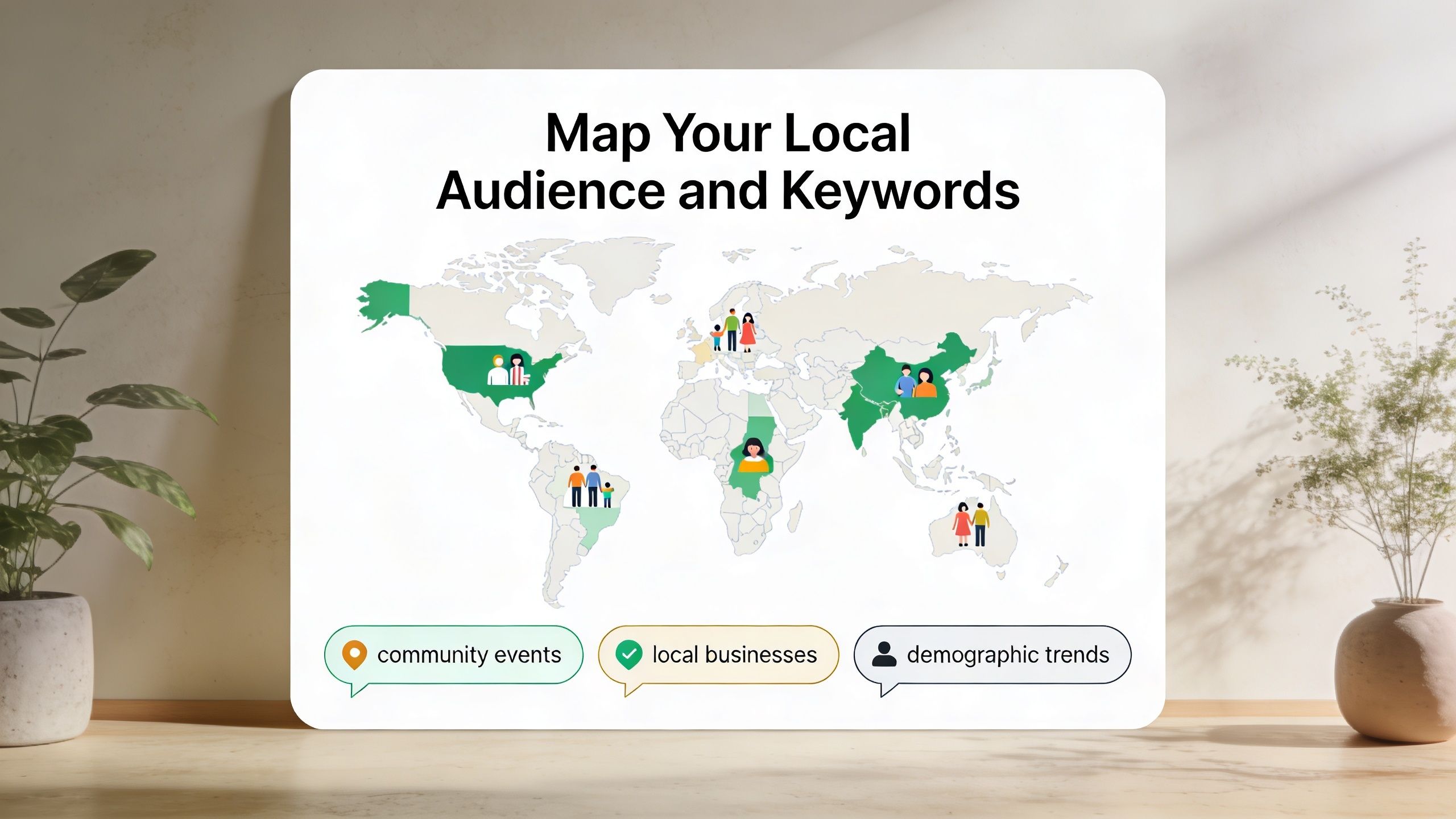
Pull phrasing from the places where intent shows up clearly:
- Phone call notes
- Contact form enquiries
- Sales and reception emails
- Reviews
- Questions asked during appointments, surveys, or venue viewings
- Google Business Profile Q&A
- Google autocomplete, People Also Ask, and related searches
The pattern matters more than the wording alone. A care provider might keep hearing questions about funding, respite availability, or dementia support in one part of the county. A private clinic may get repeated questions about parking, referral requirements, and how quickly a patient can be seen. A venue may hear the same concerns about guest capacity, on-site accommodation, and wet weather options.
Those are not side notes. They are content topics with buying intent behind them.
As the Content Marketing Institute explains in its research on audience-first planning, stronger programmes come from understanding what the audience is trying to solve, not just collecting search volume data. That same principle sits behind creating smarter content that converts, especially for local firms where intent changes by town, service, and urgency.
Sort keywords by intent and page type
A useful keyword list does one job. It tells you what page should exist and why.
I usually group local terms into four buckets.
Ready-to-buy searches
These are the commercial terms that deserve your strongest pages.
Examples:
- emergency plumber in Reading
- wedding venue in Surrey
- private GP Birmingham
- loft conversion company Stockport
Use these on service pages and location pages. Do not bury them inside blog posts.
Comparison searches
These come from people narrowing the shortlist.
Examples:
- best wedding venues near the Cotswolds
- home care vs care home Surrey
- porcelain or composite worktops Manchester
These fit guides, comparison articles, and FAQ content. Their job is to help a buyer choose, then push them into the main revenue pages.
Problem-led searches
These often sit just before an enquiry, especially in trades and healthcare.
Examples:
- leaking roof repair near me
- back pain physio Leeds
- what to do after a burst pipe York
These can work as service-supporting articles, local FAQs, or detailed sections on core pages. The trade-off is simple. If the query shows immediate service intent, keep it close to a conversion page. If it is more informational, a supporting article may be enough.
Trust and proof searches
These matter more than many businesses realise.
Examples:
- CQC registered care provider in Leeds
- experienced wedding photographer Lake District
- dentist accepting nervous patients Bath
- builder with planning experience Cheshire
These should shape testimonials, practitioner bios, accreditation sections, case studies, and FAQs. In healthcare and care especially, trust content is often what gets the lead over the line.
Build your research around real service areas
Many local businesses overstate their coverage in content and then wonder why leads are poor. If a roofer based in Swindon says they serve the whole South West, Google may still test those pages, but the enquiries often come from places the team does not want to travel to profitably.
Map keywords against the areas you genuinely want.
For a single-location business, that usually means:
- the main town or city
- nearby towns that already convert well
- villages or postcode districts you can serve efficiently
- county-level terms only where they match actual buyer behaviour
For multi-location businesses, it gets more precise. A dental group with clinics in Leeds, York, and Harrogate should not run one generic "Yorkshire dentist" strategy and hope for the best. Each clinic needs its own service priorities, local proof, and supporting topics based on what patients in that area search.
Use a repeatable local research routine
Keep the process simple enough that it gets done every quarter.
List the services you want to sell
Focus on profitable services, not every minor task you could technically take on.Add the places you want to win in
Use towns, districts, villages, boroughs, or postcode areas based on real coverage.Check Google's own signals
Search your service and area combinations. Review autocomplete, People Also Ask, related searches, and the types of pages ranking in the local pack and organic results.Review existing enquiry data
Look at which terms, places, and service combinations already bring calls or form fills through Google Business Profile and Search Console.Audit competitor page structures
Look at what local competitors have built. Service pages, town pages, FAQs, case studies, venue galleries, treatment explainers. The point is to spot gaps, not copy wording.Assign each keyword to a page
Every term needs a home. Service page, location page, FAQ, case study, blog, or GBP update.
A practical audit framework helps here. This local SEO checklist for auditing location relevance, page targeting, and conversion gaps is a useful reference while mapping the plan.
Sector examples that hold up in the real world
Trades
Urgency changes everything. Search behaviour for a blocked drain, boiler fault, or electrical issue is often immediate and location-heavy. Prioritise fault terms, emergency modifiers, service area phrases, and proof from nearby jobs.
Wedding venues
Couples often search by type of venue, county, capacity, ceremony style, and season before they search by brand. "Barn wedding venue East Yorkshire with accommodation" is far more useful than a generic wedding article that could rank anywhere in the UK.
Healthcare
Patients usually search around treatment, symptom, location, and reassurance. Good keyword mapping covers clinical intent and practical concerns. Examples include parking, referral process, wait times, practitioner qualifications, and what happens at a first appointment.
Turn the keyword list into a topic map
Random topic ideas create thin blogs and missed opportunities. A topic map creates coverage that supports rankings in both local organic results and Google Maps.
A solid structure usually includes:
- Core service pages targeting primary service plus town or city intent
- Location pages where the business has enough local proof and genuine coverage
- Supporting articles for comparisons, objections, and early-stage questions
- FAQ clusters answering repeated local concerns
- Case studies, testimonials, and team pages that strengthen trust and local relevance
- Google Business Profile content for offers, updates, seasonal demand, and events
That gives each search type a purpose. It also stops a common mistake. Businesses publish informational blogs for terms that should have been built into service or location pages from the start.
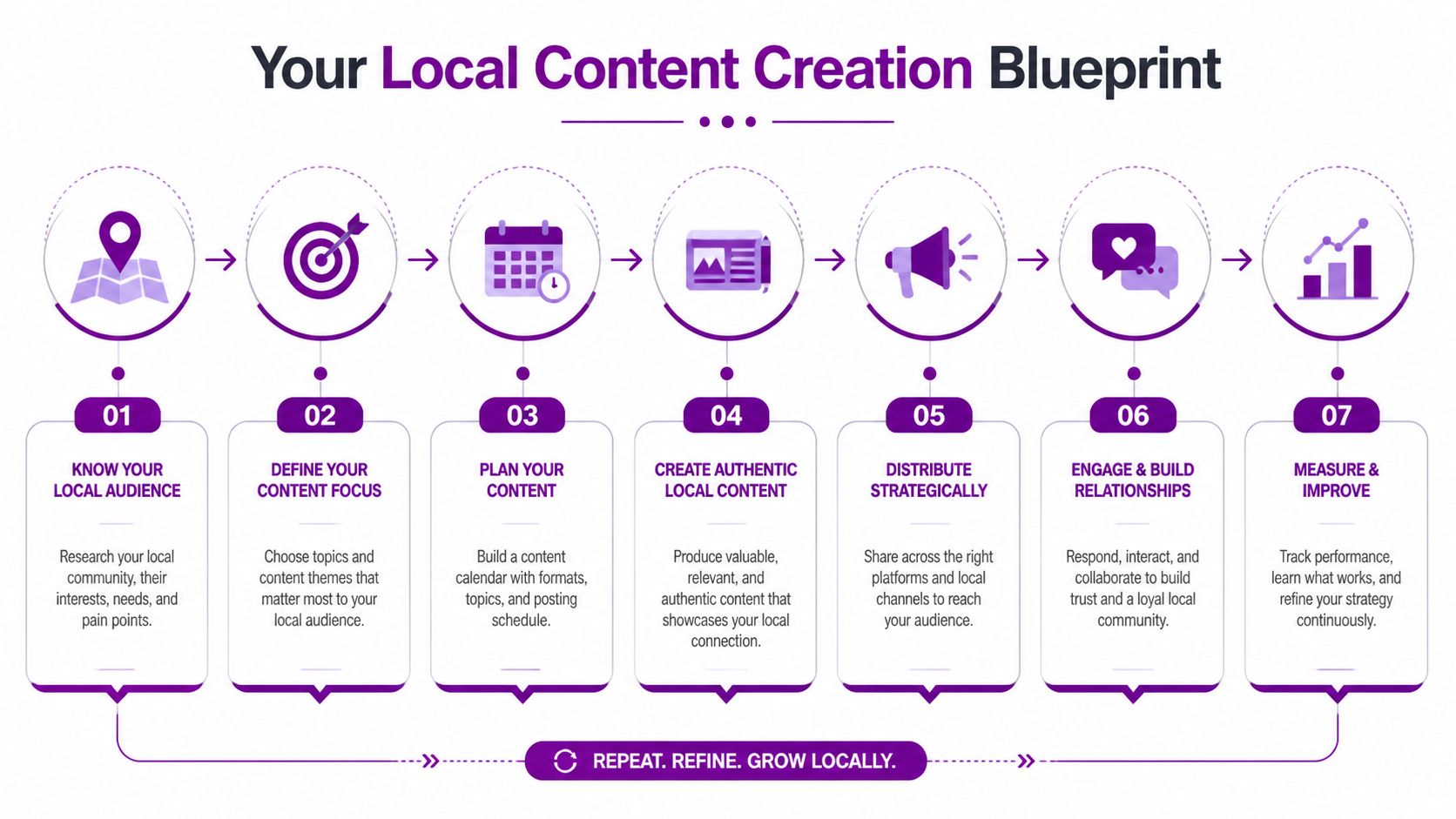
Your Local Content Creation Blueprint
A lot of local businesses get stuck at the same point. The keyword research is done, the service pages exist, and then the content plan turns into a pile of half-started blog ideas, overdue approvals, and town pages that never get finished.
The fix is a production plan that matches how local customers search and how your team operates. For a single-site trade business, that might mean one strong service-led article a month and steady page improvements. For a wedding venue or private clinic, it often means fewer posts, but better proof, better FAQs, and tighter links into enquiry pages.
Specialist content usually outperforms generic posting because it gives people a reason to trust you before they enquire. That is the true value of thought leadership. It is less about sounding clever and more about showing local buyers that you understand the job, the area, and the decision they are trying to make. LinkedIn’s B2B Institute has published useful research on why category expertise and authority matter in buyer response, which supports that wider point.
Build around three content types
Local campaigns work best when each content type has a job. In practice, three formats do most of the heavy lifting.
Location pages
These pages bring in enquiries when they are written properly. A useful location page explains the service in that area, shows local proof, and removes hesitation.
Include:
- the service and who it is for in that place
- local issues or buying triggers
- proof from nearby jobs, patients, events, or clients
- practical trust signals such as accreditations, opening details, response times, or parking
- one clear action, such as call, book, or request a quote
For example, a roofer in Chester should mention common storm damage, slate and tile issues seen on local housing stock, and recent work in nearby postcodes. A wedding venue page for North Yorkshire should cover capacity, accommodation, ceremony options, and what guests can expect on the day. A physiotherapy clinic page should answer the basics patients care about quickly, including referral routes, first appointment expectations, and access.
Long-form blogs
Blog content should support conversion pages, not drift away from them.
The strongest local articles usually do one of four jobs:
- answer a pre-enquiry question
- compare options
- handle an objection
- show real experience in a local setting
Good examples include:
- How to choose a care home in Surrey
- Questions to ask before booking a barn wedding venue in Yorkshire
- Signs your roof needs repair before winter in Chester
- How long physiotherapy treatment usually takes in Milton Keynes
Each article should point the reader to the next sensible step. That may be a service page, a location page, a booking page, or a case study.
Google Business Profile posts
GBP posts support the visibility work happening on the site. They are not a substitute for strong pages, but they can reinforce relevance and keep your listing active with useful updates.
Use them for:
- seasonal reminders
- service highlights
- local offers
- event updates
- recent jobs or project wins
- short answers to common questions
For trades, that could be a winter boiler servicing reminder. For venues, it might be an open day announcement. For a dental practice, it could be a post about hygiene appointments, new patient availability, or a finance option.
Set a publishing rhythm your team can keep up with
Consistency matters more than ambition.
A plan that your team can run for six months will beat an aggressive schedule that falls apart after week three. I usually advise local firms to start with one substantial article each month, one location page improvement each week, and regular GBP posting. That is enough to build momentum without creating a backlog.
Here is a workable monthly rhythm.
| Week | Blog Post (Long-Form) | Google Business Profile Post | Location Page Update |
|---|---|---|---|
| Week 1 | Publish problem-led local blog | Post service spotlight | Refresh one priority town page |
| Week 2 | Publish comparison or FAQ article | Post customer review or project update | Add FAQs to one location page |
| Week 3 | Publish trust-building guide | Post seasonal reminder | Improve internal links on key location page |
| Week 4 | Update older blog with local detail | Post offer, event, or team update | Add new proof section or case example |
This mix works because it balances new content with page improvement. That trade-off matters. Many local sites already have pages sitting on page two or three of Google that need better proof, better internal links, and clearer local detail more than they need another blog post.
Write for the local buyer, not for a marketing checklist
Local content succeeds when it answers the next question in the buyer’s head.
A good page tends to do five things:
- names the service clearly
- shows it is relevant to the area
- answers practical concerns
- proves you have done this work before
- gives the visitor an obvious next step
That applies across sectors. A plumber needs to show response times, job types, and coverage. A venue needs to reduce uncertainty around guest experience and suitability. A clinic needs to balance reassurance with clear treatment information.
A polished page that says very little usually loses to a plain page with useful specifics.
Build content differently by sector
The blueprint stays the same, but the emphasis changes by industry.
Wedding venues
Venues need content that helps couples shortlist and enquire. Strong assets include county pages, seasonal wedding guides, accommodation pages, ceremony FAQs, supplier advice, and galleries with context rather than just images. If you work in a visual market, examples from SEO for photographers are worth reviewing because the same trust signals apply to galleries, venue pages, and enquiry journeys.
Trades and construction
Trades need content that reflects urgency, job type, and proof. Focus on town pages, emergency service content, common fault explainers, and recent project examples with location context. It also helps to review guidance on creating smarter content that converts if your site gets traffic but too few calls or quote requests.
Healthcare and care services
Healthcare content needs precision and reassurance. Useful formats include treatment pages, practitioner profiles, first-appointment guides, accessibility information, condition-related FAQs, and pages that explain what happens before, during, and after care. The goal is to reduce uncertainty without making claims the practice cannot support.
Assign ownership before anyone starts writing
Content plans usually break because the work sits between people.
Even in a small business, the handover needs to be clear:
- Research owner gathers keywords, recurring questions, and competitor gaps
- Subject expert adds real operational detail
- Writer or editor shapes the page for clarity and search intent
- Approver signs it off quickly and checks accuracy
- Publisher uploads the page, formats it properly, and adds internal links
- Reviewer checks performance and updates weak pages
One person may cover several of those roles. That is common in owner-led businesses. The important part is knowing who is responsible, what “done” looks like, and how quickly each stage moves.
Scale Your Plan for Multi-Location Businesses
A business with five branches can end up less visible than a single-site competitor if every location page says roughly the same thing. I see this often with dental groups, estate agents, care providers, and regional trades. The brand is established, but the local signals are weak, so Google has very little reason to rank one branch above another in Maps or local organic results.
Multi-location content needs a different operating model. The job is to keep brand standards tight while giving each branch enough local detail to earn trust, rankings, and enquiries in its own area.

Use a hub and spoke model
A hub and spoke structure works well for this.
The hub covers the parts that should stay consistent across the business. Core services, brand positioning, compliance wording, design patterns, and the main site architecture usually belong here. The spokes are the branch-level pages and assets that reflect how that location operates.
For a wedding venue group, the central brand can stay the same while each venue page includes its own gallery, capacity details, nearby accommodation, transport advice, and answers to local planning questions couples ask. For a plumbing company with teams across several counties, each service area needs examples of recent jobs, response times by territory, and the kinds of property issues common in that patch.
Decide what stays central and what goes local
Multi-location plans usually drift off course at this stage. Head office writes everything and the pages sound interchangeable, or every branch writes its own copy and the site turns messy, inconsistent, and hard to manage.
Use this split as a starting point:
| Centralised | Localised |
|---|---|
| Brand positioning | Service area copy |
| Core service definitions | Team details |
| Compliance and regulated wording | Local case studies and project photos |
| Site structure and design components | Travel, parking, and access details |
| Main conversion layout | Branch-specific trust cues and FAQs |
The split will vary by sector. In healthcare, compliance, treatment descriptions, and claims need tighter central control. In trades, local proof and service coverage often do more of the ranking work.
Build fewer pages, but make each one stronger
Publishing a page for every town on a map rarely works if the business has no real presence there. It creates thin content, clutters the index, and gives sales teams little they can use.
A better plan is to build around real locations and real demand:
- one strong page for each staffed branch or genuine operating base
- service subpages only where that branch has proven demand
- local case studies tied to named jobs, areas, or property types
- branch FAQs based on actual calls and enquiries
- Google Business Profile updates that support the same local themes
- a small number of local articles where there is a clear commercial angle
A venue group does not need 40 vague area guides. It may need five excellent venue pages, seasonal wedding planning content for each county it serves, and a bank of real wedding stories tied to each site.
Use templates without producing clone pages
Templates help teams scale. Bad templates produce pages that only swap the place name.
A useful location page template gives your team a fixed structure but leaves room for branch-specific detail. Include:
- a short summary of what that location offers
- areas served or catchment detail
- local demand or common customer concerns
- named staff, clinicians, or service leads
- proof from recent jobs, events, or patient feedback
- FAQs drawn from that branch
- contact details, opening hours, map information, and next steps
For regional trades and contractors, the same principle applies to service-area expansion. The examples in this guide to SEO for construction companies show why local proof, service coverage, and page intent need to line up if you want enquiries rather than empty impressions.
Set up one production system for every branch
Branch-led content often fails because nobody knows who is feeding what into the process. One manager sends photos. Another sends nothing. Head office chases updates, pages stall, and the content calendar slips.
Set one process for briefs, approvals, publishing, and updates. Then ask each location for a small set of inputs on a fixed schedule.
Local teams should provide:
- recent jobs, wins, or patient stories that can be used safely
- photos of the team, premises, or completed work
- recurring questions from calls and walk-ins
- local service details, availability, or constraints
- community links, events, or partnerships that matter in that area
The central team should handle:
- keyword mapping by branch and service
- page structure and on-page SEO
- editing and quality checks
- internal linking
- publishing standards
- tracking and performance reviews
That division keeps quality under control and still gives each branch a page set that feels real. For multi-location businesses, that is usually the difference between a site that merely covers areas and a site that generates local leads from them.
Measure and Report on Local Success
A builder in Leeds publishes two location pages, three job-based posts, and a round of Google Business Profile updates. Six weeks later, calls are up, but nobody can say which work drove them. That is where local reporting usually breaks. Activity gets logged. Commercial impact does not.
Local lead journeys are rarely neat. Someone reads a blog on garage conversions in Headingley, comes back later through a branded search, then phones from the Google Business Profile after seeing fresh reviews. If reporting only credits the last click, content looks weaker than it is. If reporting only shows traffic, weak pages can look successful.
Track the actions that lead to revenue
Start with outcomes a business owner would care about. For a wedding venue, that is usually brochure requests, viewing bookings, and calls. For a private clinic, it might be consultation requests by treatment and town. For an electrician, it is often phone calls, quote forms, and which service areas keep producing work.
For most local businesses, the core reporting set includes:
- Phone calls from the website and Google Business Profile
- Form submissions from service, treatment, and location pages
- Direction requests for clinics, venues, showrooms, and other premises-based businesses
- Appointment, consultation, or viewing requests
- Brochure downloads where sales follow-up is part of the process
- Enquiries by town or branch so you can see where content is producing demand
This gives you a clearer view of lead quality by area, not just top-line traffic.
Build a monthly dashboard you will actually use
Fancy reporting does not fix bad tracking. Clean inputs do.
A simple dashboard in Looker Studio or even a spreadsheet is enough if it shows what changed, where leads came from, and which content assets played a part. I usually split it into four sections.
Lead outcomes
Show calls, forms, bookings, and other high-value actions by page type, service, and location.
Content contribution
Highlight the blogs, FAQs, and location pages that assisted enquiries, even when they were not the final page before conversion.
Google Business Profile performance
Track calls, website clicks, and direction requests alongside post activity, review growth, and listing edits.
Content actions taken
Log what was published, updated, consolidated, or internally linked that month. This context helps explain performance changes later.
Good reporting should answer one practical question. Which content work brought in better local enquiries?
Look for patterns that change decisions
Totals on their own are blunt. A page can bring in modest traffic and still be one of your best lead drivers. Another can rank for a visible local term and produce nothing except low-intent visits.
Monthly reviews should surface patterns such as:
- blog topics that regularly assist leads
- service pages with traffic but weak conversion rates
- branches with strong Google Business Profile engagement but poor website follow-through
- FAQs that remove hesitation and improve conversion on treatment or service pages
- towns getting visibility where the page still lacks proof, local detail, or a clear next step
This is also where trade-offs become obvious. A venue may decide to invest more in pages that produce fewer visits but better-quality viewing requests. A multi-site dental group might find one branch gets map actions but loses bookings because the page copy is thin or the enquiry path is clunky.
If you want a clearer way to tie search activity to commercial value, this self-storage ROI calculator for SEO is a useful model for forecasting return from organic growth, even if you run a clinic, venue, or trade business rather than a storage site.
Use reporting to tighten the plan
Reporting should change what happens next month.
That may mean expanding a topic cluster that keeps assisting enquiries, rewriting a weak location page, adding job photos and trust signals to an area page, or improving links from informational posts into money pages. Sometimes the right move is to stop producing a type of content that gets visits but never helps sales.
The strongest local content plans improve because measurement is built into the process from the start. That is how a content plan stops being a publishing exercise and starts pulling its weight in leads, bookings, and revenue.
Common Questions on Local Content Plans
How often should a local business publish content
As often as you can maintain quality and consistency. For most small businesses, one strong local blog post, regular Google Business Profile updates, and steady work on key location pages is better than trying to publish every day and producing weak copy.
Should service pages or blog posts come first
Start with service and location pages if they’re missing or thin. Those pages usually target the strongest buying intent. Blogs help, but they work best when they support solid commercial pages underneath.
Do I need a separate page for every town
Only for places you serve and can support with distinct, useful information. Thin duplicate pages usually underperform. A smaller number of strong pages with local detail is the better route.
What makes local content trustworthy
Specificity. Real service detail, named areas, useful FAQs, staff expertise, proof from local work, accurate contact information, and copy that answers practical concerns. Generic content sounds interchangeable. Trustworthy local content sounds grounded.
How long do content marketing plans take to work
Local content compounds over time, especially when tied to page improvements, internal linking, and Google Business Profile activity. You’ll usually see different content types move at different speeds. Some updates improve conversions quickly. Rankings and authority often take longer.
Can I use AI to write local content
AI can help with structure, outlines, and first drafts, but local lead generation still depends on real business knowledge. If the final page doesn’t reflect your service area, customer questions, and local proof, it won’t carry much weight.
If you want a practical local SEO strategy rather than another generic content checklist, Bare Digital helps UK businesses turn content marketing plans into rankings, enquiries, and measurable growth. Their team works across trades, venues, healthcare, and multi-location brands, with a focus on Google Maps visibility, location pages, Google Business Profile optimisation, and reporting that ties content work to real business outcomes.






