
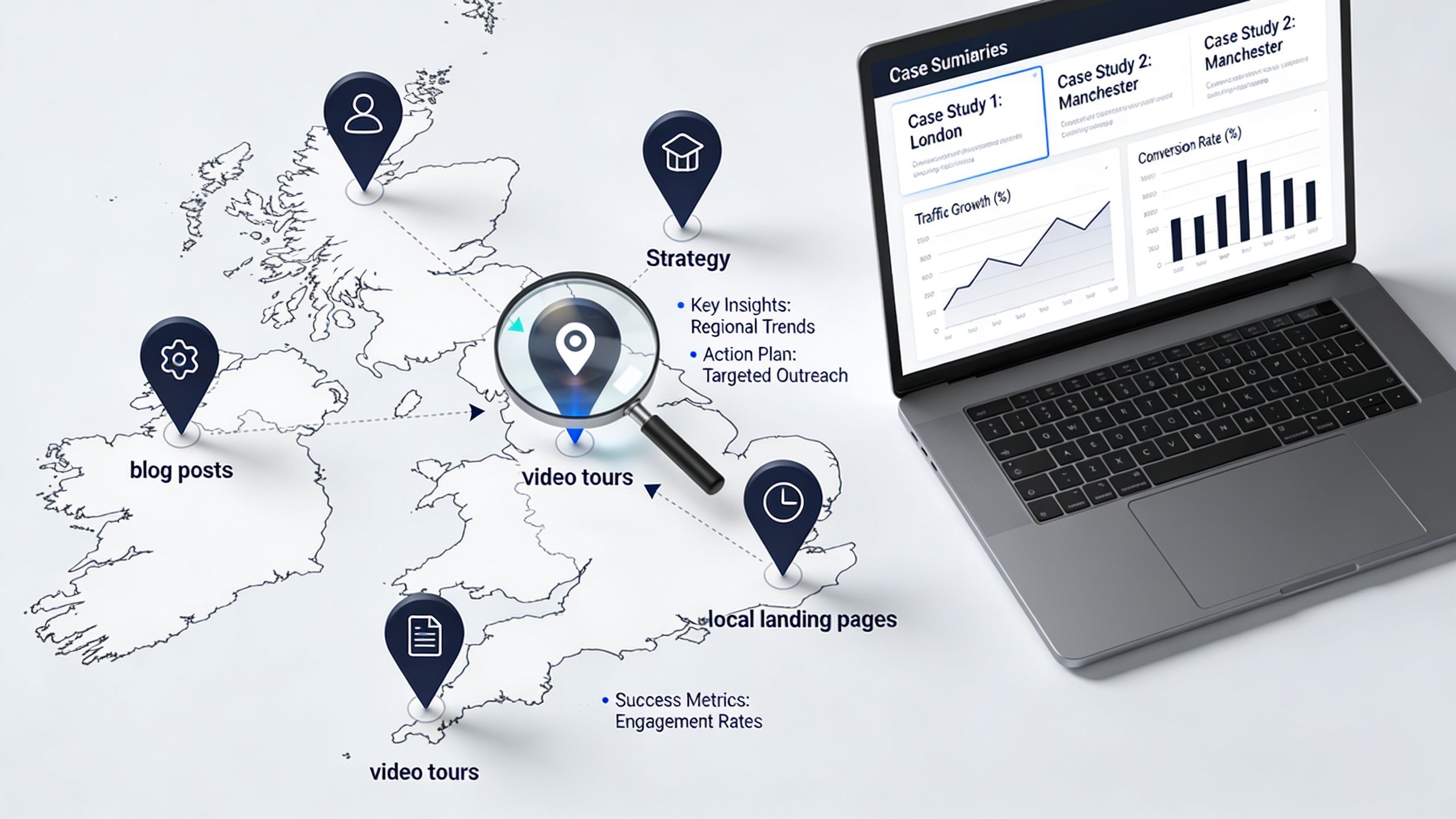

Are you publishing content that gets clicks but never turns into local enquiries? That’s the gap most generic advice misses. It talks about “brand awareness” and “thought leadership” as if a wedding venue in Yorkshire, a funeral director in Manchester, and a builder in Cardiff all need the same plan.
They don’t.
Local content marketing works when it matches how people search, compare, and decide in a specific town, city, or postcode. That’s why broad blog advice often falls flat. It ignores Google Business Profile, ignores service-area pages, and ignores the trust signals that matter when someone needs a local provider now, not next quarter.
This guide keeps it practical. You’ll find eight example content marketing wins that local UK businesses can apply, from Google Map Pack visibility to location pages, case studies, videos, FAQs, and segmented email follow-up. Each one comes with a simple blueprint, clear actions, and the KPIs worth tracking.
The opportunity is real. Content marketing has shown measurable ROI potential for UK businesses, with B2B content marketing producing an average 3:1 return and successful brands reaching median returns of 4.33:1 when campaigns are executed well, according to Genesys Growth’s content marketing ROI roundup. The catch is that results usually take time to show up, so local businesses need a plan they can sustain.
Here’s what that looks like in practice.
1. Google Business Profile Optimisation & Local Pack Rankings
Want more local enquiries without waiting for a blog post to rank?
Start with your Google Business Profile. For many UK businesses, it is the first piece of content a potential customer sees. Before they read your site, they scan your reviews, services, photos, opening hours, and recent updates in the local pack.
That matters because local intent is usually urgent. Someone searching for “funeral directors Bristol” or “kitchen renovation Cambridge” is not browsing for fun. They are comparing options fast, and Google gives them enough information to shortlist a business before a single website click happens.
A well-run profile works like a live sales page. A neglected one costs leads.
What a strong local profile looks like
The best profiles are specific, current, and tied to real buying questions.
A wedding venue can post open-day dates, seasonal package updates, and photos that show how the same room looks for a summer wedding versus a winter reception. A funeral home can write service descriptions that answer practical concerns clearly and reply to reviews with the right tone and level of care. A construction firm can upload project photos labelled by service and area, such as loft conversions in Reading or kitchen extensions in Newbury, so prospects can match the work to their own job.
Freshness matters, but relevance matters more. Weekly posting is a sensible cadence for many local businesses because it keeps the profile active without turning it into a time sink. If the team cannot maintain weekly updates, a consistent fortnightly schedule with better-quality posts is usually the better trade-off.
Practical rule: If your latest post, newest photo, and most recent review response are all old, your profile suggests the business is slow or inattentive.
Replicable blueprint for local pack gains
Use this as an operating brief, not a checklist you complete once.
- Business description: Write around core services, service areas, and differentiators. Keep it readable. Cramming in every nearby town usually makes the profile weaker, not stronger.
- Primary and secondary categories: Choose the closest fit to the main revenue-driving service first, then add supporting categories only where they reflect real delivery.
- Post schedule: Publish updates on availability, recent jobs, seasonal demand, offers, events, or common customer questions. Tie each post to a real action, such as calling, booking, or requesting a quote.
- Photos and videos: Add recent, original media. Prioritise exterior shots, team photos, completed work, and location-specific proof over stock-style images.
- Products and services: Fill these out properly. They often get skipped, but they help reinforce what the business sells.
- Q&A management: Add and answer common questions based on sales calls and front-desk queries. This saves time and improves pre-click trust.
- Review responses: Reply to every review. Good responses support conversion. Poor, defensive, or generic ones can undermine strong ratings.
- Tracking: Watch calls, direction requests, website visits, and booked actions. Those are the signals that tell you whether profile activity is turning into leads.
One warning from agency work. Google Business Profile optimisation is rarely won by one big change. It is usually the combined effect of better categories, stronger service wording, more useful posts, regular photo uploads, and faster review handling. Small gains stack up.
If you want a faster way to spot gaps, use this Google Business Profile audit tool from Bare Digital. It helps identify weak categories, thin descriptions, missing trust signals, and content gaps you can fix first.
2. Long-Form Blog Content with Local Intent & Authority Signals
What should a local business blog do if it is meant to bring in enquiries, not just fill a content calendar?
It should help someone make a decision in your area, with enough detail to prove you know the job, the local context, and the risks of getting it wrong. That is where long-form content earns its keep. A broad post about “top design trends this year” does little for an interior designer in Leeds. A practical guide on choosing an interior designer in Leeds for a period property renovation can rank for local searches, answer buyer concerns, and move readers towards an enquiry.
For local SEO, long-form content works best as a support page with a job to do. It should target a specific local question, link to the right service and location pages, and give Google clear authority signals through depth, specificity, and internal context. The trade-off is simple. Longer posts take more time to brief, write, and maintain. Thin posts are quicker to publish, but they rarely rank for useful terms or convert once someone lands.
What earns traffic and trust
The strongest local blog posts sit close to commercial intent.
A funeral home can publish a pre-planning guide based on the decisions families in its service area usually face. A wedding venue can create a county-specific guide that covers guest numbers, access, accommodation, parking, supplier rules, and wet-weather backup plans. A building firm can explain what homeowners should check before hiring a contractor in a specific part of the UK, including planning constraints, property types, and realistic timelines.
That level of detail matters because it shows lived knowledge, not recycled advice.
Weak posts usually fail for predictable reasons. The topic is too broad. The advice could apply to any town. The introduction says little. The article avoids actual buying questions, such as budget range, lead times, regulations, or how to compare providers.
A repeatable brief for local long-form content
This is the format we use when turning “we should write a blog” into a page that can support rankings and leads:
- Primary keyword: Service plus town, county, or local problem
- Secondary terms: Related questions, local modifiers, and service variations
- Search intent: Informational with clear commercial relevance
- Reader goal: What are they trying to choose, avoid, compare, or understand before they contact someone?
- Local proof to include: Nearby places, local examples, common property types, service area details, local regulations, or on-the-ground considerations
- Internal links: Relevant service page, location page, and one supporting guide
- CTA: Quote request, consultation, booking, or phone call
Many local businesses often make a mistake. They do the keyword research, then stop short of the useful part. The page needs local proof built into the brief from the start, not added as an afterthought.
A simple blueprint you can reuse
If you want these posts to work consistently, use a structure like this:
Open on the local decision
State the exact problem and area. Example: “How to choose a roofer in York for an older terrace property.”Cover the questions buyers ask before they enquire
Price expectations, timeframes, planning issues, supplier access, warranties, materials, and what can delay the job.Add local authority signals
Mention conditions that are relevant to the area, such as conservation zones, parking restrictions, local weather exposure, or common building styles.Show real experience
Use examples from past jobs, common mistakes seen during quotes, or issues that come up repeatedly in that postcode or county.Link readers to the next step
Point them to the matching service page and the relevant location page, then give them a clear action.
A good long-form post should make the service page stronger, not compete with it.
If you need a planning framework, Bare Digital’s local SEO checklist for content and internal linking is a useful reference for mapping blog topics to service pages and location pages so each article supports a wider local ranking strategy.
3. Location-Specific Landing Pages with Trust Signals
A location page should never be a find-and-replace exercise.
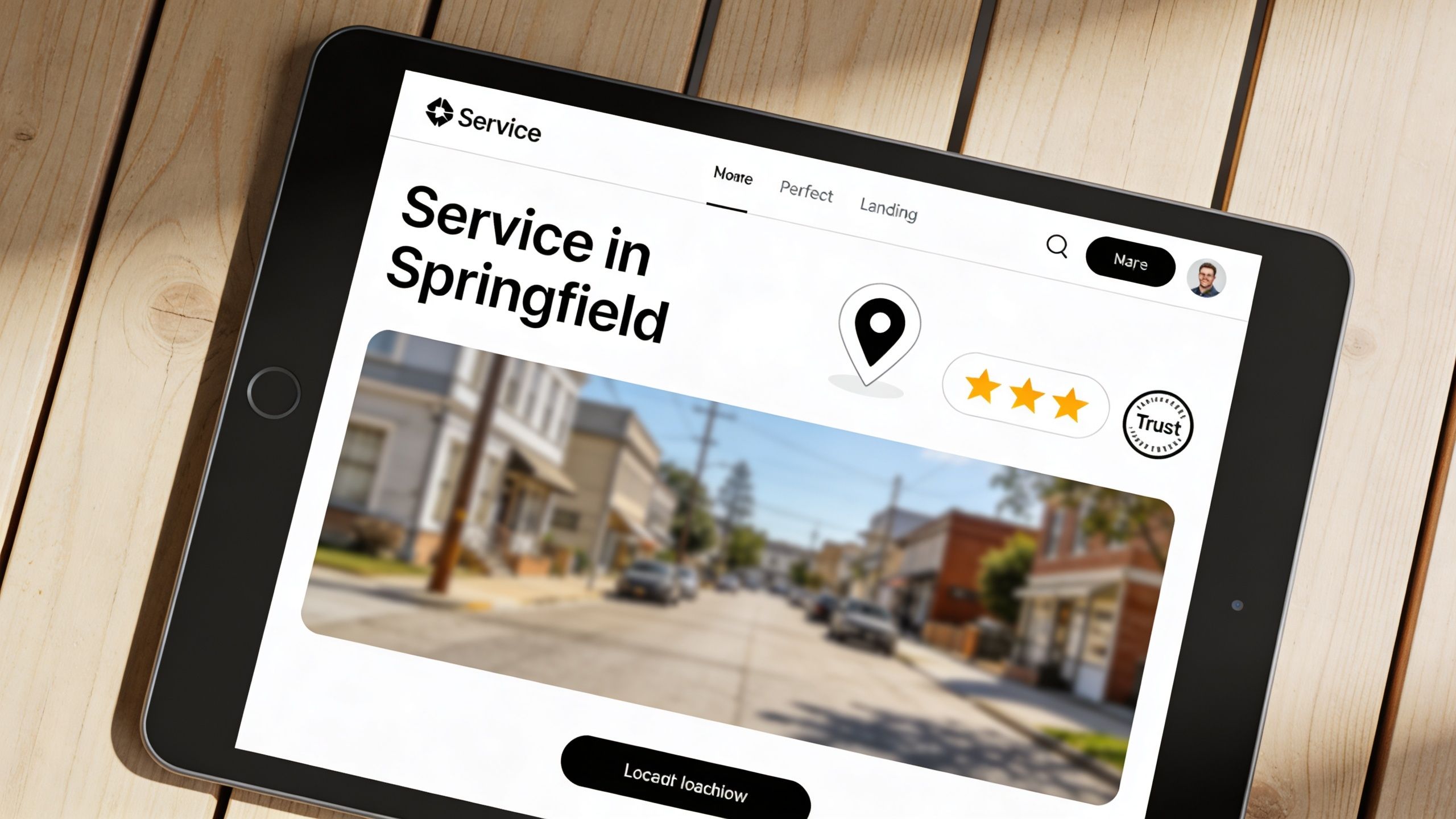
If you duplicate the same service copy across ten town pages and swap only the town name, Google can spot it and users can too. The better model is one page per service-location combination, each built around real local proof.
That means a page for “wedding venues Bristol” should not read like “wedding venues Bath” with the place name changed. The Bristol page should mention relevant local logistics, actual supplier relationships, nearby landmarks, and examples from clients in that area.
What to include on the page
A strong page combines search relevance with reassurance. For a local photographer, that might be venue-specific portfolio shots and reviews from couples in that county. For a construction firm, it could be service details, local project images, and a short explanation of the kinds of properties common in that area.
The structure can be simple:
- Opening section: Clear service and area match
- Proof section: Testimonials from local customers
- Project or story section: One relevant example from that location
- Trust section: Certifications, accreditations, partnerships
- Action section: Contact form, call button, or booking CTA
The technical layer matters too
Location pages perform better when the supporting SEO basics are right. One case study example from Fractl describes a local SEO approach that included location-specific terms, schema markup, and mobile-first performance, with a recommendation to keep page speed under three seconds in content hubs built around location pages, as covered in Fractl’s content marketing case studies article.
That doesn’t mean every small business needs a huge content hub immediately. It does mean each location page should be unique, fast, and connected to your Google Business Profile where relevant.
For a local benchmark of how service pages can be framed, look at a targeted service example like Bare Digital’s Cambridge SEO services page. It shows the value of pairing local relevance with a clear service proposition.
4. Customer Case Studies & Local Success Stories
Case studies are one of the clearest forms of example content marketing because they prove you can solve a real problem for a real client.
They also force honesty. A weak service page can hide behind polished copy. A case study can’t. Either the problem was clear, the work was sensible, and the outcome mattered, or it wasn’t.
A local version doesn’t need to be flashy. It needs to show context. A wedding venue marketing case study should explain the venue type, the visibility problem, the actions taken, and the business impact. A funeral home case study should focus on sensitivity, local reach, and trust rather than hype.
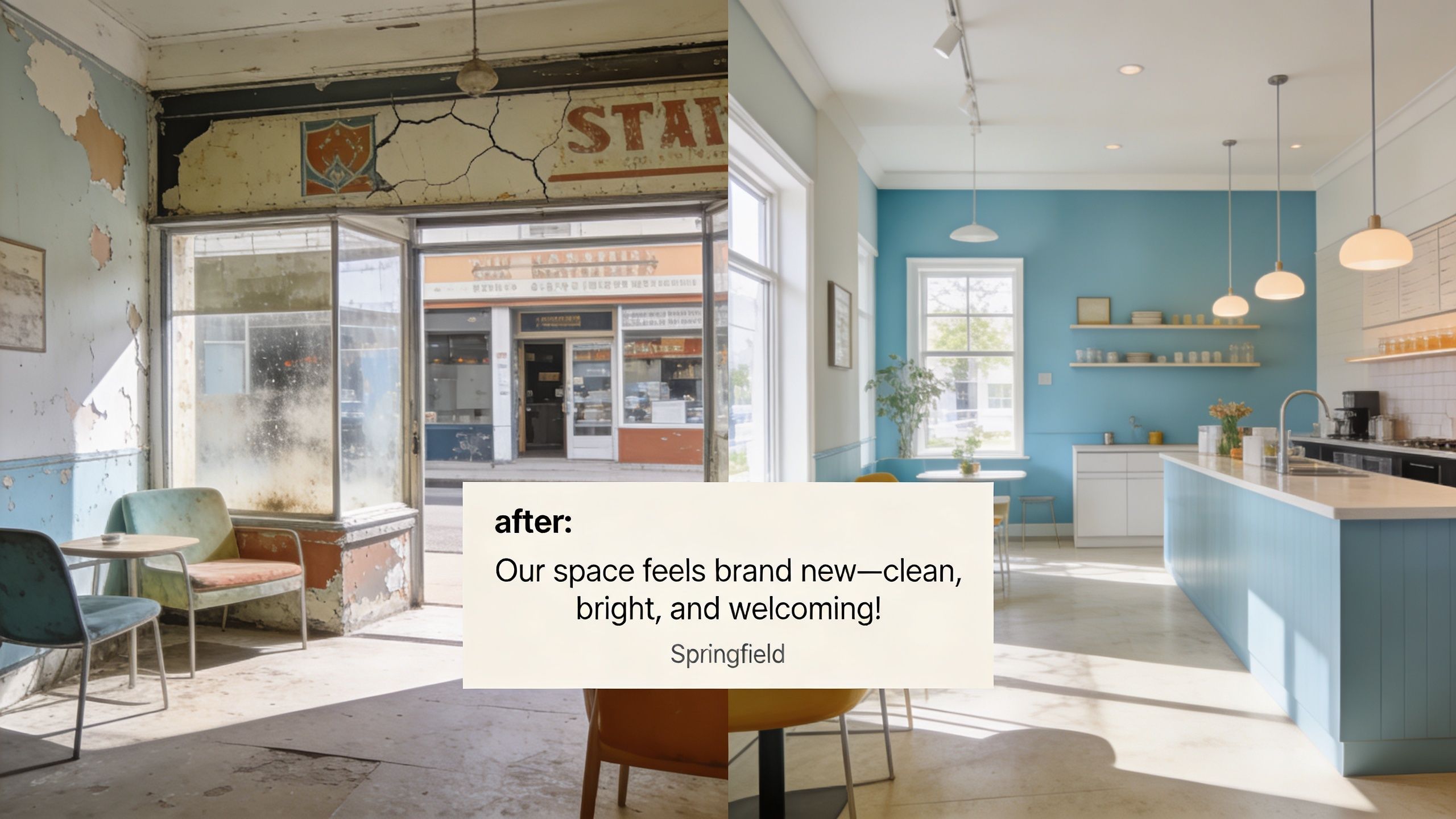
A visual before-and-after helps if the service supports it.
The best structure is simple
Use problem, action, result.
Start with what was broken. Low enquiry quality, poor local rankings, inconsistent messaging across locations, weak review management, or thin service pages. Then show exactly what changed. New location pages, revised Google Business Profile content, improved internal linking, fresh photography, monthly blogs, or stronger call-to-action placement.
Don’t overcomplicate the writing. Prospects skim case studies for relevance. They want to know whether the client looked like them and whether the result seems achievable.
One strong outside example of commercial storytelling is GolfRep’s growth system results, not because every local business needs the same tactic, but because the narrative is outcome-led and easy to follow.
What to measure and what to avoid
Track rank improvements for target terms, enquiries, booked calls, quote requests, and lead quality. If the result is mainly qualitative, say that plainly. Better-fit leads and easier sales conversations are still valid outcomes.
Avoid made-up precision. If you can’t verify a number, leave it out.
For businesses that need help tying traffic gains back to value, tools like Bare Digital’s self storage SEO ROI calculator show the broader point well. Content works best when it’s connected to commercial outcomes, not just pageviews.
A short client-led format can work on video too.
5. Authority-Building Link Campaigns & Local Partnerships
What gets a local business the right kind of links without drifting into spam? Usually, it is a useful local asset plus a sensible reason for another organisation to reference it.
Local authority is built through relevance first. A link from a nearby chamber, trade body, supplier, venue partner, college, charity, or regional publisher often does more for a local business than a random high-metric site with no connection to the area or service. Google is trying to understand whether your business is trusted in its real market, not whether you bought a batch of mentions from unrelated blogs.
That changes how the campaign should be planned.
A wedding venue can publish a practical ceremony planning guide for couples getting married in its county, then share it with photographers, florists, caterers, and local tourism sites. A funeral home can create a bereavement support resource and make local charities, counsellors, and community groups aware of it. A builder can produce a homeowner guide to planning permission, extensions, or renovation timelines for a specific town, then pitch it to property journalists, suppliers, and local business networks.
A repeatable local link campaign blueprint
Start with an asset a partner would want to cite. Good examples include:
- a local area guide tied to your service
- a downloadable checklist
- a supplier or venue directory
- a seasonal event or maintenance calendar
- a page answering common local regulations, costs, or process questions
Then build outreach around audience fit, not volume.
- Create a target list: Chambers, local press, BID organisations, schools, colleges, suppliers, venues, charities, associations, and complementary businesses.
- Match one angle to each contact: A supplier may care about a checklist. A local paper may care about a data-led comment or seasonal guide.
- Write short outreach emails: Explain why the asset helps their audience. Skip generic templates.
- Keep business details aligned: Name, address, phone number, and service information need to match across listings and mentions.
- Review the asset every quarter: Outdated pages lose trust and stop attracting links.
One pattern I see often is businesses asking for links before they have published anything worth referencing. Outreach works better when the page is useful on its own. Partners are more likely to mention a resource that saves their audience time, answers a local question, or supports their own content.
Brief template local businesses can copy
Asset type: Local resource page
Goal: Earn relevant links and referral traffic from local partners
Example topic: "Planning a Barn Wedding in Yorkshire: Venues, Suppliers, Timings and Guest Travel Tips"
Primary targets: Photographers, florists, wedding planners, local tourism sites, bridal blogs with regional coverage
Outreach hook: "We have put together a practical Yorkshire planning guide your readers may find useful, especially the venue logistics and travel section."
KPI set: New referring domains, qualified referral visits, local keyword movement, assisted enquiries
This works well in service sectors where trust and local proof carry a lot of weight. For businesses with location-led competition and long sales cycles, a focused strategy such as self storage SEO services shows the wider point. Rankings improve faster when authority signals support pages that already have clear intent, solid structure, and useful content.
Avoid two common mistakes. Chasing link quantity over local fit. Publishing a resource once, then never updating it. A small set of relevant, earned links from the right local sources is usually the better commercial play.
6. Video Content for Local Engagement & Google Rankings
What would a customer want to see before they trust you enough to call?
For many local businesses, video answers that faster than another block of copy. A venue tour shows layout, flow, and atmosphere. A builder walkthrough shows the standard of finish. A funeral director introduction shows tone and care. Those are buying signals, not just content pieces.
Video also pulls its weight across the full local search journey. It can improve engagement on service pages, give your Google Business Profile stronger media, and help hesitant prospects qualify themselves before they enquire. That usually means better conversations, not just more page views.
The video formats that work for local firms
Start with videos that remove doubt or answer a real pre-sale question.
- Walkthrough videos: Show the premises, key spaces, parking, access, and what a visit looks like
- Project breakdowns: Explain the brief, the work completed, the result, and any constraints
- Testimonial clips: Short customer comments with specific outcomes, not vague praise
- Process explainers: Cover what happens from first enquiry to completion
- Area-specific advice videos: Answer questions tied to local regulations, access issues, or customer concerns in your service area
A wedding venue should film a practical tour that covers ceremony space, reception setup, guest flow, accommodation, and wet weather options. A construction company should record a clear site walkthrough that explains phases, timings, disruption, and decisions the client needs to make. Useful beats polished in most local markets.
A simple production brief you can reuse
Keep the setup lean. One speaker. One topic. One clear next step.
Video goal: Reduce hesitation before enquiry
Audience: Local prospects comparing 2 to 5 providers
Example title: "What to Expect During a Loft Conversion in Leeds"
Must cover: Timeline, access, noise, key milestones, who manages the job
Call to action: Request a quote or book a site visit
KPI set: Video views, average watch time, page engagement, assisted enquiries
This approach keeps the content tied to a commercial purpose. Too many businesses film generic "about us" videos that look fine but answer nothing.
Where to publish it and how to get SEO value from it
Publish the full version on YouTube using a title that includes the service and location naturally. Write a description that explains what the viewer will learn, not just your company name and phone number. Embed the same video on the most relevant service or location page. Add shorter clips to your Google Business Profile if they support a specific service or local intent.
Keep the structure tight. Open with the question being answered. Get to the useful part within the first few seconds. Cut anything that only exists to make the video feel more cinematic.
Production quality matters, but only up to a point. Clean audio, steady framing, and a speaker who knows the job are usually enough. For local SEO, clarity wins because clarity keeps people watching and helps them decide.
7. FAQ Content & Featured Snippet Optimisation
What are potential customers typing into Google right before they call you?
For a lot of local businesses, those searches are the same questions your team answers every week. Wedding venues hear questions about deposits, corkage, parking, and guest numbers. Builders get asked about timelines, planning permission, access, and staged payments. Funeral directors deal with urgent, practical questions about what happens next and what paperwork is needed.
That makes FAQ content useful in two ways. It can pick up visibility for high-intent searches, and it can reduce time spent repeating the same answers by phone or email.
How to write snippet-friendly answers
Featured snippets usually go to pages that answer the query fast and cleanly. The structure matters. So does restraint. If the question is "Do I need planning permission for a loft conversion in Leeds?", the first line should answer that directly, then explain the conditions.
Use a repeatable format:
- Write the question as a real search query
- Answer it in the first sentence
- Add one short explanation with local context
- Use bullets if the answer includes steps, costs, or exceptions
- Point readers to the relevant page if they need detail
A weak answer tries to sound polished. A strong answer removes friction.
For example:
Do I need planning permission for a loft conversion in Leeds?
Many loft conversions fall under permitted development, but some do need planning permission, especially if the design changes the roof shape or the property is in a conservation area. Check the property type, proposed plans, and local restrictions before work starts.
That format works on standalone FAQ pages, but I usually get better results by placing FAQs on the page that matches the intent. Put service questions on service pages. Put area-specific questions on location pages. Put urgent process questions where someone is already deciding whether to contact you.
Where FAQs fit in a local content system
FAQ content works best when it supports a commercial page, not when it sits in an isolated library no one visits. A venue page can answer practical booking questions. A builder's York page can cover access, parking permits, terraced housing constraints, or waste removal rules. A funeral home page can explain next steps in plain language without sounding clinical.
This is also a trust play. Clear answers show that you understand how local customers make decisions. They are not looking for brand slogans. They want specifics, quickly.
Add FAQ schema where it makes sense. Use it to help search engines interpret the page. Do not rely on markup to carry weak copy. The page still needs direct answers, plain English, and a clear next action.
A simple FAQ brief you can reuse
Keep the scope tight. Start with five to ten questions pulled from real enquiries, not brainstormed guesses.
Page goal: Capture high-intent question searches and reduce pre-sale friction
Audience: Local prospects comparing providers or checking a practical detail before enquiring
Example topic: "Do I need planning permission for a loft conversion in Leeds?"
Must cover: Direct answer, local caveats, common exceptions, next step
Call to action: Request a quote, book a survey, or speak to the team
KPI set: Impressions for question-based queries, click-through rate, snippet visibility, assisted enquiries
Good FAQ content is not filler. It is sales enablement content written in search language.
8. Email Marketing & Lead Nurture Campaigns with Local Segmentation
How many leads does your website generate, then lose because every follow-up email sounds the same?
For local businesses, email should pick up the intent a visitor already showed. If someone requested a quote for a loft conversion in Leeds, send Leeds-relevant proof, timing, and next steps. If they asked about wedding dates in Kent, send availability, real weddings, and supplier recommendations for that area. Generic nurture emails flatten those differences and waste good enquiries.
The practical fix is simple. Segment by location, service interest, and lead stage.
A multi-location business does not need a complicated automation stack to do this well. Start with three to five core segments, then build short sequences around real buying questions. New enquiry from Manchester. Past customer in Bristol. Downloaded guide for kitchen extensions. Viewed pricing page twice. Those are useful signals. "Newsletter list" is not.
A local email brief you can reuse
Keep each sequence tight and tied to one commercial outcome.
Campaign goal: Turn local enquiries into booked calls, visits, or quote requests
Audience: Leads grouped by area, service, and intent level
Example use case: A wedding venue sending different follow-up sequences for Manchester couples, Cheshire couples, and people who already booked a viewing
Must cover: Local proof, service availability, common objections, clear next step
Email flow: Welcome email, one practical advice email, one local case study or testimonial, one booking prompt
CTA: Book a call, schedule a visit, request a quote, or reply to check availability
KPI set: Open rate, click rate, reply rate, booked appointments, quote requests, unsubscribe rate
The content itself should sound like a continuation of the search journey, not a separate channel. A solicitor can send area-specific guidance on timelines and common concerns. An interior designer can send project examples from nearby postcodes, budget ranges, and lead times. A construction firm can send seasonal advice, but tie it back to the service and the area the prospect asked about.
Good local nurture campaigns also respect buying speed. Some prospects want a call this week. Others need proof over a few weeks before they act. That is why I usually recommend a short sequence first, then a lighter long-term list for people who are interested but not ready. It keeps follow-up relevant without training subscribers to ignore you.
What to track
Track commercial movement, not vanity metrics.
Useful KPIs include:
- Open rate: Shows whether the subject line and timing match the lead's intent
- Click rate: Shows which services, locations, and offers pull interest
- Reply rate: Strong signal for local service businesses where deals often start in email
- Booked actions: Calls, viewings, surveys, and quote requests
- Unsubscribe rate: Early warning that the message, frequency, or segment is off
- Lead-to-sale quality: Which segment produces the best customers, not just the most clicks
As noted earlier, strong content marketing only matters if it leads to revenue. Email makes that link easier to measure because you can track which local sequence led to a booked consultation, site visit, or repeat purchase.
Well-built nurture campaigns do more than "stay in touch." They shorten decision time, recover leads that would have gone cold, and give local businesses a repeatable system they can improve month by month.
8-Point Local Content Marketing Comparison
| Strategy | 🔄 Implementation Complexity | ⚡ Resource Requirements | 📊 Expected Outcomes | 💡 Ideal Use Cases | ⭐ Key Advantages |
|---|---|---|---|---|---|
| Google Business Profile Optimisation & Local Pack Rankings | Moderate, recurring maintenance, review management | Low–Moderate (weekly posting, photos, monitoring) | Fast local visibility gains; more calls/directions within 4–8 weeks | Local storefronts, service businesses, multi-location presence | High local impact; boosts CTR and trust via reviews |
| Long-Form Blog Content with Local Intent & Authority Signals | High, deep research, writing and ongoing updates | Moderate–High (experienced writers, SEO tools, time) | Sustained organic traffic and authority over 3–12 months | Service providers seeking thought leadership and organic leads | Drives qualified traffic, backlinks, and long-term leads |
| Location-Specific Landing Pages with Trust Signals | Moderate–High, many unique pages required | Moderate (unique copy, testimonials, schema, images) | Higher rankings and conversion for “[service]+[location]” queries | Franchises, multi-location services, paid local ads | Targets high-intent queries and improves conversion rates |
| Customer Case Studies & Local Success Stories | High, interviews, editing, and production time | Moderate (client cooperation, design, promotions) | Strong trust signals and higher-quality leads | Higher-ticket services, contractors, professional services | Proprietary social proof; repurposable across channels |
| Authority-Building Link Campaigns & Local Partnerships | High, ongoing outreach and relationship work | Moderate–High (outreach tools, PR, content assets) | Domain authority and referral traffic growth over months | Businesses wanting stronger off‑page SEO and local reach | Strengthens authority and local backlink profile |
| Video Content for Local Engagement & Google Rankings | Moderate, production, editing and optimisation | Moderate (equipment or agency, editing time) | Improved CTR, engagement, time-on-site; YouTube ranking potential | Venues, retail, service walkthroughs, testimonial-driven brands | High engagement and shareability; boosts conversions |
| FAQ Content & Featured Snippet Optimisation | Low–Moderate, research and schema implementation | Low (short-form content, schema markup) | Quick wins for featured snippets and voice search (2–4 weeks) | Businesses with frequent customer questions or voice queries | Fast SERP visibility; reduces support burden; high CTR potential |
| Email Marketing & Lead Nurture Campaigns with Local Segmentation | Moderate, segmentation, automation and compliance | Low–Moderate (ESP, copy, automation setup) | High ROI; repeat business and measurable conversions | Businesses with repeat customers, bookings or seasonal offers | Best ROI channel; scalable, personalised nurture and retention |
Your Next Move: Turning Examples into Local Wins
What should a local business do first if it wants more enquiries from content, not just more pages on the site?
Start with the gap that is costing you business today. If your Google Business Profile is weak, fix that first. If service pages rank but do not convert, improve the trust signals and calls to action. If you have traffic but little authority, publish case studies, build local links, and give buyers proof that you can do the job.
That is the practical difference between a content plan and a content library. A plan ties each asset to a job. Rank in the local pack. Win a location-based search. Answer a pre-sale objection. Nurture an enquiry that did not book on the first visit.
For local UK businesses, I would usually map the next quarter like this. Pick one primary channel, one support asset, and one KPI that matters to revenue. A solicitor in Leeds might pair a location page with two case studies and track qualified contact form submissions. A kitchen fitter in Kent might improve their Google Business Profile, publish a project spotlight each month, and track calls from local search. A private clinic might focus on FAQ content and email follow-up because the bottleneck is hesitation, not visibility.
This avoids a common mistake. Trying all eight tactics at once usually creates weak output across the board. One solid system beats eight half-finished ideas.
Patience still matters. Local SEO content often needs time to settle, rank, and build trust, especially in competitive towns and cities. As noted earlier, results tend to come from consistent work over a quarter, not a rush of activity in one week.
If you are unsure where to start, get a proper audit before spending more budget. Bare Digital offers a free SEO health check that looks at Google Business Profile gaps, weak location signals, thin service content, and missed conversion opportunities. That gives you a prioritised action list, not another generic checklist.
Good local content marketing is practical. It should help a nearby customer find you, trust you, and contact you.
If you want a practical local SEO and content plan rather than more generic marketing advice, Bare Digital can help you identify the fastest route to better rankings, stronger Google Maps visibility, and more qualified local enquiries. Start with a free SEO health check and get a clear activity plan built around your location, services, and competition.






