

You're probably in one of two positions right now.
Either you're spending money on Google Ads and getting too many weak clicks, or you're relying on your Google Business Profile and referrals and wondering how competitors keep appearing above you for high-intent local searches. For a UK service business, that's a frustrating place to sit. You don't need more traffic for the sake of it. You need phone calls, messages, and booked work from people in the areas you serve.
That's where google local service ads uk becomes worth understanding. It's one of the most useful Google ad formats for local service firms, but it's also one of the most misunderstood. A lot of business owners still ask the same fair question: is this available for my business, and if it is, is it worth the hassle?
Winning Local Business in a Trust-First World
When someone needs a plumber, locksmith, cleaner, electrician, or another local provider, they rarely behave like a patient researcher. They want reassurance fast. They want to know who serves their area, who looks legitimate, and who they can contact immediately.
That's why Local Service Ads matter so much. They don't just show on Google. They appear above traditional paid search listings, and they're built around direct contact. In the UK, that trust-first format has real weight. UK-focused commentary compiled from industry sources reports that 29% of UK searchers prefer Local Service Ads, compared with 11% who prefer traditional Google Ads.
For a business owner, that changes the local search conversation. This isn't just another ad unit to test because it's new. It's a format that lines up with how local buyers make decisions when the service is urgent, sensitive, or reputation-driven.
Why trust changes the click
A standard search ad asks the customer to click through, evaluate your site, and decide whether to contact you. An LSA shortens that path. The ad itself is designed to make the business feel safer and easier to contact.
That matters even more if you work in a category where people are cautious. Reviews, visible business information, and verification cues all shape whether someone calls you or scrolls on.
Practical rule: In local services, buyers often choose the business that looks safest and easiest to contact, not the one with the cleverest ad copy.
If you're already investing in reputation work, then that effort starts compounding. If you want a useful companion read on improving local business rankings with reviews, it helps explain why review quality affects how credible you appear before a customer even visits your website.
LSAs also sit within a broader local visibility mix. Some businesses need them alongside strong organic pages, location content, and sector-specific local SEO, especially in niche markets such as events and hospitality. If that sounds familiar, this guide on SEO for wedding venues is a helpful example of how local visibility often needs more than one channel.
What Are Google Local Service Ads?
Think of LSAs as Google's pre-vetted recommendation layer for local services. They aren't the same as standard search ads, and they aren't the same as your Google Business Profile listing. They're a separate format built for service businesses that want enquiries rather than casual traffic.

The three parts that matter
The easiest way to understand LSAs is to break them into three elements.
Placement. They appear at the top of the Google results page for eligible local service searches. That top positioning is the first reason businesses pay attention to them.
Verification. Google checks the business before it can run. In UK-focused coverage of the product and Google documentation, eligible businesses can receive a trust badge, and UK commentary has also noted a shift toward a Google Verified badge in late 2025. The practical point isn't the wording alone. It's that Google wants the ad to signal that the business has been checked.
Lead-based charging. You're not paying for every click from a curious searcher. The model is built around customer contact through the ad.
What the customer sees
To a customer, an LSA usually feels closer to a shortlist than a normal advert. They can compare providers quickly, see review signals, confirm service areas, and contact the business without a long research journey.
That's why the format tends to suit businesses where the buyer wants action now. A blocked drain, an electrical issue, a locksmith callout, or a cleaning enquiry often doesn't involve a long website session.
A useful mental model is this. Standard search ads buy attention. LSAs try to convert trust into contact.
What the business gets
From the business side, LSAs create a tighter link between visibility and enquiries. You're trying to generate direct leads from people in selected areas, for specific services, through a format that filters for local intent.
That doesn't mean they replace everything else. Your website still matters. Your Google Business Profile still matters. Your reviews still matter. But LSAs change where the first decision happens. In many cases, the customer decides whether to contact you before they ever land on your site.
LSAs vs Google Ads vs Google Business Profile
Business owners often lump these three together because they all show up on Google. That's where a lot of confusion starts. They serve different purposes, run on different mechanics, and work best in different parts of the buying journey.
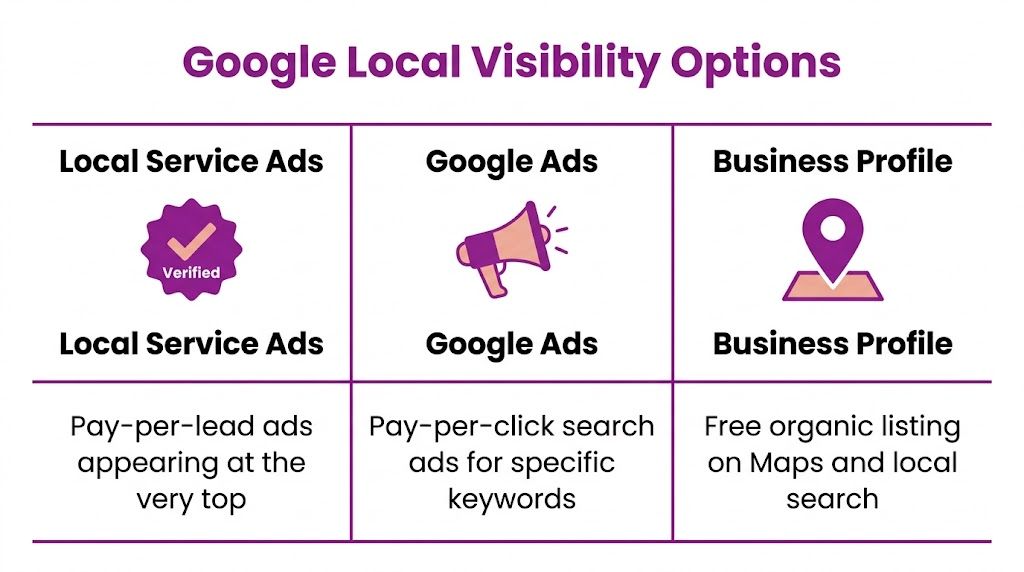
Local Marketing Tools at a Glance
| Feature | Local Service Ads (LSAs) | Google Ads (Search) | Google Business Profile (GBP) |
|---|---|---|---|
| Primary goal | Direct local leads | Keyword-targeted traffic and conversions | Local visibility on Maps and branded search |
| Charging model | Pay per lead | Pay per click | Free listing |
| Typical placement | Top of eligible local search results | Paid search placements | Maps and local listings |
| Best for | Service businesses wanting calls or messages | Businesses needing more keyword control | Every local business as a foundation |
| Main strength | Trust and immediate contact | Flexibility and targeting | Ongoing local presence |
| Main limitation | Category and eligibility limits | You pay for clicks whether they convert or not | Less direct control over enquiry volume |
The biggest difference is how you pay
The clearest distinction sits between LSAs and standard Google Ads. In the UK, Local Services Ads are lead-priced rather than click-priced, so you only pay when a potential customer contacts you through the ad, with typical UK costs reported around £10 to £50 per lead.
That one operational difference changes how you think about performance.
With standard Google Ads, you might get a lot of traffic and still wonder which clicks were serious. With LSAs, you're far more focused on whether the lead was relevant, whether your team answered quickly, and whether the enquiry turned into a job.
When each one makes sense
Use LSAs when your service is local, your buyers usually want to contact someone quickly, and your category is eligible.
Use Google Ads when you need wider keyword coverage, more control over messaging, or you want to advertise services that don't fit the LSA model.
Use GBP because every local business needs one. It's the base layer for Maps visibility, trust, and local presence, whether you run ads or not. If you want to assess how well that base layer is set up, a Google Business Profile audit tool can help you spot gaps before you spend more on paid traffic.
If you're choosing only one question to ask, make it this. Do I need more clicks, or do I need more qualified local enquiries?
UK Availability and Verification Requirements
This is the point where many businesses either move forward or realise LSAs aren't for them.
Google Local Service Ads in the UK are not a universal local advertising option for every type of business. They're designed for service businesses, and availability depends on category, area, and whether you can meet Google's verification requirements. That's why some third-party write-ups make the product sound broader than it really is.
Who usually fits the model
In practical terms, LSAs are built for businesses that deliver a service in a local area. Think home services, trades, and some professional services. If your business depends on local enquiries and direct contact, you're closer to the intended use case.
Businesses that often struggle with fit include:
- Online-only businesses that don't operate as local service providers
- National operators with no meaningful local service area structure
- Businesses outside supported categories
- Firms with incomplete public business information
A maintained Google Business Profile is part of that picture. Google's UK help material also makes clear that the product is aimed at services businesses and that leads come through calls, messages, and bookings in selected local areas, not broad national reach. That's why a strong local profile baseline matters. A GBP report can be useful if you're unsure whether your business details are consistent and ready for review.
What Google may ask you to provide
Setup often becomes slower than people expect. Google's policy documentation for UK and EMEA contexts states that advertisers may need region-specific entity verification, proof of professional licensing, worker licence certification, and a business affiliation check before ads can run.
That has a simple business consequence. Launch time is often held up by compliance, not by campaign build.
You may need to gather items such as:
- Business identity details that match your public records
- Licensing evidence if your profession requires it
- Worker certification where applicable
- Affiliation checks tied to your category
- A public Google Business Profile that's accurate and maintained
Why the friction is actually useful
This part can feel annoying when you're ready to advertise. But it's also one reason LSAs carry weight with customers. If Google has checked the business more closely than a normal advertiser, the ad format naturally feels more credible.
Businesses that prepare documents first usually move faster than businesses that try to sort compliance halfway through setup.
If you're eligible, think of verification as a barrier that filters weaker competitors out. If you're not eligible, it's better to know that early and put your budget into a channel that fits your business model properly.
How LSA Pricing and Leads Work in the UK
The biggest reason businesses look at LSAs is simple. They want a clearer line between spend and enquiries.
Google's own Local Services help documentation explains the product around charged leads, meaning advertisers can track how many leads they received from people who saw the ad on Google search results pages. That makes the system far more useful for service firms that care about booked jobs, not just sessions.
What counts as a lead
In practical UK use, the lead usually starts when a potential customer contacts you through the ad. That can include a phone call or a message. Some categories may also involve bookings, depending on how the product is set up.
What matters day to day is that your team treats LSA enquiries differently from ordinary website traffic. A missed call isn't just a missed click. It can be the whole value of the ad interaction.
Typical UK cost ranges
Google Local Services guidance summarised for the UK reports typical cost-per-lead ranges of £10 to £50 overall, with cleaning often at £10 to £25, locksmiths and plumbers at £15 to £35, and legal services at £40 to £60.
That doesn't mean every lead within those categories will be equal. A cheap lead that never converts is still expensive. A higher-cost lead for a high-value service may be perfectly sensible.
Here's the useful way to read those numbers:
- Lower ranges often show up in less costly or less competitive service types
- Mid-range costs are common in core local trades
- Higher ranges tend to sit in professional services where each new client can be more valuable
The right question isn't “Is this lead cheap?” It's “Can this lead turn into profitable work often enough to justify the spend?”
To sharpen that thinking, it helps to understand how marketers benchmark performance and reduce lead costs across channels, especially when comparing lead quality rather than just headline CPL.
Budgeting works more like a volume dial
With LSAs, your weekly budget isn't just a media cap in the same way many businesses think about search ads. It functions more like a control on how many leads you're trying to receive.
If your diary is full, a lower budget may help pace demand. If you want more local enquiries and you can answer them quickly, increasing budget can support that.
This video gives a useful visual overview of how the format works in practice.
The operational habit that matters most
Respond fast. Then review lead quality consistently.
If a lead is clearly irrelevant or invalid, businesses should review whether it can be disputed through the platform. Even without turning this into a technical process, the principle is straightforward. The more carefully you monitor lead quality, the better your spend decisions become.
Is an LSA Campaign Right for Your UK Business?
LSAs are a strong fit for some UK businesses and a poor fit for others. The mistake is treating them as automatically right for any local company that wants more visibility.
Good fit signals
You're more likely to benefit if most of the following are true:
- You sell a local service, not a product catalogue or national offering
- Customers often want fast contact, especially by phone or message
- You can pass verification without scrambling for paperwork
- Your team can respond quickly during the hours you want leads
- A booked job is worth enough to justify lead costs in your category
That's why trades often suit the model well. If someone needs a plumber or locksmith, they usually want a shortlist and a fast answer. Trust matters, speed matters, and a direct enquiry model matches the buying behaviour.
Where caution makes sense
Some businesses should pause before jumping in.
If your service involves long research cycles, a highly visual sales journey, or heavy dependence on detailed portfolio pages, LSAs may only play a supporting role. A wedding venue, photographer, or design-led business may still value the trust element, but they often need stronger website content and a longer consideration journey before a serious enquiry happens.
If you operate in construction or related sectors, your local growth plan may depend just as much on service-area SEO, maps visibility, and location pages as on paid lead generation. In those cases, a guide to SEO for construction companies can help frame what LSAs should and shouldn't be expected to do.
A simple decision filter
Ask yourself three questions:
- Is my category supported in the UK?
- Can I get verified without delays or missing documents?
- Can my business handle immediate incoming enquiries well?
If the answer is yes across all three, LSAs are worth serious consideration.
If one or more answers is no, don't force it. Standard Google Ads, stronger local SEO, or a better-managed Google Business Profile may be the smarter investment first.
Building Your Complete Local Marketing Strategy
Google Local Service Ads work best when they're part of a joined-up local visibility plan.
A business that shows strong trust signals across Google tends to be easier for customers to choose. That means your LSA activity should sit alongside a well-managed Google Business Profile, consistent business information, strong reviews, and local pages that support the areas and services you want to win.
For home service companies in particular, the wider marketing mix matters. If you want practical ideas beyond ads alone, this piece on strategies for growing home service businesses is a useful complement because it looks at how lead generation, customer communication, and local visibility work together.
A simple version of the stack looks like this:
- LSAs for trust-led local enquiries
- GBP for maps presence and brand credibility
- Local SEO for service pages, area relevance, and longer-term visibility
- Review generation for conversion support across every channel
If you're building that broader foundation, a local SEO checklist gives you a practical starting point.
One option for businesses that want help tying these pieces together is Bare Digital, which provides UK local SEO support around Google Business Profile optimisation, local content, technical fixes, and visibility planning for service-area businesses.
The main takeaway is simple. google local service ads uk can be excellent for the right business, but only when the business is eligible, verified, and operationally ready to turn local enquiries into booked work.
If you want a clear view of whether LSAs, local SEO, or Google Business Profile work should come first, you can speak with Bare Digital for a free, no-obligation SEO health check and activity plan designed for your UK business.






