


You're doing the work. You've got the van, the qualifications, the tools, and a decent reputation with past customers. But when someone in your area searches for an emergency electrician, your competitor shows up first, gets the call, and books the job before you even know it existed.
This is the core problem local SEO solves. Not vanity rankings. Not “more impressions”. More phone calls from people nearby who need electrical work now.
For electricians, local SEO isn't about gaming Google with a pile of town names stuffed into a footer. It's about making your business the obvious choice when a homeowner searches on their phone, checks your reviews, scans your services, and decides whether to tap Call.
Why Your Competitors Get All the Emergency Call-Outs
A lot of electricians still treat Google as an afterthought. They rely on word of mouth, Checkatrade-style listings, or a website that hasn't changed in years. That worked better when people asked neighbours for recommendations first. It works far less well when the customer's first move is a search on their phone.
In the UK, 81% of online journeys to purchase in the home services sector start with a search engine, according to Krofile's local SEO analysis for electricians. If you depend on urgent, high-intent local enquiries, that figure matters. It means the job often goes to the business that appears first and looks trustworthy enough to call.
That's why some firms seem to hoover up emergency call-outs. They're visible at the exact moment demand appears. They've got a complete Google Business Profile, reviews that reassure a nervous homeowner, and service pages that match what people type into Google.
Practical rule: In local SEO for electricians, visibility beats reputation if nobody can find the reputation.
The frustrating part is that many electricians lose work for avoidable reasons:
- Their Google Business Profile is half-finished and doesn't clearly show services, hours, or coverage.
- Their website is vague with one generic services page instead of pages for the work they want.
- Their location targeting is weak so Google can't tell where they operate.
- Their competitors look easier to trust because the listing has fresh reviews, photos, and useful detail.
A homeowner with a tripping consumer unit or sudden power loss isn't doing deep research. They want a local electrician who looks legitimate, answers the phone, and can come out fast. If your online presence doesn't support that decision, someone else gets the booking.
Your Digital Shopfront Google Business Profile
Your Google Business Profile is often the first thing a customer sees. Before they read your website, they've already judged your business on the map listing, the reviews, the photos, and whether your services match the problem they need fixed.
Treat it like your digital shopfront, not a basic citation.
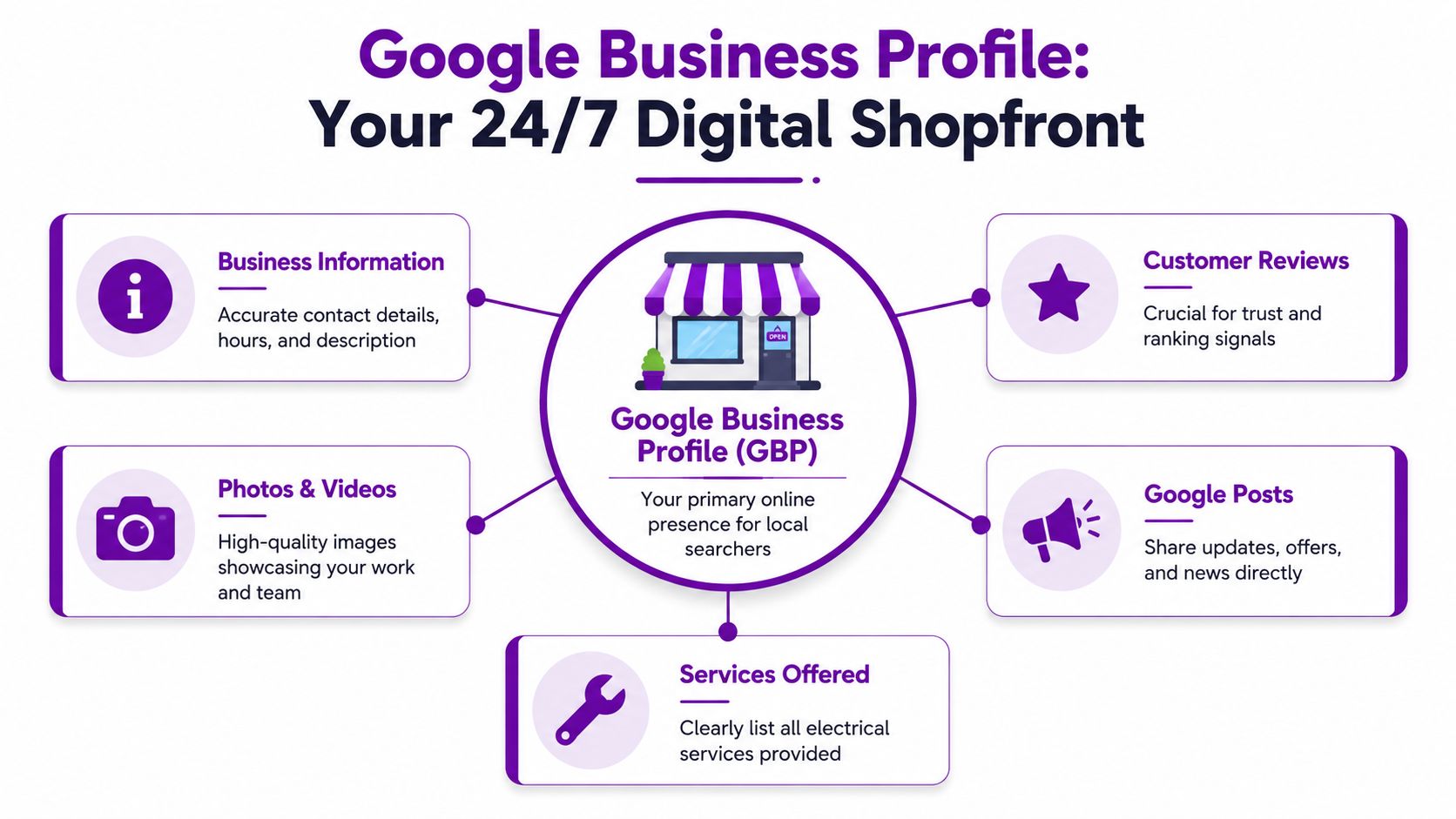
Fill the profile like you mean to win jobs
A weak profile usually looks the same. Sparse description. Barely any photos. One broad category. No real service detail. Maybe the opening hours are right, maybe they aren't.
A strong profile gives Google and the customer clear signals.
Focus on these parts first:
- Primary category. Use the main category that best reflects the business, such as Electrician.
- Service list. Add the services you want enquiries for, not just a generic “electrical services” label.
- Business description. Write clearly about domestic, commercial, emergency, inspection, or specialist work without stuffing keywords.
- Opening hours and call-out information. If you offer out-of-hours help, make that obvious where possible.
- Photos. Use real images of your team, your van branding, completed jobs, consumer unit upgrades, lighting installs, EV charger work, and testing visits.
Google also has to understand the kind of intent you serve. That matters more now because local search behaviour is shifting toward emergency, mobile, and voice-style queries, including searches around fuse-board faults, EV charger installation, and out-of-hours call-outs, as noted in Housecall Pro's electrician SEO resource.
Add service detail that matches real searches
Most electrician profiles are too broad. They say “all electrical work undertaken” and leave it there. That line tells Google almost nothing and it doesn't help a stressed customer either.
Use service entries and profile content to reflect the work you want:
| What to include | Why it matters |
|---|---|
| Emergency fault finding | Matches urgent, problem-led searches |
| Consumer unit upgrades | Helps align with safety and upgrade intent |
| EICR reports | Useful for landlords, buyers, and compliance searches |
| EV charger installation | Supports a specialist, high-intent service line |
| Rewiring and additional sockets | Covers common planned domestic jobs |
That doesn't mean cramming every phrase into every field. It means being specific.
If profile management keeps slipping because you're busy on-site, a practical guide on how agencies solve common GBP agency problems is worth a look. It's useful for spotting why many profiles go stale, inconsistent, or disconnected from real operations.
Use posts, questions, and photos as trust signals
A dormant profile looks neglected. An active one looks open for business.
The source material on electrician local SEO specifically recommends weekly Google Business Profile posts and regular review requests after completed jobs. That's not because posts are magic. It's because active management supports trust, keeps your services visible, and gives you more ways to reinforce relevance.
Useful post ideas for electricians include:
- Recent work. A quick summary of a consumer unit replacement in a nearby town.
- Seasonal reminders. Garden office power, exterior lighting, landlord checks.
- Specialist jobs. EV charger installation, fault finding, inspection work.
- Call-out updates. Bank holiday or evening availability if that's part of the service.
If someone lands on your profile from a mobile search, they should know within seconds what you do, where you work, and whether you look safe to call.
Questions and answers can help too. If customers often ask whether you cover a certain area, offer emergency call-outs, or handle landlord certificates, answer those points clearly on the profile and on the website.
If you want a quick sense of what's missing, use a Google Business Profile audit tool. It's a fast way to spot gaps in service coverage, profile completeness, and conversion basics before you waste time tweaking the wrong thing.
Building a High-Voltage Website Foundation
Your Google listing gets the click. Your website needs to back it up.
A lot of electrician websites fail at the simplest job. They don't make it easy for a visitor to confirm, “Yes, this firm does the exact work I need, in my area, and I can contact them quickly.” Instead, they bury services in dropdowns, use stock wording, and force mobile users to pinch, scroll, and hunt for a phone number.
That costs enquiries.
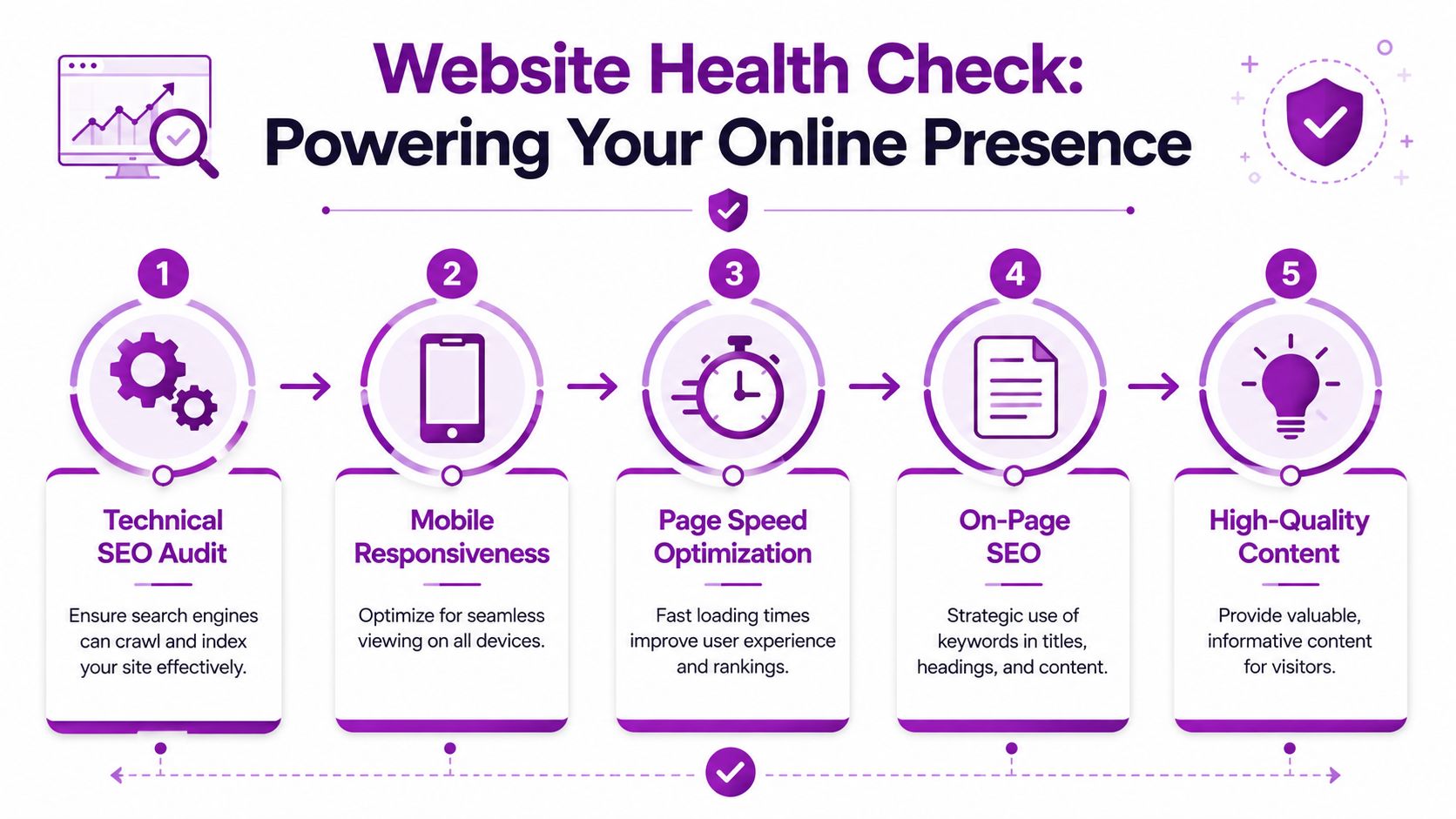
Structure the site around services and intent
An electrician's website doesn't need to be fancy. It needs to be clear.
A practical structure usually includes separate pages for major services, such as emergency electrical repairs, EICR testing, consumer unit upgrades, rewiring, lighting installation, and EV charger installation. That gives Google a defined page to rank and gives the customer a page that speaks directly to their problem.
A simple navigation model works best:
- Homepage with your main service focus and coverage area
- Service pages for each priority job type
- Location pages for your key towns or coverage zones
- Contact page with identical business details to the rest of the site
- About or credentials page showing qualifications, insurance, and trust signals
The common mistake is combining everything into one “Services” page. That weakens relevance and makes the site feel generic.
Get titles, headings, and copy working together
Most title tags and headings on trade websites are either too broad or obviously stuffed. “Best cheap electrician trusted electrical contractor emergency electrician” isn't helping anyone.
Write page titles and H1s for humans first, then tighten them for search.
For example:
| Page type | Weak version | Better version |
|---|---|---|
| Service page | Electrical Services | Emergency Electrician in Cambridge |
| Inspection page | Testing | EICR Reports for Landlords and Homeowners |
| Upgrade page | Consumer Units | Consumer Unit Upgrades by Qualified Electricians |
The body copy should then support that promise. Explain what the service is, who it's for, common signs they may need it, and what happens next if they call. Keep the language plain. Electrical customers don't want fluff.
Speed and mobile use are not optional
An electrician-focused local SEO guide gives a practical benchmark to keep page speed under 2 seconds and treat mobile responsiveness as mandatory, because urgent trade searches are often mobile-led and slow pages reduce calls and enquiries, according to Riverbase Cloud's local SEO guide for electricians.
That benchmark is useful because it forces the right question. Not “does the site technically load?” but “does it load fast enough for someone standing in a hallway with no downstairs lights?”
Slow websites don't lose rankings first. They lose impatient customers first.
A practical mobile check looks like this:
- Phone number visible immediately so the visitor doesn't have to search for it.
- Buttons easy to tap on a small screen.
- Service pages readable without zooming.
- Images compressed properly so they don't drag load time down.
- Contact forms kept short for users who can't call right then.
If your website needs a proper once-over, a local SEO checklist for service businesses can help you work through the basics in the right order instead of fiddling with cosmetic changes that won't affect calls.
Creating Landing Pages That Target Your Service Areas
A lot of electrician SEO goes wrong here.
You've probably heard the advice already. “Make a page for every town.” On the surface, that sounds sensible. If you serve ten towns, build ten pages. If you serve thirty postcodes, build thirty pages. Then watch the rankings roll in.
In practice, that usually creates a mess.
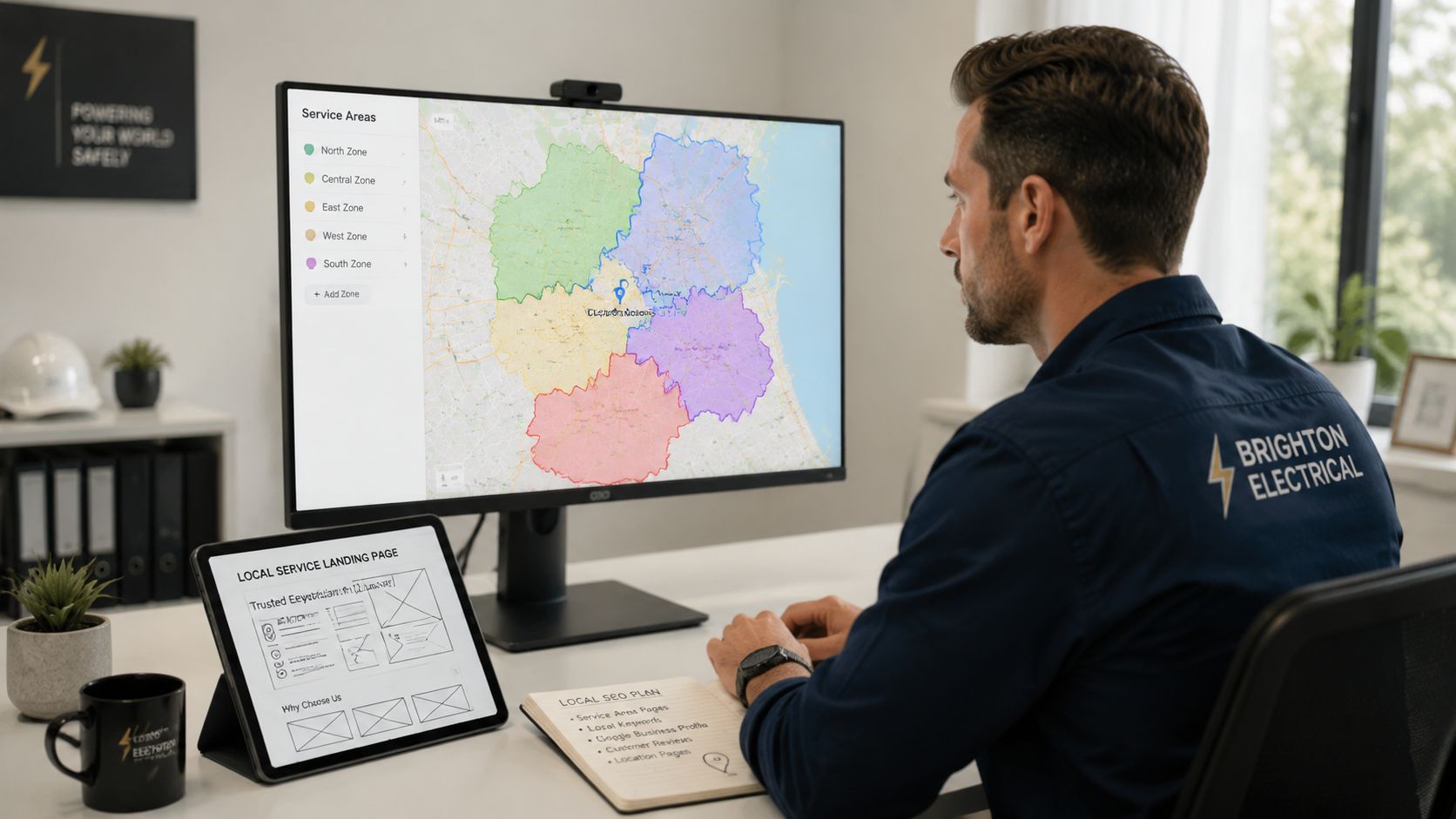
The technical problem is well established. Inconsistent NAP and overlapping service-area pages with duplicated titles, H1s, and copy reduce local relevance signals and can dilute rankings, and the recommended fix is to build one service-area page per main coverage zone with unique content, as explained in Four Winds Marketing's local SEO tips for electricians.
The wrong model and the better one
The wrong model is simple. Swap the town name in the title, H1, and first paragraph, then repeat the same service copy over and over.
That creates thin pages. It also creates an operational headache because none of those pages says anything distinctive about the place it targets.
A better model is to build pages based on real coverage zones and real demand clusters.
Use this decision framework:
| Situation | Best page type |
|---|---|
| You regularly win jobs in one main town | Create a dedicated town page |
| You cover several small nearby villages around one hub | Create one broader area page with village references |
| You only occasionally take work in a place | Mention it on a broader regional page, not a standalone page |
| Two areas overlap heavily and would produce near-identical copy | Merge them into one stronger page |
That's the practical balance most electricians need. Enough location depth to rank locally. Not so many pages that the site turns into copy-and-paste clutter.
What makes a location page genuinely useful
A page should exist because it helps a searcher in that place, not because you wanted another URL.
A strong electrician service-area page usually includes:
- A localised H1 that clearly names the town or area
- A unique opening paragraph describing the type of work you handle there
- Services that matter in that location such as landlord certificates, emergency faults, domestic upgrades, or EV chargers
- Area-specific proof like recent jobs, local testimonials, or references to property types you commonly work on
- Clear service boundaries so customers know whether you cover them
- Internal links back to the matching service pages
If you want to see how location-led SEO fits into a live service business model, review a town-focused example of SEO services in Peterborough. The useful lesson isn't the industry. It's the page intent, local specificity, and clean targeting.
A practical page template without duplication
The easiest way to avoid thin content is to change more than the place name.
Use a layout like this:
Intro with town-specific context
Mention the area naturally and describe the jobs you commonly handle there.Services in that area
Prioritise the work people in that location ask for.Why customers in this area call you
Focus on response, experience, credentials, and practical reassurance.Recent work or local examples
Keep this real and specific. Don't invent case studies.FAQs for that area
Cover call-out availability, coverage limits, and the types of properties you work on.
A good explainer on local landing pages and page intent is below. It's worth watching before you build dozens of pages you'll only have to rewrite later.
Build fewer pages with stronger local detail. That nearly always beats publishing a long tail of duplicated area pages.
Building Local Authority and Trust Signals
Getting found is only half the battle. The customer still has to choose you.
Google's local systems have been moving in this direction for years. A key milestone was Google's 2014 rollout of Pigeon, which connected traditional web-ranking signals more tightly with location relevance and distance, making location-specific content and citation consistency more important for local businesses, according to GetFieldy's overview of electrician SEO.
That history matters because it explains why local SEO for electricians isn't just about planting your business in directories anymore. Google looks for signals that suggest you're a credible, established option in the areas you target.
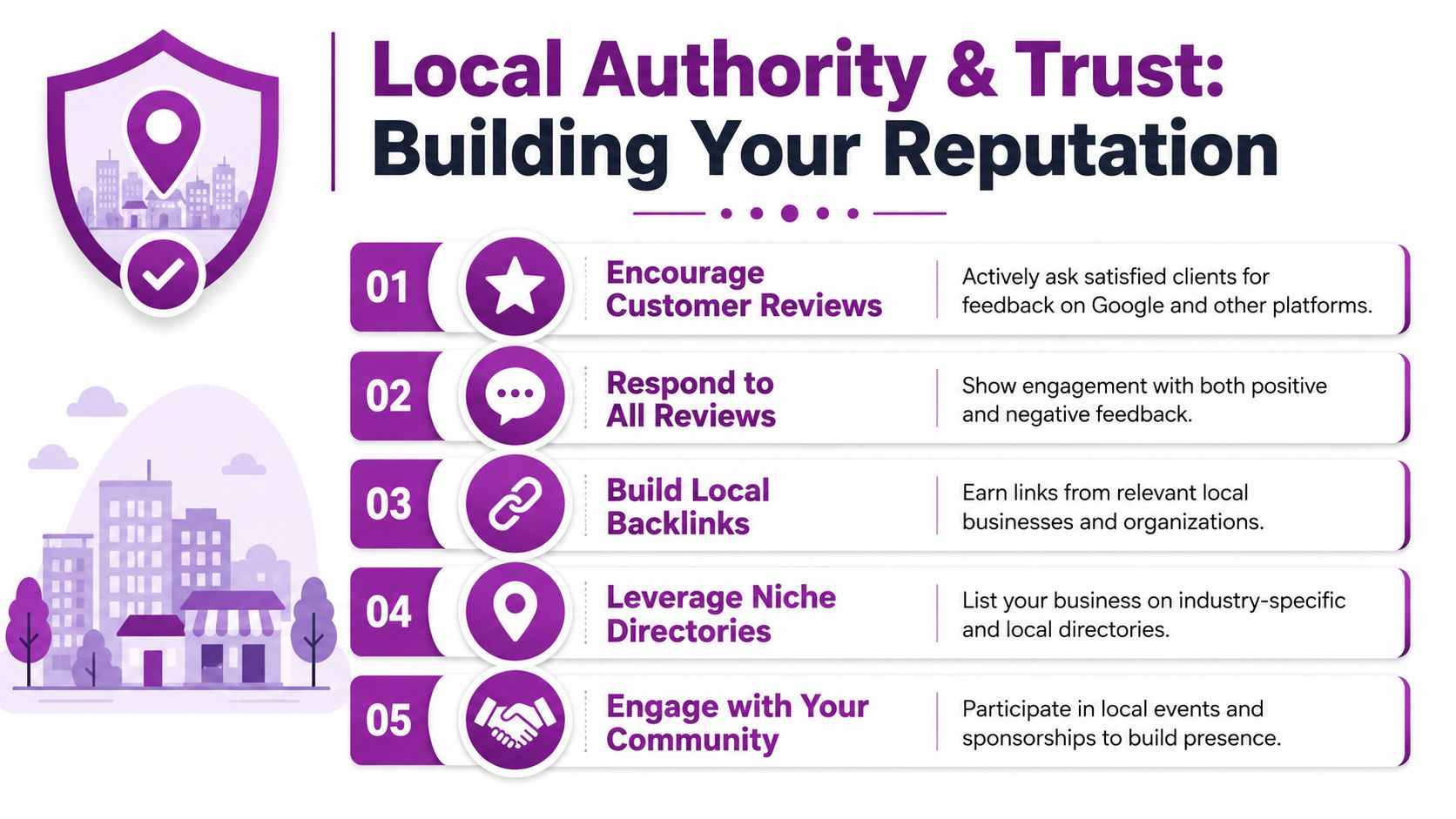
Reviews that help you rank and help you win
Reviews do two jobs. They strengthen local trust signals and they influence whether a searcher clicks or calls.
The best review strategy for electricians is the simplest one. Ask after the job is complete, when the customer is relieved the problem's sorted and before the memory goes cold. Don't overcomplicate it with long follow-up sequences.
A practical process looks like this:
- Ask on the day when the customer confirms they're happy
- Send the review link straight away by text or email
- Mention the specific job so the request feels personal
- Reply to every review so future customers see an active business
If you want a straightforward primer on the importance of Google reviews for bookings, that resource is a useful companion for owners trying to build a review habit into day-to-day operations.
Citations and links that support local authority
Not every backlink matters for an electrician. You don't need clever digital PR campaigns to start building local authority. You need signals that make sense in your area and in your trade.
Good local options include:
| Trust signal | Why it helps |
|---|---|
| Consistent listings in local business directories | Reinforces business identity and location |
| Supplier or manufacturer partner pages | Adds relevant industry association |
| Chamber or local business membership pages | Shows real community presence |
| Sponsorships or charity support pages | Builds local relevance if the link is genuine |
Keep one thing clean above all else. Your business name, address, and phone details should be identical in the footer, contact page, business listings, and any major directory profile. Small inconsistencies create avoidable confusion.
Trust isn't just algorithmic
Electricians often focus on rankings and forget the decision-making moment. A homeowner comparing two local firms isn't running an SEO audit. They're looking for signs that one business feels safer, more established, and easier to deal with.
That's why practical trust content matters:
- Credentials and accreditations on-site and on key pages
- Clear service descriptions with no jargon-heavy filler
- Real job photos instead of stock imagery
- Professional review responses even when a review is awkward
For businesses in regulated or trust-sensitive sectors, the same principles carry across. A good example is how SEO for healthcare providers leans heavily on authority, consistency, and reassurance before conversion. Electricians aren't healthcare providers, of course, but the trust mechanics are surprisingly similar. High-stakes service, anxious customers, and a low tolerance for mixed signals.
Measuring What Matters and Scaling Your Success
If you judge local SEO by rankings alone, you'll make bad decisions.
A top position for a phrase you don't convert from is less useful than a lower-visibility page that consistently drives calls for profitable work. The metrics that matter are the ones tied to booked jobs.
Track outcomes such as:
- Phone calls from your Google Business Profile
- Contact form enquiries from service and location pages
- Direction requests and website clicks from local search
- Which pages lead to real conversations, not just visits
Use your form tracking, call tracking setup, website analytics, and Google Search Console to build a basic picture of what's producing leads. You don't need a complicated dashboard to start. You need to know which services, towns, and pages are doing useful work.
A page that brings the right enquiry is worth more than a page that simply ranks.
Scaling then becomes much easier. Once one location page format works, repeat the structure only for places where you have real coverage and enough unique detail to justify a standalone page. Once one service page starts bringing calls, expand into related services with the same level of clarity.
That's also where a business stops guessing about expansion. If one area consistently brings strong enquiries, that's a better signal for adding another engineer or widening your radius than chasing visibility everywhere at once.
For owners who like sanity checks around return before committing to more work, a tool such as an SEO ROI calculator can help frame the commercial side. The example is built for another sector, but the thinking applies. Tie SEO effort to enquiries, booked work, and margin, not just rankings.
If your electrical business needs more than generic SEO advice, Bare Digital can help you tighten the parts that drive calls. That means sharper Google Business Profile optimisation, cleaner service-area targeting, stronger local landing pages, and reporting built around enquiries rather than fluff. If you want a clearer route from local visibility to booked jobs, they're worth speaking to.






