

You know the situation. Heavy rain hits overnight, a few tiles come off somewhere in town, and by 7am homeowners are on Google looking for a roofer who can answer the phone, get out quickly, and look trustworthy enough to let onto the property. If your business isn't showing in the map pack, in Google Business Profile, or on a relevant local page, those calls go elsewhere.
For most UK roofers, local SEO isn't a branding exercise. It's a visibility and enquiry system. Google reported in 2024 that it handled more than 8.5 billion searches per day globally, and Ofcom's UK media-use research has consistently shown search engines are among the most-used online services for finding businesses and services in the UK, which is why local search visibility sits at the centre of lead generation for trades (uprankd on how local SEO and Google Maps dominate roofing lead generation).
The roofers who win local search usually aren't the ones with the fanciest website. They're the ones who've got the basics right, built the right town and service pages, and made trust obvious. If you want a broader framework to compare against your own setup, this a comprehensive local SEO resource for 2026 is a useful companion. For a practical audit list you can work through page by page, this local SEO checklist is also worth keeping open while you review your site.
Why Your Roofing Business Is Invisible Without Local SEO
A lot of roofing firms still rely on reputation, vans on the road, referrals, and the odd directory listing. Those still matter. They just don't control discovery anymore.
When someone searches roofer near me, roof repair in Leeds, or emergency roofer SW15, Google decides who gets seen first. That's the key shift. Search behaviour has moved from broad browsing to high-intent, proximity-led decisions, especially on mobile. For roofers, that means your visibility depends on three assets working together: Google Business Profile, the local map pack, and location-specific pages on your website.
What invisible usually looks like
Most roofing businesses that struggle with local SEO have one or more of these problems:
- Weak profile setup. Their Google Business Profile exists, but the services, categories, hours, and photos are thin or outdated.
- No local page structure. They have a homepage and maybe a generic services page, but nothing built around towns, postcodes, or urgent call-out intent.
- Trust isn't clear. There's no obvious proof of insurance, trade membership, warranty information, or local job evidence.
That combination leaves Google with limited relevance signals and leaves homeowners with too little confidence to call.
Practical rule: If a homeowner can't tell where you work, what you do, and why they should trust you within a few seconds, local SEO is already losing the enquiry.
What actually generates calls
Vanity rankings don't pay for scaffolding, labour, or materials. Calls do.
The useful goal isn't “rank nationally for roofer”. It's to appear when someone nearby searches for the exact job they need. That could be a leaking flat roof in Reading, ridge tile repairs in Wakefield, or storm damage help in a specific postcode. Good local SEO turns your business into the obvious local option for those searches.
Old-school awareness still has a place. But if your business isn't visible in local search, you're depending on people already knowing your name. That's a fragile way to fill the diary, especially in competitive areas or after bad weather when search demand spikes.
Your Foundation The Perfect Google Business Profile
Google Business Profile is your most important local asset. For UK roofers, the rise of Google Business Profile and the map pack replaced older directory-led discovery as the main local lead path, and guidance around roofing SEO now treats complete profiles, accurate service areas, categories, photos, updates, location pages, and review activity as core inputs rather than extras (roofersseo.co.uk on the rise of Google Business Profile for roofers).
Start with the profile before you worry about blog posts, backlinks, or fancy SEO tools.
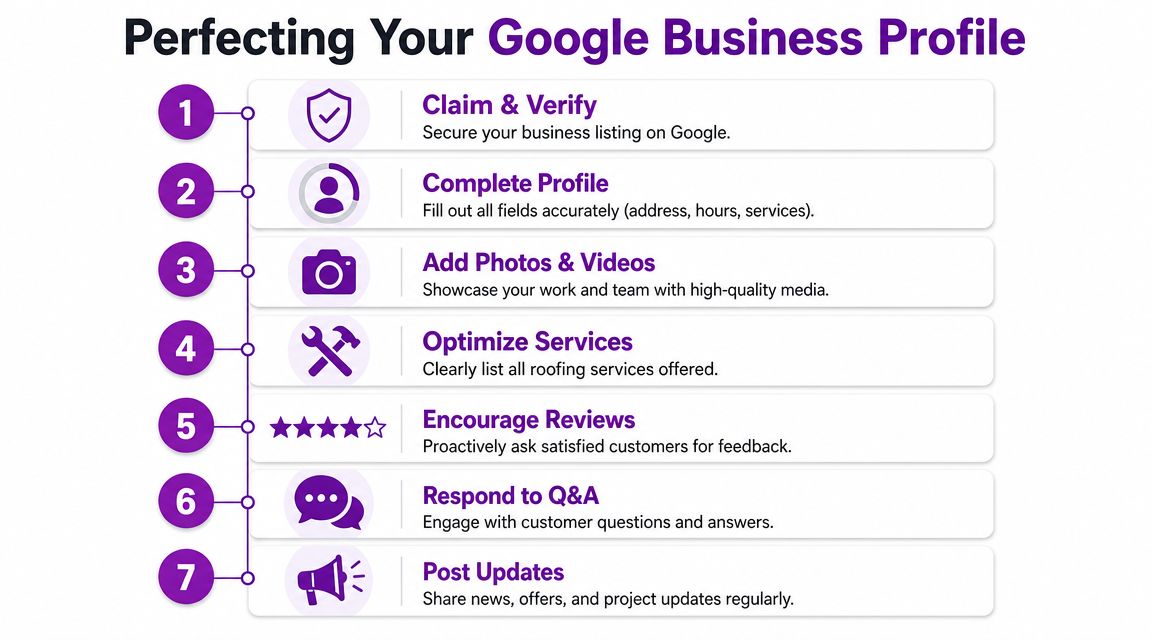
Claim it, verify it, complete everything
A half-filled profile is common in this trade. It's also a wasted opportunity.
At minimum, your profile should include:
- Correct business name. Use the trading name you use on your website, invoices, and signage.
- Phone number that gets answered. Don't send local search traffic to a number no one picks up during working hours.
- Business category and services. Pick the most accurate roofing category available, then add relevant services like roof repairs, roof replacement, flat roofing, guttering, chimney repairs, and emergency call-outs where they apply.
- Service areas. Set these carefully around the towns and areas you serve.
- Hours and emergency availability. If you offer urgent call-outs, make that obvious without making claims you can't fulfil.
A useful way to sense-check the listing is to run it through a Google Business Profile audit tool. That quickly shows where the obvious gaps are.
Use photos like proof, not decoration
Roofing is a trust-first service. Your photos should prove you do real work locally.
Upload:
- Before and after job photos from real projects
- Team photos in branded clothing or vans
- Close-up workmanship shots of leadwork, flashing, ridge repairs, flat roof finishes, or guttering
- Location-linked project images where the town or area is clear in the caption or surrounding context
Don't fill the profile with generic stock roofing images. Homeowners can spot that a mile off.
Later in the setup, this video is a solid visual refresher on the profile basics and common optimisation points.
Post updates that match real roofing demand
Most roofers ignore Google posts. That's a mistake, especially in the UK where weather-led urgency changes demand fast.
Use posts for things like:
Storm response availability
If high winds or heavy rain have hit your area, post that you're handling emergency inspections or temporary repairs in specific towns.Recent project updates
A short note about a completed roof replacement or leak repair gives fresh local relevance.Seasonal service reminders
Gutter clearances, winter roof checks, flat roof inspections, and fascia or soffit repairs all fit well.Trust-building updates
Share warranty information, safety practices, or accreditation-related updates where relevant.
Don't neglect Q&A and service descriptions
The Q&A section is one of the easiest ways to pre-handle objections. Add and answer common questions clearly.
Examples:
- Do you provide emergency roof repairs?
- Which areas do you cover?
- Do you work on slate, tile, and flat roofs?
- Are you insured?
- Do you provide written quotes?
A strong profile doesn't just help Google understand your business. It helps a worried homeowner decide whether to call you now or keep scrolling.
Finding Customers with Hyper-Local Keyword Research
Most roofers start keyword research too broadly. They target roofer, roofing company, or roof repair and stop there. That brings in vague traffic and misses the searches that lead to quick enquiries.
The better approach is to map searches by service, location, and urgency.
Think in jobs, towns, and moments
A homeowner rarely searches the way a marketing agency writes a proposal. They search based on the problem in front of them.
That means your keyword list should include combinations such as:
- Emergency roof repair Nottingham
- Flat roof repair Croydon
- Leaking roof roofer Chesterfield
- Storm damage roof repair near me
- Roof tarpaulin service postcode
- Slate roof repair Harrogate
- Garage roof replacement town name
Those terms are messy, specific, and commercially useful. That's exactly why they matter.
Why storm-related intent deserves its own plan
Many roofing SEO campaigns fall flat. They build generic city pages but ignore what people search during bad weather.
A real gap in roofing SEO content is how to win postcode- or area-specific emergency queries during storm season. That matters in the UK because urgency is highly local. The Met Office reported that Storm Henk brought disruption across England and Wales in January 2024, and the Environment Agency said 2023 was the second-wettest year on record in England, both of which make postcode-level emergency intent more valuable than broad city targeting (Spartan SEM on roofing SEO and storm-related local intent).
So instead of only building “roofer in Birmingham”, build content around the urgent versions people use after bad weather.
A simple keyword framework for roofers
Use a worksheet or spreadsheet and sort terms into four buckets:
| Search bucket | Example intent | Best page type |
|---|---|---|
| Core service | Roof repair in York | Service page or location page |
| Specialist service | Flat roof specialist in Romford | Specialist service page |
| Emergency need | Emergency roofer in BS16 | Emergency page with rapid-response message |
| Weather-led problem | Storm damage roof repair in Kent | Storm damage page or local update |
This matters more than chasing volume. A smaller, sharper set of local terms usually drives better leads than a bloated list of broad phrases.
If you want a sense of how local service targeting works in a live commercial setting, this example page for SEO services in Peterborough shows how place-led intent can be framed around a specific area.
What doesn't work
A few patterns waste time:
- One giant services page trying to rank for every roof type, repair type, and town
- Thin postcode pages with swapped place names and no local substance
- Blog-heavy strategy first when your money pages are underbuilt
- Keywords with no buying intent, such as purely informational searches that don't connect to a service page
The best keyword plan for local SEO for roofers is usually narrower than people expect. It should follow the jobs you want, the places you can serve profitably, and the searches that happen when people are ready to call.
Building Location Pages that Convert Local Searches
If you cover more than one town, one homepage won't do the job. It's too vague for Google and too generic for the homeowner who wants someone local.
A proper location page gives both of them what they need. Google gets relevance signals tied to a service area. The homeowner gets reassurance that you provide services there.
What each page should do
A good roofing location page isn't just a clone with the town name swapped in. It should answer a practical question: why should someone in this area choose you?
The core elements are straightforward:
- A clear headline such as “Roof Repairs in Guildford” or “Emergency Roofers in Stockport”
- A short area-specific introduction that reflects the type of property stock, exposure, or roofing issues common there
- The right service mix for that location, not a pasted list of everything you've ever done
- Strong calls to action for phone calls and quote requests
- Proof of local work through photos, testimonials, or short project references
What local detail actually means
Local detail doesn't mean stuffing the page with landmarks. It means making the page believable and useful.
For example, a page for a coastal town might mention exposure to wind and driving rain. A page for an area with older housing stock might reference slate repairs, chimney work, or age-related roof issues. A commuter belt town might respond better to fast inspections and tidy quoting for busy homeowners.
That kind of detail separates a real local service page from a mass-produced SEO page.
If every location page reads the same apart from the town name, it won't convert well and it usually won't rank well either.
A practical page structure
Here's a simple layout that works well for many roofers:
Opening section
State the service and area clearly. Mention the kind of roofing work you handle there.Services in that location
Tailor this list. Not every area needs the same emphasis.Why homeowners call you there
Mention speed, availability, local knowledge, repair types, or roofing materials where relevant.Local proof
Include reviews, project photos, or short examples tied to the area.FAQs
Cover emergency call-outs, inspection availability, roof types, and service radius.Contact and quote action
Make it easy to ring or send an enquiry.
For a broader look at how this kind of structure applies across the trade, this guide on SEO for construction companies shows how location relevance and service clarity work together.
Which pages to build first
Don't try to launch pages for every village and postcode in one go.
Start with:
- Your strongest service areas
- Towns where you already have jobs, reviews, or photos
- Locations close enough to serve quickly
- Areas where your margins still make sense after travel and labour
A smaller set of solid pages beats a sprawling set of weak ones. Build the pages where you can back up the claim that you're a genuine local option, then expand from there.
Earning Trust with Reviews and UK-Specific Signals
Roofing sits in one of the least forgiving trust environments online. Homeowners are wary of poor workmanship, vague guarantees, disappearing traders, and lead-gen sites pretending to be local firms. That means your SEO setup has to do two jobs at once. It has to help you rank, and it has to prove you're legitimate.
UK consumers are highly sensitive to online reviews. The Competition and Markets Authority has highlighted that online reviews materially affect consumer decisions and has been active on fake-review enforcement, while Trustpilot's UK-focused consumer research shows reviews are a major trust cue in purchasing decisions. A key weakness in most roofing SEO advice is that it stops at “get more reviews” instead of showing how to present accreditations, insurance, and warranties in ways that improve conversion as well as visibility (ServiceTitan on roofing SEO, reviews, and UK-specific trust signals).
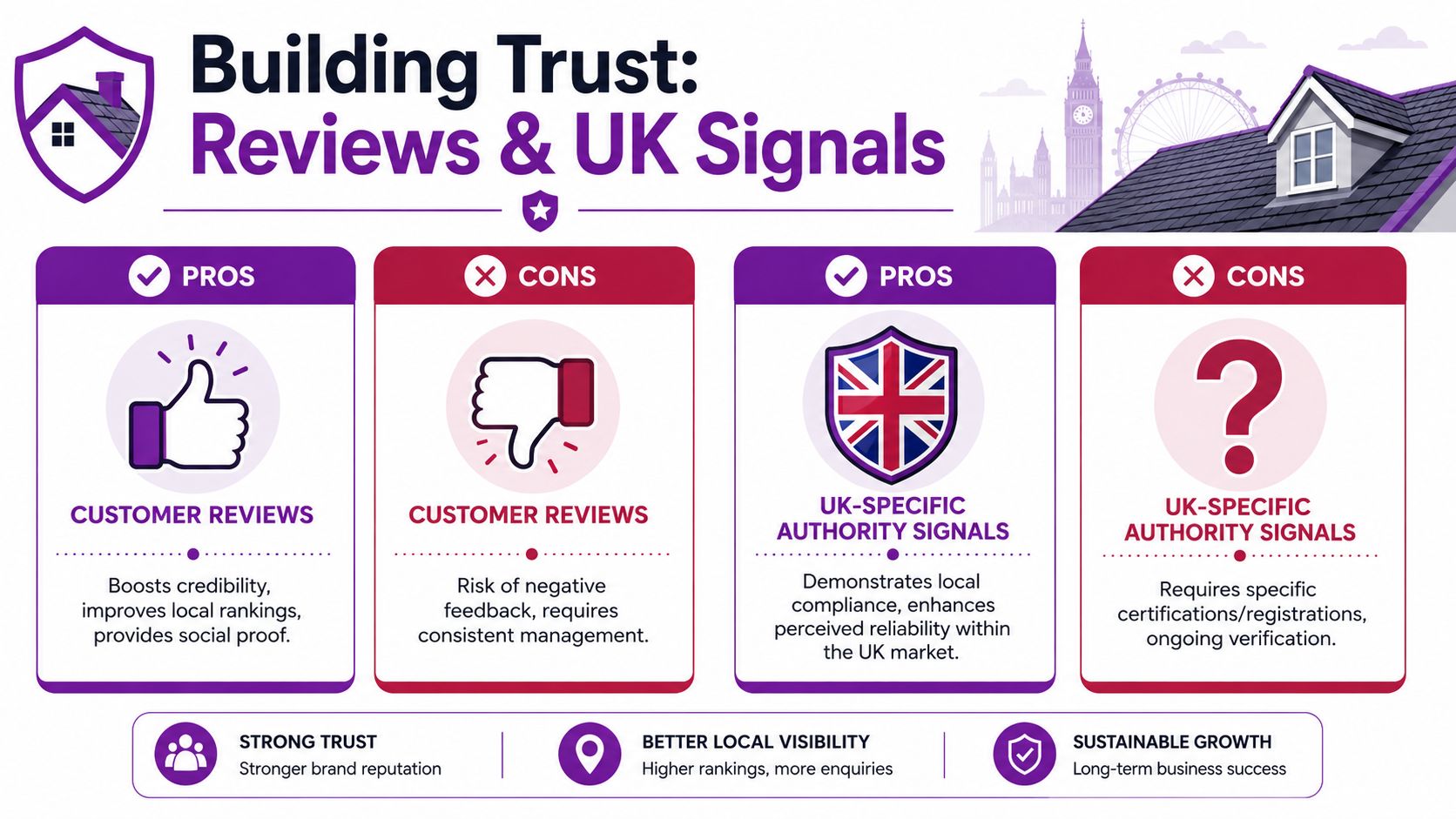
Reviews matter, but not in isolation
A strong review profile helps in two ways. It gives social proof, and it reduces hesitation at the point of contact.
The best review approach is simple:
- Ask after successful jobs when the customer has seen the finished result
- Send a direct review link rather than vague instructions
- Request honest detail about the job type and area
- Reply to every review in a calm, professional tone
Good replies can reinforce relevance. If someone mentions a flat roof repair in a specific town, your response can naturally confirm the service and location.
The trust signals roofers often bury
Many firms leave money on the table. They may have the right trust signals, but they hide them in the footer or don't mention them at all.
For UK roofers, useful trust markers often include:
| Trust signal | Where to show it | Why it helps |
|---|---|---|
| Trade accreditations | Homepage, service pages, contact page, profile imagery | Shows external validation |
| Public liability insurance | About page, quote page, FAQs | Reduces perceived risk |
| Warranty information | Service pages and quote process | Supports confidence in the work |
| Company registration details | Footer, contact page | Reinforces legitimacy |
| Local address and service areas | Contact page and location pages | Confirms local presence |
If you produce a regular GBP reporting view, it's easier to see whether profile activity, reviews, and trust-focused updates are supporting local visibility.
What trust looks like on the page
A homeowner comparing roofers wants quick evidence, not detective work.
That means your pages should show:
- Real team and project photos
- Named service areas
- Clear warranty wording
- Insurance mention where appropriate
- Accreditation badges that are current and relevant
- A proper business identity, not just a mobile number and a contact form
Homeowners don't just ask, “Can this roofer fix the problem?” They ask, “Can I trust this business to turn up, do the work properly, and still be reachable if something goes wrong?”
What not to do
Three trust mistakes show up constantly in roofing SEO:
- Buying or manufacturing reviews
- Using badges with no explanation or proof
- Publishing thin testimonials with no service or area context
Trust works best when it's layered. Reviews get attention. Accreditations and business proof support the decision. Clear local pages close the gap between interest and enquiry.
Measuring What Matters and Scaling Your Reach
If your SEO report doesn't connect to calls, quote requests, and booked inspections, it isn't helping you run the business.
You don't need a complicated dashboard to judge whether local SEO for roofers is working. You need a short list of actions that tie directly to revenue.
Track actions, not vanity metrics
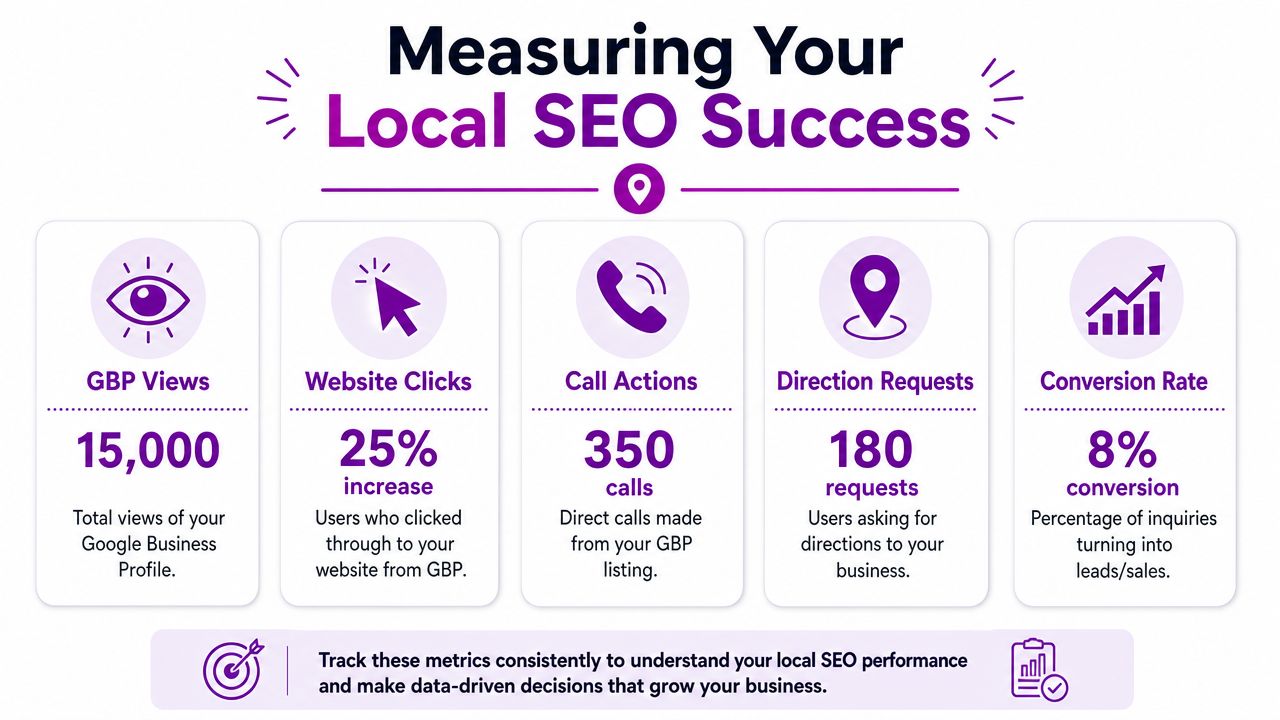
The most useful indicators are usually:
- Calls from Google Business Profile
- Website enquiries from service and location pages
- Clicks from profile to website
- Direction requests if you operate from a physical location
- Which towns and service pages generate real leads
Those numbers tell you where local demand is turning into contact.
A lot of roofers also miss the operational side. If local SEO increases quote requests but your estimating process is slow, you still lose jobs. That's where tools such as Exayard estimating software for roofers can help tighten the handover from lead to quote.
Review performance by page and area
Look at your site like a patchwork of service zones.
Ask:
- Which location pages generate calls?
- Which emergency or storm-related pages get enquiries after bad weather?
- Which towns attract leads you want to service?
- Which pages get traffic but no contact?
That last group matters. If a page gets visits but no quotes, the problem is usually one of three things: weak trust, weak offer clarity, or poor match between the page and the search intent.
How to scale without making a mess
When you find a location page or service type that works, don't copy it blindly across twenty areas. Replicate the framework, not the wording.
Scale in this order:
- Strengthen proven locations first
- Add adjacent towns you can serve reliably
- Build specialist service pages where demand exists
- Create emergency and storm-response content for the areas most likely to need it
That keeps the site organised and commercially sensible. It also stops you filling it with thin pages that create maintenance work without adding leads.
The roofers who do best at local SEO tend to treat it like operations, not magic. They tighten the profile, build the right pages, track what produces calls, and expand from the areas already proving profitable.
If you want help turning local search visibility into more roofing enquiries, Bare Digital can audit your current setup, identify the gaps in your Google Business Profile and location pages, and build a local SEO plan around the towns and services that matter most to your business.






