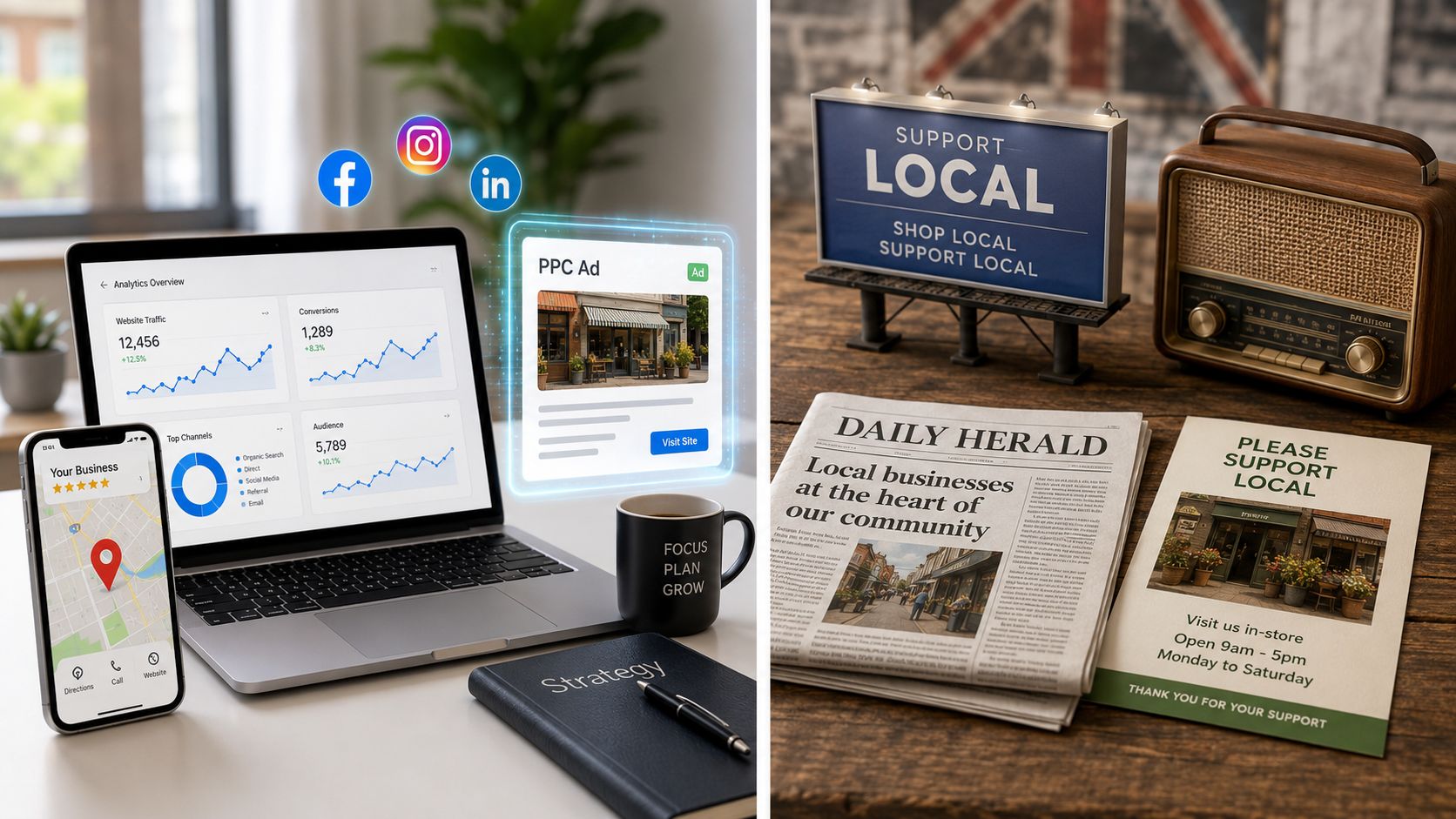

For any UK business owner, the question isn't if you should market, but where. It’s a decision that often boils down to two very different worlds: traditional marketing casting a wide net with things like print and radio, versus digital marketing using online tools for pinpoint accuracy. Your choice really depends on what you're after—broad brand awareness or a direct, measurable path to new customers.
Digital vs. Traditional: Choosing Your Marketing Approach
In today's market, figuring out whether to spend your marketing budget on digital or traditional channels feels like a huge decision. But it's not a battle between old and new. It’s about making a strategic choice based on your specific goals, who you’re trying to reach, and, most importantly, your budget. This guide will help you decide if your pounds are better spent on a local newspaper ad or a highly targeted Google Ads campaign.
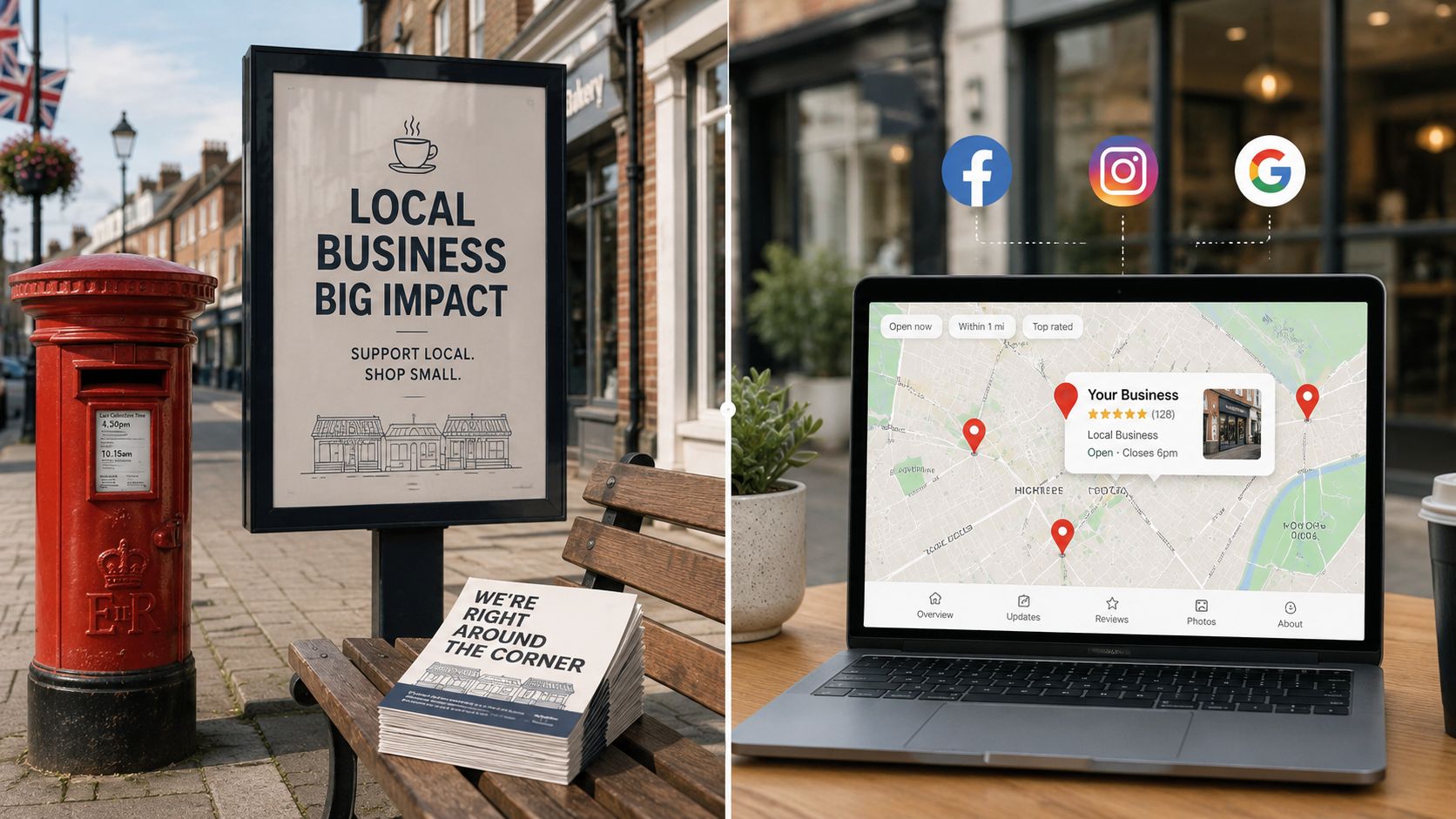
The fundamental difference comes down to the medium and the method. Traditional marketing works offline, using tangible assets like flyers, billboards, and radio spots to build a presence in a local area. It’s all about reaching a broad, general audience.
Digital marketing, on the other hand, lives entirely online. It uses websites, social media, and search engines, relying on data to connect with specific people at the very moment they’re looking for what you offer. It’s a two-way street, where you get immediate feedback through clicks, comments, and direct engagement.
To make an informed choice, let's break down the core differences.
| Aspect | Digital Marketing | Traditional Marketing |
|---|---|---|
| Medium | Online (websites, social media, email) | Offline (print, radio, direct mail, TV) |
| Interaction | Two-way and immediate (likes, comments, clicks) | One-way and passive (ad is viewed or heard) |
| Audience | Highly specific and targeted (interests, behaviour) | General and broad (local or regional population) |
| Measurement | Precise and in real-time (analytics, ROI) | Difficult to track directly (estimates, surveys) |
While digital offers incredible precision and measurability, it’s not a magic bullet. The online world is incredibly crowded, and keeping up with constant algorithm changes requires a real commitment. You can explore some of the other disadvantages of digital marketing to get a more balanced view.
The most effective strategy often isn't about choosing one over the other. It's about understanding how they can work together to achieve your unique business objectives, from building initial trust to capturing a final sale.
This guide is designed to help you navigate this decision, focusing on what delivers measurable growth for UK businesses, whether you're targeting customers in a specific town or across multiple postcodes.
Audience Reach and Targeting Precision Compared
The real heart of the digital marketing vs. traditional marketing debate comes down to one thing: how you find your audience. Traditional marketing has always been a game of casting the widest net possible. Think of a full-page advert in a regional newspaper—it gets seen by thousands, but it isn’t really speaking to any single one of them. It’s a broadcast model, great for building mass awareness but terribly imprecise.
Digital marketing flips that completely on its head. It’s all about narrowcasting. Instead of shouting at a crowd, you can zero in on specific individuals based on their online behaviour, their demographics, and, most importantly, what they need right now. For a local UK business, this precision is a game-changer.
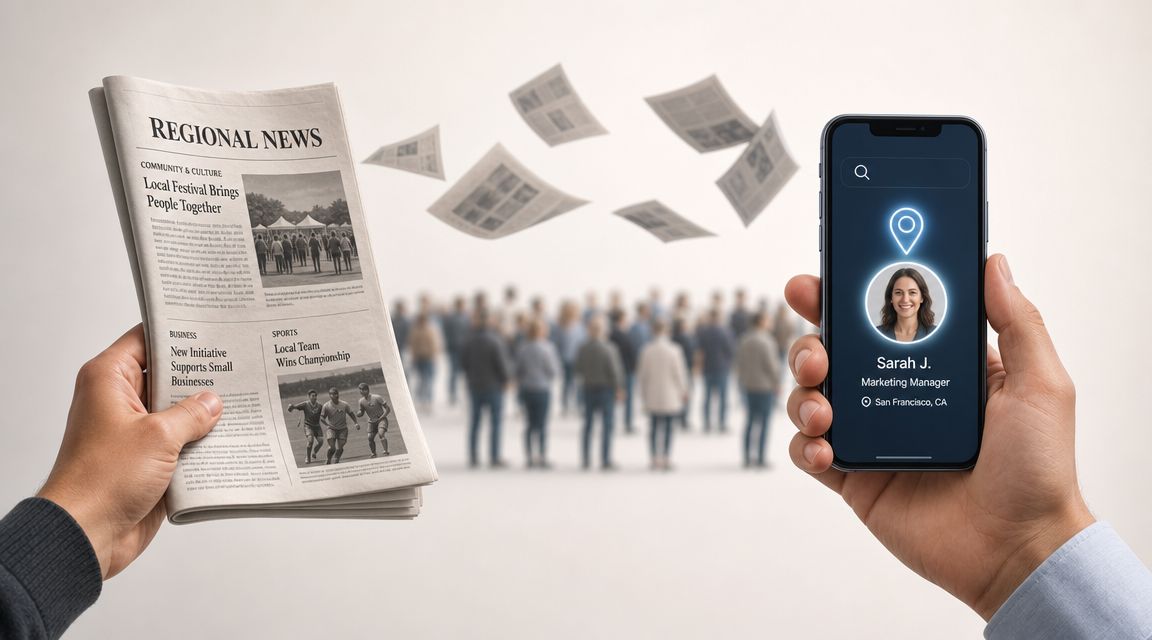
Broadcasting vs. Narrowcasting in Action
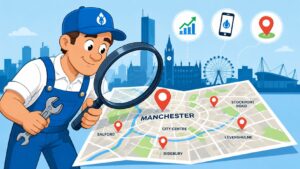
Let’s imagine a local law firm in Manchester that wants to bring in more conveyancing clients.
- Traditional Approach: They could place an advert in the Manchester Evening News. This reaches a huge general readership, but the vast majority of those readers won’t be in the process of buying or selling a house. The advert is relying on brute force and a bit of luck, hoping to catch the eye of the tiny percentage who happen to need their services at that exact moment.
- Digital Approach: They could run a Google Ads campaign targeting people who search for "conveyancing solicitor Manchester" or "best conveyancer near me." The ad is only shown to people who are actively looking for that specific service, turning every penny of their marketing spend into a genuinely qualified lead.
This fundamental shift from broadcasting to narrowcasting is incredibly powerful. You move from hoping the right person sees your message to ensuring only the right people do. This is especially true when it comes to reaching specific age groups or interest profiles, a topic we cover in our guide to social media advertising for small businesses.
The critical distinction is intent. Traditional marketing interrupts a potential customer, while digital marketing meets them at their moment of need.
Following the Audience Online
This move towards precision is driven by a simple reality: your audience has already moved online. Ofcom reports that UK adults now spend over four hours online every day. In fact, 61% of us use the internet more than TV, radio, or print to find information.
This matters because digital channels meet people where they already are, while traditional media is left competing for a much smaller slice of their attention. A homeowner looking for a local architect is far more likely to start their search on Google Maps and check online reviews than they are to flick through a newspaper advert. You can read more about these trends in digital vs traditional marketing statistics to see the data for yourself.
Comparing Costs and Measuring Your Return on Investment
For any UK small business, every pound in your marketing budget needs to work hard and prove its worth. This is where the financial tug-of-war between digital and traditional marketing gets really interesting. It’s a critical decision that directly impacts your bottom line.
Traditional methods often feel like a big, scary commitment. Think about it: a three-month billboard rental or a full-page ad in a local paper comes with a hefty upfront price tag. For a smaller business, that kind of cash outlay can be a massive hurdle, tying up funds that could be used elsewhere.
Digital marketing, on the other hand, lets you dip your toe in the water without plunging your entire budget. You can fire up a local pay-per-click (PPC) campaign with as little as £10 a day or spend nothing at all to optimise your Google Business Profile. This scalability is a game-changer. It allows you to test, learn, and only increase your spending when you see the results rolling in, dramatically cutting your initial financial risk.
Marketing Investment and ROI: A Comparative Snapshot
This table breaks down the fundamental differences in how you invest and measure the return from traditional and digital marketing channels, using common examples for a local business.
| Aspect | Traditional Marketing (e.g., Local Paper Ad) | Digital Marketing (e.g., Local SEO) |
|---|---|---|
| Upfront Cost | Typically high and fixed (e.g., cost of ad space). | Highly scalable, from free (GBP) to low daily budgets. |
| Commitment | Often requires long-term contracts or one-off large payments. | Flexible and adaptable, can be paused or adjusted daily. |
| Audience Targeting | Broad and general (e.g., all readers of a publication). | Hyper-specific, targeting by location, interest, and behaviour. |
| ROI Measurement | Difficult and indirect; relies on estimates and guesswork. | Precise and direct, tracked through clicks, calls, and sales. |
| Optimisation | "Set and forget"; very difficult to change once launched. | Real-time adjustments based on live performance data. |
As you can see, the contrast is stark. While traditional channels offer broad exposure, digital provides the precision and accountability that small businesses thrive on.
Proving Your Marketing Works
Here’s where the two approaches really diverge. The biggest, most glaring difference is in measuring your return on investment (ROI). How do you definitively track the impact of a leaflet drop? It's almost impossible. You might notice more people walking through the door, but linking that uptick directly to that specific campaign is pure guesswork.
This is where digital marketing brings undeniable clarity. It offers a treasure trove of crystal-clear metrics that draw a straight line from your spending to the results. Instead of vaguely estimating your reach, you get to measure exact performance indicators:
- Cost-per-click (CPC): You know precisely what you’re paying every time someone clicks on your ad.
- Conversion rates: You can see the exact percentage of website visitors who take a specific action, like filling out a contact form or buying a product.
- Cost per acquisition (CPA): You can calculate the precise cost of gaining one brand-new customer.
This kind of granular data is incredibly empowering. For instance, if you’re trying out influencer marketing, a good guide to influencer performance metrics can show you exactly how to measure engagement and, crucially, conversions.
This level of detail lets you prove what’s working and, just as importantly, what isn’t. It allows you to make smart, data-backed decisions about where to put your money next. For more on this, our guide on creating a marketing budget for a small business is a great place to start.
The core financial advantage of digital marketing isn't just about lower entry costs; it's about the ability to measure, adapt, and optimise your spending in real time to maximise ROI.
Recent UK advertising data shows exactly why digital marketing has become the go-to choice for businesses that need to justify every penny. Digital formats now command the lion's share of the market, while the print sector continues to contract. A billboard might get thousands of views, but you can’t confidently tie a single one of those views to a sale.
In contrast, digital channels like SEO and social media are tracked all the way through to clicks, calls, and conversions. For local businesses battling with tight budgets, this precision is invaluable. Even small, data-led improvements in your conversion rate can have a significant and immediate impact on your revenue.
How Digital Wins on the Local High Street
When the contest between digital and traditional marketing moves to the local high street, digital’s strengths really come into their own. For any UK business serving a specific community, digital marketing offers a level of focus that old-school methods just can't match. It’s about more than just general brand awareness; it's about targeting customers with real, local buying intent.
Let’s say you’re a construction company in Bristol that specialises in loft conversions. In the old days, you might have placed an ad in a regional magazine and hoped for the best. With digital, you can run a campaign that targets specific postcodes where the housing stock is perfect for conversions, reaching homeowners who have recently searched for "loft conversion costs". This is the core of modern local marketing: finding your neighbours at the exact moment they need you.
Mastering Hyperlocal Targeting
This kind of pinpoint accuracy comes from a handful of digital tools that have no real traditional equivalent. For a local business, these aren't just nice-to-haves; they are essential for competing in 2026 and beyond.
- Google Business Profile (GBP): Optimising your GBP is the most powerful free thing you can do for your local visibility. It’s what gets your business featured in the all-important Google ‘Map Pack’ when someone searches for “cafe near me” or “emergency plumber in Islington.”
- Location-Specific Pages: A hairdresser with salons in both Leeds and Harrogate can create separate, optimised pages for each one. This tells Google they are a relevant local authority in both areas, helping them rank for searches like “best haircut Harrogate.”
- Hyperlocal Ads: A new restaurant can run Facebook ads that only target users who are physically within a two-mile radius, pushing a time-sensitive lunch offer. This is how you turn digital ads directly into footfall through the door.
Digital marketing lets you draw a virtual circle around your ideal customers. You're not just marketing in a town; you're marketing to the right people, on the right street, at the precise moment they are looking for what you sell.
The visual below highlights the clear financial and measurement advantages that make these precise digital tactics so effective.
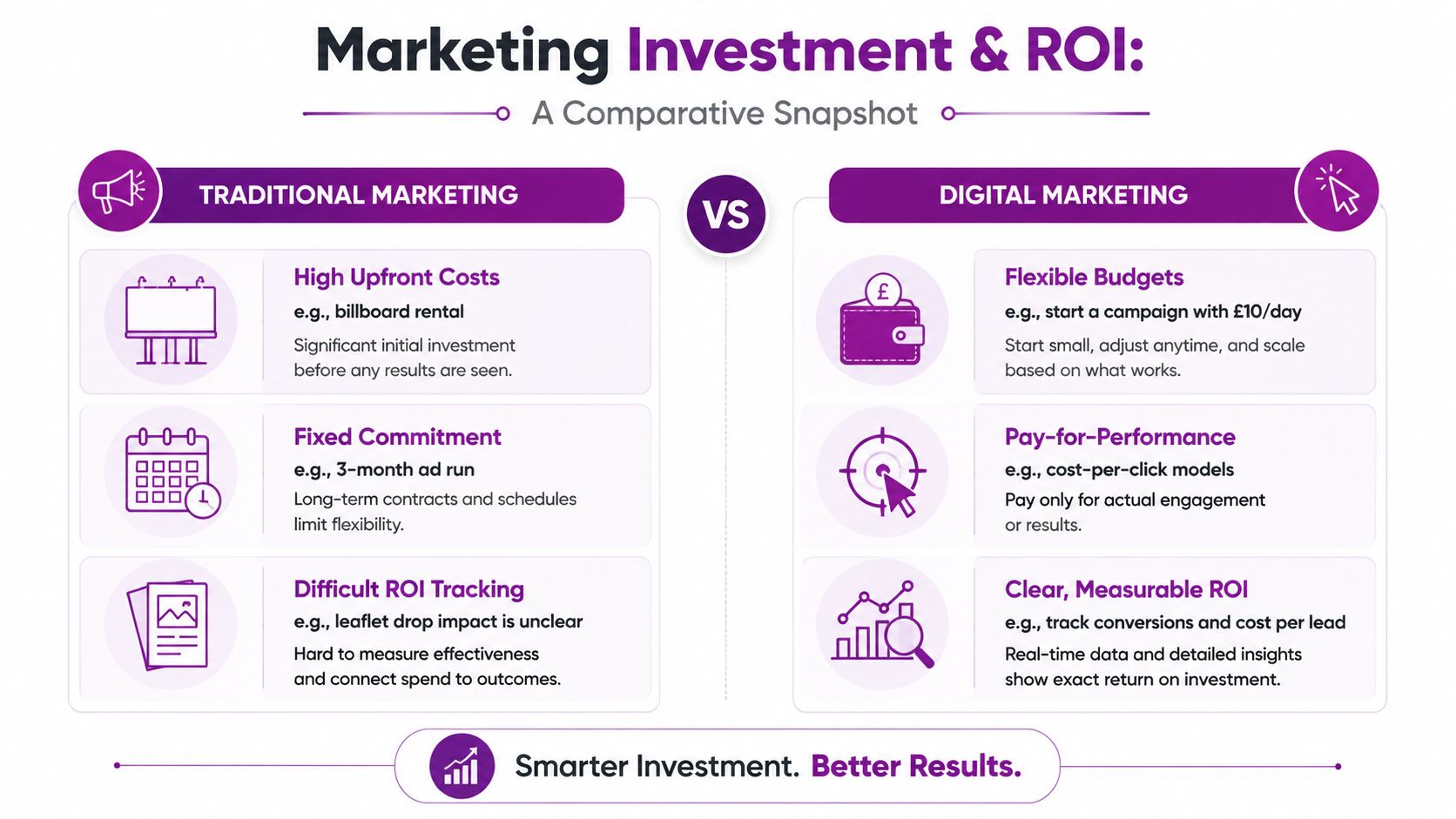
As the infographic shows, digital’s flexible, performance-based costs and transparent ROI tracking give businesses the confidence to invest smartly in these hyperlocal campaigns.
These digital actions have a direct, measurable impact on a local business’s bottom line. They drive phone calls, requests for directions, online bookings, and quote submissions from the people who matter most: your neighbours. By getting to grips with these tactics, you don’t just compete; you start to dominate your local patch. For a deeper dive into these strategies, explore our complete guide to digital marketing for local businesses.
Building a Hybrid Strategy for Maximum Impact
So, which is it: digital or traditional? The truth is, for most UK businesses, that's the wrong question. The most powerful approach isn't about picking a side but building a hybrid strategy where each channel amplifies the other's strengths.
This means using your marketing tactics in tandem to create a seamless journey for your customers.
Take a new restaurant sponsoring a local food festival. That's a classic traditional move, building immediate, tangible buzz right in the community. But the smart play is adding QR codes to menus and flyers that link to their Instagram page with a special offer. They instantly bridge the gap, capturing long-term followers and creating a direct line for future promotions.
It's the same for a tradesperson. Their branded van (traditional) builds brand recall all over their service area. When a homeowner later needs a plumber and searches online, a solid local SEO strategy ensures that familiar name is right there at the top of the search results, ready to turn that awareness into a booking.
Balancing Brand Awareness and Lead Generation
A hybrid model allows you to be much more strategic with your budget. As a general rule, traditional marketing is often best for building broad brand awareness and credibility, while digital absolutely excels at capturing and converting intent.
- Traditional for Awareness: Use local radio, event sponsorship, or print ads to introduce your brand and establish it as a trustworthy local name.
- Digital for Conversion: Use SEO, PPC, and social media ads to appear at the exact moment customers are actively searching for your products or services.
This integrated approach makes sure you're not just making noise, but also capturing the demand you create. Timeless creative ideas from traditional print ads can be brilliantly adapted for modern digital campaigns; you can find great inspiration in resources like this AdStellar blog on creative advertising.
The goal is a virtuous cycle: traditional marketing makes your brand familiar, and digital marketing makes it findable and actionable when that familiarity sparks curiosity.
While traditional marketing still matters here in the UK, its role has shifted. It’s no longer the default channel but one crucial part of a wider mix. UK adults spend a huge amount of time with digital media, and while formats like print have seen usage decline, they haven't disappeared. Channels like local papers and direct mail still build brand recall and credibility, especially for local businesses where trust is paramount.
This distinction is central to a good strategy; you can explore this further by understanding the link between content marketing and digital marketing. Ultimately, traditional marketing often introduces a business, but digital marketing is usually what converts a nearby searcher into a sale.
Your Action Plan for Prioritising Digital Marketing
Making the switch from traditional marketing to digital can feel like a huge job, but you can get things moving with a few simple, foundational steps. Think of this as a practical checklist for any UK business owner who’s ready to sharpen their digital presence and see some real, immediate results. Your first move? Start treating your online visibility like it’s your new high street window.
The single most powerful action you can take to pull in local customers is to claim and fully optimise your Google Business Profile (GBP). This is the free listing that pops up on Google Maps and in local search results. A complete, well-managed profile with photos, opening hours, services, and your address is an absolute must-have.
Once you have that sorted, you need to get inside your customers’ heads and figure out what they’re actually looking for.
Building Your Digital Foundation
First, identify your top location-based keywords. You have to think like a customer. Are they searching for a “plumber in Leeds” or the “best wedding photographer near York”? Getting these phrases woven into your website and GBP connects you directly with people who have genuine local intent.
Once people find you, they’ll want proof that you’re the real deal. This means you need a simple system for gathering and responding to online reviews. Actively encourage happy customers to leave feedback, and make sure you reply professionally to both positive and negative comments. It’s a massive trust-builder.
It’s also crucial to audit your current marketing spend. Take a hard look at funds tied up in less measurable traditional channels, like that recurring print ad. Reallocating even a small portion of that budget to a pilot digital campaign can deliver invaluable data.
When you're building out your action plan, you also need to keep an eye on what’s coming next. User behaviour is constantly changing, and it's becoming more important than ever to grow business visibility in AI search to make sure you stay ahead of the competition.
This roadmap isn't about ditching what already works. It’s about layering in precise, measurable tactics. By focusing on these initial steps, you can build a strong digital foundation, start bringing in tangible local leads, and set your business up for modern success.
Your Top Questions Answered
Choosing between digital and traditional marketing always brings up a lot of questions, especially for UK business owners trying to make every penny count. We hear them all the time.
To cut through the noise, we've rounded up straight, no-nonsense answers to the most common queries we get from businesses just like yours.
Which Is Better for a Small Local Business?
For the vast majority of small UK businesses, digital marketing wins hands down. It’s simply a more efficient use of your money, thanks to its lower entry cost, pinpoint targeting, and completely measurable results.
Think about it. A new cafe in Norwich could burn through its budget on a single regional newspaper advert, hoping the right people see it. Or, it could use local SEO and a well-managed Google Business Profile to show up the exact moment someone in the area searches "coffee near me." One is a shot in the dark; the other is a direct line to a potential customer.
While traditional marketing still has a place for building general brand awareness, digital marketing makes a small budget work much, much harder.
Can I Do Digital Marketing Myself?
Yes, absolutely. In fact, there are foundational tasks every business owner should be doing themselves. Claiming your Google Business Profile, encouraging customers to leave reviews, and posting on your social media channels are all things you can—and should—start today.
These first steps are crucial for building a basic online footprint.
But as you look to get more competitive and drive serious growth, the complexity ramps up. Running advanced tactics like technical SEO, building a profile of high-quality backlinks, or managing a sophisticated pay-per-click (PPC) campaign usually needs a specialist to get a positive return.
How Much Should I Budget for Digital Marketing?
There’s no magic number here, as the right budget hinges on your industry, your location, and how fast you want to grow. As a solid starting point, many small businesses aim to invest between 5% and 15% of their revenue into their overall marketing, dedicating a hefty slice of that to digital.
The smartest way to approach it is with flexibility:
- Start Small: Kick things off with a modest, controlled budget for a single campaign, like some local Google Ads.
- Measure Everything: Keep a close eye on your cost per lead and how many of those leads turn into actual customers.
- Scale What Works: Once you've found a channel that’s bringing in profitable business, you can increase your spend with confidence.
This data-led method takes the guesswork out of it, minimising risk and making sure your budget is spent where it will make a real difference.
Is Traditional Marketing Completely Dead?
No, not dead, but its role has definitely changed. Think of it less as the star player and more as a valuable member of the supporting cast.
Traditional marketing is at its best when it's used to support and amplify your digital efforts. A branded company van (traditional) is great for building name recognition around town. But it’s a strong SEO strategy (digital) that makes sure you capture all the online searches that local familiarity creates. The two can work together beautifully.
At Bare Digital, we specialise in creating bespoke local SEO strategies that answer these questions with real, measurable results for your business. If you're ready to see how a targeted digital approach can transform your local visibility, get in touch for a free SEO health check.