
You've probably seen this already. Your site gets traffic, Search Console shows impressions, and a few pages even rank well enough to feel promising. But the enquiries are weak, the calls are patchy, and half the leads come from places you don't even serve.
That usually isn't a traffic problem. It's a local keyword problem.
General SEO can put you in front of people who want information. Local SEO keywords put you in front of people who want a service in a specific place, often right now. If you're a plumber in Leeds, a funeral director in Kent, a wedding venue in the Cotswolds, or a care provider in South London, ranking for broad terms means very little if your ideal customer can't find the right page, in the right area, at the right moment.
The mistake I see most often is simple. Businesses treat local keyword research as “main service + town name” and stop there. That misses intent, misses placement, and misses the language real customers use when they're ready to book. It also creates pages that attract visits but not enquiries.
A better approach starts with the words customers already use in reviews, forms, phone calls, and Google Business Profile questions. Then it maps those phrases to the right asset. Some belong on service pages. Some belong on area pages. Some belong in your Google Business Profile, not on your website at all.
If you're in a lead-driven trade, it's worth looking at practical conversion advice alongside keyword work. Recepta.ai's plumbing lead capture guide is a useful example because it focuses on turning visibility into booked work, which is the core purpose of local SEO. The same principle applies whether you're a trades business or a niche service provider. If you work in a visual or location-led niche, the same local intent patterns show up in sectors like SEO for photographers, where geography shapes who enquires and who doesn't.
From Invisible to Unavoidable in Local Search
A strong website can still underperform locally.
That happens when your pages are optimised for broad relevance instead of local buying intent. You rank for a service term, maybe even get decent click-throughs, but Google doesn't associate your business strongly enough with the exact towns, districts, postcodes, and proximity signals that matter to your customer base.
Why broad rankings often disappoint
A local searcher usually isn't asking a generic question. They're looking for a provider they can call, visit, or book in a defined area. That means the query carries two layers of intent: service intent and geographic intent.
When those are mismatched, the wrong things happen:
- Wrong-area traffic: You attract visitors from outside your service radius.
- Weak landing relevance: The page ranks, but it doesn't reassure the user that you serve their area.
- Poor conversion alignment: Searchers don't see location signals that match their immediate need.
- Bloated keyword targeting: One page tries to rank for every place and ends up being specific to none.
Local SEO fails quietly. You still see impressions and some rankings, so it looks healthy on the surface. The problem only shows up when the phone stays quiet.
What local keyword strategy actually fixes
Good local keyword work doesn't mean stuffing town names into every heading. It means building a structure that mirrors how people search in the real world.
That usually involves:
- Core service terms for your main commercial pages
- Location modifiers for the places you want to win
- Area-specific landing pages where a town or district deserves its own page
- Google Business Profile signals for proximity-led searches such as “near me”
- Customer-language variants that tools often miss but enquiries reveal
The shift is practical. Instead of asking, “What keywords have volume?” ask, “What wording do local buyers use when they're close to action?”
That's the difference between being visible and being chosen.
Understanding Your Local Keyword Landscape
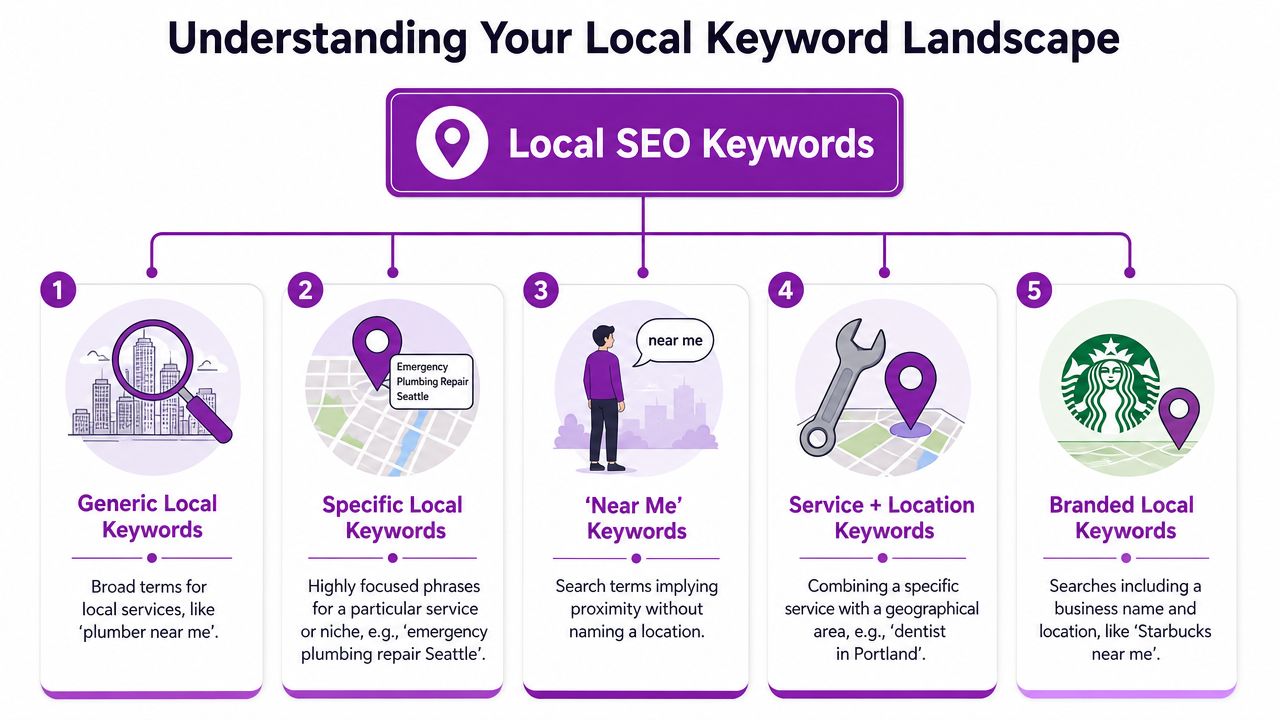
Most businesses start with one pattern: service + city. That's useful, but it's only one part of the overall picture.
Local SEO keywords sit across several categories, and each one reflects a slightly different type of search behaviour. If you don't separate them, your site structure gets messy fast.
The five keyword groups that matter most
Think of local keywords as a hierarchy, not a flat list.
| Keyword type | What it looks like | Best use |
|---|---|---|
| Generic local | plumber near me | GBP and overall local relevance |
| Service + location | emergency plumber Manchester | Service and location pages |
| Specific local | boiler repair Didsbury | Deeper local landing pages |
| Branded local | Brand name Bristol | Reputation and navigational searches |
| Question-led local | how much is roof repair in Bristol | Blog or supporting content |
Implicit and explicit local intent
Some searches name the location. Others don't.
An explicit local query includes the place directly, such as “architect in Bath” or “wedding venue Cotswolds”. An implicit local query leaves the location out and expects Google to infer it, such as “funeral director near me” or “care home nearby”.
That distinction matters because your website and your Google Business Profile don't do the same job.
Practical rule: If the search phrase depends on proximity, don't force it into page copy. Build the right location signals around your GBP and supporting pages instead.
Local keywords are geographic buckets, not one master list
A common reporting mistake is treating all local keyword data as one national pool. That hides intent.
Portent's guidance is useful here. Effective local keyword work means grouping Search Console queries by location and prioritising keyword groups by geographic buckets, rather than treating all search data as one dataset. That's because local keywords combine a product or service with a place, so they need specific targeting on landing pages and area content, as Portent explains in its local keyword data guide.
For a UK business, those buckets might be:
- Primary market: The town or city where your main office sits
- Secondary markets: Nearby towns you actively serve
- Micro-locations: Neighbourhoods, boroughs, villages, or postcodes
- Brand-led searches: People already looking for you by name
This becomes even more relevant if you're trying to appear in AI-driven local results as well as classic search. Research methods that help you win AI answer share locally tend to favour clean geographic targeting and clear intent separation, not vague catch-all pages.
A quick way to sense keyword quality
For local service businesses, the best terms usually answer one of these questions:
- What do you do?
- Where do you do it?
- How urgently is it needed?
- How specifically is the customer describing the problem?
A caterer might target “wedding caterer Surrey”, “Asian wedding catering Croydon”, and “canape catering for weddings in Sussex”. An architect might target “residential architect Cambridge”, “planning drawings Islington”, and “house extension architect near me” through different assets.
If you can see the difference between those intents, you can build pages that match them properly.
The Modern Workflow for Finding Local Keywords
Most keyword lists are built backwards.
People open Ahrefs or Semrush, export a spreadsheet, sort by volume, and call it research. That's how you end up chasing phrases that look attractive in a tool but never turn into calls or bookings.
The better workflow starts inside the business.
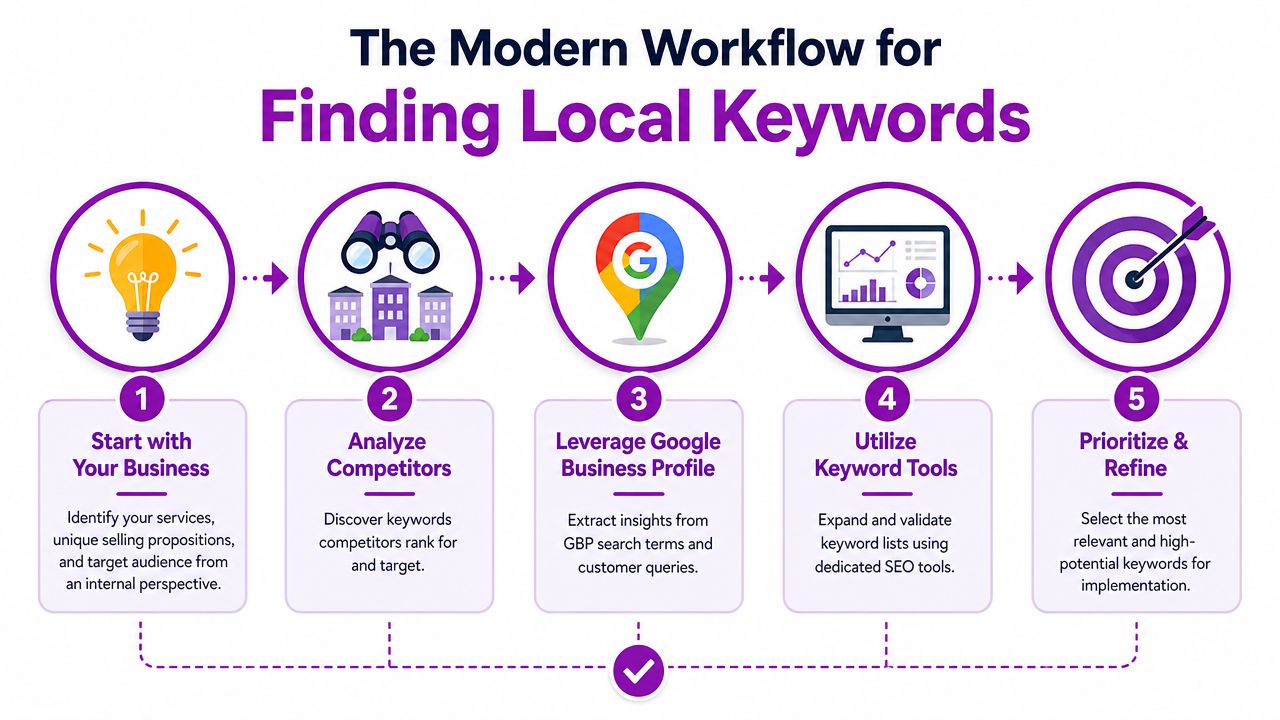
Start with language you already own
The best seed terms often come from places most businesses ignore. Not keyword tools. Actual customer interactions.
A strong process involves pulling phrase patterns from Google Search Console, GBP Q&A, intake forms, and review language, then layering in cities and neighbourhoods. That approach helps uncover zero-volume or low-volume queries that still convert well, especially in UK markets split across towns, boroughs, and postcodes, as noted in Gavel Grow's guide to local keyword research.
Look at:
- Search Console queries: What people typed before landing on your site
- Google Business Profile questions: What prospects ask before they contact you
- Contact form wording: How customers describe the job in their own words
- Sales call notes: The exact problem, urgency, and area mentioned
- Reviews: Repeated phrases around service type, outcomes, and locality
A funeral home might discover that customers search less for industry jargon and more for plain-language phrases around direct cremation, local arrangements, or support with paperwork. A care provider may find that families search by condition, urgency, and area, not broad category terms.
Turn raw phrases into usable seed sets
Once you've gathered customer language, group it into clusters.
A simple version looks like this:
| Cluster | Example seed terms |
|---|---|
| Core service | emergency plumber, boiler repair, blocked drain |
| Location | Leeds, Headingley, LS6, West Yorkshire |
| Situation | same day, urgent, weekend, 24 hour |
| Customer wording | no hot water, leaking boiler, burst pipe |
Now combine them sensibly.
You're not trying to generate every possible permutation. You're trying to identify the combinations that reflect buying intent. “Emergency plumber Leeds” matters. “What causes a boiler leak in winter” may support content, but it's not the same kind of lead.
Validate with tools, but don't let tools lead
Google Keyword Planner and Google Trends are useful. They help you validate demand patterns and compare phrasing, but they shouldn't decide your strategy on their own.
A practical local-keyword workflow is to start with intent-led seed terms such as service plus place, landmark, or neighbourhood, then validate them in Google Keyword Planner and Google Trends, and prioritise by business value rather than raw volume. The key metrics to track after launch are local pack rank, organic rank, website clicks, calls, and direction requests, with monthly reviews used to prune terms that drive traffic but no engagement and expand terms that produce conversions, as outlined in Causal Funnel's local SEO keyword workflow.
That last point matters. A lower-volume local term with strong service fit often beats a broader phrase that sends low-quality traffic.
If you work in a sector where area intent and lead quality matter heavily, adjacent industries can offer useful ideas. For example, local targeting patterns in AI marketing for real estate agents often map well to service businesses because both rely on geography, trust, and fast lead response.
Before you move to implementation, it helps to audit the basics. A practical local SEO checklist keeps the keyword work tied to the pages, profiles, and technical elements that support local visibility.
Prioritise by value, not ego
Here, strategy beats spreadsheet work.
Use three decision filters:
Commercial intent
Does the phrase suggest someone wants to hire, visit, call, or book?Service fit
Is this a profitable or strategically important service?Location importance
Do you want more business from that area, and can you realistically serve it well?
If a keyword brings visitors but no calls, no form fills, and no meaningful engagement, it's a content topic at best. It isn't a priority commercial keyword.
What usually doesn't work
Several patterns keep showing up in underperforming local campaigns:
- Copying competitors blindly: Their page structure may reflect old decisions, not good ones.
- Building one giant service-area page: That rarely gives Google enough page-level geographic relevance.
- Prioritising search volume over fit: A bigger term isn't automatically a better one.
- Ignoring low-volume phrasing: In local SEO, some of the best-converting searches look small in tools.
- Forcing every keyword onto one page: That creates muddled intent and weak rankings.
Later, when you map keywords to assets, those distinctions become the difference between a tidy local footprint and a site that cannibalises itself.
A useful refresher on the workflow is below.
Mapping Keywords to Your GBP and Landing Pages
Finding local SEO keywords is only half the job. The other half is putting them in the right place.
Many businesses falter at this stage. They collect a decent list, then dump everything onto the homepage, repeat it across service pages, and stuff “near me” into headings. Google gets mixed signals, users get repetitive copy, and local relevance stays weaker than it should.
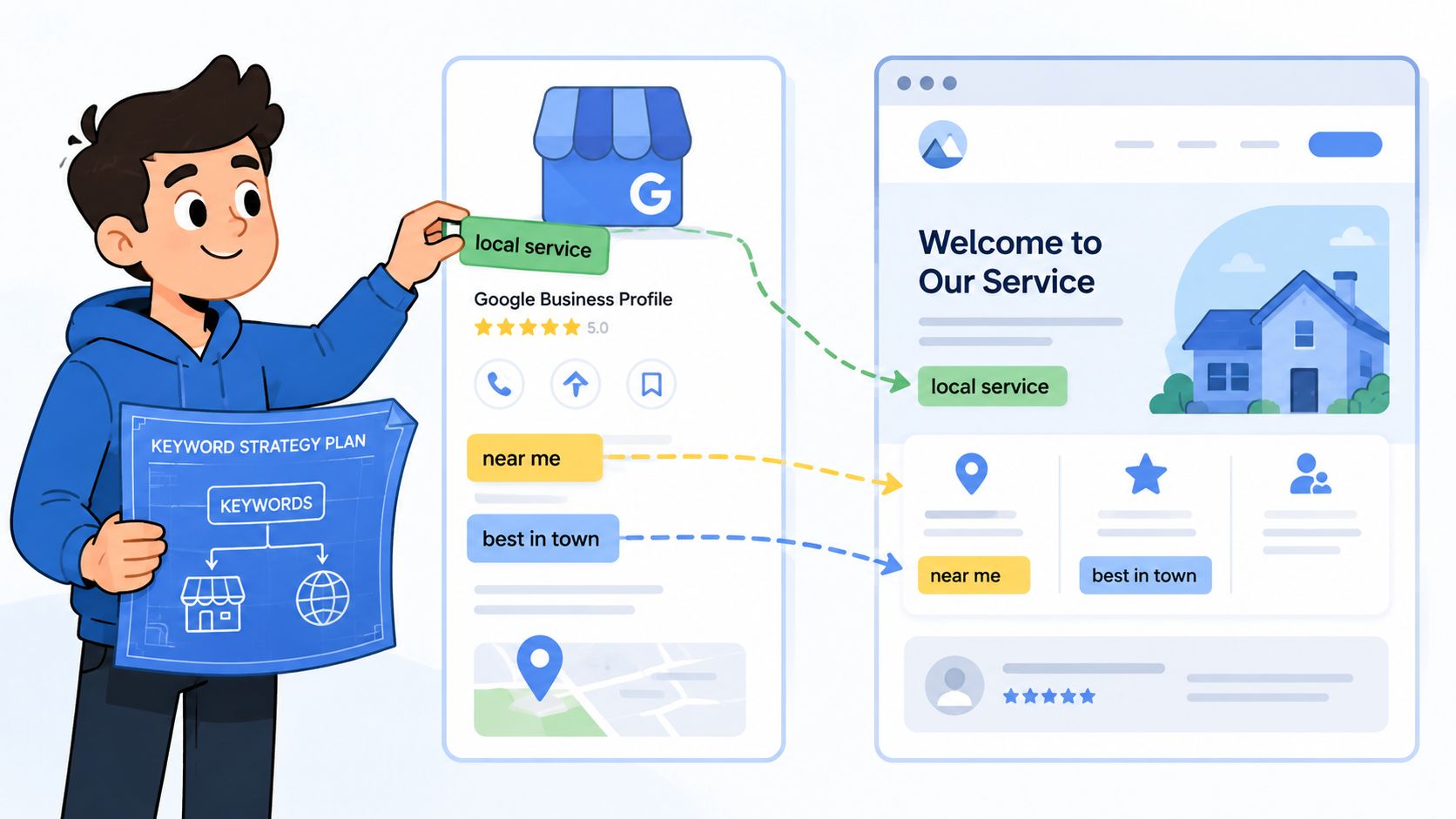
The keyword placement map that keeps things clear
Different keyword types belong to different assets.
| Asset | Best keyword type | Example |
|---|---|---|
| Homepage | Broad service + main area | plumber in Leeds |
| Main service page | Primary commercial service terms | boiler repair Leeds |
| Area landing page | Service + town, district, postcode | boiler repair Roundhay |
| Blog post | Question-led and supporting intent | how much does boiler repair cost in Leeds |
| GBP | Proximity and service relevance | near me, nearby, local intent signals |
That last line is where many businesses slip.
A major gap in local SEO advice is the difference between website keywords and Google Business Profile prompts. “Near me” should be treated as a GBP and proximity signal, not a phrase stuffed into page content. Query phrases belong on pages, proximity signals belong in GBP, and location variants belong on area landing pages, as explained in Boulder SEO Marketing's local keyword placement guide.
What goes on the page, and what doesn't
Use your website to show service relevance and geographic relevance clearly.
That means:
- Homepage: Main service category and core location signals
- Primary service pages: The money terms tied to your main services
- Location pages: Individual towns, districts, or service areas with enough unique local detail
- Blog content: Questions, comparisons, local guides, and supporting educational intent
Don't use pages for things that are primarily about proximity.
A page can rank for a place. A Google Business Profile helps Google trust your proximity and local prominence. They work together, but they're not interchangeable.
A practical example for a UK service business
Take a roofing company based in Bristol.
A clean map might look like this:
- Homepage: Roofing company Bristol
- Service page: Emergency roof repair Bristol
- Service page: Flat roof replacement Bristol
- Area page: Roof repair Clifton
- Area page: Roof repair Bedminster
- Blog post: Signs your roof needs urgent repair after heavy rain in Bristol
- GBP signals: Categories, services, reviews, photos, posts, service areas
That structure tells Google what the business does, where it does it, and which pages deserve to rank for which combinations.
If your GBP is weak, your keyword mapping will still struggle. A Google Business Profile audit tool can help spot the gaps between your page targeting and your profile signals before you keep publishing more content.
What an effective area page needs
A location page doesn't need to be clever. It needs to be locally convincing.
Include things such as:
- Specific local references: Towns, districts, landmarks, or service coverage details
- Relevant service detail: The exact service the page targets
- Proof of local fit: Reviews, service examples, or practical details tied to the area
- Clear conversion paths: Phone number, enquiry form, booking prompt
What doesn't work is cloning the same page across ten towns and swapping only the heading. Google can spot that, and users can too.
Scaling Keyword Strategy for Multi-Location Brands
Single-location businesses can manage local SEO with a focused page set and one strong Google Business Profile. Multi-location brands need a system.
Without one, the work collapses into duplication. One generic service-area page tries to rank for every branch, location pages reuse the same copy, and reporting becomes impossible to trust.
Why location-specific landing pages aren't optional
For multi-location UK businesses, keyword strategy should be built around location-specific landing pages. Core local ranking inputs include location-based keywords and schema markup. Multi-location brands also saw their Google 3-pack presence for top keywords rise from 23.8% in 2022 to 33.4% in 2024, according to Moz's overview of local ranking factors.
That shift matters because it reflects how competitive page-level local targeting has become.
A clinic group, estate agency, self-storage operator, or wedding venue group won't win consistently with one broad “locations we serve” page. Google needs branch-level relevance, and users need branch-level confidence.
If you manage local visibility in a venue-led market, the same logic applies to niche sectors such as SEO for wedding venues, where each location can attract a very different search pattern even under one brand.
The scalable model that works
The right structure is usually a templated framework with local customisation.
Keep the following consistent across all locations:
- Core service hierarchy
- URL structure
- Metadata patterns
- Internal linking rules
- Schema implementation
- Primary conversion elements
Then localise what users and Google care about:
- Branch-specific service notes
- Local staff or team details
- Town, district, or nearby landmark references
- Reviews connected to that branch
- Unique FAQs
- Branch contact details and practical visit information
How to keep keyword research manageable at scale
Don't run each branch as a completely separate SEO project if the service set is broadly the same.
Use a model like this:
| Layer | What stays centralised | What changes by location |
|---|---|---|
| Core services | Main service keyword set | Local modifiers |
| Brand terms | Brand naming conventions | Branch name variations |
| Content templates | Page structure and sections | Local proof and area detail |
| Tracking | KPI framework | Branch-level reporting |
Multi-location SEO gets expensive when every page is custom from scratch. It gets weak when every page is identical. The middle ground is standardised structure with genuinely local detail.
That's usually enough to scale without producing thin pages or impossible reporting.
Measuring Success with the Right Local KPIs
If your reporting stops at rankings, you're missing the full picture.
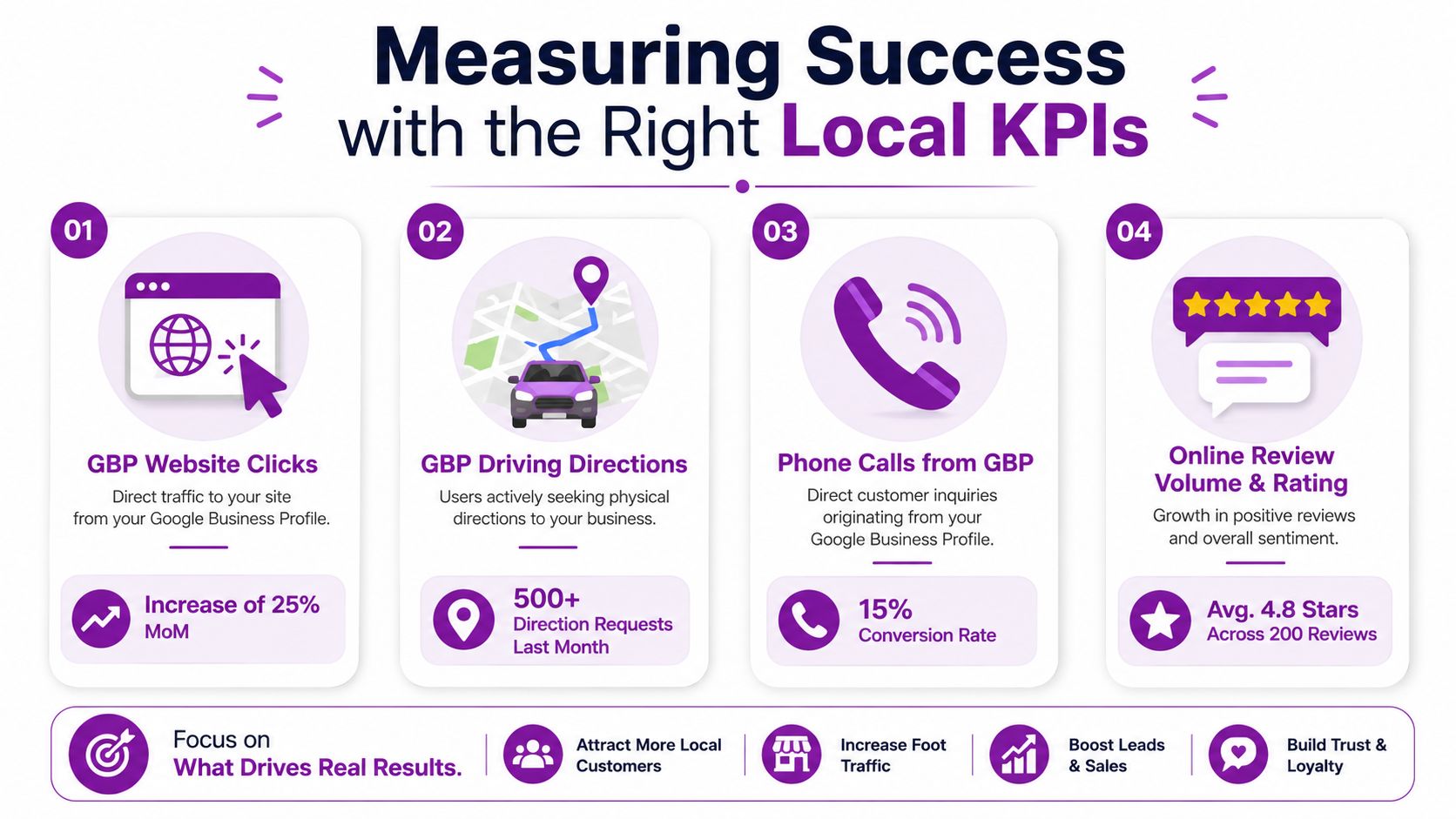
Local SEO keyword work should be judged by the actions it creates. Calls. Website clicks. Direction requests. Form submissions from the right area pages. Those are the signals that tell you whether your targeting is producing business, not just visibility.
Why local pack performance matters more than vanity rankings
Businesses appearing in Google's local 3-pack receive 126% more traffic and 93% more actions, including calls, website clicks, and direction requests, than businesses ranked 4 to 10, according to SOCi's local SEO statistics.
That's why “we rank on page one” often isn't enough. The difference between sitting in the local pack and sitting just below it can be the difference between steady enquiry flow and disappointing lead volume.
The KPIs worth tracking every month
A practical local dashboard should include:
- Local pack rank: Are you visible where high-intent local clicks happen?
- Organic rank by page and location: Are the right pages appearing for the right area terms?
- GBP website clicks: Are people moving from the profile to your site?
- GBP calls: Are proximity-led searches turning into direct contact?
- Direction requests: A strong signal for visit intent and local relevance
- Page-level conversions: Which location pages generate enquiries?
How to interpret the data properly
Not every increase means success.
If a location page grows traffic but produces no calls or forms, the keyword targeting may be too broad, too informational, or tied to the wrong place. If a GBP gets impressions but weak action volume, your profile relevance, reviews, categories, or landing-page alignment may need work.
A simple rule helps here:
Track rankings to diagnose. Track actions to decide.
If you need a commercial lens on whether those enquiries justify the effort, tools like a self-storage ROI calculator for SEO are useful examples of how to connect search visibility to actual return rather than treating rankings as the end goal.
What to do with the results
Use a monthly review cycle and make changes based on behaviour:
- Prune weak targets that bring visits but no engagement
- Expand strong clusters where calls and leads are already showing up
- Improve underperforming pages before creating new ones
- Refine GBP support signals when map visibility doesn't convert
That's how local SEO keywords become a revenue system instead of a reporting exercise.
If you want a practical local SEO strategy that turns keyword research into calls, bookings, and sales, Bare Digital can help. They work with UK businesses that need stronger Google Maps visibility, cleaner location page strategy, and reporting tied to real enquiries rather than vanity rankings.