
You're good at the work. You fix leaks fast, diagnose awkward faults, and know the difference between a simple washer swap and a job that needs proper investigation. Yet a homeowner types “plumber in Manchester” into Google and calls someone else.
That usually happens because the better page wins, not always the better plumber.
A lot of Manchester plumbing websites make the same mistake. They try to say everything, cover every service, and please every visitor. The result is a weak page that doesn't clearly tell Google what the business does, where it works, and why anyone should trust it. You don't need a huge website to beat that. You need one landing page built with the same care you'd give to a neat pipe run. Every section should have a purpose. Every detail should connect.
Your Blueprint for Dominating Manchester Searches
Think about the week many plumbers have. Monday starts with one emergency call from a repeat customer. Tuesday is quiet. Wednesday brings two quote requests, but both came from Checkatrade or another directory that sits between you and the customer. By Friday, you've seen a rival show up across Google for jobs you know you could do better.
The problem usually isn't skill. It's presentation.
Google can't inspect your soldering, pressure test your installs, or watch how you handle a panicked homeowner with a leak under the floorboards. It judges the signals on the page. If your website says little more than “trusted local plumber” and “24/7 service”, you blend in with everyone else.
Practical rule: A strong landing page should answer three questions within seconds. What do you do, where do you do it, and why should anyone trust you?
For a plumber in Manchester, that means building one page that works like a well-labelled control panel. It should show your services in a clear hierarchy, map your local coverage properly, prove your credentials, connect with your Google Business Profile, and make calling you feel easy.
A page like that doesn't just rank better. It filters the right leads. Someone with a burst pipe in Didsbury wants confidence and speed. Someone in Chorlton comparing boiler installation quotes wants clarity. Someone in an older property wants reassurance that you understand hidden issues, not generic sales copy.
Treat the page like a call-out kit. If a tool doesn't help solve the problem, it doesn't belong there. If a section doesn't help rankings or conversions, remove it. Tight pages outperform bloated ones.
Structuring Your Plumbing Services for Search Engines
A weak services section looks like this: “We do plumbing, boilers, bathrooms, emergencies and more.”
That tells Google almost nothing. It also forces the customer to guess whether you handle their exact problem.
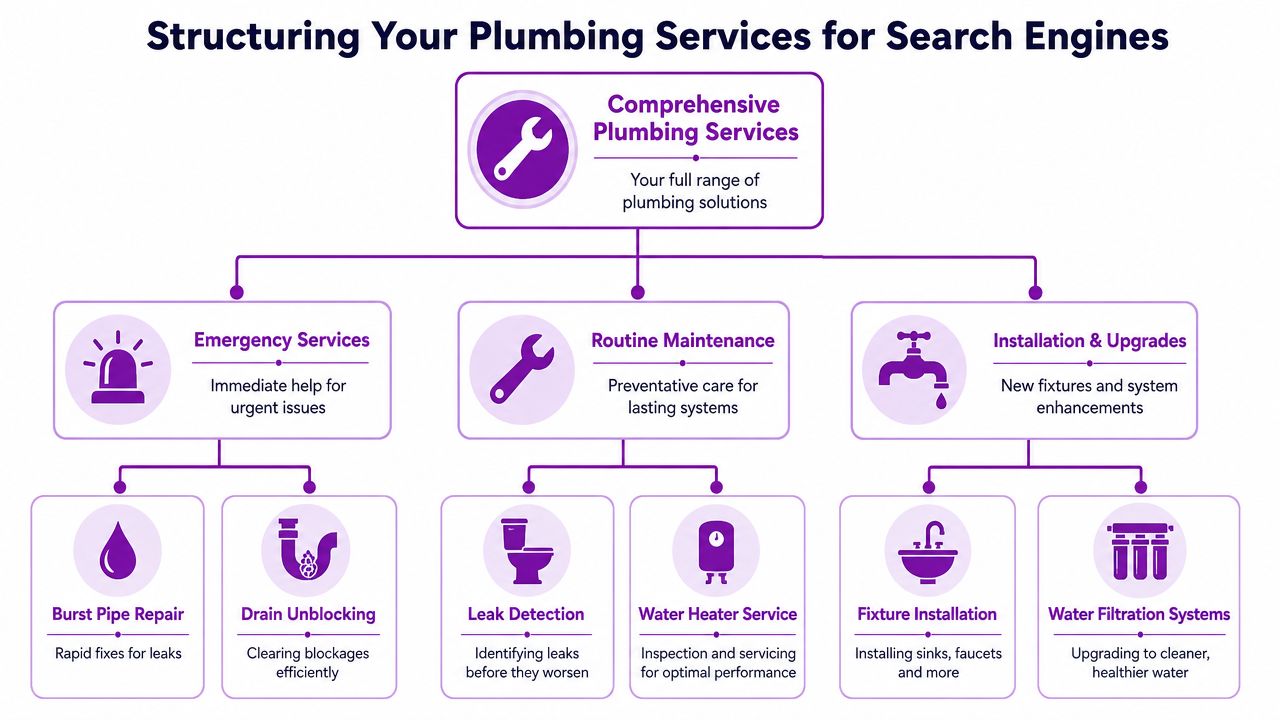
A stronger page groups services into logical buckets. Search engines like structure because it helps them understand topical depth. Customers like structure because it helps them self-diagnose. If someone lands on your page with no hot water, they should immediately spot the right path.
Build service groups like a pipe system
Start with three top-level categories:
- Emergency services for urgent jobs such as burst pipes, blocked drains, major leaks and no water
- Repairs and maintenance for faults that need fixing but aren't immediate disasters
- Installation and upgrades for planned work such as new taps, radiators, cylinders or bathroom plumbing
That layout mirrors how people search. It also creates room for more specific phrases underneath each heading. In local SEO for trades, specific local terms matter. Valve+Meter notes that plumbers in the UK should prioritise local phrases like “plumber in [city]” and long-tail terms such as “emergency leak repair [city]” because they're easier to rank for than broad terms and attract customers in the service area.
Write for real searches, not brochure language
A customer rarely searches “general plumbing solutions”. They search for the fault.
Compare these examples:
| Basic wording | Better landing page wording |
|---|---|
| Boiler repair | Emergency boiler service in Manchester |
| Leak repairs | Leaking pipe repair in Didsbury |
| Tap services | Dripping tap repair in Chorlton |
| Installations | New kitchen tap installation in South Manchester |
You don't need to stuff every sentence with area names. You do need to show service depth. Google should see that you handle the full path from diagnosis to repair to replacement.
A useful format is:
- Main service heading such as Emergency Plumbing
- Short explanation of the problem types covered
- Specific sub-services with natural Manchester modifiers
- A call to action tied to that service group
For example, under Emergency Plumbing, you could include burst pipe repair, overflow issues, blocked waste pipes, urgent leak tracing, and loss of hot water. Under Installation and Upgrades, you might include radiator fitting, outside tap installation, bathroom plumbing and pipework upgrades.
Customers don't want to decode your capabilities. Label them clearly and they'll do the sorting for you.
One more point matters. Don't lump unrelated searches onto one paragraph. “Boiler repair”, “toilet replacement” and “drain unblocking” each signal different intent. Keep them visually separate with sub-headings and short descriptions.
If you want to apply the same service-page logic across a wider trades site, this guide to SEO for construction companies shows the same principle at a broader level.
Mapping Your Manchester Coverage and Response Times
Many plumbing pages say “We serve all Manchester and surrounding areas.” That sounds fine to a human, but it's weak as a local signal.
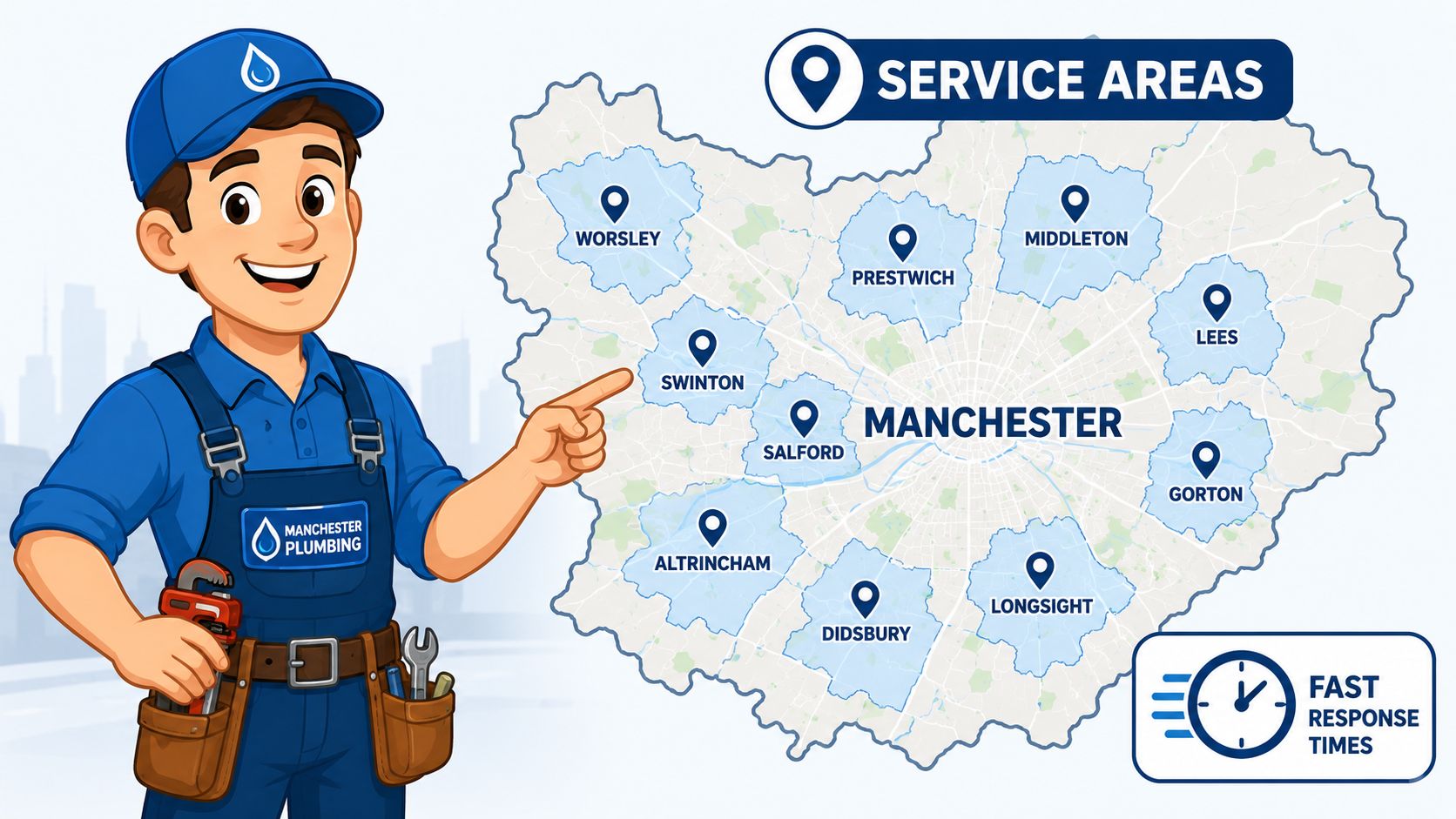
Google wants evidence that you operate in real places, not a vague service cloud. Your landing page should name the areas you cover and do it in a way that feels useful, not stuffed.
Go narrower than Manchester
A better coverage section includes neighbourhoods and postcodes where relevant. For example:
- City centre jobs in M1 and nearby areas
- South Manchester coverage including Didsbury and Chorlton
- Inner residential areas such as Ancoats and other nearby neighbourhoods
- Student and rental-heavy areas where emergency call-outs often need quick coordination with landlords or tenants
This works for two reasons. First, users instantly know whether they're in your patch. Second, Google sees stronger geographic relevance.
You don't need to list every postcode in Greater Manchester. That can look spammy. Pick the areas you cover well and explain what that means in practice. If certain areas get same-day emergency response more often because they're close to your base, say so clearly. If outer areas may need a booked slot, say that too.
Use local housing knowledge as a ranking advantage
Most plumber pages stop at area names. That leaves a gap you can exploit.
One of the strongest ways to sound local is to explain how the housing stock affects plumbing problems. A cited source states that Manchester's median home age is 48 years, and 32% of UK plumbing emergencies in older homes involve concealed leaks. It also argues that addressing this risk is a key content gap on most Manchester plumber websites.
That gives you a practical angle for areas with older housing. If you serve places such as Cheetham or Harpurhey, mention that older properties can hide leaks behind plaster, under floors, or in ageing pipe runs. That's not fluff. That's useful local context.
A customer in an older terrace doesn't just want “emergency plumber Manchester”. They want someone who understands why a damp patch might not sit directly under the failed section of pipe.
Turn coverage into conversion copy
Instead of writing a dead list of areas, write short, useful notes.
For example:
- Didsbury often suits planned installations, boiler-related plumbing and upgrade work.
- Chorlton may bring a mix of modern kitchen refurbishments and repairs in older homes.
- Inner Manchester properties can need leak tracing where access and parking affect visit planning.
That sort of detail makes your page feel lived-in.
If your visibility in the map pack is weak even with a decent page, a Google Business Profile audit tool can help identify what's missing from the local side of the setup.
Building Unshakeable Trust with Customers and Google
A landing page can rank, but it won't convert well if it feels risky. Plumbing is a trust-led service. Customers let you into their homes, rely on your advice, and often call when something's already gone wrong.
Google treats that kind of service seriously as well. If your page lacks proof, it can look thin and replaceable.
Put regulated signals where people can see them
If you do any gas-related work, don't bury your credentials in the footer. In the UK, Gas Safe Registration is a legal requirement for gas-related work. The same source also notes that plumbers must comply with drainage building regulations, landlords must carry out annual water safety reviews, and hot water should be maintained at 60°C to inhibit bacteria growth.
Those details matter because they signal competence. They tell a customer that you work within real standards, not just marketing claims.
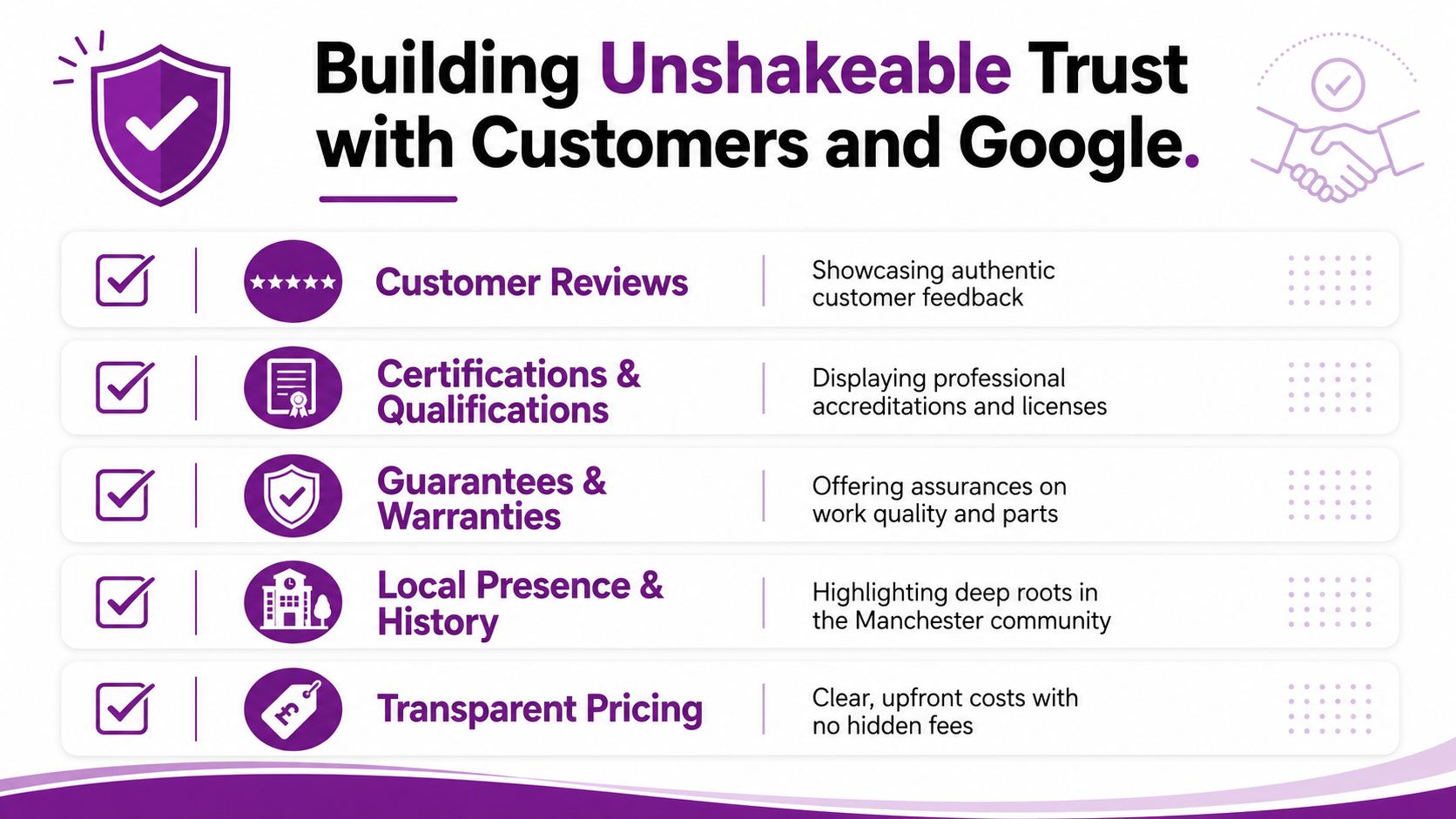
A strong trust section should include:
- Qualifications such as NVQ Level 2 in Mechanical Engineering Services (Plumbing), where relevant to your team profile
- Gas Safe details if you undertake gas work
- Insurance mention so customers know you're covered
- Compliance language that shows you understand legal and safety standards
- Review proof from real customers
Reviews aren't decoration
A lot of plumbers treat reviews as a sidebar item. That's a mistake. Reviews support trust with both users and local search systems.
A useful benchmark appears in a LinkedIn best-practice piece, which says plumbers should aim for 150+ quality reviews per location and respond to every review to build trust and visibility in local and AI-driven search results. I'll keep the exact review target for the final conversion section where it matters most, but the principle belongs here as well. Reviews show consistent service quality over time.
Place selected reviews beside the service promise they support. If you say “fast emergency leak response”, show a review mentioning speed. If you claim tidy installation work, show a review about cleanliness and communication.
Trust test: If a nervous homeowner landed on your page at 10pm with a leak, would your proof calm them down?
Make E-E-A-T visible, not abstract
Google's quality thinking often gets summarised as E-E-A-T: experience, expertise, authoritativeness and trustworthiness. For a plumber in Manchester, that isn't an academic framework. It's page design.
Here's how it looks on the page:
- Experience comes through real job photos, area-specific problem solving and practical descriptions
- Expertise shows in service detail, qualifications and precise terminology
- Authoritativeness grows when your business looks established and consistent across the web
- Trustworthiness comes from reviews, regulation, guarantees and clear contact details
If you want to tighten the local proof attached to your profile and reviews, this GBP reporting page gives a useful view of how local presence gets measured.
Video can also reinforce trust when it explains standards and professionalism clearly:
Connecting Your Page to the Local SEO Engine Room
A landing page on its own is like fitting a good boiler and never connecting the controls. The visible page matters, but the hidden system around it decides how well it performs.
For local SEO, that system includes your Google Business Profile, your citations, your on-page signals and the technical setup that joins them.
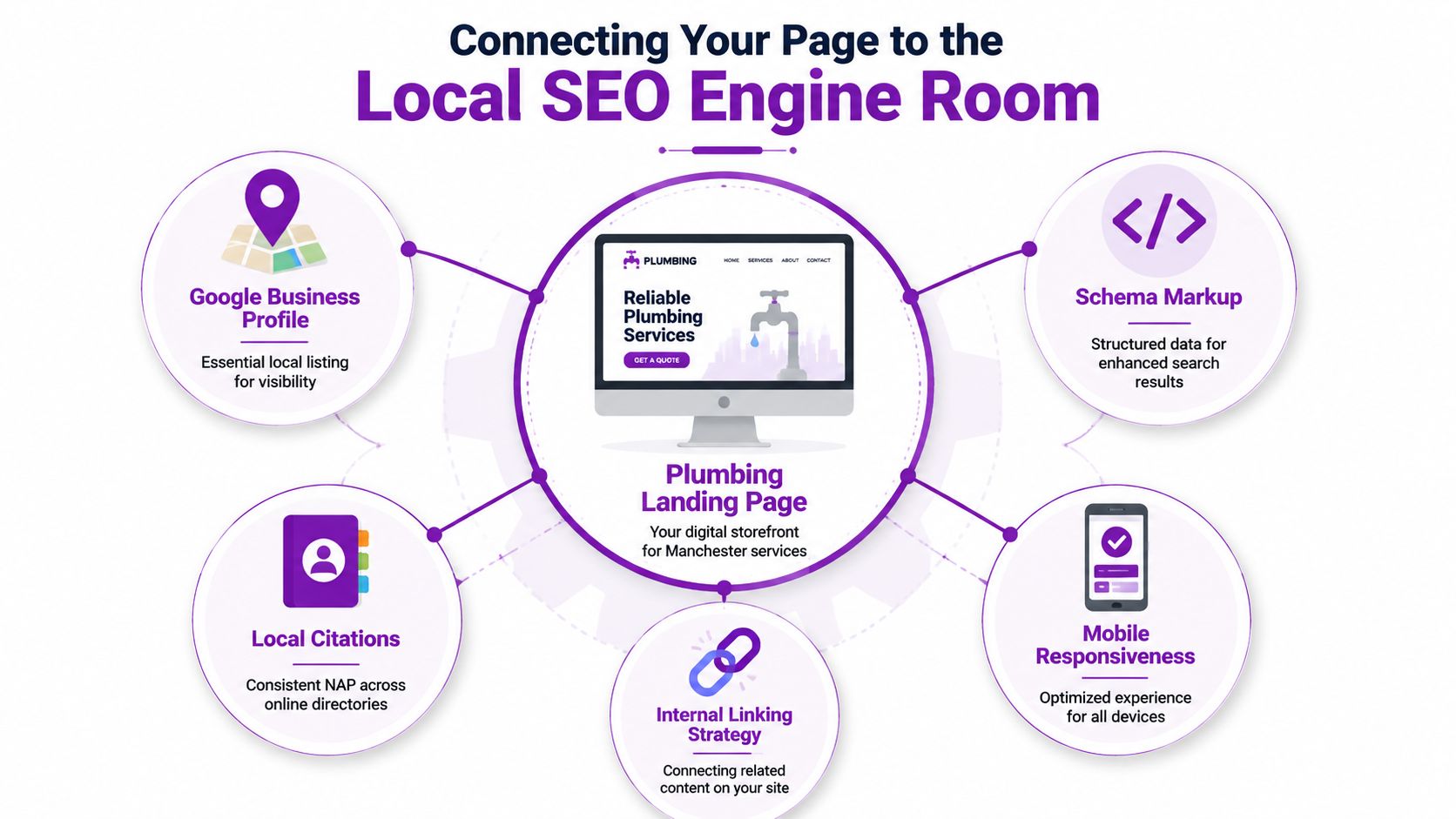
Treat your Google Business Profile as the hub
Your Google Business Profile isn't just a business listing. It's often the first thing a customer sees before they ever hit your site.
That means your landing page and your profile should mirror one another. If the page highlights emergency plumbing, leak repair, and installations in Manchester, your profile should reference the same service themes. If the page uses photos of your vans, team, and recent jobs, your profile should do the same. Mixed signals weaken trust.
A clean setup usually includes:
- Matching services between site and profile
- Fresh photos of work, vehicles and team members
- Short updates or posts tied to seasonal issues or common jobs
- Consistent business details everywhere they appear
NAP consistency is basic, but it still breaks rankings
This is one of the least glamorous tasks in local SEO, and one of the most important. CausalFunnel states that plumbers must keep Name, Address, and Phone Number details consistent across listings because even minor differences can confuse search engines and hurt local rankings.
That means no variation between “Street” and “St” in one place, one tracking number on a directory and another on your website, or a slightly altered business name on a citation.
A simple checklist helps:
| Asset | What should match |
|---|---|
| Website contact block | Business name, address, main phone |
| Google Business Profile | Same core details |
| Directories like Yell or Angi | Identical formatting where possible |
| Social profiles | Same business identity and contact route |
If you use call tracking, set it up carefully so measurement doesn't create confusion. For plumbers comparing systems, this guide to top call tracking platforms is useful because it frames the software around lead attribution rather than just call logging.
Add supporting technical signals
Your local page should also include technical markers that reinforce meaning:
- Embedded map if you have a legitimate business address or service base you want to associate with the page
- Schema markup for local business and services
- Mobile-first layout because many plumbing searches happen when someone needs help quickly
- Internal links to supporting pages such as drain unblocking, boiler services, or contact
None of those elements wins on its own. Together, they form a system. The page says what you do. The profile says where you are. Citations confirm it. Technical markup helps search engines read it cleanly.
A good local SEO checklist is handy here because local pages often fail through small inconsistencies, not dramatic errors.
Turning Clicks Into Customers with a Clear Call to Action
A page can rank well and still waste leads if the next step feels awkward.
For a plumber in Manchester, the CTA should be as clear as an isolation valve. The visitor shouldn't have to hunt for a phone number, decode a long form, or wonder whether you handle their job. The best local landing pages remove friction.
Put the main action where mobile users can reach it
Most service searches don't happen from someone sitting comfortably with time to browse. They happen in kitchens, hallways, utility rooms and workplaces while a problem is unfolding.
Your page should include:
- A clickable phone number near the top so mobile users can tap and call
- A short service-led CTA such as “Call for emergency plumbing in Manchester”
- A simple out-of-hours form for people who can't call immediately
- Reassurance text like free, no-obligation quotes where appropriate to your business model
If the CTA is weak, users bounce. If users bounce because the page feels hard to use, that quality problem can work against you over time.
Keep the form short and specific
Long forms lose leads. A plumbing enquiry form doesn't need to feel like an insurance application. Usually, name, phone, postcode, and a short problem summary are enough for first contact.
The details that matter are practical:
- Field count should stay low
- Button text should say what happens next
- Error messages should be clear
- Mobile spacing should make tapping easy
If you want a good primer on reducing drop-offs, these tips for lowering form abandonment are useful because they focus on friction points that often get ignored.
A CTA works best when it answers the customer's hidden question: “How quickly can I get help, and what do I do next?”
Use reviews to support the final push
At the point of conversion, social proof matters most. According to a LinkedIn best-practice resource, plumbers should aim for over 150 quality reviews per location and respond to every single one, because that volume of review activity helps visibility in local map packs and AI-driven search results as well as customer trust (LinkedIn best practices for plumbers).
That doesn't mean dumping a wall of testimonials above the contact form. It means placing a few relevant proof points next to the call button or form. Keep them short. Keep them specific. Speed, tidiness, communication, and reliability are the themes that usually move service buyers.
Finally, link the CTA area directly to your contact route. Don't make users return to the menu. Don't hide contact behind a generic “learn more” button. Let the page do the job it was built to do.
If your current contact setup feels clumsy, reviewing the structure of a dedicated contact page can help you simplify the handoff.
If you want expert help turning your plumbing website into a local lead machine, Bare Digital can help. They specialise in UK local SEO, Google Business Profile optimisation, location landing pages, and conversion-focused strategy that turns visibility into enquiries.