

A lot of UK business owners are in the same spot right now. The phone is quieter than it should be, referrals are uneven, and you know people need what you sell, but you’re not seeing enough of them come through the door or send an enquiry.
The missing piece usually isn’t demand. It’s visibility.
If someone needs a wedding venue in their county, a funeral director nearby, a builder for an extension, or a private clinic they can trust, they almost always start online. In the UK, 46% of all Google searches have local intent, and 72% of users visit a store within 5 miles after a local search, according to local search statistics compiled here. That’s the whole game in one line. People search locally, then they act locally.
Local business marketing online isn’t about being “active on the internet”. It’s about showing up at the exact moment a buyer is ready to compare, call, visit, or book. Done properly, it turns Google Maps, your website, your reviews, and your local reputation into a joined-up lead generation system.
What matters is order. Most businesses waste time because they do the right things in the wrong sequence. They post on social media before fixing their Google Business Profile. They run ads to a weak page. They ask for links before sorting out their business details. That’s like repainting the front door while the shop sign is missing.
The better approach is simple. Build the foundations first, then optimise your website for local intent, then earn trust signals, then scale what already works. That’s the framework below.
Why Your Next Customer Is Searching For You Online Right Now
The customer you want probably isn’t browsing casually. They’re trying to solve a problem.
A couple planning a wedding aren’t searching for “content”. They’re searching for availability, style, location, pricing cues, and reassurance. A homeowner with a leaking roof wants someone credible, nearby, and easy to contact. A family arranging a funeral needs clear information and confidence that they’re dealing with a professional.
That’s why local search matters so much. It catches people with intent. Not vague awareness. Not passive scrolling. Intent.
When a business doesn’t appear in those moments, competitors collect the click, the call, and the booking. That loss is easy to miss because you never see the customer you didn’t win. You just feel the quieter pipeline.
Practical rule: If a local buyer can’t quickly confirm where you are, what you do, and why they should trust you, they move on.
The businesses that win local search usually get the basics right before they chase anything clever. They make it easy for Google to understand the business, easy for customers to compare options, and easy for prospects to take the next step.
That applies across sectors, but the way it plays out differs. A construction firm needs strong service-area signals and proof of completed work. A wedding venue needs high-quality visuals and pages optimized for the places couples search. A funeral home needs location clarity, compassionate copy, and strong review handling.
Local business marketing online works best when every tactic answers one of three questions:
- Can people find you
- Can they trust you
- Can they contact or visit you without friction
If one of those breaks, enquiries slow down. If all three work together, local visibility turns into revenue.
Mastering Your Local Digital Shopfront
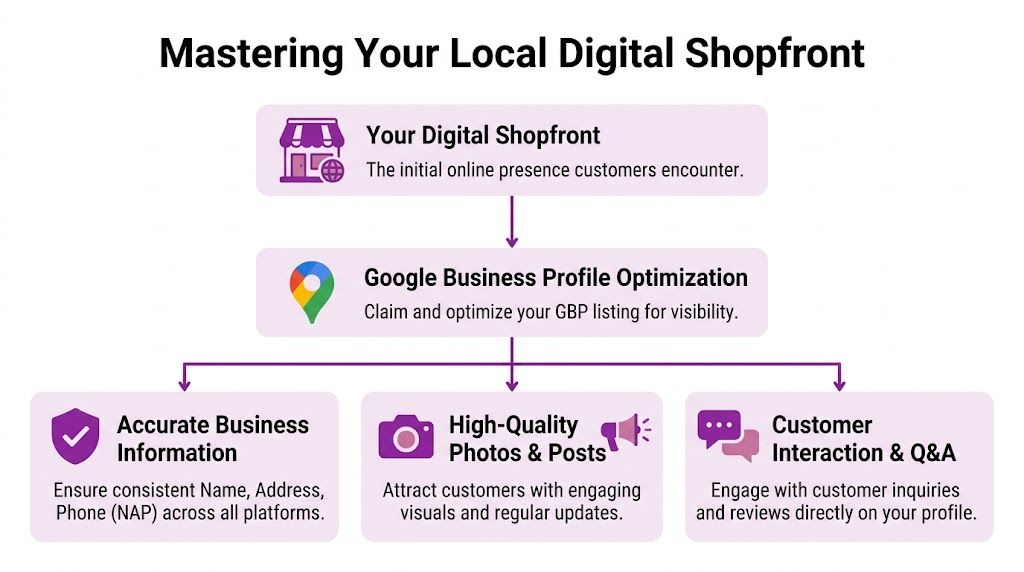
Think of your online presence as your digital shopfront. Before anyone reads a long service page or speaks to your team, they usually see a listing, a map result, your opening hours, your reviews, or your contact details.
If that shopfront looks unfinished, inconsistent, or stale, trust drops fast. That matters because over 58-60% of UK small businesses were actively engaged in digital marketing in 2024, with 73% maintaining websites, which means a polished online presence is now standard, not a bonus, according to UK small business marketing data.
Start with Google Business Profile
Your Google Business Profile is the first asset to fix because it influences how you appear in Google Maps and branded local searches. For many businesses, it gets seen before the website.
Claiming the profile is only the start. The gains come from completeness and accuracy. The profile needs the right primary category, sensible secondary categories, service details, opening hours, phone number, website link, photos, and a business description written for real customers rather than stuffed with keywords.
A few practical points matter more than people expect:
- Choose the right main category. A wedding venue shouldn’t hide behind a broad label if a more precise option exists.
- List real services. Builders, clinics, caterers, and photographers should define what they offer, not just the business type.
- Upload current photos. Exterior, interior, team, completed work, and service context all help users decide quickly.
- Keep hours updated. Wrong opening times damage trust faster than most technical SEO issues.
Fix your NAP before you do outreach
NAP means name, address, and phone number. It sounds basic because it is basic. It’s also where many local campaigns often falter.
If your Google profile says one phone number, a directory says another, and your website footer uses an old address format, search engines get mixed signals. Customers do too. For single-location firms, that creates avoidable friction. For multi-location firms, it creates ranking confusion at scale.
Your job is to make every core business detail match across your website, Google Business Profile, Bing Places, Apple Business Connect, key directories, and sector-specific listings.
Use one canonical version and stick to it. That includes:
- Business name formatting
- Address style
- Primary phone number
- Opening hours
- Website URL
- Service area wording where relevant
A local SEO campaign often improves simply because the business stopped sending contradictory signals.
What a strong shopfront looks like
A well-managed local profile doesn’t just “exist”. It reassures the buyer and supports conversion.
For example, a funeral home needs calm, accurate profile information, clear service categories, and thoughtful review responses. A construction company needs project photos, service coverage details, and a phone number that’s easy to tap from mobile. An architect or interior designer benefits from strong imagery and clear proof of locality.
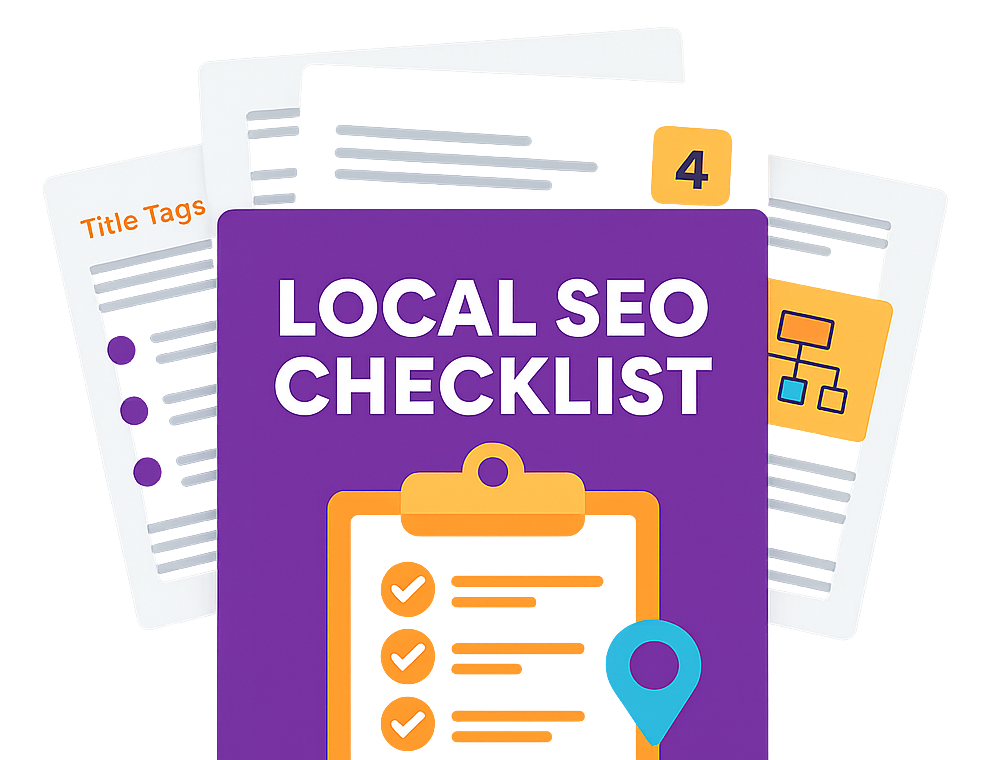
A good working checklist helps. If you want a practical benchmark, this local SEO checklist covers the areas most businesses miss at the foundational stage.
What not to do first
Businesses often jump ahead to the more visible tasks because they feel productive. Running posts, paying for ads, or chasing backlinks looks like momentum. It isn’t, if your digital shopfront is weak.
Avoid these common sequencing mistakes:
- Don’t run paid traffic to an inconsistent brand presence. You’ll pay for clicks that don’t convert well.
- Don’t collect reviews onto the wrong profile. Old duplicates can split your credibility.
- Don’t build location pages before confirming address data. The site and listings must agree.
- Don’t rely on social media as your main local discovery channel. For high-intent local buying, search and maps usually carry more weight.
The first win in local business marketing online is rarely flashy. It’s clarity. Once your shopfront is clean, accurate, and active, the rest of the campaign has something solid to build on.
Winning the Near Me Search Game
Your Google Business Profile helps you appear. Your website helps you compete.
That distinction matters. A profile can earn attention, but your site does the heavy lifting when someone wants details, reassurance, pricing context, service coverage, or a reason to choose you over the next option in the search results.
Think in service plus place
Most local SEO campaigns improve when the business stops targeting broad vanity terms and starts targeting the combinations people use. In practice, that means pairing what you do with where you do it.
Examples look like this:
- Wedding venue in Cambridgeshire
- Kitchen extension builder in Norwich
- Private dentist in Guildford
- Funeral director in Harrogate
- Cotswolds wedding catering
The wording varies by sector. Some industries get direct “near me” demand. Others get town, district, or county modifiers. Some buyers search by problem, others by service type. You need all three lenses.
A useful way to organise local keywords is:
| Search type | Example | Why it matters |
|---|---|---|
| Service-led | wedding photographer York | Captures direct intent |
| Problem-led | emergency roofer near me | Reaches urgent buyers |
| Area-led | architect in Surrey Hills | Helps with geographic relevance |
Build pages for places you actually serve
One of the most common mistakes is trying to rank one generic services page across every town. That rarely holds up in competitive local markets.
A better setup is a clear site structure with dedicated pages for real services and, where justified, dedicated pages for real locations. The key phrase there is where justified. If you create weak, near-duplicate pages for every village within driving distance, you’ll end up with thin content and little value.
Strong location pages usually include:
- The exact service in that area
- Useful detail about how the service works locally
- Relevant examples, imagery, or proof
- Clear contact options
- Internal links to related services
- A map or service-area context where appropriate
For a wedding venue, that might mean pages targeting nearby counties where couples commonly search. For a builder, it might be town pages tied to real service demand. For a funeral director, it could mean pages for specific branches or clearly defined service areas.
One niche where intent is especially specific is funeral search behaviour. If you want a grounded example of how location-led phrasing shapes demand, this guide to cremation near me searches is useful because it shows how people phrase urgent local needs in a sensitive sector.
On-page local SEO that actually helps
A local page doesn’t need SEO theatre. It needs clarity.
That means placing the target topic naturally in the title tag, H1, opening copy, and supporting headings. It means writing copy that answers the visitor’s actual questions. It means using schema, internal links, and page structure to remove ambiguity.
Good local SEO copy sounds like a competent business explaining its service clearly. Bad local SEO copy sounds like it was written to impress a spreadsheet.
These are the on-page elements worth getting right:
Page title
Keep it specific to the service and location.Main heading
Match the intent of the search, not just the keyword.Intro paragraph
Confirm the service area and what the user can do next.Supporting sections
Include process, FAQs, examples, trust signals, and coverage details.Calls to action
Give users a simple next step such as call, enquiry form, or booking.
A technical audit helps spot weaker pages, missing metadata, duplicate intent, and local relevance gaps. If you’re reviewing the website side of local visibility, this Google Business Profile audit tool is a practical place to compare listing strength against what your site is signalling.
Don’t treat every area page the same
Local intent changes by sector. That’s where many templated campaigns fall down.
A construction firm can justify pages around extensions, loft conversions, refurbishments, and service towns. A wedding venue may need pages built around county appeal, nearby cities, accommodation, ceremonies, and planning support. A photographer might need pages by shoot type first, location second. A clinic often needs service pages that reflect compliance, practitioner trust, and treatment-specific language.
The page strategy should follow buying behaviour, not just map coverage.
Here’s a simple decision filter:
- If people search by service first, build strong service pages before expanding locations.
- If they compare options by town or county, create robust location pages.
- If urgency drives demand, prioritise fast-loading pages with obvious contact paths.
- If trust drives demand, add reviews, credentials, FAQs, and team signals early.
A short video can also help teams understand how local search intent fits into the wider ranking picture:
What works and what wastes time
The pages that perform tend to do one job well. They answer one local need for one audience in one place.
What doesn’t work is the usual clutter:
- Town pages with barely changed wording
- Service pages with no local proof
- Footer keyword stuffing
- Writing for search engines instead of buyers
- Trying to rank a homepage for every service and every location
When local business marketing online is working, the website becomes a filter. It attracts the right local traffic and helps that traffic qualify itself. That means fewer vague enquiries and more conversations with people already close to booking.
Earning Credibility Through Reviews and Local Links
Technical optimisation gets you considered. Third-party validation gets you chosen.
That validation usually shows up in two forms. The first is reviews. The second is local links and mentions from other trusted websites. They look different on the surface, but they do the same job. They tell both Google and the customer that other people vouch for you.
Reviews are conversion assets, not decoration
Many businesses treat reviews as something nice to have. In practice, they shape click-throughs, enquiries, and trust before a prospect ever speaks to you.
That’s especially true in sectors where buyers feel risk. Healthcare, funeral services, home improvement, and higher-value creative services all rely on reassurance. A review isn’t just social proof. It reduces uncertainty.
The strongest review strategy is steady and operational. It isn’t random.
- Ask at the right moment. Usually after the service has been delivered well and the client is happy.
- Make it easy. Send a direct link and a simple request.
- Respond consistently. Thank positive reviewers and handle criticism calmly.
- Use the feedback. Repeated questions and concerns often reveal where your process or messaging needs work.
If your team needs a sensible framework for handling both positive and difficult feedback, these reputation management best practices are worth reviewing.
The goal isn’t to look perfect. The goal is to look real, responsive, and trustworthy.
Local links work best when they come from real relationships
A backlink campaign for local SEO shouldn’t look like generic link building with town names pasted on top. The strongest local links tend to come from actual business relationships, community participation, suppliers, directories, venues, associations, and relevant editorial mentions.
For example:
- A wedding venue might earn links from photographers, caterers, florists, and local wedding directories.
- A builder might earn mentions from architects, suppliers, trade bodies, and local property publications.
- A healthcare provider could gain visibility through professional associations, partner organisations, and trusted local resources.
The easiest test is relevance. Ask whether the link makes sense for a human reader in your market. If yes, it’s usually worth pursuing. If it only exists to manipulate rankings, it usually leaves a weak footprint.
Reviews and links support each other
At this stage, many campaigns improve. They stop treating reputation and authority as separate workstreams.
A community event sponsorship can generate a local mention, a useful link, fresh photos, and review opportunities from attendees or partners. A well-run patient information page can attract links while also answering the questions that lead to more confident reviews. A venue open day can feed local press, supplier mentions, and customer testimonials at once.
That joined-up thinking matters in regulated or trust-sensitive sectors. For businesses refining credibility signals in clinical settings, this page on SEO for healthcare is a useful example of how trust, compliance, and local visibility overlap.
What to stop doing
A lot of local businesses still lose time on the wrong authority tactics.
| Weak approach | Better approach |
|---|---|
| Buying vague directory links in bulk | Building a clean set of relevant local citations |
| Asking every customer the same way | Timing review requests around successful outcomes |
| Ignoring negative feedback | Responding clearly and improving the process behind it |
| Chasing any backlink available | Focusing on relevant local and industry mentions |
Reviews and links both work because they’re earned. When they reflect genuine service quality and genuine local presence, they strengthen rankings and conversion at the same time.
Scaling Your Reach Across Postcodes and Platforms
Once the foundations are in place, growth stops being about visibility in one spot and starts becoming a coverage problem. You want to know which towns, postcodes, branches, and channels deserve more effort, and which ones are draining budget without enough return.
Consequently, local business marketing online becomes less like a checklist and more like operational planning.
Multi-location businesses need separate local signals
A business with one site can often build around one primary profile, one strong location page set, and one local reputation footprint. A business with several branches can’t.
That’s because for multi-location UK businesses, Google’s algorithm shift now prioritises verified proximity signals, and a BrightLocal UK study cited here notes a 35% penalty risk for over-optimising a single Google Business Profile, which is why individual location pages matter so much for each branch, as discussed in this overview of local marketing strategy.
The practical implication is simple. Don’t force several locations into one local identity.
Each branch or service hub needs its own:
- Accurate profile data
- Location-specific page
- Review footprint
- Service coverage clarity
- Supporting internal links
- Performance tracking
If you merge them all into one generic page and one generic profile strategy, Google has less reason to rank you locally in each area, and users have less confidence that you serve them.
Single site and multi-site work differently
The trade-offs become clearer when you compare them side by side.
| Tactic | Single-Location Focus | Multi-Location Focus |
|---|---|---|
| Google Business Profile | Optimise one profile deeply | Manage each profile individually with local accuracy |
| Website structure | Strong service pages plus one core location hub | Unique location pages for every branch or trading area |
| Reviews | Build one steady review stream | Generate reviews for each location, not one pooled profile |
| Content | Write around local services and nearby demand | Segment content by branch, region, and search behaviour |
| Reporting | Track calls, leads, and rankings for one market | Compare visibility and enquiries across locations and postcodes |
Paid local channels work best as accelerators
Paid media can help, but only when it supports an already coherent local setup.
For service-led businesses, Google Ads can capture high-intent searches where ranking organically will take longer. For visually led businesses or those with event-based demand, Meta campaigns can keep your brand visible in specific areas. For some sectors, geofenced campaigns can help tie visibility to in-person activity when they’re tracked carefully.
A sensible rule is this: use paid channels to amplify proven demand, not to compensate for unclear positioning.
If the landing page is weak, paid traffic scales waste.
This matters even more for multi-location brands. The ad copy, targeting, and landing page all need to align with the local branch or postcode cluster you’re targeting. Sending Manchester clicks to a national homepage rarely ends well.
Content helps you expand beyond obvious searches
Many businesses hit a ceiling because they only target bottom-of-funnel phrases. Those are important, but they aren’t the whole market.
A local content strategy lets you rank for the questions and comparisons buyers search earlier in the decision process. For a wedding venue, that might include planning checklists, seasonal considerations, or local ceremony advice. For a builder, it could be planning permission questions, renovation timelines, or budgeting topics. For a funeral service, it may involve clear guidance on arrangements, options, and local process questions.
Useful local content does three things:
- Supports topical authority
- Creates internal linking opportunities
- Pre-qualifies enquiries before they reach your inbox
For businesses expanding service-area visibility around a specific town or region, a focused local landing page strategy often sits alongside broader SEO support such as SEO services in Cambridge, where the challenge is balancing geographic relevance with wider service demand.
Measurement gets more specific as you scale
At this stage, broad vanity metrics stop being useful. You need operational metrics.
Track indicators like:
- Calls from specific profiles or pages
- Direction requests
- Form submissions by location
- Bookings by branch
- Search terms by area
- Landing page performance by postcode cluster
Some businesses also use geofencing and location-based conversion tracking to compare which neighbourhoods and campaigns generate store visits, calls, or appointment actions. That level of measurement is particularly useful when paid local campaigns are involved, because it helps separate browsing behaviour from real intent.
Scaling isn’t about doing more everywhere. It’s about finding where your local authority is already taking hold and pushing that advantage across adjacent towns, branches, and platforms without losing relevance.
Your 90-Day Plan for Local Marketing Success
A good local marketing plan should reduce confusion, not create more of it. If you try to fix everything at once, the work sprawls and the results become impossible to read.
The first 90 days should focus on sequence. Quick wins first. Structural work second. Expansion third.
Days 1 to 30
The first month is about cleaning up the assets that influence visibility fastest.
Start with your Google Business Profile, core citations, website contact details, and location accuracy. Check that your business name, address, phone number, hours, categories, and service descriptions are consistent everywhere that matters. Remove duplication where you can and correct old listings where you can’t remove them.
Then review your site from a local user’s point of view. Can someone land on it and instantly understand where you operate, what you offer, and how to contact you?
Focus on these actions:
- Audit your profile for missing fields, poor categories, and outdated photos
- Standardise NAP data across your site and major listings
- Improve mobile contact paths so calls and forms are friction-free
- Identify your priority services and locations before writing anything new
Days 31 to 60
Month two is where the website starts carrying more weight.
Build or refine your key service pages and location pages. Tighten title tags, headings, internal links, and conversion points. Add FAQs where buyers need reassurance. Put real local proof on the page, such as project context, service-area details, or relevant imagery.
At the same time, start a review process that your team can repeat. One request after a good outcome beats ten rushed requests sent at random.
A practical mid-point checklist looks like this:
| Priority | What to do | What success looks like |
|---|---|---|
| Website pages | Improve service and location relevance | Visitors reach the right page for the right search |
| Reviews | Ask consistently and respond promptly | Buyers see active, credible feedback |
| Internal links | Connect related services and locations | Users navigate easily and pages reinforce each other |
Don’t judge the whole campaign too early. In local SEO, the first clear gains often come from cleaner signals and better conversion paths before rankings fully settle.
Days 61 to 90
The third month is where you start adding momentum rather than just repairing weaknesses.
Publish the next layer of local content. Begin outreach for relevant local links and mentions. If your organic setup is stable, test paid support in selected locations or for high-intent services. For multi-location businesses, compare which branches are strongest and use those patterns to guide expansion.
This is also the point where measurement needs to become disciplined. Track:
- Google Business Profile actions such as calls or direction requests
- Website enquiries from local landing pages
- Service page performance by location intent
- Review volume and quality trends
- Lead quality, not just lead quantity
If you need a way to connect visibility work back to commercial outcomes, a specialist tool like this self-storage ROI calculator for SEO shows the broader principle well. Local SEO is most useful when it’s measured against revenue logic, not just rankings.
Quick wins and long-term investments
The fastest gains usually come from fixing profile completeness, local accuracy, and weak conversion paths. The slower but more valuable gains come from page depth, review consistency, local authority, and content compounding over time.
That distinction matters because it keeps expectations sensible. Some improvements change visibility quickly. Others build market position gradually. The businesses that stick with the second category usually end up with the more resilient lead flow.
Common Questions about Local Online Marketing
How long does local SEO take to work
Some fixes can help quickly, especially when a profile is incomplete or business information is inconsistent. Broader gains from content, local authority, and location pages usually take longer because search engines need time to recrawl, compare, and reassess your relevance.
The better question is whether your setup is improving week by week. Look for cleaner profile performance, stronger enquiry paths, better page engagement, and more qualified local leads, not just one headline ranking.
Can I do local business marketing online myself
Yes, up to a point.
Many owners can handle profile updates, photo uploads, review requests, and basic page improvements. The challenge appears when the work becomes technical, multi-location, or time-sensitive. That’s usually where businesses stall. They know what should happen, but not how to prioritise it or measure whether it’s working.
What should I prioritise if budget is tight
Start with the assets closest to conversion:
- Google Business Profile
- Core business details across the web
- Your main service pages
- Review generation
- Clear contact journeys on mobile
That order gives you the best chance of turning existing demand into leads without spreading effort too thinly.
Are paid ads better than local SEO
Not better. Different.
Paid ads can create immediate visibility, especially for urgent or competitive searches. Local SEO builds durable visibility that doesn’t disappear the moment ad spend stops. Most local businesses do best when ads support a strong organic foundation rather than replacing it.
What if I serve several towns but don’t have an office in each one
You can still build visibility across a service area, but the strategy needs honesty and precision. Create strong pages for places you genuinely serve, explain how the service works in those places, and avoid pretending each town is a staffed office if it isn’t.
That approach tends to hold up better for users and for search.
If you want a clearer view of where your local visibility is leaking leads, Bare Digital can help you audit the fundamentals, prioritise the right fixes, and turn local search demand into measurable enquiries and sales.