
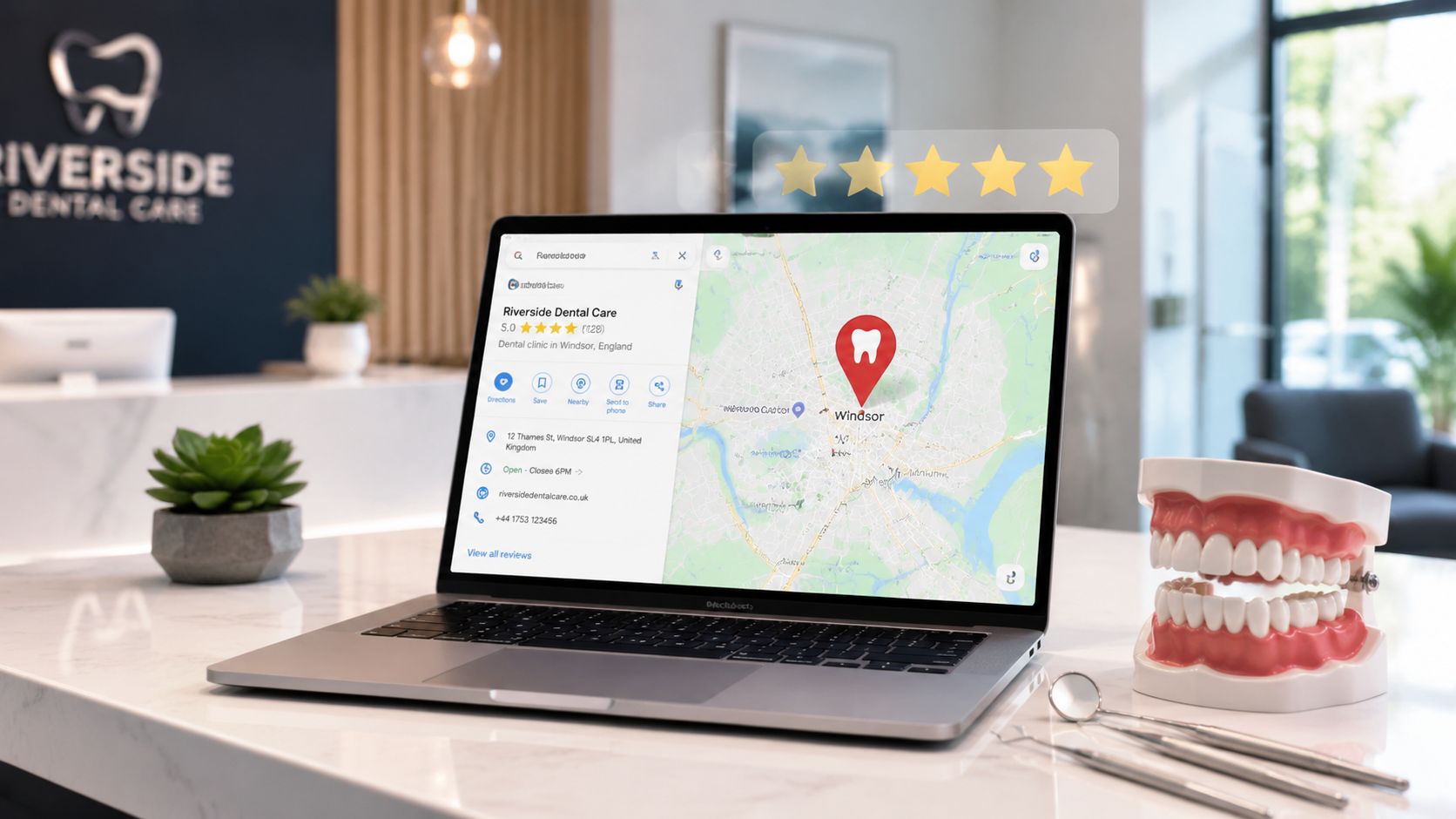

Someone in your town wakes up with a cracked molar, a swelling gum, or a child complaining of tooth pain before school. They don't open a directory. They don't start comparing ten practices in detail. They reach for their phone and search for the nearest credible option.
If your practice doesn't appear where that search happens, another clinic gets the call.
That's why local seo for dentists isn't a side task for the practice manager or a box to tick on a marketing plan. It's the system that decides whether a nearby patient discovers you at the exact moment they're ready to book. For most practices, that moment starts in Google Maps, the local pack, and a tightly connected set of local search signals.
Your Next Patient is Searching Right Now
A local patient rarely begins with brand loyalty. They begin with urgency, convenience, and trust. The search is often blunt and practical: emergency dentist near me, dentist in Cambridge, Invisalign dentist near me, Saturday dentist [town].
That intent matters because these aren't casual searches. Google reported that 76% of people who search for something nearby on their smartphone visit a related business within a day, and 28% of those searches result in a purchase, which is why local mobile search has become such a high-intent channel for dental practices, as noted in this analysis of local SEO for dentists.
A lot of practices still treat local SEO like website housekeeping. Update a title tag here. Add a blog there. Ask for a review when someone remembers. That approach usually creates activity, not patient enquiries.
The practices that win local search do something simpler and more disciplined. They make it easy for Google to understand exactly where they are, what treatments they offer, and why a patient should trust them enough to call.
Practical rule: If a patient can't confirm your location, services, availability, and credibility within seconds of finding you, local visibility won't turn into booked appointments.
That also means the handoff after the search matters. A click-to-call button is useful, but so is a reliable follow-up process once someone becomes a lead. If your front desk team is reviewing appointment reminder and messaging workflows, this guide to secure patient communication is worth reading because patient communication systems can either support or undermine the enquiries local search generates.
For practices trying to improve visibility in a competitive catchment, the work usually starts with a proper audit of Google Business Profile, local landing pages, and review signals rather than another generic SEO package. That's the kind of local-first thinking behind specialist support such as SEO services in Cambridge, where the goal is not more traffic in the abstract but more local calls from the right searches.
The Three Pillars of Local Dental SEO
Local dental SEO works best when you stop viewing it as a list of separate tasks. A strong profile, a decent website, and a handful of reviews won't do much if they don't reinforce each other.
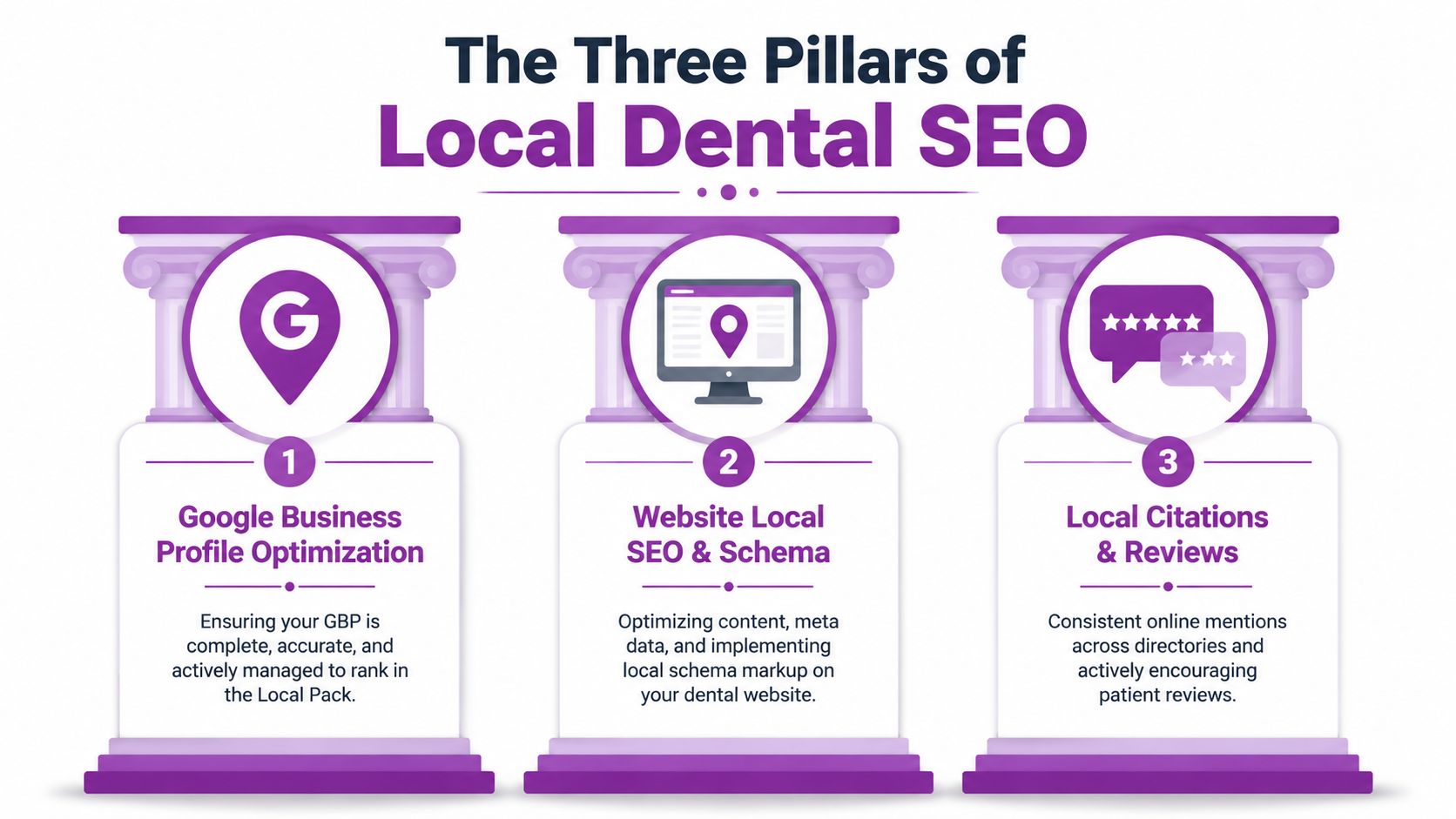
The system has three pillars. If one is weak, the others underperform.
Google Business Profile is the front door
This is usually where the first serious interaction happens. Patients see your category, reviews, opening hours, directions, photos, and call button before they ever decide whether your website is worth visiting.
A neglected profile sends the wrong signals fast. Missing services, wrong hours, poor category choices, and old photos make even a good practice look second-rate.
What works:
- Complete profile data with accurate services, treatment areas, hours, and contact details
- Relevant categories that reflect what you want to be found for
- Fresh visual proof of the practice, team, surgeries, and reception
- Active management of reviews, questions, and updates
What doesn't:
- Claiming the listing and leaving it alone
- Uploading stock-looking images
- Stuffing service names everywhere
- Ignoring profile features because “the website explains it all”
The website does the heavy lifting
Google Business Profile wins attention. Your website closes the gap between interest and action.
For dentists, that means pages have to do more than exist. A homepage with every service dumped into one block of text is weak local SEO and weak conversion design. Patients want clarity. Search engines do too.
A useful dental website should answer four things quickly:
| Pillar check | What the patient wants to know |
|---|---|
| Location | Are you actually near me? |
| Service fit | Do you offer the treatment I need? |
| Trust | Are you credible and established? |
| Action | Can I call or request an appointment easily? |
Practices that want stronger local visibility usually need service pages, location signals, consistent contact details, and a layout that supports quick action. That's also why many dental groups now treat local performance as part of broader SEO for healthcare providers, not a bolt-on task.
Reputation is the conversion multiplier
Reviews do two jobs. They strengthen local trust signals, and they help nervous or undecided patients choose your practice over the clinic a few streets away.
A polished profile without recent, believable reviews often looks less trustworthy than a simpler listing with active patient feedback and professional responses.
That's the part many teams miss. Reviews aren't only a ranking factor in practice. They're often the deciding factor in whether a caller picks up the phone.
Master Your Google Business Profile for Patient Calls
Google My Business launched in 2014 and later became Google Business Profile. That change wasn't cosmetic. It marked the move from traditional SEO to location-first SEO, where map visibility, proximity, and review-based trust became central to how UK dental practices acquire patients from local searches.
For most practices, this is the single asset that deserves the most attention first.
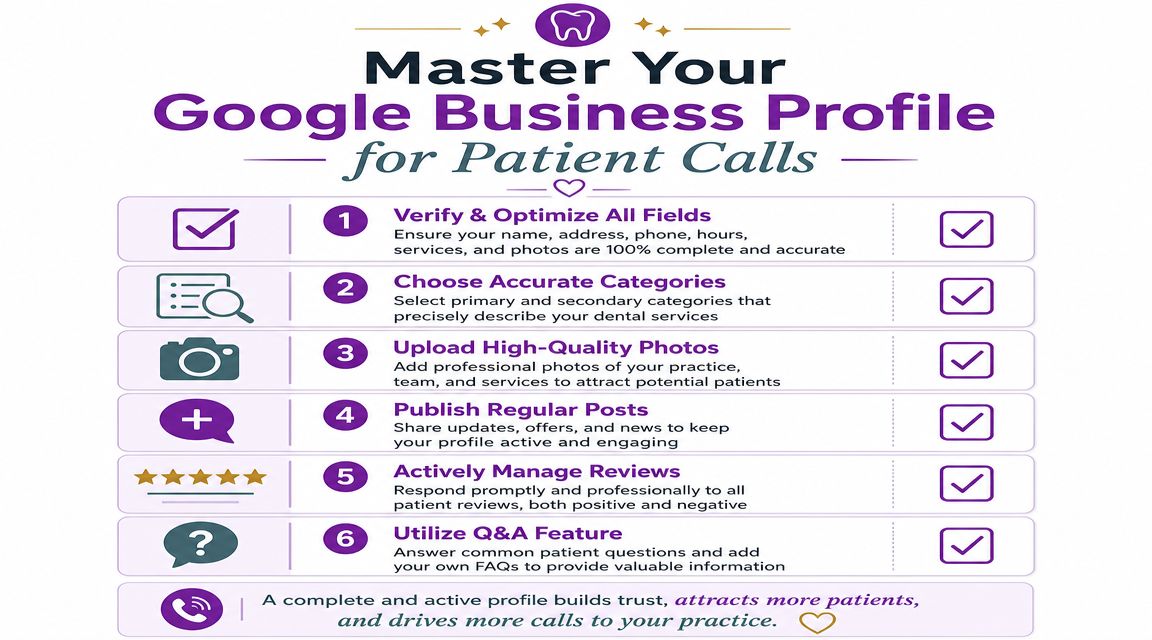
Get the foundation right
Start with accuracy. If your trading name, phone number, hours, or address are wrong or inconsistent, every later optimisation sits on shaky ground.
Use your real-world business details exactly as patients know them. Don't add extra keywords into the business name. Don't shorten the address one place and spell it out elsewhere. Don't use a tracking number in one profile and a main reception line on the website unless your setup is planned carefully.
The basics to check first:
Primary category
This has a big influence on relevance. Choose the category that best reflects the core service patients should associate with the practice.Secondary categories
Add these to reflect real treatments and practice types. The goal is relevance, not volume.Opening hours
Update standard hours, holiday changes, and any emergency availability accurately.Appointment link
If you have online booking, make it easy to access.Services section
List meaningful services patients search for, using plain language.
A lot of profiles underperform because the owner set them up once and never returned. If you want a practical benchmark, tools such as a Google Business Profile audit tool can help identify obvious gaps before you start rewriting anything.
Write for patients, not for the algorithm
The business description matters, but not in the way many people think. It isn't the place to cram in every treatment and town name you can think of.
Write a clear summary of the practice. Include your core services, who you help, and any practical differentiators that matter to patients. Keep it readable. If a nervous patient lands on your profile, they should get a calm, competent impression, not a page of SEO jargon.
Good description themes include:
- Treatment scope such as family dentistry, emergency appointments, cosmetic work, implants, hygiene, or orthodontics
- Location context that makes your catchment area clear
- Patient experience such as same-day emergency slots, nervous patient support, or modern diagnostic technology
- Ease of contact so the next step feels obvious
Here's a useful principle: if the line sounds unnatural when read aloud by your receptionist, it probably shouldn't be in the profile.
Use photos like proof, not decoration
Most dental profiles are visually weak. They either have too few photos or the wrong kinds.
What patients want to see:
- Exterior shots so they recognise the practice on arrival
- Reception and waiting area photos so the environment feels familiar
- Treatment rooms that look clean and professional
- Team photos that humanise the practice
- Branding and signage that reinforce legitimacy
Avoid generic stock imagery. Patients notice. Google also has plenty of real visual signals to compare against, and authentic assets tend to create a stronger impression anyway.
This walkthrough gives a useful overview of profile optimisation in action:
Don't ignore posts, Q and A, and reviews
These are often treated like optional extras. They aren't. They help shape relevance, freshness, and trust.
Use posts to highlight:
- Emergency availability
- Popular treatments
- Practice updates
- New clinician arrivals
- Seasonal reminders, if useful
For Q and A, add sensible common questions yourself and answer them clearly. Patients often want quick answers to practical concerns such as parking, payment options, emergency appointments, or whether you accept new patients.
The best Google Business Profiles feel maintained. The weak ones feel abandoned.
Finally, review responses matter. Keep them professional, brief, and compliant. A thoughtful reply shows prospective patients that the practice is attentive. A defensive reply does the opposite.
Optimise Your Website for Local Patient Searches
Your website shouldn't compete with your Google Business Profile. It should support it. The strongest setups give Google the same local signals in both places, then make it easy for a patient to move from search to enquiry.
For UK dental practices, a practical setup is straightforward. Create a dedicated landing page for each branch, place the exact name, address, and phone number on that page, use town or postcode modifiers in titles and headings, and reinforce the page with LocalBusiness schema and an embedded map, as outlined in this local SEO guidance for dentists.
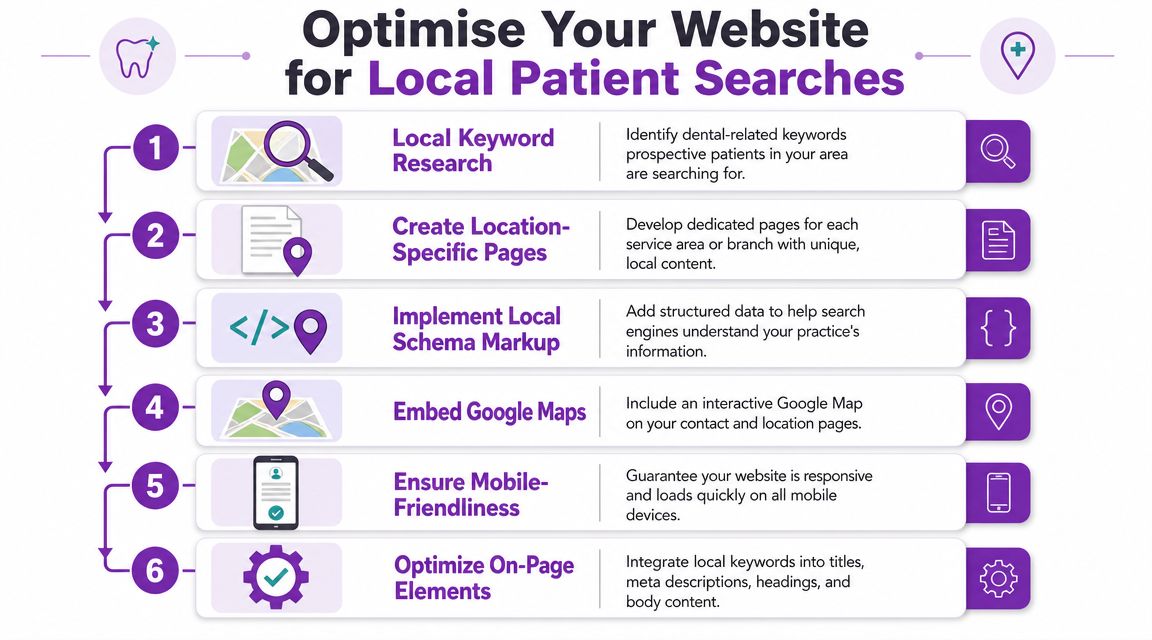
Build pages around locations and services
Single-location practices still need clear local signals. Multi-site groups need them even more.
If you operate from multiple branches, don't send all traffic to one generic contact page. Give each location its own page with unique copy, exact contact details, map, directions, opening information, and branch-specific cues. Patients searching for a dentist in Ely shouldn't land on a vague group page covering six towns.
Then separate service intent from location intent. A patient searching for Invisalign and a patient searching for an emergency dentist aren't looking for the same thing, even if they're in the same town.
A solid structure usually includes:
- One page per location
- One page per core service
- Clear internal links between the relevant location and service pages
- Visible contact options on every important page
If you need a sense-check on page structure, a local SEO checklist is useful for spotting gaps before you rewrite the site.
Use local keywords without making the copy robotic
A lot of local dental sites either under-optimise or overdo it. They mention the town once and hope for the best, or they cram the same phrase into every heading until the page sounds absurd.
Use local modifiers where they help clarify relevance:
- Title tags
- H1 and H2 headings
- Meta descriptions
- Body copy
- Image alt text, when descriptive
- Internal anchor text
Examples of sensible phrasing:
- dentist in [town]
- emergency dentist [town]
- dental implants [town]
- family dentist near [postcode area]
What not to do is repeat one phrase mechanically. Google doesn't need that, and patients definitely don't.
Add the technical signals Google expects
Local pages need more than words. They need supporting structure.
The essentials are simple:
| Website element | Why it matters |
|---|---|
| Exact NAP | Confirms business identity and location |
| Embedded map | Reinforces geography and helps users |
| LocalBusiness schema | Gives search engines clear structured data |
| Mobile-friendly design | Matches how local patients search |
| Fast contact paths | Helps convert visits into calls or forms |
Schema is especially useful because it removes ambiguity. It helps search engines connect your branch page with a real local entity rather than a generic service page.
If Google has to guess which branch serves which area, your local pages aren't built properly.
Avoid the pages that look optimised but do nothing
Some of the worst local SEO work is technically present but commercially useless.
That includes:
- Thin location pages with barely any unique information
- Duplicated service pages where only the town name changes
- Overstuffed headers that look written for bots
- Hidden phone numbers and weak calls to action
- No branch-level proof, such as images, directions, or clinician context
A good local page should make a patient feel they've landed on the right practice in the right place for the right treatment. If it reads like a template, it won't convert well and it often won't rank well either.
Build a 5-Star Reputation That Attracts Patients
Reviews are where trust becomes visible. Dentistry is personal, sometimes urgent, and often anxiety-driven. Patients don't just want proof that you exist. They want proof that other people felt safe choosing you.
The difference between a strong and weak review profile usually isn't star rating alone. It's whether the practice has a repeatable process.
What a real review system looks like
The best-performing practices don't “remember to ask” when the receptionist has a spare moment. They build the request into the patient journey.
A simple process works:
- Ask at the right moment after a positive visit or successful treatment milestone
- Send the link quickly while the experience is still fresh
- Make the ask personal rather than scripted and awkward
- Keep the route simple so the patient doesn't have to search for your listing
- Reply consistently so future patients see an engaged practice
That process matters more than grand campaigns. Small, steady review acquisition beats bursts followed by silence.
Good responses sound calm and professional
A review response is public. It isn't just for the reviewer. It's for the next patient reading the profile and deciding whether your team feels trustworthy.
A poor response often sounds defensive:
“We have no record of you as a patient and disagree with this review.”
That may be emotionally satisfying. It rarely helps.
A better response stays measured:
“Thank you for your feedback. We're sorry to hear you were unhappy with your experience. We take patient care seriously and would welcome the opportunity to discuss your concerns directly with the practice.”
That style protects confidentiality and shows maturity.
For positive reviews, don't paste the same generic line every time. Vary the response naturally and keep it warm without revealing private details.
What to avoid
A lot of reputation work becomes busywork because the team focuses on the wrong actions.
Common mistakes:
- Asking everyone in one batch, then doing nothing for weeks
- Offering overly scripted wording that feels unnatural
- Ignoring neutral or critical reviews
- Mentioning treatment details publicly
- Treating reviews only as a ranking tactic, not a trust asset
Patients don't read reviews like marketers do. They're scanning for reassurance, consistency, and signs that your team handles problems well.
A review profile should tell a believable story. Friendly team. Clean practice. Clear communication. Good outcomes. Smooth booking. Helpful follow-up. Those signals often matter more than polished marketing copy.
Dominate Your Area with Advanced Authority Building
A practice can have solid on-page work, a polished Google Business Profile, and plenty of reviews, yet still lose visibility to a nearby competitor that feels more established in the area. That gap usually comes down to authority.
For dental practices, authority is not an abstract SEO score. It is the collection of signals that tell Google, and prospective patients, that your clinic is a real local choice with recognised relevance in the community. In competitive towns and city catchments, that is often the difference between showing up and getting chosen.
AI-shaped search is making this sharper. Search results are giving users quicker summaries, more map features, and fewer reasons to click around casually. That raises the value of clear local trust signals. The practice with stronger local validation is more likely to stay visible across maps, organic results, and AI-assisted answers.
Clean citations support trust, but they are maintenance work, not growth work
Citation management still matters. It just should not consume the whole strategy.
The job is straightforward. Keep your name, address, phone number, opening hours, and website details consistent across your site, Google Business Profile, major directories, professional bodies, and any local listings that patients might see. Inconsistencies create friction. Old phone numbers, duplicate listings, outdated practitioner names, and legacy addresses are common problems, especially after a rebrand or relocation.
For single-location practices, a quarterly review is usually enough unless details have changed. For multi-site groups, I would check more often because errors spread quickly and branch-level confusion can affect calls, directions, and local relevance.
Local links matter because they prove real-world relevance
Generic backlinks from unrelated sites rarely move the needle for a dental clinic. Local and sector-relevant mentions are far more useful because they reinforce geography, trust, and legitimacy at the same time.
Good opportunities usually come from activity the practice is already doing:
- Sponsoring a school event, sports team, or community fundraiser
- Supporting a local charity and earning a mention on its website
- Providing oral health advice for a local organisation or publication
- Joining credible business groups, chambers, or dental associations
- Collaborating with nearby complementary providers where appropriate
There is a trade-off here. Some link opportunities look attractive on paper but deliver little if the site has no local relevance and no real audience. A smaller local mention on a trusted community site is often worth more than a higher-metric link that has nothing to do with your area or your services.
Publish pages that answer real patient questions in your area
Authority grows faster when the website covers the questions patients ask before they call.
That does not mean filling the blog with generic dental advice. It means building useful pages around local intent and treatment concerns. Examples include emergency dental options in your town, what happens during an Invisalign consultation at your practice, when tooth pain needs urgent assessment, or what parents should expect at a child's first visit.
This kind of content supports three goals at once. It broadens the range of local searches you can appear for. It gives search engines clearer topical context. It helps a patient feel informed before they contact reception.
The test is simple. If the page would genuinely help someone decide whether to book, it is worth creating. If it exists only to target a keyword variation, it is usually busywork.
Turn offline reputation into visible online authority
Many practices already do things that strengthen local authority. They support community events, take part in school education, build referral relationships, host open days, or contribute to local causes. The SEO value appears when that activity is documented properly on the website and connected back to the practice's local presence.
Create a short news post. Add photos where appropriate. Mention the location clearly. Tie it to the relevant service or team page if there is a sensible connection. Then share it through your profile and social channels if those platforms are active.
Weaker competitors often fall short in this regard. They do the activity, but they never publish the evidence. Google cannot give full credit for signals it cannot see.
Keep authority work tied to enquiry growth
Authority building should feed the same system as GBP optimisation, local landing pages, and reviews. If it does not support visibility in your target area or improve patient confidence, it should be questioned.
That is why I prefer a simple operating rhythm. Clean up citations. Earn a small number of relevant local links. Publish useful local content. Document real community involvement. Then review the outcome in a Google Business Profile reporting dashboard alongside calls, clicks, and direction requests.
That approach is slower than chasing shortcuts. It also holds up better, and it is much more likely to help fill the appointment book.
Measure What Matters Tracking KPIs and Proving ROI
If local SEO doesn't connect to patient enquiries, it isn't working well enough. Rankings can be useful diagnostics. They are not the end result.
What matters is whether local search creates real actions from potential patients.
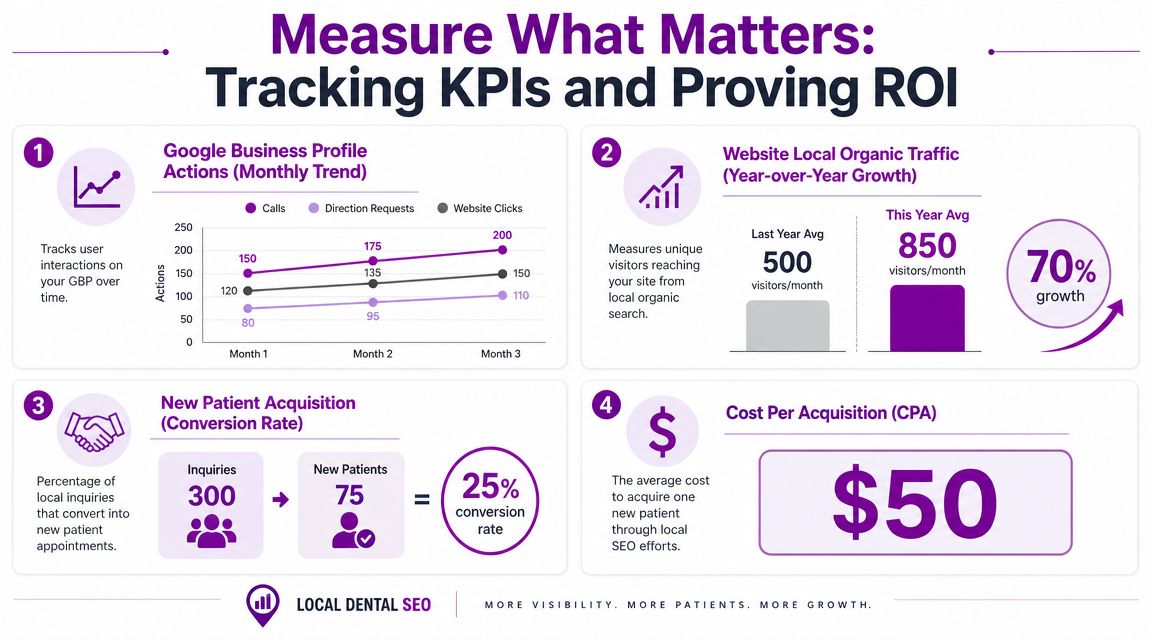
Track actions, not vanity metrics
A lot of reporting decks are padded with numbers that look busy and explain very little. For a dental practice, the useful question is simple: did local visibility produce booked opportunities?
Focus on:
- Calls from Google Business Profile
- Direction requests
- Website clicks from the profile
- Appointment form submissions
- Contact page interactions
- Calls from local landing pages
Google Business Profile insights, Google Analytics, call tracking setups, and form tracking can all help, provided the implementation is clean and the practice reviews the data.
For reporting discipline, something like a GBP reporting dashboard helps keep the focus on action metrics rather than screenshots of rankings.
Key Local SEO KPIs for Dental Practices
| Metric | What it Measures | Why it Matters |
|---|---|---|
| Google Business Profile calls | Phone enquiries initiated from the listing | Shows whether map visibility is creating direct patient demand |
| Direction requests | People asking Google Maps how to reach the practice | Strong signal of in-person intent |
| Website clicks from GBP | Visits from the profile to the website | Helps assess whether the listing is driving deeper consideration |
| Appointment form submissions | Completed online enquiry or booking requests | Connects traffic to lead generation |
| Landing page call clicks | Taps on phone links from service or location pages | Useful for mobile-led local journeys |
| Review volume and response consistency | Ongoing reputation activity | Indicates trust development and profile management quality |
Tie the metric to the patient journey
Not every KPI sits at the same stage.
Direction requests and click-to-call actions usually show strong immediate intent. Service page visits often sit earlier in the decision cycle. Review activity supports conversion across the whole journey.
That means reporting should answer practical questions:
- Which locations generate the most direct actions?
- Which services lead to actual enquiries?
- Which pages attract traffic but fail to convert?
- Where do reviews or profile completeness appear to hold performance back?
A useful monthly review doesn't need to be complicated. It needs to be honest. If traffic is up but calls are flat, the issue may be conversion. If the website performs but the map listing is weak, the issue may be profile quality or review momentum.
The point of measurement isn't to prove that work happened. It's to prove that local search is helping fill the appointment book.
If your practice wants a clearer route from local visibility to patient enquiries, Bare Digital helps UK businesses turn Google Maps rankings, local landing pages, and reputation signals into measurable growth. Their team focuses on the parts that drive enquiries, then reports performance in a way practice owners can effectively use.






