
A lot of Kent businesses are in the same spot right now. The website looks respectable, the service is strong, the phone should be ringing more often than it is, and yet competitors keep appearing above them in Google for the searches that matter.
That’s usually the point where business owners realise a website and a search strategy are not the same thing. A site can sit online for years like a brochure in a locked drawer. Seo in Kent is what puts that site in front of people who are already looking for a wedding venue in the Weald, a physio in Canterbury, a builder in Medway, or a funeral director in Folkestone.
Kent is a tricky county to market in because it isn’t one market. It’s a patchwork of commuter towns, coastal towns, historic city centres, villages, and trade-heavy service areas. What works for a premium architect in Tunbridge Wells won’t be the same as what works for a drainage company covering Ashford, Maidstone, and Dartford. The businesses that win understand the search behaviour in their patch, then build their visibility around it.
Why Your Kent Business Needs More Than Just a Website
A website on its own doesn’t create demand. It only catches demand if someone can find it.
That’s the core issue for many local firms. They invest in design, copy, and photography, launch the site, then assume enquiries will follow. But if your company doesn’t appear when someone searches for your service plus a place name, or taps a “near me” result on their phone, the website is invisible at the exact moment buying intent is highest.
Local search is where buying intent lives
For local businesses, search traffic isn’t casual browsing. It’s often someone trying to solve a specific problem today. 46% of all Google searches have local intent, and 76% of people searching for nearby services visit a business within 24 hours, according to Kent SEO Company’s local SEO reporting.
That matters in Kent because local competition is dense. In many sectors, you’re not just competing with the business down the road. You’re competing with directories, national brands, marketplaces, and well-optimised independents across nearby towns.
A caterer in Maidstone might think they only need a strong homepage. In reality, they may need clear signals for Maidstone, Bearsted, and surrounding venue-led searches. An architect in Tunbridge Wells might be selling a premium service, but if the firm’s visibility is weak in local organic results and Google Maps, prospective clients may never see the portfolio.
Practical rule: If your ideal customer searches with a location in mind, your marketing has to be built around local intent, not just brand presentation.
A website should work like a lead asset
A strong local site does three jobs at once:
- Gets discovered: It appears in Maps and organic search for relevant local terms.
- Builds trust quickly: It shows proof, clarity, and service relevance for the area searched.
- Turns interest into action: It makes calling, booking, or enquiring easy on mobile.
Most underperforming local sites fail on the first job. They may look polished, but they’re not structured to rank, and they don’t support the business profile signals Google uses to decide who deserves local visibility.
If you want to sense-check whether SEO can produce a worthwhile return in your market, a simple tool like this self storage ROI calculator for SEO is useful as a way to think about lead value, search visibility, and commercial upside before you commit budget.
Kent buyers don’t search like marketers write
Business owners often describe their service one way. Customers search another way.
People don’t always type polished industry language. They search for “wedding venue Kent”, “builder CT1”, “private GP Sevenoaks”, “emergency electrician near me”. Good local SEO aligns your site with that real behaviour. That’s why it outperforms a brochure-style website every time.
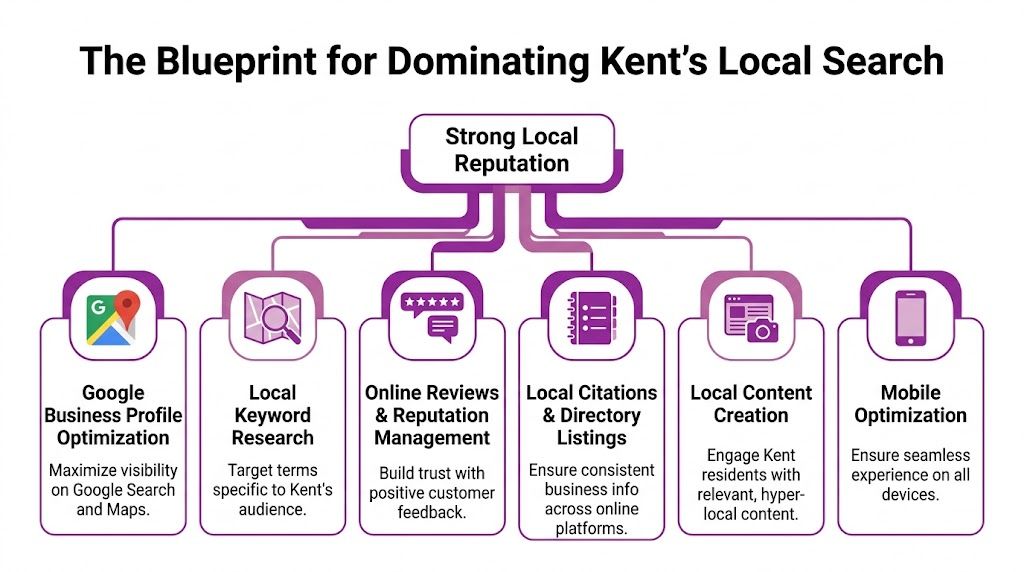
The Blueprint for Dominating Kent's Local Search
Think of local SEO like building a reputation in a town centre. Your shopfront has to be easy to find, your signage has to be clear, people need to trust what they see, and the local community needs to recognise your name. Google works in much the same way.
The businesses that perform well in seo in Kent usually get four foundations right. They don’t chase tricks. They make it easy for search engines and customers to understand who they are, where they work, and why they’re the right choice.
Your Google Business Profile is the front door
For most local firms, your Google Business Profile does the first round of selling before anyone reaches your website. It shows your category, reviews, photos, service area, opening hours, and the actions people can take next.
If that profile is incomplete, inconsistent, or poorly categorised, you’re making Google guess. That rarely ends well.
A good profile should include:
- Precise business details: Your name, address, phone number, and opening information must be consistent everywhere.
- Strong category selection: Primary and supporting categories need to reflect the actual service you want to rank for.
- Useful media and updates: Photos, service descriptions, and regular posts help users judge legitimacy and fit.
A lot of Kent businesses also miss simple opportunities here. They upload generic brand imagery instead of service-led photos. They describe the company well, but don’t explain the actual locations covered. They collect reviews, but don’t guide reviewers to mention specific services naturally.
If you want a quick diagnostic before changing anything, this Google Business Profile audit tool is a practical starting point.
Local keyword strategy means using the language buyers use
Keyword research for local SEO isn’t about stuffing town names into pages. It’s about matching the wording, intent, and geography behind real searches.
A Kent wedding venue may need pages and copy aligned with venue-style queries, county-level discovery searches, and nearby town modifiers. A trades business may need tighter targeting around service-plus-postcode terms. A healthcare provider may need stronger trust signals around the exact treatment plus town combinations people search before booking.
Here’s where firms go wrong:
- They target broad vanity phrases: Ranking for a vague term can bring poor-fit traffic.
- They ignore service area variation: Search behaviour in Canterbury may differ from Maidstone or Dartford.
- They optimise only the homepage: One page can’t carry every service and every location well.
On-page and technical SEO keep the structure sound
If your Google Business Profile is the front door, the website is the building behind it. It needs clear rooms, clean wiring, and signs that make sense.
On-page SEO covers the visible signals. Page titles, headings, internal links, service descriptions, FAQs, location copy, and conversion points all help Google understand context. Technical SEO handles the mechanics underneath. Crawling, indexing, mobile rendering, speed, structured organisation, and error handling all affect whether your site can compete.
A well-optimised local site doesn’t just look better. It removes friction for both Google and the customer.
In practice, that means your service pages shouldn’t be thin or duplicated. Your location pages shouldn’t read like a list of town names pasted into the same template. And your mobile experience should feel fast and obvious, because many local searches happen when someone wants to act, not research for an hour.
Local links and citations are reputation signals
Google wants confirmation that your business exists where it says it exists and is recognised by relevant local sources.
That’s where citations and local links matter. Citations are references to your business details on directories and listings. Local links are endorsements from nearby organisations, suppliers, partners, venues, press outlets, associations, or community websites.
The best local link building in Kent tends to come from real-world relevance:
- Venue and supplier relationships: Useful for weddings, hospitality, and events.
- Trade associations and community listings: Strong for construction, healthcare, and professional services.
- Local features and partnerships: Ideal for businesses with recognisable regional expertise.
A random backlink from an irrelevant website won’t do much. A relevant mention from a local source can support visibility and trust far better.
Navigating the Kent Digital Landscape
Kent isn’t one search market. It behaves more like several smaller economies sharing a county border.
That changes how seo in Kent should be planned. A business targeting affluent homeowners in Sevenoaks needs a different content angle, trust profile, and conversion journey from a volume-driven service company covering Medway or a seasonal venue competing across the county.

Different towns create different search realities
Some Kent sectors are broad and competitive at county level. Others are highly local and postcode-driven.
A wedding venue often competes on visual appeal, review strength, and county-wide discovery. A plumber or electrician often wins by appearing in the right part of Google Maps at the right moment, close to the searcher. An architect or interior designer may need to balance prestige-led branding with town-specific trust signals to attract the right calibre of lead.
Three patterns come up repeatedly:
- County-wide discovery terms: Common in weddings, creative services, catering, and destination-led hospitality.
- Town and postcode intent: More common in trades, clinics, legal services, and urgent need categories.
- Hybrid service areas: Typical for businesses that operate from one base but serve several nearby towns.
The mistake is treating all three the same. If you do, you either end up too broad to rank well or too narrow to win meaningful coverage.
Multi-location businesses need more than duplicate pages
It is in this area that many Kent firms lose ground. A company with branches in Canterbury, Maidstone, and Folkestone often assumes that separate location pages and a few directory listings are enough. They aren’t.
According to Tootle Works on local SEO strategies for Kent businesses, 68% of UK local searches are location-specific. The same source notes that advanced tactics like geo-grid heatmap analysis can reveal ranking weaknesses in 40% of multi-location setups, leading to a 42% ranking uplift compared to only 15% from basics alone.
That’s a meaningful distinction. Basics matter, but they don’t show you how visibility changes street by street, postcode by postcode, or town by town.
Multi-location SEO fails when every branch looks interchangeable. Google needs proof that each location has its own relevance, not just its own page.
A geo-grid heatmap gives you that proof visually. Instead of checking one ranking from one point, it shows how your Maps visibility changes across a local area. That matters because a business can look strong in its immediate vicinity and weak just a few miles away where real customers are searching.
What geo-grid analysis shows in practice
A heatmap is useful because it reveals blind spots that standard rank tracking often misses.
For example, a construction firm with depots in Ashford and Dartford may appear healthy when staff check rankings from each office. But the map can show weaker visibility in key residential zones or commuter belts where purchase intent is stronger. That changes the plan. You might need better service-area cues, more location-specific reviews, stronger local landing pages, or tighter business category alignment.
Here’s a simple way to look at it:
| Search situation | What basic tracking tells you | What geo-grid tracking adds |
|---|---|---|
| Single office in one town | A general position for a target term | Visibility variation across neighbourhoods |
| Service area business | Whether you rank at your base | Whether you disappear outside your core radius |
| Multiple branches | A headline ranking per branch | Which branch underperforms in overlapping areas |
For owners who haven’t seen this before, this walkthrough helps explain the local visibility logic in a practical way:
Kent rewards specificity
The firms that gain traction usually make one strategic choice early. They decide whether they are trying to win a town, a corridor, or the county.
Once that choice is clear, the SEO strategy gets cleaner. Content becomes more targeted. Reviews become more useful. Location pages become easier to write well. Reporting becomes more honest, because you’re measuring the territory that matters commercially rather than chasing vague visibility everywhere.
Fine-Tuning Your Website for Local Visibility
A local website should answer three questions within seconds. What do you do, where do you do it, and why should someone trust you enough to contact you now?
Many sites in Kent answer the first question and leave the other two vague. That’s why on-page and technical work matters. It turns a general website into a local lead asset.
Build location pages that deserve to rank
A strong location page is not a spun version of the same template with a different town name.
If you want to rank for something like a funeral director in Folkestone, the page needs signals that are specifically tied to that area. That can include local landmarks mentioned naturally, service details relevant to the town, an embedded map, FAQs based on real customer questions, and trust elements that feel local rather than generic.
A practical location page usually includes:
- A focused page title and H1: These should match the actual service and location intent.
- Area-specific copy: Write about the service in the context of the place, not as boilerplate.
- Proof and conversion elements: Testimonials, enquiry prompts, map embeds, and clear contact paths matter.
URL structure also helps. Clean, readable paths tend to outperform cluttered ones because they make the hierarchy obvious to both users and search engines. Service and location relationships should be clear without overcomplicating the folder structure.
Speed and mobile UX affect local performance
Local searches often happen on a mobile phone when someone is ready to compare, call, or book. If the page hesitates, shifts around, or takes too long to load, people leave.
That’s why technical SEO isn’t a side issue. It affects visibility and conversion at the same time. Technical SEO fixes like improving site speed and mobile responsiveness can deliver 20-35% ranking uplifts for local searches in Kent, and unoptimised sites with load times over 3 seconds can see a 22% drop in Google Maps visibility for near me queries, according to JDM Web Technologies on Kent local SEO.
Field note: If your site feels slow on your own phone using mobile data, prospects are feeling it too.
The usual weak points are oversized images, poor mobile layouts, unused scripts, and pages built for desktop first. None of these are glamorous fixes, but they often have a direct effect on both rankings and lead quality.
Small technical tasks that make a real difference
This work is usually less dramatic than a redesign, but it’s often more profitable. Start with the pages that already matter commercially.
A practical checklist looks like this:
- Fix broken links and dead ends: These waste crawl paths and frustrate users.
- Review headings and internal links: Pages should support one another clearly, especially between services and locations.
- Optimise images properly: Compress them, name them sensibly, and add descriptive alt text.
For teams that publish a lot of local imagery, a tool like this AI alt text generator can help produce useful image descriptions more efficiently, especially for gallery-heavy sectors such as venues, interiors, or healthcare.
- Check mobile calls to action: Buttons should be obvious, thumb-friendly, and visible without hunting.
- Tidy indexing signals: Important pages should be easy for search engines to discover and understand.
If you’re reviewing your own site, this local SEO checklist is a sensible framework for prioritising the essentials before you start changing templates or rewriting everything.
What works better than broad homepage optimisation
A common mistake is trying to force every service and every town into one homepage. That usually creates a weak page for all of them.
A cleaner setup is:
- One homepage focused on the core brand and main market.
- Separate service pages for primary offers.
- Separate location pages where there is real commercial intent.
- Internal links that connect the right services to the right areas.
That structure gives Google cleaner relevance signals. It also gives users a page that matches what they searched for.
Your 90-Day SEO Action Plan in Kent
Most business owners don’t need more SEO theory. They need to know what happens first, what changes on the site, and what they should expect to see in the early stages.
A well-run local campaign should feel organised from the start. Not busy for the sake of it. Not random monthly tasks. Just a clear sequence that fixes the foundation, builds useful local relevance, and then measures how search visibility and lead activity are moving.
The first month is about clarity
The opening phase is where the hidden problems usually surface. Tracking is checked, the site is audited, the business profile is reviewed, and the local search environment gets mapped properly.
This is also where priorities should be narrowed. A business serving all of Kent might sound broad on paper, but the plan often works better when it starts with the services and towns that produce the strongest margin or best-fit enquiries.
Good early work often includes:
- Technical and local audit: Site health, indexation, mobile usability, and profile completeness.
- Keyword mapping: Matching services to locations and user intent.
- Measurement setup: Calls, forms, profile actions, rankings, and page-level behaviour.
The second month is where relevance gets built
Once the groundwork is set, the focus usually shifts to on-page improvements and content production. This is the point where service pages are tightened, location pages are added or improved, and internal links start making more strategic sense.
A common mistake at this stage is publishing content that sounds clever but doesn’t help a buyer decide. Local content should answer real questions, reduce doubt, and support the conversion path. That could mean service comparisons, area guides, FAQ sections, or pages built for location-specific intent.
Early momentum in local SEO often comes from fixing what already exists before creating lots of new pages.
The third month starts proving the direction
By this point, authority-building and reporting become more useful. Not because SEO is finished, but because you can start to see which pages are earning visibility, which terms are appearing more often, and where the next effort should go.
That’s also when local reputation work becomes easier to tie into SEO. Reviews, local mentions, and business profile activity start reinforcing the pages and services that have already been improved.
Here’s what a typical first quarter can look like:
| Phase | Key Activities | Example KPIs to Track |
|---|---|---|
| Month 1 | Audit website health, review Google Business Profile, map service and location keywords, check tracking setup | Organic visibility trends, profile interactions, form tracking status, priority page indexation |
| Month 2 | Rewrite core service pages, improve titles and headings, build or refine location pages, tighten internal linking | Landing page impressions, local keyword movement, calls from priority pages, engagement on key location pages |
| Month 3 | Build local authority signals, request relevant reviews, monitor profile performance, review page-by-page outcomes | Calls, direction requests, enquiry quality, Maps visibility across target areas |
A reporting view matters here. Business owners shouldn’t have to piece the story together from screenshots and loose notes. A structured GBP report dashboard helps make local actions visible in a way that’s easier to review against real business outcomes.
What not to expect in the first quarter
You shouldn’t expect every target term to jump at once. You also shouldn’t judge the campaign purely on one headline ranking.
Local SEO tends to improve in layers. First the site becomes easier to crawl and understand. Then some pages begin appearing more consistently. Then profile actions and lead signals become more reliable. That’s a healthier pattern than sudden spikes built on weak foundations.
For most Kent businesses, the first ninety days are about building traction with discipline. The payoff comes from compounding, not from one-off activity.
Success Stories from Local Kent Businesses
The clearest way to judge seo in Kent is to look at how strategy changes outcomes in different sectors. Not every business needs the same playbook, but the strongest campaigns usually follow the same pattern. Tighten the local relevance, remove friction, and build trust where buyers are searching.
A wedding venue that needed better-fit enquiries
A venue near the Weald had a polished site and strong photography, but too many enquiries were vague, budget-misaligned, or clearly early-stage browsing. The problem wasn’t just traffic. It was intent.
The shift came from treating local visibility and conversion quality as part of the same job. The venue improved its profile imagery, tightened page copy around venue-specific search intent, and made the booking journey clearer for couples comparing shortlisted options. Visibility became more aligned with the kind of searcher who was ready to enquire, not just save inspiration.
A Medway construction firm that needed geographic precision
This firm covered several service areas but had been relying on a generic services page and broad messaging about quality workmanship. That may reassure existing referrals, but it rarely captures high-intent local search.
The better approach was to build clearer service-and-location relevance. Separate pages were created around core services in priority areas, internal links were cleaned up, and the business profile was aligned more closely with the areas that generated the best jobs. Enquiries improved not because the website said more, but because it answered the right local question at the right moment.
Better local SEO usually improves lead quality before it improves lead volume in a way owners can feel.
A healthcare provider that needed stronger trust signals
A private healthcare provider in West Kent faced a different challenge. The service mattered, but the searcher’s hesitation mattered just as much. In healthcare, people look for confidence cues before they book.
The site was strengthened with clearer treatment pages, location-specific reassurance, and content that addressed common pre-booking concerns in plain language. Local authority signals also mattered more here than they would for a simpler trade service. The result was a cleaner journey from search to booking because the trust gap had been reduced.
What these examples have in common
The sectors are different, but the pattern is consistent:
- They stopped treating the homepage as the answer to everything.
- They matched pages to local intent instead of writing generic brand copy.
- They used trust signals in a way that fit the service, not as decoration.
That’s the part many businesses miss. SEO isn’t separate from positioning. In Kent, the companies that rank well and convert well usually make their local relevance obvious and their next step easy.
Take Control of Your Local Rankings Today
Local visibility in Kent isn’t something you can leave to chance. If your competitors are investing in better pages, stronger business profile signals, cleaner technical performance, and more deliberate location targeting, a passive website won’t hold its ground for long.
The challenge is real. Only 5.7% of websites manage to reach Google’s top 10 rankings within their first year, according to the University of Kent SEO documentation. That’s a useful reminder that rankings usually don’t come from publishing a site and hoping for the best. They come from sustained work, clear priorities, and consistent improvement.
For owners weighing up next steps, it helps to know what to look for before engaging an SEO agency. The right fit should be able to explain the plan in plain English, tie activity to measurable outcomes, and show you where the local opportunities are.
If you’re serious about getting more from seo in Kent, the sensible first step is to get a proper diagnosis. A free review should tell you where your visibility is being held back, which towns or services offer the best opportunity, and what needs fixing first.
If you want that level of clarity, book a no-obligation SEO health check with Bare Digital. It’s a practical way to turn your website from a static asset into a reliable local lead channel.
Frequently Asked Questions about SEO in Kent
How long does local SEO take in Kent
It depends on your market, your starting point, and how strong the local competition is. Some improvements show up early, especially after technical fixes and business profile work. The bigger wins usually come from consistent work over time.
Is SEO in Kent worth it for small businesses
Yes, if local search is how customers find businesses like yours. For trades, healthcare, venues, creative services, and professional firms, local visibility often affects both enquiry volume and lead quality.
Can I do local SEO myself
You can handle parts of it in-house, especially profile updates, review requests, and basic page improvements. The difficulty comes when technical issues, location strategy, content structure, and reporting all need to work together.
What should I track
Track the actions that connect to real enquiries. That usually includes calls, forms, business profile interactions, visibility for priority service areas, and the performance of key service and location pages.
Should I target all of Kent at once
Usually not. Most businesses get better results by starting with the towns, services, or branches that matter most commercially, then expanding from a stronger base.
Bare Digital helps UK businesses turn local search visibility into qualified enquiries, booked jobs, and measurable growth. If you want a practical strategy for ranking better in Kent, improving your Google Business Profile, and building location pages that convert, visit Bare Digital.