

You know the feeling. Your business does good work, customers are happy, referrals come in, and yet online you’re oddly hard to find. A nearby competitor with a weaker reputation appears first on Google, shows up on the map, gets the calls, and wins the shortlists before you’ve even been considered.
That gap is where many UK business owners get stuck. They’ve heard of SEO, but it often sounds like a vague technical service with unclear returns. Rankings, keywords, backlinks, algorithms. Plenty of jargon, not enough straight talk about leads, booked calls, site visits, and sales.
A search engine optimization business should fix that confusion, not add to it. Its job isn’t just to “improve visibility”. Its job is to help the right people find you at the right moment, then measure whether that visibility turned into real commercial outcomes.
From Invisible Online to In-Demand Locally
A couple search for a wedding venue on a Sunday evening. A daughter looks for a funeral director after work. A facilities manager needs a local contractor before the week starts. These are not casual searches. They are moments when someone is close to making contact, asking for a quote, or booking a visit.
For a UK local service business, that is the commercial value of search. It puts you in front of people who already have a need, a location, and a reason to act soon. If your business does not appear clearly for the services you offer in the areas you cover, those enquiries do not pause. They go elsewhere.
Why invisibility costs more than rankings
Many owners treat poor search visibility as a branding problem. In practice, it is usually a pipeline problem.
If you are hard to find online, the losses show up in places that affect revenue:
- Fewer qualified leads: People searching by service and area are often closer to contacting a supplier than someone casually scrolling social media.
- Fewer calls and form enquiries: If a competitor appears first, they get the first look and often the first call.
- Lower trust before you even speak: Strong local visibility works like a busy shopfront on the high street. People assume the business they keep seeing is established and reliable.
- Wasted website spend: A polished website without search visibility is a smart showroom on a road nobody uses.
That last point catches many firms out. They invest in design, copy, and branding, then wonder why the phone is still quiet. The issue is not always the website itself. Sometimes the problem is that the right buyers never reach it.
Local search is also tied closely to action. People often search on the move, compare providers quickly, and contact the business that answers their question fastest and looks closest, most relevant, or most trustworthy. For a small business owner, that means SEO should be judged by what happens after the click. Did it produce calls, quote requests, bookings, and sales?
Practical rule: If customers cannot find you by service and area, referrals and reputation have to work harder than they should.
A good SEO partner starts there. They look at the gap between how your business appears online and how real customers search. Then they connect that visibility work to outcomes you can measure, such as enquiries from service pages, calls from your Google Business Profile, and leads from specific locations.
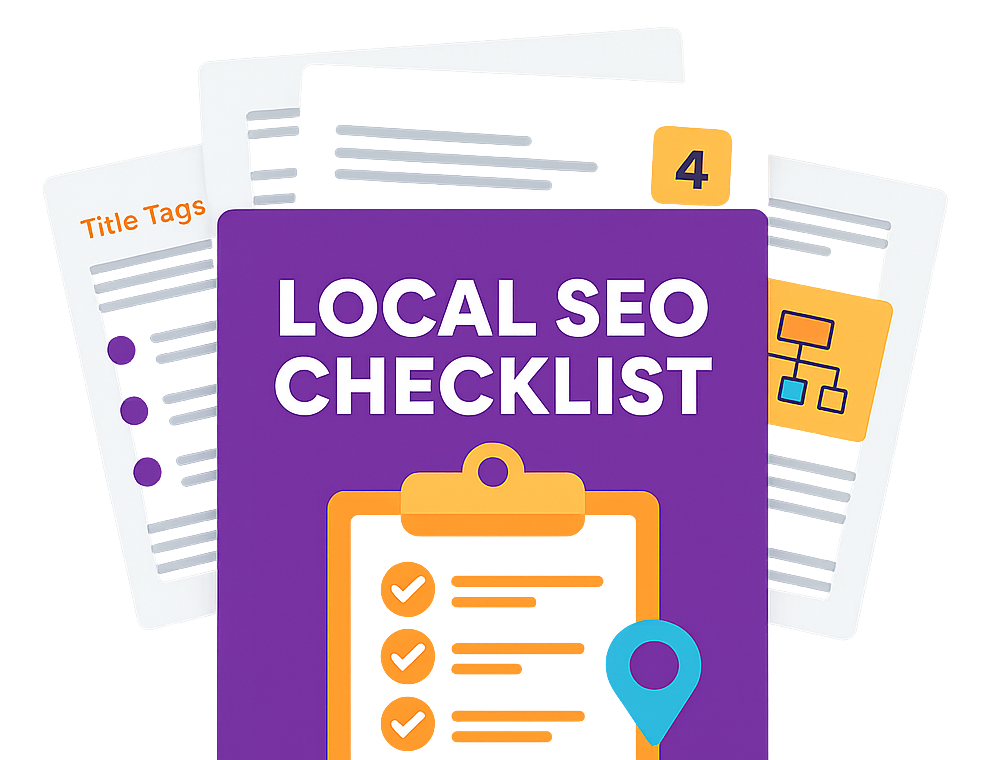
A useful first check is to review the basics with a local SEO checklist for UK businesses. It can help you spot why a good local firm stays hidden, whether that is thin location pages, weak Google Business Profile signals, or service pages that never answer the questions buyers type in before they get in touch.
What a Search Engine Optimisation Business Actually Does
Most business owners already understand retail. That makes SEO much easier to understand.
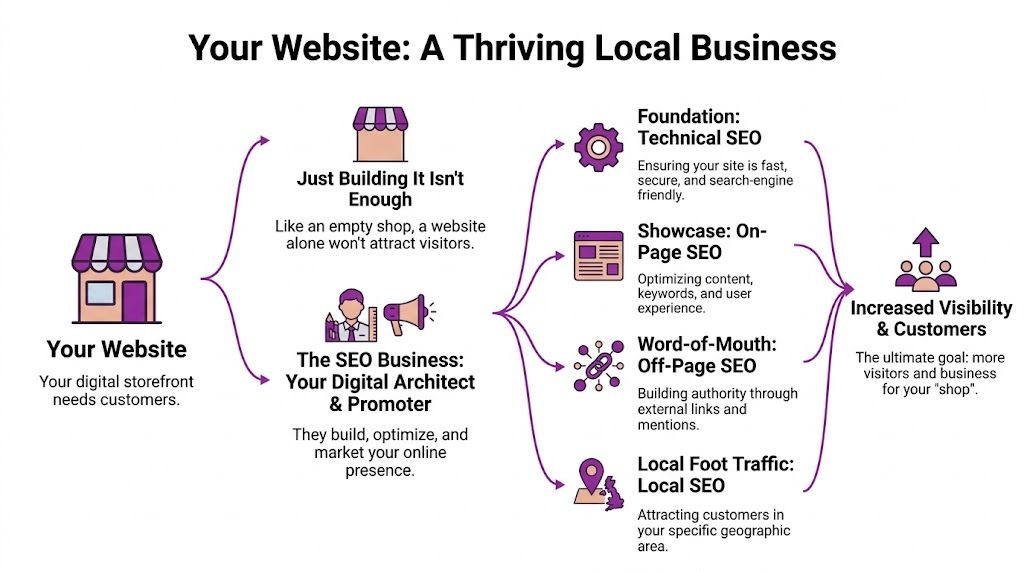
Think of your website as a physical shop. You can pay to build it, brand it, and furnish it beautifully. But if it sits on an empty road, has no sign, confusing aisles, and no local reputation, customers won’t walk in. A search engine optimization business works like the team that gets your shop onto the busiest high street, improves the signage, organises the shelves, and helps local people trust it enough to come through the door.
It’s not about tricking Google
A lot of confusion starts here. SEO isn’t a bag of tricks. Good SEO helps search engines understand three things clearly:
- What you do
- Where you do it
- Why your business is trustworthy
If you’re a funeral director in one town, a wedding venue in another, or a construction firm covering several postcodes, your website has to make those facts obvious. Search engines reward relevance and clarity. If your pages are vague, slow, duplicated, or missing local context, Google has less confidence in showing them.
The digital high street version of your business
Here’s how that shop analogy plays out in practice.
| High street reality | Online equivalent |
|---|---|
| Shop location | Where your pages appear in search results |
| Front sign | Your Google Business Profile and search listing |
| Window display | Your page titles, descriptions, reviews, and imagery |
| Helpful staff | Clear page content that answers buyer questions |
| Easy route to checkout | Contact forms, click-to-call, quote buttons, booking paths |
A search engine optimisation business works across all of these areas. It doesn’t stop at traffic. It improves the route from search to sale.
The four jobs most SEO providers handle
Some agencies explain SEO in technical categories. That’s fine, but most owners care more about business function. In plain language, an SEO provider usually does four jobs.
- Makes your site discoverable: They fix crawl issues, page speed problems, poor structure, and weak metadata so search engines can understand your site.
- Makes your offer relevant: They align service pages, location pages, and content with what people search for.
- Builds trust signals: They strengthen authority through links, reviews, citations, and better business information across the web.
- Improves conversion paths: They reduce friction between a visit and an enquiry, whether that means clearer phone numbers, stronger calls to action, or better contact forms.
The best SEO work feels less like “marketing magic” and more like removing obstacles between buyer intent and your business.
This is why rankings alone aren’t the finish line. A top-three result for the wrong search term won’t help much. But visibility for the right local searches, backed by clear service pages and a strong profile, can produce the kind of enquiries your sales team wants.
The Core Services That Drive Local Growth
The easiest way to judge an SEO service is to ask one question repeatedly: how does this make the phone ring more often, or bring in better enquiries?
That question cuts through fluff. Every task should link back to discoverability, trust, or conversion.
Google Business Profile and local intent
For many UK service firms, your Google Business Profile is the digital equivalent of your front door sign. It tells searchers where you are, what you offer, when you’re open, and whether previous customers trust you.
Local buying journeys are short; thus, a person searching for “wedding venue near me”, “funeral director in Leeds”, or “builder in Surrey” often compares a small number of businesses quickly. If your profile is incomplete, inconsistent, or inactive, you lose before they even reach your website.
Good local SEO work here includes:
- Category accuracy: Choosing the closest business type to your real service.
- Service detail: Listing services in language customers use, not internal jargon.
- Location signals: Reinforcing towns, regions, and service areas consistently.
- Review management: Encouraging and responding to reviews in a credible, human way.
- Regular updates: Publishing posts, photos, and business updates that keep the profile alive.
If you want a sense of where your listing stands today, a Google Business Profile audit tool can highlight gaps that affect visibility and conversion.
Technical SEO and on-page basics
This is the part many owners fear because it sounds engineering-heavy. In reality, the goal is simple. Make your website easy for Google to read and easy for humans to use.
A good SEO provider checks things such as page indexing, mobile usability, internal links, duplicate content, broken pages, title tags, heading structure, and whether each page has one clear purpose.
Here’s why that matters in business terms:
- A slow service page leaks leads because visitors leave before engaging.
- A vague title tag reduces clicks even if you do rank.
- Duplicate location pages confuse Google and weaken local relevance.
- Thin content makes it harder for buyers to trust what they’re seeing.
Content that matches how people actually search
A lot of content marketing fails because it’s written from the company’s perspective. Buyers don’t search like that.
They search by need, location, urgency, and trust. A wedding venue prospect might search for a venue in a specific county with accommodation. A construction buyer might look for a contractor in a town, then narrow by service type. A funeral services customer may search gently worded terms that reflect a sensitive moment.
That means content needs to do more than exist. It needs to mirror real questions and local intent.
Useful formats include:
- Service pages: Focused on one offer, written for one search intent.
- Location pages: Built for specific towns, cities, or postcodes you serve.
- FAQ sections: Helpful for common pre-enquiry concerns.
- Blog articles: Good for answering longer questions and supporting authority.
A useful test: If a page could apply to any business in any town, it probably isn’t strong local SEO content.
Location pages for multi-area businesses
This is especially important if you serve several places. One generic “areas we cover” page usually isn’t enough. Buyers want signs that you know their area and can serve them properly. Search engines want that evidence too.
Dedicated location pages work best when they’re distinct, useful, and tied to real commercial intent. For a construction company, that could mean separate pages for extensions, refurbishments, or roofing in each target area. For a venue, it might mean county-specific pages tied to local wedding searches.
Link building and local authority
Links are often described as votes of confidence. That’s broadly true, but quality matters far more than quantity.
A smart link campaign looks for relevant mentions from local organisations, business directories, industry sites, partnerships, sponsorships, chambers, press coverage, or trusted supplier relationships. The aim is to strengthen authority in a way that matches your market.
A photographer might earn links from local wedding directories or venue partners. A funeral provider might benefit from trusted local listings and community references. A builder might secure relevant mentions from trade associations, project features, or local business networks.
The service mix should fit your sales model
Not every business needs the same SEO recipe. A single-location café, a regional care provider, and a multi-branch contractor have different search behaviour, different lead values, and different buying cycles.
That’s why package names matter less than scope. Some firms need strong Google Business Profile work first. Others need service pages rebuilt. Others need better location architecture, tracking, and reporting. One example in the UK market is Bare Digital, which offers local SEO work such as profile optimisation, location-specific landing pages, blog management, technical fixes, and KPI tracking for businesses that want more measurable local enquiries.
The point is simpler. You shouldn’t be paying for “SEO activity”. You should be paying for work that increases your chance of being found, chosen, and contacted by the right customers.
Measuring the Real-World Value and ROI of SEO
A business owner in Leeds searches their own company name, sees better rankings, and still asks a fair question. Why has this not shown up clearly in sales yet?
That question usually points to a tracking problem, not an SEO problem.

SEO value becomes easier to judge when you stop treating it like a visibility exercise and start treating it like a pipeline exercise. Rankings help. Traffic helps. What matters more is whether search brings the kind of enquiries that turn into revenue.
A simple way to frame it is this. Visibility is the shop window. Enquiries are people walking in. Sales are what they buy at the till. If your report only shows the window, you are missing the commercial part of the story.
Start with conversion actions, not vanity metrics
The first job is to define which actions have business value. For one company, that might be quote requests. For another, it is booked surveys, phone calls, finance applications, brochure downloads, or direction requests from people ready to visit.
Good SEO reporting connects search activity to those actions.
A practical setup usually tracks:
- Phone call leads: Calls from the website and, where possible, calls prompted by your Google Business Profile
- Form submissions: Quote requests, booking forms, consultation requests
- Direction requests: A useful local intent signal for offices, clinics, showrooms, and venues
- Landing page performance: Which service pages and location pages produce enquiries
- Lead quality notes: Which leads were relevant, which were poor fits, and which later became customers
That last point often gets missed. Ten enquiries are not equal if eight are time-wasters and two become profitable jobs. SEO should be judged by lead quality as well as lead volume.
Track the full route from search to sale
Many UK SMEs can see leads coming in, but they do not always connect those leads back to closed revenue. The fix is usually straightforward. Add a few checkpoints and review them consistently.
Use this basic attribution model:
- Record first touch: How did the person first find you?
- Record lead source: Which page, search theme, or listing led to the enquiry?
- Record sales outcome: Did the lead become a sale, and what was it worth?
- Review trends monthly and quarterly: This matters most if your buying cycle is longer than a few days
This works like fitting your sales process with signposts. Without them, you know people arrived. You do not know which road brought the best customers.
A practical way to estimate return before expanding spend is to use a tool like this ROI Calculator. It helps you test what better lead flow or stronger conversion rates could mean in pounds and pence, even if your tracking is still improving.
Long sales cycles can hide SEO's contribution
Some services generate revenue quickly. Others take weeks or months.
A homeowner may read several builder pages, leave, come back through a branded search, then call after comparing quotes. A family may find a care provider through search, revisit later, and only enquire once other relatives have agreed. In cases like these, SEO starts the process even when it does not get the final click.
That is why last-click reporting can understate return. If you only credit the final action, you miss the earlier searches that introduced your business and built trust.
For local firms, that matters a great deal. SEO often creates the first useful touchpoint with a buyer who was not ready on day one but became ready later.
Multi-location reporting needs local clarity
If you serve several towns, one headline number for "organic traffic" can blur what is happening. One branch may attract strong calls from its location page while another gets traffic but very few real enquiries.
Location-level reporting solves that.
You want to see which towns generate calls, which pages attract quote requests, and where weaker conversion rates point to a messaging or trust problem rather than a ranking problem. A self-storage SEO ROI calculator shows this idea well by focusing on location-specific commercial outcomes instead of broad traffic totals.
For a deeper look at how SEO performance can be interpreted over time, this short video gives a useful overview:
SEO works best when measured over time
SEO rarely behaves like paid ads, where spend goes in and clicks appear the same day. It behaves more like improving a high street location. Better signage, stronger reputation, and clearer offers build value over time, and the gains can continue long after the initial work is done.
That is why monthly ranking snapshots are too narrow on their own.
A better review asks:
- Are more qualified people finding the business?
- Are more of them calling, enquiring, or requesting directions?
- Are those leads turning into sales at a healthy rate?
- Is the cost per acquired customer improving over time?
Measure those consistently and SEO becomes much easier to assess fairly. The key test is not whether a keyword moved up three places. The key test is whether search is producing more of the enquiries and sales your business wants.
Understanding SEO Pricing Models and Key KPIs
A £300 monthly SEO package and a £1,500 one can both sound reasonable on a sales call. The difference is usually not the label. It is the amount of work, the skill behind it, and whether that work connects to enquiries you can track.
That is why pricing needs translating into plain business terms. If an agency cannot explain what gets done each month, what gets measured, and how that links to leads or sales, the price tells you very little.
Common pricing models in the UK
UK SEO providers usually price their work in three ways.
- Monthly retainer: Ongoing work carried out every month. This often covers technical fixes, content updates, Google Business Profile work, reporting, and regular improvement based on results.
- Project-based fee: A fixed scope for a specific job, such as a site audit, website migration, tracking setup, or local landing page rebuild.
- Hourly consulting: Specialist advice for businesses with an in-house team or developer who can carry out the recommendations.
For many local firms, a retainer works like having a part-time growth mechanic. SEO is not a one-off repair. Pages need improving, tracking needs checking, competitors change, and new opportunities appear in different towns, services, or postcodes. A business comparing providers in trade sectors can see how local strategy often changes by niche in examples such as SEO for construction companies.
Here is a simple way SME packages are often positioned.
| Feature | Growth Package | Advanced Package | Accelerate Package |
|---|---|---|---|
| Best suited to | Single-location small businesses | Growing firms in competitive local markets | Multi-location or aggressively expanding businesses |
| Typical focus | Core local SEO foundations | Broader content and authority work | Heavier content, location expansion, deeper reporting |
| Google Business Profile work | Yes | Yes | Yes |
| Technical fixes | Core priority issues | Ongoing improvements | Ongoing improvements plus wider implementation support |
| Content production | Light to moderate | Moderate to strong | Strong, often with multiple location/service assets |
| Link building | Foundational | Ongoing | More extensive |
| Reporting depth | Core KPI dashboard | More detailed trend analysis | Advanced location-level and lead-performance reporting |
What good KPIs look like
Good SEO reporting should work like a shop till, not like a trophy cabinet. It should show what is coming in, where it came from, and whether it turned into revenue.
Rankings still have a place. They help you spot visibility gains or losses. But on their own, they can mislead. A business can rank well for a phrase that never produces a phone call.
More useful KPIs include:
- Organic traffic to service and location pages: This shows whether the pages that sell are attracting visits.
- Visibility for buying-intent terms: Phrases such as "accountant in Leeds" or "emergency plumber Bristol" suggest someone is closer to choosing a provider.
- Google Business Profile actions: Calls, website clicks, and direction requests often show local intent more clearly than traffic graphs do.
- Conversion rate from organic traffic: This helps separate a ranking issue from a page issue. If visits rise but enquiries stay flat, the page may need better trust signals, offers, or calls to action.
- Qualified enquiries and closed sales influenced by SEO: Through these, SEO demonstrates its commercial utility, moving beyond mere interest.
One point often gets missed. KPI choice should match the sales process. A locksmith may care about phone calls and same-day jobs. A commercial contractor may care more about form fills, quote requests, and lead quality over several weeks.
Pricing only makes sense beside scope and measurement
A lower fee can still be expensive if it buys very little action. A higher fee can be sensible if it improves the pages that bring in profitable work and gives you reporting that matches real outcomes.
Ask simple questions. How many hours or deliverables are included? Which pages will be improved first? Is tracking set up for calls, forms, and quote requests? Will reports show leads by location or service line?
The quality of the reporting matters as much as the activity. If you want a clearer sense of the platforms agencies use for audits, crawling, rank tracking, and dashboards, this overview of the best tools for SEO agencies is a useful reference point.
A better pricing question is: what work is included, what business outcome should it influence, and how will we know if it paid off?
How to Choose the Right SEO Partner in the UK
A typical mistake looks like this. A business owner signs with an agency after hearing about rankings, traffic, and monthly reports, then six months later still cannot answer a basic question. Did SEO bring in more calls, better enquiries, or actual sales?
That gap is often what separates a useful SEO partner from an expensive one.
What to look for first
The difference between providers usually shows up early in the questions they ask. A strong UK SEO partner will want to know how your business makes money, which services bring the best margin, which towns or postcodes matter most, how long leads take to close, and what counts as a good enquiry.
That matters because SEO is not only a visibility job. It is a route-planning job. If an agency sends more visitors to pages that rarely convert, you may see busier reports without seeing more revenue. A good partner works backwards from sales, then decides what to improve first.
Local context matters too. Ranking a national advice article is one task. Getting a business found in the right counties, cities, or service areas is another. A firm that understands sector detail will usually make better decisions about page structure, local intent, and lead quality. If your business operates in a specialist trade, it helps to review examples such as this page on SEO for construction companies.
Process matters as well. You do not need a provider to list every tool they use, but they should explain how they audit a site, prioritise fixes, track rankings, and connect activity to enquiries. If you want a clearer view of the platforms agencies often use behind the scenes, this overview of the best tools for SEO agencies is a useful reference.
Questions worth asking in a discovery call
A discovery call should feel like a working conversation, not a sales script. Ask questions that reveal how the agency thinks.
- How do you decide which services, keywords, and locations to prioritise first? You are listening for commercial logic, not a list pulled from a tool.
- How will you track phone calls, form fills, quote requests, and booked jobs? If they only talk about traffic, the reporting may stop before the business result.
- What would you change on our site in the first 90 days, and why? Strong answers are specific and tied to likely impact.
- How do you report on results across several locations or service lines? This matters if different areas produce different lead quality.
- Can we see an example report? A useful report should make it easy to connect SEO work to enquiries and sales discussions.
- How are you adapting to AI-influenced search? This shows whether they are keeping up with how people now discover businesses.
That last point is worth pressing on. By early 2026, AI-driven search features such as Google’s AI Overviews are projected to influence a larger share of UK searches, according to this AI search optimisation guide. You do not need an agency that chases every new trend. You do need one that can explain, in plain English, how changes in search behaviour may affect your leads.
Ask about GEO, not just SEO
Generative Engine Optimisation, or GEO, means preparing your content so AI-driven search features can interpret, summarise, and cite it more clearly.
For a UK small business, that often comes down to practical improvements. Clear service pages. Specific location details. FAQs that answer the questions buyers ask before they call. Consistent business information. Strong evidence that you do the work you claim to do.
It works like making your shop signage easier to read from the road. Traditional SEO helps people find the street. GEO helps new search experiences understand what your business offers and when to show it. Both affect whether a prospect ends up contacting you.
Red flags to watch for
Some warning signs appear in the first conversation.
- Guaranteed number one rankings. Search results change constantly, and no credible agency controls Google.
- Vague methods. If they cannot explain what they plan to do, you cannot judge whether it suits your business.
- No conversation about conversion tracking. More visitors mean little if no one is measuring calls, forms, bookings, or sales.
- One-size-fits-all proposals. A local solicitor, a roofing firm, and an ecommerce brand need different priorities.
- No baseline. If they do not record where leads, rankings, and enquiries stand now, future reporting will be hard to trust.
A good SEO partner should leave you with more clarity than you had before the call. You should understand what they plan to work on, how that work connects to leads and sales, what will be measured, and how long meaningful progress is likely to take.
Your Next Step A Free SEO Health Check
At this point, the picture should be clearer. A search engine optimization business isn’t there to chase vanity metrics. It should help your company become easier to find, easier to trust, and easier to contact. Above all, it should connect that work to measurable outcomes such as calls, enquiries, bookings, and sales.
For many UK businesses, the hardest part is knowing where the leaks are. Is the issue your Google Business Profile, weak location pages, technical problems, thin service content, poor tracking, or all of the above? You don’t need to guess.
A practical first step is a no-obligation review of your current position. You can request a free SEO health check to understand what’s limiting your local visibility, where the quickest gains may be, and what activity would move the needle for your business.
That kind of review is useful even if you’re not ready to commit immediately. Clarity comes first. Better decisions usually follow.
Frequently Asked Questions About SEO Services
How long does SEO take to show results
SEO usually builds gradually rather than all at once. In local markets, some improvements can show earlier, especially when obvious issues are fixed, but meaningful commercial movement often takes time. The key is to watch the right signals. Better visibility for local service terms, more calls, and stronger enquiry quality matter more than a short-term ranking spike.
Can I do SEO myself
You can handle some basics in-house. Many owners can improve page copy, upload better photos, answer reviews, and tighten service descriptions. The challenge comes when you need technical fixes, scalable location pages, structured reporting, and a joined-up plan across content, links, and conversions. That’s where a specialist usually saves time and avoids expensive mistakes.
What’s the difference between general SEO and local SEO
General SEO aims to increase visibility more broadly. Local SEO focuses on helping your business appear for searches with geographic intent. That includes map visibility, service-area relevance, location pages, and signals that show where you operate. If your customers come from specific towns, cities, or postcodes, local SEO should be central.
Are rankings the main thing I should monitor
No. Rankings are one indicator, but they can mislead if viewed in isolation. The better question is whether search visibility is producing qualified leads and sales opportunities. A lower-volume keyword with strong buying intent can be worth much more than a broad term that brings casual visitors.
Does SEO still matter now that AI is changing search
Yes, but the shape of SEO is evolving. Clear, well-structured, trustworthy content matters even more when AI systems summarise results and surface businesses directly in answers. That’s why agencies should now discuss both traditional SEO and GEO.
Should I choose the cheapest SEO provider
Usually not. Cheap SEO often means shallow work, weak reporting, or generic deliverables that don’t fit your sales model. It’s better to choose a provider that can explain the commercial logic behind their plan and show how they’ll measure progress.
What should I prepare before speaking to an SEO agency
Bring the basics that help them understand your business properly:
- Your priority services: Which ones matter most commercially
- Your service areas: Towns, cities, or regions you want to win in
- Your lead goals: Calls, forms, bookings, walk-ins, or consultations
- Your sales reality: Typical lead quality, close rate, and buying cycle
The clearer you are about those points, the easier it is to judge whether an SEO proposal is grounded in reality.
If you want a clearer picture of where your local visibility stands and what to fix first, Bare Digital offers a practical starting point for UK businesses that want SEO tied to measurable enquiries and sales.