
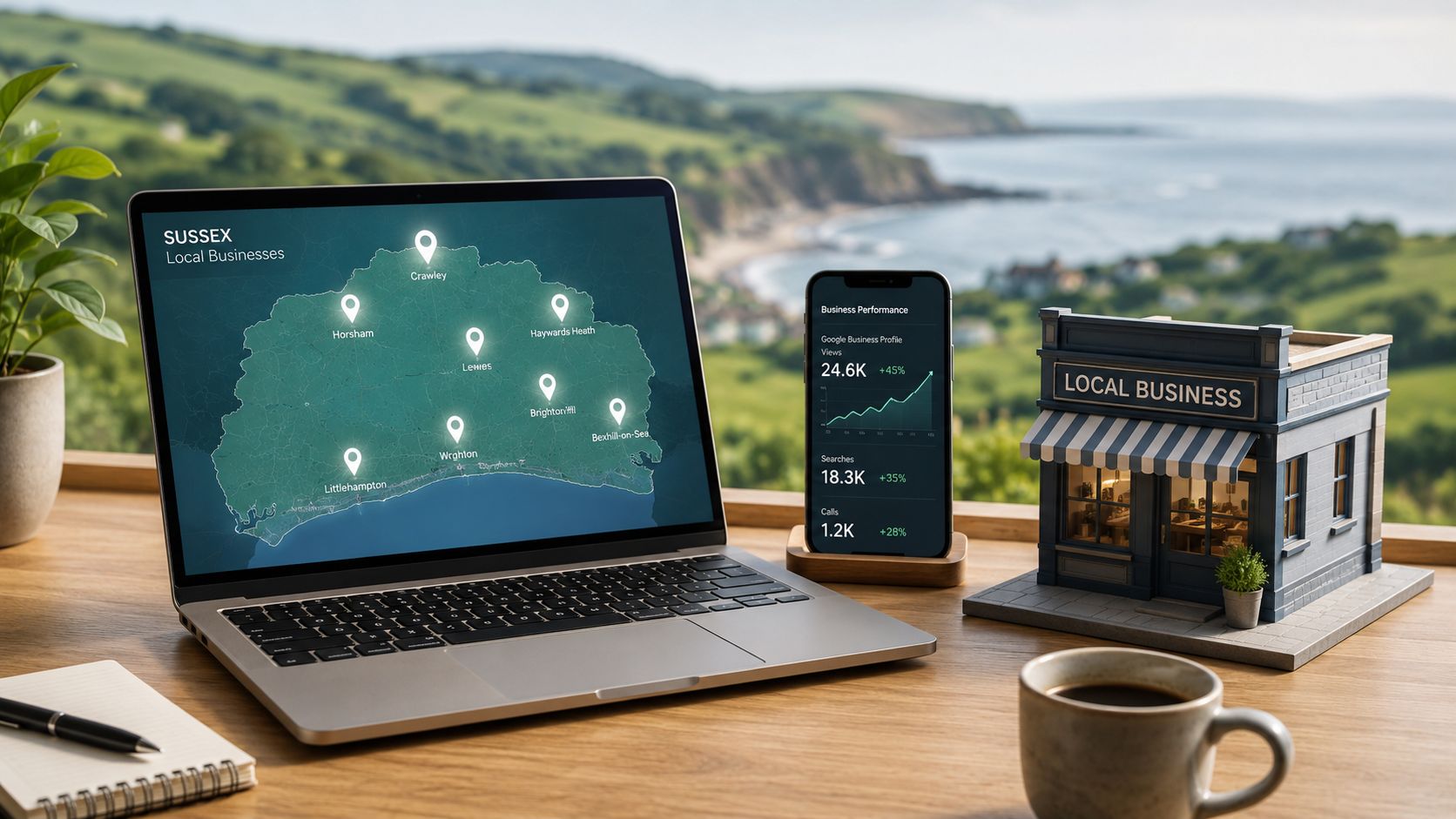

You know your customers are in Sussex. They're in Brighton looking for a wedding photographer, in Crawley needing an emergency plumber, in Chichester comparing clinics, or in Horsham searching for a service they want this week. Yet when you search your own business name, or the service you offer, you either don't appear, appear too low, or show up with a weak Google profile that doesn't inspire action.
That's the frustrating part of local SEO. You can be good at what you do and still feel invisible online.
A lot of Sussex business owners assume they need “more SEO” in the abstract. Usually, they need something more specific. They need to show up where local buyers make decisions, they need a site that supports trust, and they need a plan that turns visibility into calls, bookings, and enquiries. That's what this guide is about.
Why Your Sussex Business Needs to Be Seen on Google
If your business depends on local customers, Google is your modern shop window. People don't walk past your premises first anymore. They search first, compare first, and judge first.
That matters even more in the UK because Google dominates search behaviour. The Competition and Markets Authority has repeatedly found Google holds the overwhelming majority of general search queries in the UK, with share levels typically above 90% over recent years, as discussed in this overview of SEO in Sussex and Google's local search importance. If you're weak in Google's local results, you're not just missing a channel. You're missing the channel relied upon by the vast majority of searchers.
Visibility is often the difference between busy and quiet
A local search isn't casual window shopping. It's often a buyer trying to solve a problem nearby. That could be “accountant Brighton”, “dentist near me”, or “builder Worthing”.
Google's local systems are built around relevance, distance, and prominence. In plain English, Google asks three questions:
- Is this business a good match for what the person searched?
- Is it nearby or clearly serving that area?
- Does it look trusted based on reviews, website quality, and wider signals?
If your business sends weak signals on any of those, you can slip behind competitors who aren't necessarily better. They're just clearer.
Your website and Google Business Profile need to tell the same local story. Who you help, where you help them, and why someone should trust you.
There's another layer here. SEO doesn't just capture existing demand. It also supports the way people discover and remember your brand over time. If you want a useful primer on that bigger picture, Formzz has a good piece on key insights on demand generation. Local SEO works best when it sits inside that wider demand and trust-building process.
Sussex businesses need practical local visibility
For most small and medium-sized firms, the goal isn't “rank nationally”. It's simpler than that. You want to be visible when someone nearby is ready to act.
That's why SEO services in Sussex should be tied to commercial outcomes, not vanity rankings. If you want a broader explanation of why this matters commercially, Bare Digital also explains why SEO is important for businesses.
A florist in Lewes, a roofing company in Eastbourne, and a therapist in Hove all need the same core thing. They need to stop being hidden when local buyers are searching with intent.
What a Sussex SEO Strategy Actually Includes
A proper local SEO campaign is a bit like opening and running a physical shop. You need a clear sign outside, a tidy entrance, a good layout inside, a reputation in the area, and a reason for people to recommend you.
That's why good SEO services in Sussex aren't one task. They're a set of connected jobs.
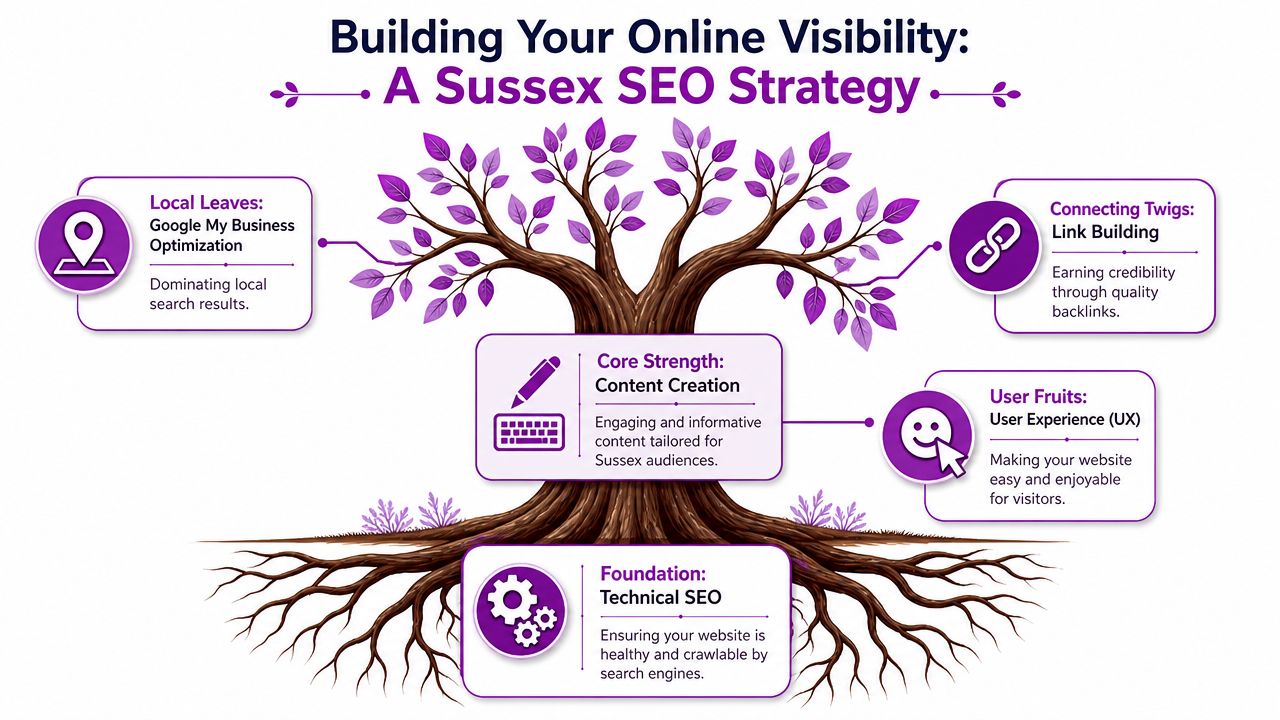
Your Google Business Profile is your digital front door
For local businesses, your Google Business Profile often gets seen before your website does. It's the panel people use to check your opening hours, service area, reviews, photos, and contact options.
Google's own guidance says businesses with complete and accurate profile information are more likely to be shown in local results, and prominence is influenced in part by review quantity and score, website authority, and local content relevance, as summarised in this piece on local ranking signals and Google Business Profile completeness.
That means your profile can't be half-finished. It needs:
- Correct core details such as business name, address, phone number, and categories
- Strong service descriptions that match what people search for
- Real photos of your work, team, premises, or projects
- Review management so trust signals grow over time
A neglected profile is like a shop with faded signage and no opening times on the door.
Local keyword research tells you what buyers actually ask for
Many businesses target phrases that sound nice internally but don't match buyer behaviour. Local keyword research fixes that.
You're looking for the language customers use when they're close to a decision. That might include town names, postcode areas, “near me” intent, or service combinations like “kitchen fitter Brighton” or “family photographer Sussex”.
This research then shapes:
- service pages
- town pages
- FAQs
- page titles and headings
- internal linking
If you want a plain-English guide to creating effective SEO content, Feather's article is worth reading because it connects content decisions to actual search intent.
Your website has to be technically sound
You can write brilliant pages, but if search engines struggle to crawl, render, or understand them, they won't perform properly.
Technical SEO usually includes work like:
- Page speed improvements so mobile users don't bounce
- Mobile usability checks because local searches often happen on phones
- Canonical tag reviews so location pages don't confuse search engines
- XML sitemap checks to make sure important URLs can be discovered
- Duplicate content clean-up when similar town pages overlap too heavily
Practical rule: If Google can't confidently understand your location pages, it won't rank them with confidence either.
Location pages build relevance town by town
A single “Areas We Cover” page rarely does enough. If you serve multiple places across Sussex, you usually need dedicated pages that explain your service in a meaningful local context.
Good location pages are not copies with the town name swapped out. They include local examples, specific service details, proof, FAQs, and calls to action that fit the area.
For example, a Sussex trades firm may need separate pages for Brighton, Haywards Heath, and Worthing because search behaviour and competition differ. A clinic may need pages for both service and location combinations.
Link building and local reputation support prominence
Links still matter, but local SEO link work should be about credibility, not volume. Think local directories, relevant business listings, community mentions, local press references, partnerships, and sector-relevant sites.
This is also where trust signals connect. Reviews, citations, on-site content, and local mentions all help reinforce that your business is active and real.
If you want a practical framework for planning all of this, Bare Digital has a useful guide on how to create an SEO strategy.
How Long SEO Takes and What Success Looks Like
One of the biggest mistakes in local SEO is expecting it to behave like paid ads. You don't switch it on Monday and fill the diary by Friday. SEO is cumulative. You build clarity, trust, and authority over time.
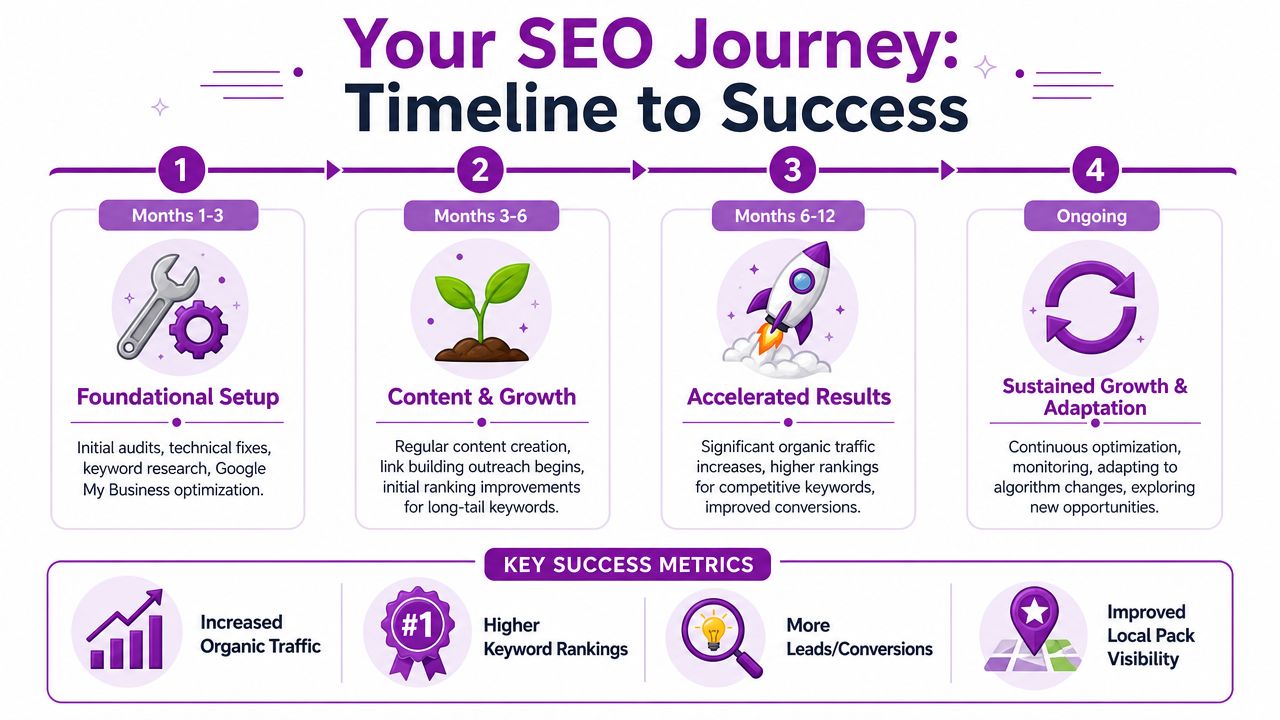
Industry research cited in 2025 reports that about 70% of businesses invest in SEO services to improve online visibility, and sustainable gains usually come from consistent execution over 3–12 months rather than quick fixes, according to this roundup of SEO services statistics and typical timeframes.
What usually happens in the early months
The first phase often looks less dramatic than business owners hope. That doesn't mean nothing is happening.
In the early stages, the work is usually about fixing weak foundations:
- Auditing the site for technical and content problems
- Improving local pages so they match buyer intent
- Sorting Google Business Profile issues and citation inconsistencies
- Building a reporting baseline so progress can be measured properly
You may see early movement in visibility for longer, more specific searches first. That's normal.
Success should be measured beyond rankings
Rankings matter, but they are not the final business result. If you rank better and nothing commercially improves, the campaign isn't doing its job.
A smarter way to judge progress is to separate leading indicators from commercial outcomes.
| Type | What to watch |
|---|---|
| Leading indicators | Better local visibility, more keywords appearing, stronger Google Business Profile engagement, improved landing page performance |
| Commercial outcomes | More phone calls, more enquiry forms, better booking quality, more quote requests, stronger branded searches |
The real win isn't “we moved up a few positions”. The real win is “more of the right people contacted us”.
A sensible timeframe for judging SEO
At around the earlier part of a campaign, you want to see whether the basics are improving. Later, you want to see whether that visibility is turning into demand from the right areas and services.
A good agency should be able to explain:
- What changed this month
- Why that change matters
- What early signals look promising
- Which pages, towns, or services need more work
If you want a more detailed expectation-setting guide, Bare Digital covers this clearly in how long SEO takes to work.
How to Choose the Best SEO Agency for Your Business
Not every agency selling SEO services in Sussex is selling the same thing. Some are doing strategic local search work. Others are doing surface-level tasks that sound busy but don't move the needle.
This choice matters because local intent is highly valuable. Google UK has reported that 76% of people who search on their smartphone for something nearby visit a business within a day, and 28% of those searches result in a purchase, as referenced in this article on local SEO and mobile intent. If an agency doesn't understand how mobile local searches convert, they can waste your budget by chasing traffic that doesn't turn into enquiries.
Questions worth asking before you sign
Start with the practical questions that reveal how they think.
How will you prioritise my area and services
A good answer should mention town pages, Google Business Profile work, and search intent. A weak answer usually stays generic.How do you report on success
You want more than ranking screenshots. Ask how they connect work to calls, forms, bookings, or leads.What will you do in the first few months
Serious agencies can describe an actual plan. Audits, technical fixes, profile optimisation, content improvements, and local authority building are all reasonable answers.How do you handle reviews and trust signals
This matters for local prominence and for conversion after the click.
For a broader external comparison, Surnex shares useful insights on local SEO providers that can help you compare agency styles and service models.
Red flags that should make you cautious
Some warning signs are easy to miss if you haven't bought SEO before.
If an agency promises guaranteed number one rankings, they're selling certainty nobody can honestly control.
Watch for these problems:
No clear local strategy
If they never mention Google Business Profile, location pages, or review signals, they may not specialise in local SEO.One-size-fits-all packages
A Sussex wedding venue and a Sussex electrician should not get identical strategies.Reporting that avoids business outcomes
Fancy dashboards are not enough if they don't explain lead quality and intent.Thin explanations
If they can't explain their work in plain English, communication may become painful fast.
A solid shortlist should leave you feeling informed, not pressured. Bare Digital's guide on how to choose an SEO company is also useful if you want a practical checklist before meetings.
Example SEO Packages and What to Expect for Your Budget
SEO pricing feels confusing because agencies often sell very different levels of work under the same label. One retainer may cover basic housekeeping. Another may include technical fixes, content production, Google Business Profile management, and local authority building.
The easiest way to judge value is to ask what work gets done each month, how that work is prioritised, and whether the package matches your business model.
Example monthly local SEO packages for Sussex businesses
| Feature | Growth (from £600/mo) | Advanced (from £1,200/mo) | Accelerate (from £2,500+/mo) |
|---|---|---|---|
| Local SEO audit and roadmap | Included | Included | Included |
| Google Business Profile optimisation | Core setup and monthly checks | Ongoing optimisation and posting | Full optimisation, posting, and deeper multi-area management |
| Keyword targeting | Core service and town terms | Broader service clusters and local intent mapping | Large-scale targeting across services, towns, and supporting topics |
| On-page SEO | Priority page updates | Ongoing page optimisation | Continuous optimisation across a larger site |
| Location pages | Limited rollout | Regular rollout | Extensive rollout for wider coverage |
| Content production | Light monthly content support | Steady content production | High-volume content and landing page development |
| Link and citation work | Foundational local signals | Ongoing authority building | More aggressive outreach and authority acquisition |
| Reporting | Monthly summary | Deeper reporting with insights | Detailed reporting tied to areas, services, and lead trends |
How to think about budget sensibly
A smaller package usually suits a single-location business with a focused service range. A larger package often makes sense when you serve several towns, have stronger competition, or need content and authority work at pace.
The question isn't only “What does SEO cost?” It's “What level of work is needed to become visible for the searches that make us money?”
For a UK-wide pricing overview, Bare Digital explains how much SEO costs in the UK.
Adapting SEO for Weddings Trades and Healthcare
The biggest misunderstanding in local SEO is thinking every industry should follow the same template. The foundations stay similar, but the trust signals, content style, and buyer journey change a lot depending on what you sell.

Weddings need inspiration and reassurance
A wedding business rarely wins on technical correctness alone. Couples are emotional buyers. They want to picture the day going well. They want evidence that your style fits them, and they want confidence before they enquire.
That means wedding SEO in Sussex often works best when it combines:
- Strong venue or service pages tied to actual locations
- Visual galleries that support image-led browsing
- Real testimonials and reviews that reduce risk
- Useful planning content that answers local questions
A wedding photographer in Brighton and a venue near Lewes both need location relevance, but they also need pages that feel aspirational and trustworthy. Thin pages with stuffed keywords won't do much. Rich portfolios, useful FAQs, and local proof matter more.
Trades need speed, clarity, and hyper-local targeting
Trades businesses often lose leads because their sites are vague. The user wants to know three things fast. Do you cover my area? Do you do the job I need? Can I trust you enough to call?
For plumbers, roofers, electricians, and builders, local SEO often works best when it focuses on specific towns, postcodes, and urgent service phrases. This section of the market usually benefits from sharp service pages, clear call buttons, visible reviews, and trustworthy details such as accreditations, insurance information, and project examples.
A trades site should feel like a reliable van pulled up outside. Clear branding, clear service list, and no confusion about where you work.
There's also a useful distinction here. Many trades firms don't need broad countywide visibility first. They often get better returns from owning a smaller set of profitable local areas.
A short visual explainer can help make this clearer in practice:
Healthcare needs stronger trust than almost any other sector
Healthcare SEO has less room for fluff. People are often anxious, privacy-conscious, and careful. They're not only asking “Can you help?” They're asking “Should I trust you with something important?”
That means healthcare providers need:
- Clear practitioner and service information
- Strong contact and location details
- Careful review management
- Helpful, accurate content that answers common concerns
- A site experience that feels calm and credible
In this sector, authority and trust signals carry extra weight from a human perspective. The content needs to be useful without sounding robotic or over-optimised. Reviews need handling sensitively. Every service page should reduce uncertainty.
Whether you're in weddings, trades, or healthcare, the same principle applies. Local SEO works best when it reflects how people choose in that category, not just how search engines crawl a page.
Your Sussex SEO Questions Answered
Does AI search make local SEO less important
No. It changes what good local SEO looks like.
Recent UK data from Ofcom's 2024 Online Nation research shows Google remains the most-used search service in the UK, reinforcing that local visibility now depends on how well a business is represented across Google Search, Maps, reviews, and structured data rather than on-page keywords alone, as noted in this discussion of SEO in Sussex and adapting to AI search.
That means a business needs to look complete and trustworthy across the whole Google ecosystem. Your brand signals, reviews, service clarity, and consistent local information matter more than old-style keyword stuffing.
Should I target all of Sussex or just a few towns
Usually, start narrower than you think.
If most of your profit comes from a few towns or postcodes, focus there first. It's often better to build strong local landing pages, reviews, and visibility in a smaller area than to spread effort thinly across the whole county.
A broad Sussex strategy can come later once the most valuable areas are working.
What if my competitors have more reviews than I do
You don't need to panic, but you do need a system.
Ask happy customers for reviews consistently, respond professionally, and make sure your website backs up the trust those reviews create. Review generation works best when it becomes part of your normal customer process, not a one-off push.
Can negative reviews hurt local SEO
They can affect trust and conversion, especially if they're left unanswered. But a profile with thoughtful responses and an active review pattern often looks more credible than one that appears silent or unmanaged.
What matters is how you handle them. Reply calmly, fix the underlying issue where appropriate, and keep earning fresh positive feedback that reflects the current state of the business.
Is ranking the main goal
Not really. Ranking is one stage in the journey.
The primary goal is profitable visibility. You want the right people to find you, trust what they see, and take the next step. That might be a phone call, a quote request, a booking, or a visit.
If your business is visible in Sussex searches but not getting enough enquiries, or if you're barely appearing at all, Bare Digital can help you assess where the gaps are. Their team works on local SEO strategy, Google Business Profile optimisation, location pages, technical fixes, and reporting that ties search visibility to real business outcomes.






