

You're probably seeing this already. A customer searches for “electrician near me”, “wedding venue Surrey”, or “accountant Cambridge”, and Google shows a map with three businesses at the top. One of them is your competitor. You know you do solid work, but you're not the one getting the click, the call, or the visit.
That gap is what local SEO is about.
If you want the plain-English answer to what is local seo, it's this: local SEO is the work that helps your business appear when nearby people search for the service you offer. It covers Google Maps, your Google Business Profile, and the local pages on your website. Done well, it turns search visibility into real enquiries, bookings, footfall, and sales.
Why Your Competitors Show Up on Google Maps First
A good way to think about local SEO is to picture a digital high street. Google Maps and the local search results are the busiest part of that street. The businesses at the top get seen first, trusted first, and contacted first.
That matters because local search isn't a niche channel. 46% of all Google searches have local intent, and for UK businesses, 76% of people who search for something nearby visit a related business within 24 hours, while 78% of those local searches result in an offline purchase according to local SEO statistics compiled by SOCi.
A trades business feels this when someone needs help now. A venue feels it when couples compare options in a county or town. A solicitor, architect, photographer, or funeral director feels it when trust and proximity shape the shortlist before anyone reaches the website.
Local SEO is visibility plus trust
Plenty of owners think local SEO just means “show up on Google Maps”. That's part of it, but not the whole thing.
Local SEO does three jobs at once:
- Makes you visible so people can find you when they search nearby
- Makes you relevant so Google understands what you do and where you do it
- Makes you credible so searchers feel confident enough to call or enquire
If your Google Business Profile is incomplete, your address appears differently across directories, or your site doesn't mention the areas you serve, Google has less confidence in your business. When that happens, competitors with clearer signals often win the space above you.
Practical rule: If a nearby customer can't quickly confirm who you are, where you are, and what you do, Google usually won't put you in front.
For many small firms, local SEO starts with fixing basics, not chasing tricks. A useful place to sense-check that is a Google Business Profile audit tool, because your profile is often the first thing customers see before they ever visit your site.
How Google Decides Who to Show Nearby
Google isn't trying to be clever for its own sake. It's trying to help a searcher solve a local problem fast. If someone searches for “coffee shop near me” or “emergency plumber Croydon”, Google acts like a local concierge. It has to recommend businesses that look relevant, genuinely nearby, and trustworthy enough to send a real person to.

Relevance, Distance and Prominence
These three ideas sit behind most local rankings.
Relevance is how well your business matches the search. If you're a wedding photographer but your profile is vague, your service pages are thin, and your categories are broad, Google has less evidence that you're the right result.
Distance is exactly what it sounds like. Google estimates how close your business is to the searcher or the location named in the query.
Prominence is your reputation and authority online. Reviews, links, mentions, and a well-maintained profile all help.
One detail causes confusion for a lot of business owners: proximity isn't only about where your office sits on a map. Google also checks whether your business details look consistent across the web. According to Semrush's explanation of local SEO mechanics, NAP inconsistencies across your website and directories can reduce Distance scoring by up to 15 to 25% in algorithmic tests.
Why NAP consistency matters so much
NAP stands for Name, Address, Phone.
If your website says “21 High Street”, your profile says “21 High St”, and a directory lists an old phone number, those may look minor to you. To Google, they can look like uncertainty. That uncertainty makes it harder to trust your location data.
Here's how that plays out in practice:
| Signal | What Google is checking | Common problem |
|---|---|---|
| Business name | Is this the same business everywhere? | Different naming versions |
| Address | Is the location real and consistent? | Old address, formatting changes, missing postcode |
| Phone number | Can users contact the right branch? | Tracking numbers used inconsistently |
A single-location café might recover quickly from a mismatch. A multi-location service business can create confusion at scale if each branch is listed slightly differently.
Google doesn't reward the business with the fanciest website. It rewards the business it can verify with confidence.
Later in the process, your website, reviews, and links all matter. But if Google can't clearly confirm who you are and where you operate, the rest of your effort is working uphill.
A useful primer on how search engines evaluate nearby results is below.
The Core Components of Local SEO Success
Local SEO works best when you treat it as a system, not a single task. A claimed profile helps. Reviews help. Better pages help. But the strongest results usually come when all the signals support each other.
Research summarised by BrightLocal's local SEO statistics page shows that Google Business Profile signals account for 32% of local pack ranking influence, followed by on-page signals at 19%, review signals at 16%, and link signals at 15%.
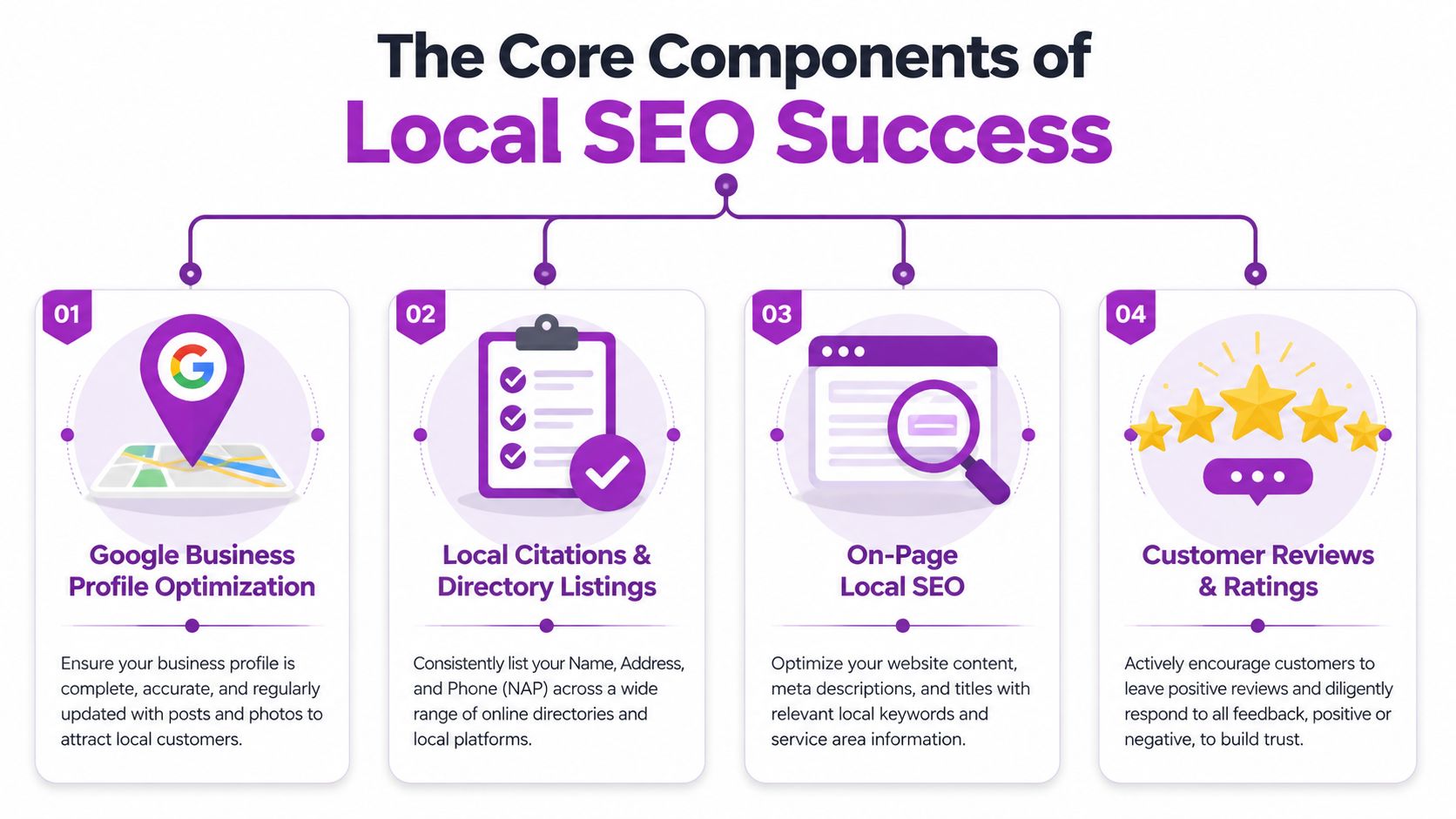
That weighting doesn't mean the lower items are optional. It means some levers tend to move rankings faster than others.
Google Business Profile
This is your shopfront in local search. It carries your categories, opening hours, reviews, service areas, photos, and contact options.
If you run a salon, clinic, venue, or showroom, this is often where the first decision happens. A complete profile helps Google understand the business. It also helps customers decide whether to call, click for directions, or keep scrolling.
Focus on these points first:
- Choose the right primary category because it strongly shapes which searches you can appear for
- Complete every relevant field including services, hours, attributes, and business description
- Add fresh photos so searchers can quickly judge trust and fit
- Keep details current especially seasonal hours, phone numbers, and service changes
On-page local SEO
Your website tells Google what you do in each place you want to rank. Service pages, town pages, title tags, headings, internal links, and schema all pull together for this purpose.
For example, a funeral director serving several towns shouldn't rely on one generic homepage. Separate pages for each area give Google clearer location signals and give users more specific answers.
A local page usually needs:
- A clear service and location pairing such as “Family Solicitor in Cambridge”
- Real local context including the areas served, practical details, and relevant FAQs
- Consistent contact details that match your wider online presence
If you're reviewing whether your current pages support local rankings, SEO services in Cambridge is an example of the kind of service focus many businesses need, especially when they want one page to rank for one clear local intent.
Reviews and reputation
Reviews affect both ranking and conversion. Even when two businesses appear side by side, the one with stronger, more recent, and more detailed feedback often gets the click.
What matters isn't only star rating. The wording inside reviews also helps reinforce your services, locations, and trust signals. A review that mentions “helpful probate solicitor in Ely” or “brilliant wedding coordinator in Surrey” carries more context than a simple “great service”.
What to ask for: Ask customers to describe the service they used and, where natural, the area they're in.
Citations and directories
Citations are mentions of your business details on directories and local listing sites. In the UK, that often includes mainstream business directories and sector-specific platforms.
Their role is simple. They reinforce that your business exists, operates where it says it does, and can be contacted through consistent details. Think of citations as identity checks for your local presence.
Local links
Links from relevant websites still matter because they support prominence. A venue might earn links from local wedding blogs or supplier directories. A builder might get listed by a trade body, local chamber, or regional publication. A care provider might be referenced by community organisations.
Not every link has equal value. One relevant local link can tell Google more than a batch of weak, unrelated ones.
Local SEO Strategies for Different UK Sectors
The basics stay the same, but the way local SEO works in practice changes by sector. A plumber, a wedding venue, and an accountant all need local visibility. They don't need the same page structure, keyword targets, or conversion journey.
Trades and contractors
A plumber or electrician usually wins business from urgency and proximity. Someone has a leak, no heating, or a power issue. They search with a place name, a postcode, or “near me”.
For UK service businesses, Logical Position's local SEO guide notes that 40 to 50% of high-intent local searches include proximity terms like “near me” or specific postcodes, and location-specific landing pages can generate 3 to 5x higher conversion rates than a generic homepage.
That means a contractor shouldn't stop at one “areas we cover” paragraph. A stronger setup might include pages for each main town or postcode area, such as:
- Emergency plumber M20
- Boiler repair Stockport
- Electrician near Croydon
If you're trying to turn search visibility into enquiries, this guide on how to get more contractor leads is a useful companion because it connects local traffic with lead handling.
Wedding venues and creative businesses
A wedding venue doesn't usually win on urgency. It wins on fit, trust, and visual appeal. Searchers compare options, shortlist favourites, and revisit them.
So the local SEO approach changes. A venue page targeting “wedding venue Surrey” needs more than keywords. It needs high-quality photography, detailed location information, FAQs, nearby transport notes, and reviews that reflect the kind of events hosted there.
Photographers, caterers, florists, and planners benefit from the same logic. Local pages work better when they show local relevance, not just mention a county in the title tag.
Professional and care services
For solicitors, architects, funeral homes, and care providers, trust is often the deciding factor. The website has to reduce doubt. The profile has to look current. Reviews have to reassure without sounding forced.
That's why local SEO for these sectors leans heavily on:
- Clear service pages for each office or service area
- Visible credentials and practical contact details
- Helpful content that answers anxious, high-stakes questions in plain English
A home care provider serving several towns, for example, often needs separate pages that explain availability, services, and how families can make contact locally. Generic copy rarely performs as well as pages built around a specific area and need.
Your Local SEO Starter Checklist
Most businesses don't need a huge reset to begin. They need a clear list and a couple of hours of focused work. If you're learning what is local seo for the first time, start with the tasks that remove confusion for Google and friction for customers.

The first jobs to complete
- Claim and verify your Google Business Profile so you control the business details customers see in search and Maps.
- Check your core NAP details and make sure your business name, address, and phone number appear the same on your website, profile, and key directories.
- Choose the right primary category because Google uses it to connect your business with relevant searches.
- Write a proper business description that explains what you do, who you help, and where you operate in plain language.
- Upload real photos of your premises, team, work, or venue so people can assess credibility quickly.
- List your actual services rather than relying on broad labels like “contractor” or “consultant”.
Then improve your website
- Create one page per core service so Google doesn't have to guess which page matches which search.
- Add location-specific pages where needed if you serve multiple towns, districts, or postcodes.
- Include local wording naturally in page titles, headings, and body copy without stuffing place names everywhere.
- Make contact details easy to find in the footer and contact page.
Build the trust signals
- Ask recent customers for reviews while the experience is still fresh.
- Reply to reviews because it shows both Google and future customers that the business is active.
- Check your directory listings and fix outdated entries.
- Look for local link opportunities through partnerships, memberships, events, and relevant directories.
Starter mindset: Don't try to “do SEO”. Make it easy for Google to verify you, and easy for customers to choose you.
If you want a more structured version to work through, this local SEO checklist is the kind of resource worth saving and using as a working document.
Measuring What Matters in Local SEO
A lot of business owners get stuck here because SEO reports can look busy without saying much. Rankings, impressions, and visibility graphs have their place, but they're only useful if they connect to actual business activity.
The better question is simple: did local search produce more of the actions that matter to your business?
The KPIs worth watching
For most local businesses, the strongest signals are:
- Phone calls from your profile or website
- Direction requests if customers visit a physical location
- Website clicks from your Google Business Profile
- Contact form enquiries from local landing pages
- Bookings or quote requests tied to local traffic
- Rankings for your core town and postcode terms
A wedding venue might care about brochure downloads and viewing requests. A trade business may care more about calls and form submissions. A solicitor may track consultation enquiries by office location.
Match metrics to buying behaviour
Context matters. If you run a café, map visibility and direction requests can be very meaningful. If you run a home services business, clicks-to-call may matter more than footfall.
A simple measurement model looks like this:
| Business type | Useful local KPI | Why it matters |
|---|---|---|
| Trades | Calls and quote forms | Searchers often want immediate contact |
| Venues | Viewing enquiries and brochure requests | The sale usually follows a longer decision process |
| Professional services | Consultation forms and tracked calls | Trust builds before purchase |
| Retail or hospitality | Direction requests and site clicks | Local discovery often leads to visits |
Offline activity matters too. If you use QR codes on leaflets, window signage, brochures, or direct mail, learning about measuring printed code traffic can help you connect local offline campaigns with online visits.
For businesses that want to estimate returns from organic growth rather than just watch rankings, a tool like a self storage ROI calculator for SEO shows the kind of commercial thinking that makes SEO easier to judge.
If a metric doesn't help you decide where to invest next, it's probably not the main metric to lead with.
Turning Local Visibility into Growth with Bare Digital
Local SEO isn't just about appearing on a map. It's about showing up at the moment someone nearby is ready to choose a business like yours.
That's why getting the fundamentals right matters so much. Your profile, your pages, your reviews, your citations, and your local links all help Google decide whether you're the right answer for a nearby search. For trades, that can mean more inbound calls. For venues, more viewing requests. For professional services, more qualified enquiries from people already looking in the right area.
The field also keeps shifting. As noted in the verified trend data, UK “near me” queries surged 52% year on year, AI overviews now capture 22% of local clicks, and anonymised schema reviews have shown a 40% ranking uplift for sectors such as healthcare and home care. Those changes mean older, set-and-forget tactics won't carry a business as far as they once did.
If your local presence feels patchy, inconsistent, or hard to measure, getting a proper review of the current setup is usually the smartest next step. Bare Digital works with UK businesses that need local visibility tied to real enquiries and sales, especially in sectors where geography and trust shape the buying decision.
If you want a practical next step, Bare Digital offers a no-obligation review of your local search presence so you can see where Google is getting mixed signals, where competitors are outranking you, and what to fix first. Visit Bare Digital to request a health check and get a clearer plan for turning local searches into local customers.






