
If you're a local business owner, you've probably had this thought already. You know people are searching for exactly what you sell, but your phone isn't ringing enough, the right enquiries aren't coming through, and every marketing channel seems to promise more than it delivers.
Google Ads can fix that. It can also burn through budget quickly if the setup is lazy.
For UK trades, wedding venues, funeral homes, architects, caterers, photographers, interior designers, healthcare providers, and construction firms, google ads for local businesses works best when it's built around geography, intent, and trust. That means tight service targeting, strict location settings, strong landing pages, and a Google Business Profile that doesn't look neglected.
The Foundation of Local Ad Success
Most local campaigns fail before the first click. Not because Google Ads is broken, but because the business hasn't defined what a lead is, what area it serves, or what page the click should land on.
If you're a roofer covering Leeds and Wakefield, a lead isn't just a website visit. It's a call, a quote request, or a form submission from a homeowner in your patch. If you're a wedding venue, the win might be brochure requests and viewing enquiries. If you're an architect, it might be consultation bookings from clients in a narrow group of postcodes.

Define the local outcome first
A good local account starts with business reality, not with keywords.
Before spending anything, pin down:
- Primary conversion action. Decide whether the main result is phone calls, form fills, appointment requests, directions, or a sale.
- Service geography. List the exact towns, boroughs, or postcodes you want. Don't rely on a vague radius if your service area is irregular.
- Commercial priorities. Separate high-margin services from low-margin ones. An emergency plumber and a planned bathroom refit shouldn't sit in the same bucket.
- Lead quality rules. Write down what counts as a qualified enquiry. This matters later when you decide which campaigns deserve more budget.
That sounds basic, but it's where a lot of waste begins. Businesses often ask Google Ads to "get more leads" without defining which leads they want. The platform will happily send volume if you let it. Volume isn't the same as quality.
Practical rule: if you can't explain to a third party what a good lead looks like, your campaign settings will drift towards cheap clicks instead of profitable enquiries.
Why Google is still the main local channel
For UK businesses, local search still starts with Google. Google holds a 93.51% search engine market share in the UK as of 2025, and 65% of UK SMEs are investing in PPC campaigns. Businesses typically achieve £2 in revenue for every £1 invested, while average conversion rates reach 7.52% overall, with some service categories higher, including 11.62% for physicians according to Google Ads market and performance data.
That doesn't mean every account will print money. It means the opportunity is real if the fundamentals are right.
Your Google Business Profile is not optional
For local advertisers, the Google Business Profile sits at the centre of trust. It's often the first thing a searcher checks after seeing your ad. If your profile has weak imagery, inconsistent information, poor categorisation, or no recent activity, it drags down what the ad click might have become.
A strong profile helps in practical ways:
- It supports location extensions, which make ads more useful on the search results page.
- It reinforces local trust through reviews, business details, opening hours, and service relevance.
- It improves the handoff between ad click, map result, and direct action like calling or getting directions.
For a funeral home, a neglected profile raises doubt. For a wedding venue, poor photos lose attention fast. For a builder, missing service area details create friction before the prospect even visits the site.
If your local presence is messy, fix that before pushing budget. A useful starting point is this local SEO checklist for UK businesses, because your paid results and local organic visibility shouldn't work against each other.
What works and what doesn't
Here's the trade-off in plain English. Broad campaigns can generate activity quickly, but they also attract low-intent clicks, out-of-area traffic, and irrelevant searches. Tighter campaigns generate fewer clicks at first, but the leads are usually cleaner.
What works:
- Clear service segmentation
- Location-specific intent
- Matching ads to the right page
- A maintained Google Business Profile
- Accurate conversion tracking from day one
What doesn't:
- Sending every click to the homepage
- Targeting an entire county when you only serve selected towns
- Running ads before the website can convert
- Ignoring reviews, map presence, and trust signals
Your ad account doesn't operate in isolation. Searchers judge the whole business, not just the headline in the ad.
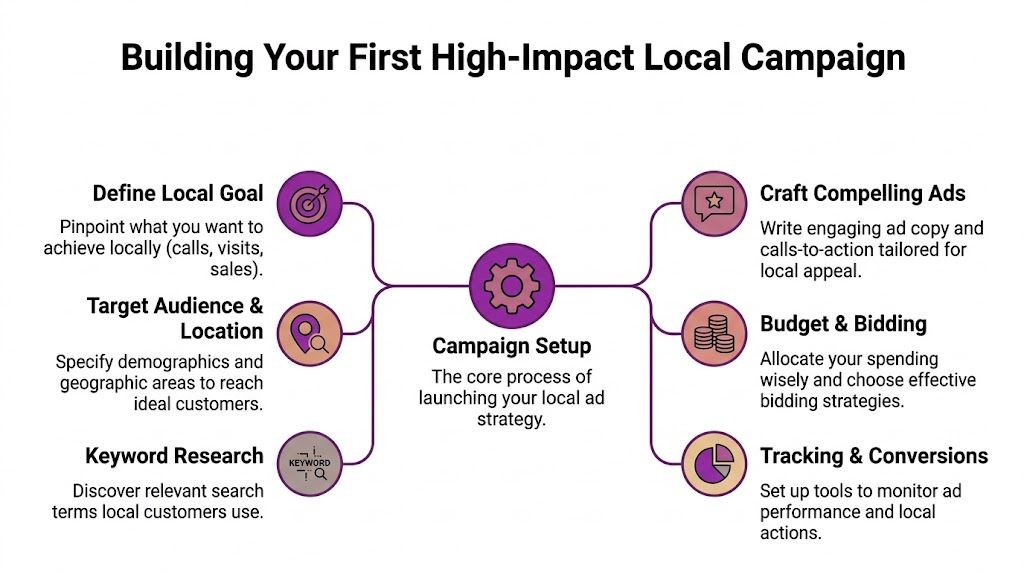
Building Your First High-Impact Local Campaign
The best first campaign for most local businesses isn't the cleverest one. It's the one that gives you control.
That usually means starting with a Search campaign focused on the services people actively look for. It gives you better visibility into search terms, cleaner budget control, and a more direct path from keyword to enquiry.
Start with Search, not complexity
A proven local setup starts with Search campaigns using long-tail keywords, and the location setting must be Presence only in Google Ads. That setup can help avoid wasting up to 40% of budget on people outside your service area. When you integrate your Google Business Profile for location extensions, it can increase click-through rates by 15-20%, and UK service businesses using this focused approach report 3-5x ROAS within 90 days according to this local Google Ads strategy breakdown.
That single setting matters more than many businesses realise. If you leave Google on looser location intent options, you'll often pay for people who are interested in your area but aren't physically there. That's useless if you're a locksmith in Bristol who doesn't serve tourists planning a future trip.
Choose the right campaign type
Don't launch every campaign type at once. For most local firms, that's where clarity disappears.
| Campaign Type | Best For | Control Level | Typical Use Case |
|---|---|---|---|
| Search | High-intent leads | High | Roofer targeting "roof repair Leeds" |
| Performance Max | Broader expansion after data exists | Lower | Multi-service brand with strong tracking |
| Local Services Ads | Verified local service providers | Medium | Plumbers, electricians, trades taking direct leads |
| Display | Retention and visibility | Lower | Light remarketing to previous site visitors |
Search should usually lead. Performance Max can help later, but not before you've built a clean baseline. Local Services Ads can be excellent in eligible sectors, though they still need operational discipline behind them.
If you want a plain-language refresher on PPC mechanics before building campaigns, this PPC marketing Google guide gives a useful overview.
Structure by service, not by wishful thinking
A local account should mirror the business. That means separate campaigns or ad groups based on how people search and how you deliver services.
For example:
- Boiler repair should sit apart from new boiler installation.
- Wedding venue hire should sit apart from civil ceremony venue if the messaging and landing pages differ.
- Funeral director services shouldn't be merged into a generic "funeral" group if users search for cremation arrangements, prepaid plans, or local family funeral directors in different ways.
This structure helps with three things:
- Better ad relevance
- Cleaner search term analysis
- More accurate budget allocation
A common mistake is packing every service into one campaign because it looks easier to manage. It isn't. It creates mixed signals, diluted ad copy, and poor reporting.
Build your keyword list around local intent
Local keywords should reflect how real people search when they want a nearby provider now or soon.
Good examples include:
- emergency plumber near me Leeds
- wedding venue York countryside
- funeral director in Harrogate
- architect for house extension Bristol
- kitchen fitter LS16
- commercial photographer Manchester
Long-tail terms usually tell you more about urgency and fit. Postcode modifiers, town names, and service qualifiers often bring cleaner traffic than generic head terms.
Use your own service list, Google Ads Keyword Planner, search term reports once the campaign is live, and your Google Business Profile categories as inputs. If the business serves several distinct towns, group keywords in a way that maps cleanly to local landing pages.
A useful checkpoint before launch is running your profile through a Google Business Profile audit tool. That helps you spot whether your map presence and ad strategy are aligned.
Tight geo-targeting is where local campaigns are won
At this point, many accounts leak money.
If you're a construction firm serving selected postcodes in South Yorkshire, don't target the whole region. If you're a photographer who only wants weddings within driving distance of your studio, don't let Google infer broad intent. If you're a care provider with branch-specific service areas, target each territory deliberately.
Set locations to the places you actually serve, then exclude the places you know you don't want. That one decision improves lead quality more than most ad copy tweaks.
For local businesses, practical targeting usually means one of these:
- Town and city targeting when the service area is straightforward
- Postcode clusters when the coverage map is uneven
- Smaller radius targeting for urban trades and nearby service demand
- Separate campaigns by branch for multi-location brands
Negative keywords from day one
A local campaign without negative keywords is unfinished.
Add exclusions for irrelevant intent early. Terms like free, jobs, DIY, training, salary, or course often waste budget for service businesses. A wedding venue may also need to block searches related to jobs, decor hire only, or unrelated event intents. A builder may need to block trade supply searches.
Don't wait for wasted spend to pile up. Build the habit from launch.
Crafting Ads and Landing Pages That Convert
A local Search campaign can be technically sound and still underperform if the ad sounds generic or the landing page gives people no reason to trust you.
Clicks happen because the searcher thinks you solve their problem in their area. Conversions happen because the page confirms that quickly.
Write ads like a local operator
The best local ads are specific. They mention the service, the place, and the action you want the user to take.
For example, a weak ad for a heating engineer says "Trusted Heating Services. Contact Us Today." That could be anyone, anywhere.
A stronger version says the equivalent of: boiler repair in Leeds, same-day appointments, local engineer, call now. It narrows the message. That helps attract the right user and discourages the wrong one.
Use these principles:
- Include the location in at least some headlines where it reads naturally.
- Match the keyword intent instead of writing one broad message for every service.
- Use direct calls to action such as book a survey, request a quote, call today, or arrange a viewing.
- Reflect buying concerns. For venues, that may be availability and exclusivity. For funeral directors, it's sensitivity and trust. For trades, it's speed, reliability, and local coverage.
A local ad doesn't need to sound clever. It needs to sound relevant and dependable.
Use extensions that improve decision-making
Ad extensions make local ads easier to trust and easier to act on. The most useful options for local businesses are usually:
- Location extensions that connect the ad with your Google Business Profile
- Call extensions so mobile users can ring straight from the result
- Sitelinks that send people to specific service pages, venue galleries, FAQs, or contact pages
- Image extensions where appropriate, especially for visually driven sectors such as venues, interior design, or photography
The aim isn't to load every extension available. It's to remove friction. If someone searches for a caterer in their town, showing the location, call option, and relevant subpages helps them choose faster.
Match each ad group to a page with one job
A common local PPC mistake is sending all paid traffic to the homepage. Homepages are often too broad, especially for intent-driven service searches.
A better setup is one landing page per main service, ideally specific to the location where that service is delivered. A page for "roof repair in Sheffield" should talk about roof repair. It shouldn't ask the visitor to figure out whether you also do loft conversions or gutter cleaning.
A strong local landing page usually includes:
- A clear headline that repeats the service and local relevance
- A visible phone number that works well on mobile
- A short enquiry form without unnecessary fields
- Trust signals such as reviews, accreditations, insurance details, or years in trade if relevant
- Real local references including areas served, project types, or practical service details
- A strong next step such as request a quote, book a consultation, or check availability
Trust matters more in local categories with risk
The higher the perceived risk, the more your landing page needs to reassure.
For funeral homes, the tone should be calm and respectful. For architects, the page should show credibility and project understanding. For home improvement firms, visitors want confidence that you're legitimate, responsive, and experienced in the kind of job they're planning.
Poor trust signals hurt hard. Thin pages, stock-heavy visuals, no reviews, and no local proof create hesitation. Mobile users leave quickly when they can't find a number or don't feel confident enough to enquire.
Keep the post-click experience simple
Don't make local prospects work.
If the ad says emergency drainage in Nottingham, the page should immediately confirm emergency drainage in Nottingham. If the ad promotes wedding venue viewings, the page should prioritise bookings, availability, and imagery. If the ad targets private healthcare enquiries, the form shouldn't feel like a maze.
The most effective local landing pages are usually not the fanciest. They're the clearest.
Advanced Optimisation and Smart Budgeting
Once a campaign starts generating conversions, the job changes. You stop asking whether the ads are running and start asking where the margin is.
That means looking at postcode performance, repeat searchers, call quality, and which services justify higher bids.
Use geo-bid layering instead of flat location bidding
Not every area is equally valuable. Some postcodes convert better, bring larger jobs, or are easier for your team to serve profitably.
Advanced local accounts reflect that. According to geo-bid layering and local Google Ads benchmarks, geo-bid layering can deliver a 35% lower CPA versus a flat radius target. The same source notes that RLSA can capture up to 25% of total conversions at a 40% lower cost, that top-ranking LSA profiles can capture 60% of lead share, and that successful campaigns aim for CTR above 5% and ROAS above 4x.
In practice, this means:
- Bid more aggressively in your strongest postcodes
- Reduce bids in secondary areas
- Exclude locations that produce weak leads or operational headaches
- Review performance by geography, not just by campaign total
For a home care provider, central catchment areas may deserve stronger bids than distant edge zones. For a wedding photographer, one city might bring premium enquiries while another brings price shoppers. For an architect, affluent suburbs may justify dedicated attention.
RLSA helps you recover missed demand
A lot of local prospects don't convert on the first visit. They compare providers, discuss the purchase with a partner, or get distracted.
Remarketing Lists for Search Ads lets you treat those return searchers differently. If someone visited your page for loft conversions or venue hire and later searches again, you can bid more assertively because they're warmer than a first-time user.
That's especially useful in categories with longer decision cycles:
- Wedding venues
- Architectural services
- Interior design
- Higher-value construction work
- Private healthcare enquiries
Returning searchers often need reassurance, not a completely different message. Keep the ad aligned with the original intent and sharpen the offer.
Smart bidding works best when the account has clean signals
Automated bidding can be very effective once conversion data is trustworthy. It isn't a substitute for account structure.
If your campaign mixes poor leads with good ones, or tracks weak actions as conversions, smart bidding will optimise towards the wrong outcome. That's why local businesses should only scale automation after fixing keyword targeting, landing page alignment, and conversion definitions.
This is also where operations and marketing intersect. If your team is slow to answer calls, misses form enquiries, or doesn't qualify leads consistently, ad performance suffers no matter how good the campaign looks.
Businesses that want to improve response handling can also look at tools beyond Google Ads. For example, conversational support on the site can help route enquiries and answer common questions outside office hours. This AI chatbot for marketing guide is useful if you're considering that layer as part of lead handling.
When to test Local Services Ads or Performance Max
Local Services Ads make sense for verified trades and service categories that qualify. They're especially worth attention if your team can respond quickly and your Google Business Profile is in good shape.
Performance Max is different. It can expand reach, but it also reduces visibility into exactly where budget goes. That loss of control is often a bad trade early on. Search gives cleaner diagnostic value. Performance Max is better treated as an expansion test once the core Search campaigns are producing reliable leads.
This is a useful moment to review the economics, especially if you manage multiple locations or have a long sales cycle. A practical benchmark tool like this SEO ROI calculator for self-storage and location-led growth planning can help frame how paid and organic channels work together over time.
A quick visual refresher helps when you're reviewing campaign efficiency and budget decisions:
Budget where the business can actually fulfil demand
More spend isn't always better. If one campaign brings high-quality enquiries for profitable work and another fills the inbox with poor-fit leads, the answer isn't to "balance" them. It's to cut waste and back the better source.
Smart local budgeting usually looks like this:
- Protect core service campaigns first
- Prioritise locations with proven lead quality
- Separate testing budget from core budget
- Scale only after lead handling is stable
The strongest local accounts feel disciplined. They don't chase every impression. They buy the right attention and make it easier for sales staff or business owners to turn that attention into work.
Measuring What Matters for Local Growth
Local PPC reporting goes wrong when businesses focus on platform activity instead of business outcomes. Clicks, impressions, and average positions are interesting. They aren't the scoreboard.
The core question is simpler. Which campaigns produce qualified local enquiries at a sensible cost, and which ones don't?
Track real actions, not vanity metrics
Set up conversion tracking before you start judging performance. For local businesses, the most useful tracked actions are usually:
- Phone calls from ads
- Calls from the website
- Form submissions
- Appointment or consultation requests
- Direction requests where relevant
- Key lead actions on mobile
If you're a funeral home, a phone call may be the highest-priority conversion. If you're a wedding venue, a brochure request and a viewing enquiry may matter more. If you're a builder, you may want separate tracking for quote requests and emergency call-outs.
Read the account with a local lens
Broad account averages can hide problems. A campaign may look fine overall while one town drains budget and another carries the account.
Review performance by:
| Metric | What it tells you | Why it matters locally |
|---|---|---|
| Click-through rate | Whether the ad matches the search | Weak CTR often signals poor local relevance |
| Conversion rate | Whether clicks turn into leads | Helps separate traffic quality from page quality |
| Cost per conversion | What you're paying for each lead | Useful when comparing services and areas |
| Search terms | What people actually typed | Reveals wasted spend and new keyword opportunities |
| Location performance | Which areas produce results | Helps shape exclusions and bid adjustments |
| Landing page behaviour | Whether visitors engage after the click | Useful for spotting mismatch or trust problems |
You don't need a bloated report. You need one that helps you make decisions.
If a local campaign can't tell you which service, keyword theme, and area produced the lead, the reporting isn't finished.
Use KPI reviews to guide action
A weekly review should answer practical questions:
- Are the calls and forms coming from the right places?
- Which search terms need to be added or excluded?
- Are mobile users converting cleanly?
- Which services deserve more budget?
- Is one landing page underperforming despite relevant traffic?
Monthly reporting should go further. Compare lead quality, not just lead count. Speak to whoever answers the phone or processes enquiries. If they say leads from a campaign are weak, treat that as real performance data and investigate.
For businesses that rely heavily on local presence, combining ad reporting with map visibility gives a clearer picture. A Google Business Profile reporting dashboard can help connect paid activity with wider local discovery and engagement.
Keep reporting simple enough to use
The best local reporting isn't the prettiest. It's the report that gets read and acted on.
For most businesses, that means:
- A short weekly check for waste and lead flow
- A monthly review of service performance and location quality
- Notes from the team handling calls and forms
- Decisions attached to every report, not just data dumps
When measurement is tight, optimisation gets easier. You stop guessing which half of the spend is working.
Your Next Steps and Common Questions
Local Google Ads usually works best when you keep the first version tight. Start with Search. Focus on a real service area. Match keywords to services. Send clicks to pages that can convert. Then optimise based on lead quality, not noise.
Most local businesses don't need more complexity at the start. They need cleaner targeting, better trust signals, and proper measurement.
Local Google Ads FAQ
| Question | Answer |
|---|---|
| Should a local business start with Search or Performance Max? | Start with Search in most cases. It gives clearer control over keywords, budget, geography, and messaging. |
| Do I need separate campaigns for each service? | Usually, yes if services differ in intent, margin, or landing page. That keeps reporting and budget decisions clearer. |
| Is a homepage good enough for paid traffic? | Usually not. Service-specific landing pages convert better because they match the search more closely. |
| How important is the Google Business Profile? | Very important. It supports trust, local visibility, and ad features tied to location. |
| Should I target a radius or postcodes? | Use whichever best reflects the real service area. Postcodes are often better when the coverage shape is uneven. |
| When should I add remarketing or more advanced bidding? | After the account has clean conversion tracking and enough data to make those tools useful. |
| What if leads are coming in but they're poor quality? | Tighten keywords, add negatives, refine locations, and review whether the landing page is attracting the wrong enquiries. |
| Can multi-location brands run one campaign for all branches? | They can, but separate campaigns by branch usually give better control and cleaner local messaging. |
If you want a second opinion on your setup, your tracking, or your local targeting, it's worth getting someone to audit the account before increasing spend. If you'd like that conversation, you can contact the team.
Bare Digital helps UK businesses turn local search visibility into real enquiries and sales. If you want support with Google Ads, Google Business Profile optimisation, local landing pages, or a joined-up local growth strategy, speak to Bare Digital.