

You’re good at the work. The issue is pipeline.
A lot of trades businesses still run on referrals, repeat customers, and the odd Facebook post. That can keep things ticking over, until one quiet month turns into two, the phone goes flat, and you realise the firms showing up on Google aren’t necessarily better at the job. They’re just easier to find.
That’s where seo services for tradesmen matter. Not as a vanity exercise. Not as a bundle of jargon. As a practical lead generation system that helps the right people find you when they need a plumber, roofer, electrician, builder, decorator, or heating engineer in their area.
Why Your Trade Business Is Invisible Without SEO
A common situation looks like this. A good electrician in Leeds gets solid word-of-mouth work, does clean jobs, turns up on time, and has loyal customers. But referrals come in waves. One week is packed. The next is thin. Meanwhile, another firm appears in Google Maps, has recent reviews, clear service pages, and keeps picking up the call-outs.
That gap usually isn’t about skill. It’s about visibility.
In the UK, 68% of consumers use Google to find local services before making hiring decisions, and trades rely heavily on “near me” searches that generate over 75% of mobile local traffic for service-based businesses, according to UK contractor marketing trend data. If your business isn’t showing up where people search, you’re leaving work on the table.

Good workmanship alone doesn’t create steady demand
A van, tools, insurance, and quoting process are all part of your operating kit. Online visibility belongs in that same category now. It’s the digital version of being the name everyone in the pub recommends, except it works at scale and it works when people need help quickly.
That matters even more if your jobs depend on fast estimates and efficient follow-up. The businesses that tie their marketing to quoting systems and workflow tools usually move quicker from enquiry to booked work. If you’re tightening up that side of the operation too, construction estimating software can help reduce delays between lead, quote, and decision.
Practical rule: SEO won’t rescue a poor service business, but it will expose a good one to more buyers who are already looking.
Why your competitor keeps appearing
Google rewards signals of legitimacy and relevance. If your competitor has a better-managed profile, clearer location pages, and stronger proof online, they’ll often appear ahead of you even if your workmanship is just as good or better.
For trades and construction firms, that usually comes down to a few basics:
- A complete Google presence: Accurate contact details, service areas, and categories
- A convincing website: Real service pages, real locations, real examples of work
- Trust signals: Reviews, consistent listings, certifications, and useful content
- Local relevance: Pages and profile content tied to towns, postcodes, and actual services
A lot of firms don’t need a total rebuild. They need a proper local search setup. If your business overlaps with larger construction work as well as domestic enquiries, Bare Digital’s SEO for construction companies page gives a useful view of how local visibility connects to qualified leads rather than just traffic.
SEO isn’t magic. It’s closer to keeping your workshop organised. When everything is in the right place, jobs move faster and fewer opportunities get missed.
The Foundations of Local SEO for Tradesmen
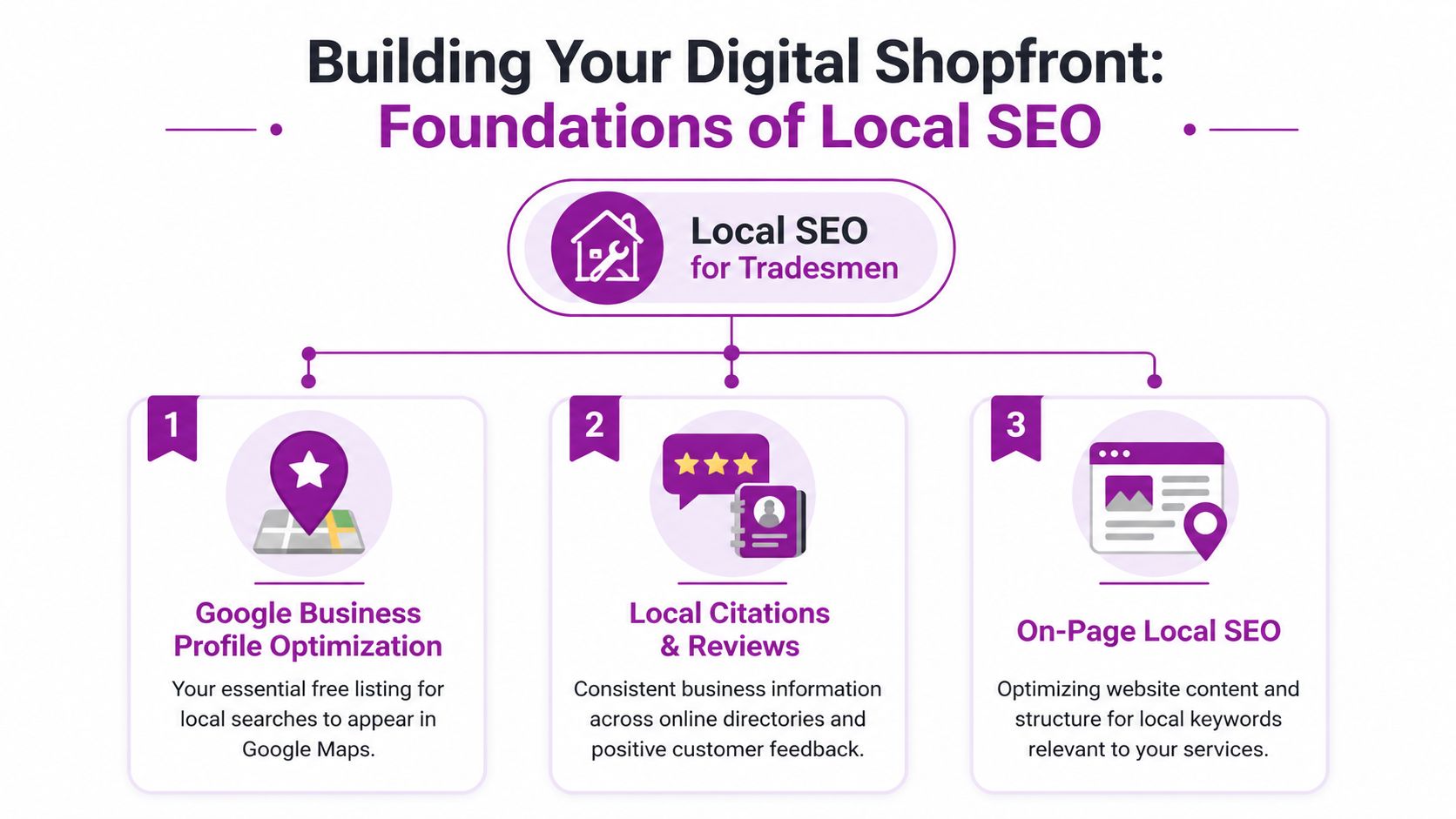
Think of local SEO as your digital shopfront. If the sign outside is wrong, the window is messy, and nobody in town can confirm you exist, people won’t walk in. Google works much the same way.
For most tradesmen, the foundation sits on three parts. Your Google Business Profile. Your website. Your local citations and reviews. If one is weak, the whole setup underperforms.
Google Business Profile is your front sign
When someone searches for “boiler repair near me” or “builder in Nottingham”, your Google Business Profile is often the first thing they see. It needs to be complete, current, and tied to the services you offer.
In the UK, trades businesses that optimise their Google Business Profile with LocalBusiness schema markup see a 25 to 35% uplift in local pack visibility for local intent searches, according to this tradesmen SEO benchmark summary. That’s why a proper setup goes beyond filling in the basics.
A strong profile usually includes:
- Correct business details: Your name, address, phone number, hours, and service area must match everywhere
- Service-led categories: Not broad guesses. The categories should reflect the actual jobs you want
- Recent photos and updates: Finished work, team photos, vans, and regular posts help prove the business is active
- Review responses: Not generic thanks. Replies that mention the job and area help reinforce relevance
Your website is the showroom
Your profile gets attention. Your website closes the gap between interest and enquiry.
A trades website doesn’t need to be clever. It needs to be clear. Customers want to know what you do, where you do it, whether they can trust you, and how to contact you. If that takes too many clicks, you lose them.
The pages that usually matter most are:
- Service pages for each core job, such as rewires, roof repairs, boiler servicing, or kitchen fitting
- Location pages for the towns and areas you cover
- Proof pages like reviews, accreditations, guarantees, and project examples
- Contact paths with click-to-call buttons, short forms, and obvious next steps
If you want a useful primer before hiring anyone, this essential guide to getting started with SEO covers the basics in plain language.
A tidy website does the same job as a tidy van. It signals professionalism before you’ve even spoken to the customer.
Citations and reviews are your reputation around town
Citations are mentions of your business details on directories and relevant websites. Reviews are public proof that real people have hired you and were happy with the work. Together, they help search engines trust your business and help customers feel safer contacting you.
The trap is inconsistency. If your business name is written one way on Google, another on a directory, and your old mobile number still appears somewhere else, you create doubt. Google doesn’t like doubt, and neither do customers.
A simple local SEO checklist should include:
| Element | What to check | Why it matters |
|---|---|---|
| Business details | Same name, address, and phone everywhere | Prevents confusion and supports trust |
| Reviews | Recent, relevant, answered | Improves confidence and engagement |
| Service coverage | Towns and postcodes clearly stated | Helps local relevance |
| Website links | Directory listings point to the right pages | Makes authority signals cleaner |
If you want a practical benchmark for those basics, Bare Digital’s local SEO checklist is a solid reference point.
A lot of SEO problems in trade businesses aren’t advanced problems. They’re foundation problems. Fix the sign, sort the showroom, clean up the reputation trail, and the rest of the campaign has something to build on.
The Core Services Your SEO Agency Should Provide
Once the foundations are in place, the core work begins. At this point, many trades businesses encounter difficulties. An agency says it’s “doing SEO”, but the work is vague, reports are fluffy, and the phone doesn’t ring any more often.
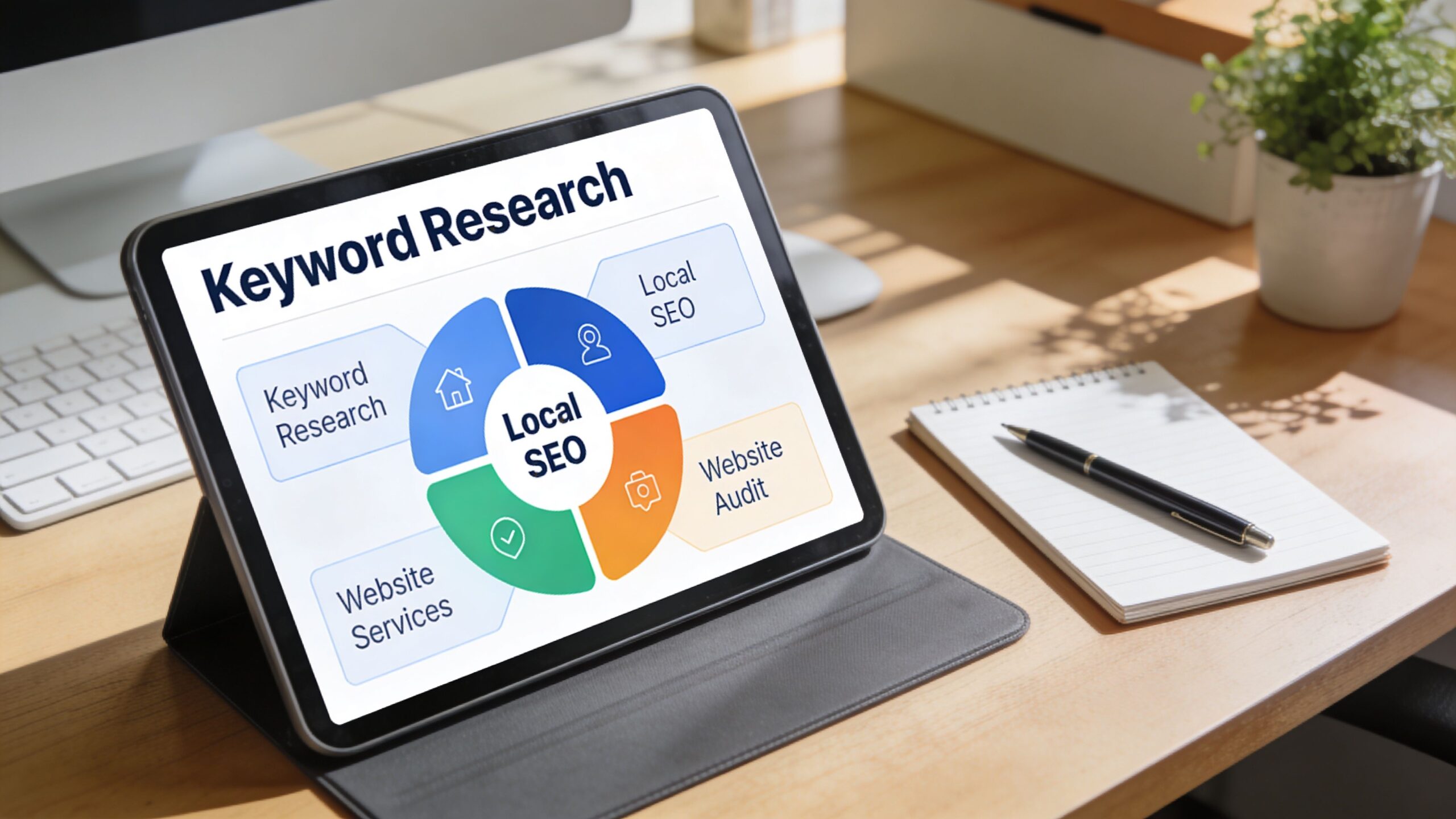
A useful SEO service should feel like a proper maintenance schedule. You should know what’s being worked on, why it matters, and how it connects to enquiries.
Google Business Profile management that actually moves the needle
Claiming a profile is not the job. Managing it is.
A serious local SEO service should handle ongoing updates, review response strategy, service edits, photo uploads, and regular posting. For trades, that can include completed jobs, service reminders, seasonal advice, and short updates that show the business is active.
Good agencies also review the profile for avoidable issues such as wrong categories, duplicate listings, weak descriptions, and inconsistent service areas. If you want to see where your profile stands, a Google Business Profile audit tool is useful for spotting gaps before you spend money fixing the wrong problem.
Hyper-local keyword strategy
Real buyer intent gets separated from generic traffic.
“Plumber” is broad. “Emergency plumber in Swindon” is closer to a booking. “Boiler repair SN1” is closer still. A proper agency won’t just chase high-volume phrases. It will map services to towns, villages, and postcodes you serve.
That matters more for firms covering multiple areas. A key issue for UK trades businesses is scalable citation management and hyper-local keyword clustering. 62% of small construction firms operate in 2 or more locations, yet only 15% report effective multi-location visibility, according to this overview of SEO opportunities for construction and trade firms.
That gap is where a lot of missed revenue sits.
On-page and technical SEO
If your website is slow, messy on mobile, or difficult for search engines to understand, rankings suffer and leads leak out.
A competent agency should be doing work such as:
- Service page optimisation: Clear titles, headings, and copy matched to specific jobs
- Internal linking: Connecting related pages so users and Google can move through the site easily
- Schema implementation: Structured data that helps search engines interpret your business and services
- Technical fixes: Broken pages, duplicate content, indexing issues, clumsy mobile layouts, and poor page speed
This part isn’t glamorous, but it matters. It’s like keeping your tools sharp. Customers won’t praise it directly, yet the whole job depends on it.
Location pages for every area that matters
A lot of trade sites make the same mistake. One homepage says “we cover all of the South East” and expects to rank everywhere. That rarely works.
If you serve Reading, Wokingham, Bracknell, and Newbury, each area usually needs its own page with relevant services, local context, proof of work, and a clear enquiry path. Thin copy stuffed with town names won’t do the job. Nor will cloned pages with one place name swapped out.
A useful location page should answer four things fast:
| Page element | What the customer wants to know |
|---|---|
| Service match | Do you do the exact job I need? |
| Area fit | Do you genuinely work in my town or postcode? |
| Trust | Have you done this work before and can I verify that? |
| Action | How do I call, message, or request a quote now? |
This short walkthrough shows the sort of local search thinking agencies should be applying to trades campaigns:
Content and links that support revenue, not fluff
Trades businesses don’t need endless blog posts about broad industry topics. They need content that helps real customers choose and helps search engines understand the site.
That can include service explainers, local FAQs, emergency advice pages, maintenance guides, and pages built around common buyer concerns. It also includes earning links from places that make sense, such as suppliers, merchants, local business groups, and relevant directories.
Field note: The best links for a local trade firm are often the boring ones. Supplier mentions, association pages, local sponsorships, and trade partners usually beat random blog placements.
One option agencies use for this is a managed local SEO setup that combines Google Business Profile work, keyword targeting, on-page fixes, location pages, and reporting. Bare Digital offers that kind of service structure across trade and construction campaigns, but the principle matters more than the provider. The agency should be able to show the work, not just describe it.
If an SEO agency can’t explain its service in plain English and tie each task to visibility, enquiries, and booked jobs, it’s not offering a business tool. It’s selling fog.
What to Expect Timelines Pricing and ROI
Most tradesmen ask three fair questions before signing anything. How long will this take. What will it cost. Will it pay back.
The honest answer is that SEO takes time to build, but when it’s done properly it behaves more like an asset than a tap you keep turning on and off. Paid ads can fill gaps quickly. SEO builds a stronger base underneath your lead flow.
UK trade and service businesses using SEO reported median returns of 748% in 2025, with £7.48 in revenue for every £1 invested in local SEO, according to UK SEO ROI statistics for service industries. That’s why the useful question isn’t “does SEO cost money?” It does. The useful question is whether the work is being tracked against profitable enquiries and sales.
What progress usually looks like
A sensible campaign has phases. Early work tends to focus on fixing visibility blockers. Later work compounds into stronger rankings, more map pack presence, and more consistent enquiries.
| Phase | Duration | Key Activities | Expected Outcomes |
|---|---|---|---|
| Foundations and early wins | Months 1 to 3 | Audit, Google Business Profile improvements, technical fixes, page updates, citation clean-up | Better local clarity, stronger profile quality, early movement on targeted searches |
| Gaining momentum | Months 4 to 6 | Location pages, review strategy, content publishing, internal linking, authority building | More qualified visibility, broader service coverage, more reliable lead tracking |
| Local dominance | Months 7 to 12 and beyond | Ongoing optimisation, link acquisition, multi-location scaling, conversion improvements | Stronger market coverage, steadier enquiry flow, better efficiency from organic search |
That timeline matters because many businesses quit too early or expect SEO to behave like emergency ad spend. It doesn’t.
What you should measure instead of vanity metrics
Traffic on its own doesn’t pay wages. Rankings on their own don’t fill the diary. The KPIs that matter to a trades business are operational:
- Phone calls from search
- Contact form enquiries
- Quote requests
- Jobs booked from organic and Google Maps leads
- Enquiry quality by service and area
- Cost per lead compared with other channels
If a report tells you impressions are up but can’t show whether quote requests improved, the report is only half useful.
Dashboards help here, but only if they connect search activity to business outcomes. A calculator can also help you frame what return might look like before committing budget. Bare Digital’s SEO ROI calculator is designed for a different sector, but the logic is still useful for understanding how lead value, close rate, and monthly spend shape return.
Pricing trade-offs that matter
Some agencies offer one-off fixes. Others work on monthly retainers. One-offs can make sense if your profile is a mess, your site has technical issues, or your listings are inconsistent. Retainers make more sense when you need ongoing growth, review management, content, location expansion, and proper reporting.
Cheap SEO often means one of three things. Little work. Wrong work. Work you can’t verify.
The right budget is the one that allows enough meaningful activity to move the business. For a tradesman, that means focusing on booked work by area and service line, not generic promises about “online growth”.
How to Choose the Right SEO Agency for Your Trade
A decent SEO agency should talk like a foreman, not a magician. Clear scope. Clear process. Clear reporting. If the conversation sounds slippery, it usually is.
Sustainable rankings for tradesmen typically compound over 9 to 12 months and can deliver 3x ROI. However, 70% of SMEs struggle to sustain SEO retainers beyond 6 months due to inconsistent leads, according to this discussion of SEO cashflow pressure for trade businesses. In plain terms, you need a partner that can build long-term value and show enough early progress to keep the investment sensible.

Green flags worth paying attention to
When I review agencies for trade firms, the strongest signs are usually practical rather than flashy.
- They focus on leads, not just rankings: They ask what a good enquiry looks like, which jobs are most profitable, and which areas you want more of
- They show their working: You can see what they changed on the site, what they posted on your profile, and what they’re doing next
- They report transparently: A live dashboard or regular plain-English report beats a monthly PDF full of charts nobody can act on
- They understand location strategy: If you work across several towns, they should talk about location pages, service clusters, and citation consistency
- They offer an audit first: Good agencies usually want to inspect the roof before quoting to fix it
A reporting example helps. A GBP performance report gives a good sense of what useful local visibility tracking should look like.
Red flags that usually lead to wasted budget
The warning signs are fairly consistent too.
| Red flag | Why it’s a problem |
|---|---|
| Guaranteed number one rankings | No agency controls Google |
| Very cheap monthly fees with huge promises | The workload is usually too light or too generic |
| Vague deliverables | If you can’t tell what’s being done, you can’t judge value |
| No trade or local experience | General SEO knowledge doesn’t always translate to local service intent |
| Talk of secret methods | Good SEO is process, not mystery |
Ask one simple question: “What will you do in month one, and how will that improve enquiries?” If the answer is woolly, walk away.
Questions to ask before signing
Use these in any agency call:
- Which services and locations would you target first, and why?
- How will you track calls, forms, and quote requests from SEO?
- What work is included every month?
- How do you handle Google Business Profile management and reviews?
- What happens if my business serves several towns or postcodes?
- What should I expect in the first few months?
A strong agency won’t dodge those questions. It’ll welcome them.
Your Practical SEO Checklist and Case Studies
If you want a five-minute sense check of your current setup, start here. This isn’t a technical audit. It’s a workshop inspection. The aim is to spot what’s obviously loose, missing, or working against you.
Your five-minute self-audit
Go through each point and answer yes or no.
- Google Business Profile claimed: Is it verified, complete, and using the right primary service category?
- Contact details consistent: Does your business name, address, and phone number match across your website and listings?
- Service pages in place: Do you have a separate page for each main job you want enquiries for?
- Area pages present: If you cover multiple towns, do you have dedicated pages for them?
- Review activity current: Have you replied to your last few Google reviews?
- Proof visible: Can visitors quickly see photos, accreditations, testimonials, and examples of completed work?
- Mobile usability: Can someone on a phone call you or request a quote without hunting around?
- Tracking set up: Do you know whether leads came from Google Maps, organic search, or somewhere else?
If you answer “no” to several of those, you don’t need more marketing noise. You need cleanup and focus.
Case example one, the local plumber
A local plumbing firm usually has two lead types. Planned work and urgent work. The planned work might come through referrals and existing customers. The urgent work often goes to whoever appears first and looks trustworthy.
The SEO work that tends to help most in that scenario is straightforward. Tighten the Google Business Profile, sharpen service pages around emergency intent, improve click-to-call paths on mobile, and build location relevance around the actual service area. The practical result is usually better quality call-outs rather than more low-intent browsing.
Customers with a leak under the sink don’t want a brand story. They want proof, proximity, and a phone number.
Case example two, the regional roofer
A roofer covering several towns faces a different problem. One homepage can’t carry the whole region. Google needs clearer local signals, and customers want confidence that the business operates in their area.
The better approach is to create location-specific service pages, keep business details consistent across listings, and build local authority through relevant mentions such as merchants, suppliers, community organisations, or trade partners. That usually improves visibility town by town rather than trying to rank everywhere at once.
The pattern across both examples is the same. SEO works best when it mirrors how the business operates. Real services. Real areas. Real proof. Real routes to contact.
Frequently Asked Questions about SEO for Tradesmen
Can I do SEO myself
Yes, you can handle the basics yourself. You can claim and update your Google Business Profile, upload job photos, ask for reviews, reply to feedback, and make sure your contact details are consistent.
Where most tradesmen hit the wall is time and depth. Technical fixes, keyword mapping, location page strategy, tracking, structured data, and ongoing optimisation take regular attention. If you’re on the tools all day, SEO often becomes one of those jobs you mean to get back to and never do properly.
Is SEO better than Google Ads
They do different jobs.
Google Ads can create immediate visibility. That’s useful for short-term gaps, testing a service line, or supporting seasonal demand. But the minute you stop paying, the visibility stops too.
SEO is slower, but it builds a stronger long-term asset. A well-ranked profile and website can keep generating enquiries without the same day-to-day dependency on ad spend. For many trade businesses, the best setup is using ads tactically while SEO builds the durable pipeline underneath.
My work is seasonal, so is SEO still worth it
Usually, yes. Quiet months are often the best time to do the groundwork that busy months depend on.
That can mean improving service pages, building out location coverage, cleaning up listings, strengthening reviews, and publishing useful local content. When demand lifts again, you’re not starting from cold. You’re already visible.
How do I know if an agency is doing proper work
Ask for evidence of activity and business impact. You should be able to see what changed on your site, what was done on your Google Business Profile, how visibility is moving, and whether leads improved.
If all you get is jargon, screenshots of rankings with no context, or reports that don’t connect to calls and quote requests, the agency is making itself difficult to judge. Good SEO should be inspectable.
If you want a clear view of what’s helping and what’s holding your visibility back, Bare Digital offers local SEO support focused on Google Maps rankings, organic visibility, and enquiry growth for UK businesses, including construction and trades. A practical starting point is a health check that looks at your Google Business Profile, website, local pages, and tracking so you can decide what’s worth fixing first.